Studying in Durham: universities, housing and student life
A practical guide to Duke, North Carolina Central and the Triangle around them — where students live in Durham, what a room costs, how the free buses work, and what the city gets right and wrong.
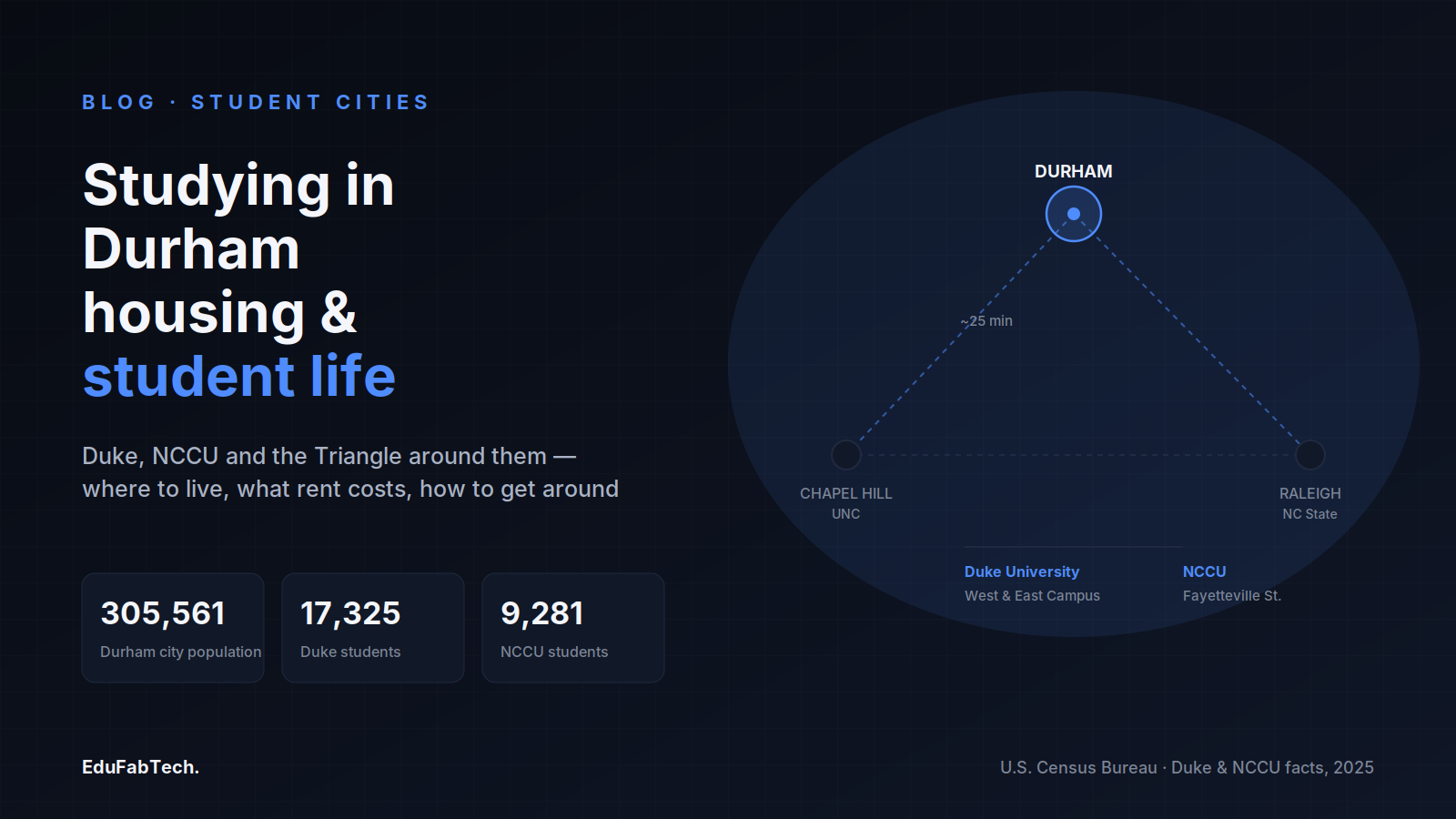
Durham sits at the northern corner of the Research Triangle, the metropolitan triangle its three anchor cities draw between Durham, Raleigh and Chapel Hill. Locals call it the Bull City, a nickname inherited from the Bull Durham tobacco that built the place: the brick warehouses that once dried and packed it now hold apartments, offices and the restaurants of the American Tobacco Campus beside downtown. That reuse is the texture of student life here — a city that turned a tobacco economy into a research-and-software one without demolishing its old centre.
Two universities actually live in Durham: Duke University, the private research university whose Gothic towers sit on the west side, and North Carolina Central University, a public historically Black university on the south side. Two more of the region's big institutions are a short drive away — the University of North Carolina at Chapel Hill to the west and North Carolina State University in Raleigh to the east — so a Durham student lives inside a dense academic region rather than a single college town.
The U.S. Census Bureau's QuickFacts put Durham city's population at 305,561 as of 1 July 2025 (census.gov), which makes this a mid-sized American city with real traffic, real neighbourhoods and a housing market that students compete in alongside the tech workers of Research Triangle Park. It is humid and hot from June into September, mild the rest of the year, and spread out enough that where you live determines how much of your week you spend in transit.
The universities, from Duke's quads to NCCU's Eagles
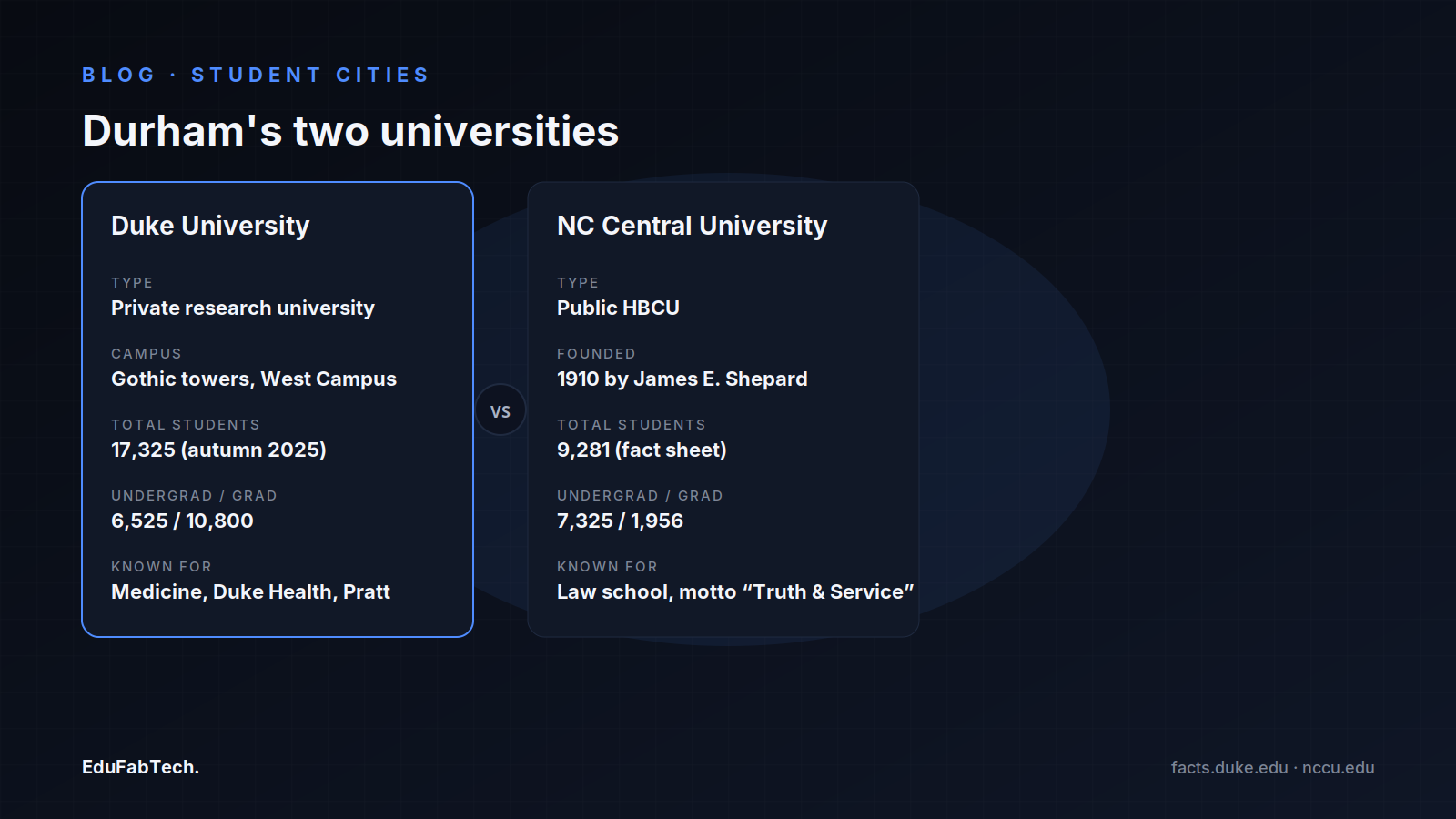
Duke University reports 17,325 total students for autumn 2025 — 6,525 undergraduates and 10,800 graduate and professional students across ten schools and colleges (facts.duke.edu). Its layout is worth knowing before you arrive: East Campus is the leafy Georgian-brick quad where the university first settled, about a mile and a half from West Campus, the 442-acre Collegiate Gothic core built around the 210-foot Duke Chapel and next to Duke University Medical Center (facts.duke.edu). Duke is known for medicine and health research through Duke Health, for engineering at its Pratt School, and — in the spring — for a basketball season that shuts down conversation about anything else.
North Carolina Central University was founded in 1910 by James E. Shepard as the first state-supported liberal arts institution for Black students, and its fact sheet lists 9,281 students — 7,325 undergraduates and 1,956 graduate and professional students — on a campus off Fayetteville Street in south Durham (nccu.edu). NCCU's motto is "Truth and Service"; it runs one of only a handful of law schools at historically Black universities, and its presence gives Durham a second, distinct student culture with its own homecoming, its own Eagles, and a strong pull on the city's south and east sides.
The rest of the region's degree-granting institutions are reachable but not in Durham, and it helps to know which is which. The University of North Carolina at Chapel Hill, the state's flagship public university, is roughly a 25-minute drive west; North Carolina State University, the land-grant university strong in engineering, design and agriculture, sits in Raleigh with its research-and-industry Centennial Campus. Smaller and specialised units round out the list: William Peace University, a small private university in Raleigh; Shaw University, also in Raleigh and founded in 1865 as the first historically Black university in the South; the Poole College of Management, NC State's business school; the Nicholas School of the Environment, Duke's graduate school for environmental science and policy; the Graduate School of Duke University, which confers Duke's master's and doctoral degrees; and the University of North Carolina at Chapel Hill School of Dentistry, which trains the state's dentists. Most Durham-based students will only ever set foot on Duke or NCCU, but cross-registration and library access do reach across these institutions.
The neighbourhoods students choose, from Trinity Park to Hayti
Durham is a city of named neighbourhoods rather than one student quarter, and the right one depends on which campus you orbit and whether you want to walk, bus or drive.
Trinity Park runs right up against Duke's East Campus: bungalows and Craftsman houses, many split into rooms, quiet and leafy, popular with graduate students and anyone who wants to walk to East in five minutes. Old West Durham and the Ninth Street district sit just west of East Campus and act as the social spine of off-campus Duke life — coffee, bookshops, bars and groceries within a short walk of West Campus. These two areas are the most convenient for Duke and priced accordingly.
Downtown and Old North Durham put you among the tobacco-warehouse conversions, the Durham Central Park pavilion and the city's restaurants; it is the best choice if you want urban life and easy bus connections more than a short campus walk. Walltown, wedged between Duke's campuses and downtown, is a historically Black neighbourhood that has long housed students and university staff and remains comparatively central. For NCCU students, the blocks around Fayetteville Street and the historic Hayti district on the south side are the natural base, close to classes and to the James E. Shepard Memorial Library. Further out, south Durham neighbourhoods such as Woodcroft trade the walkable-core experience for cheaper, larger apartments and a bus or car commute — a common compromise for students with partners, cars or tighter budgets.
Renting a room without losing a deposit
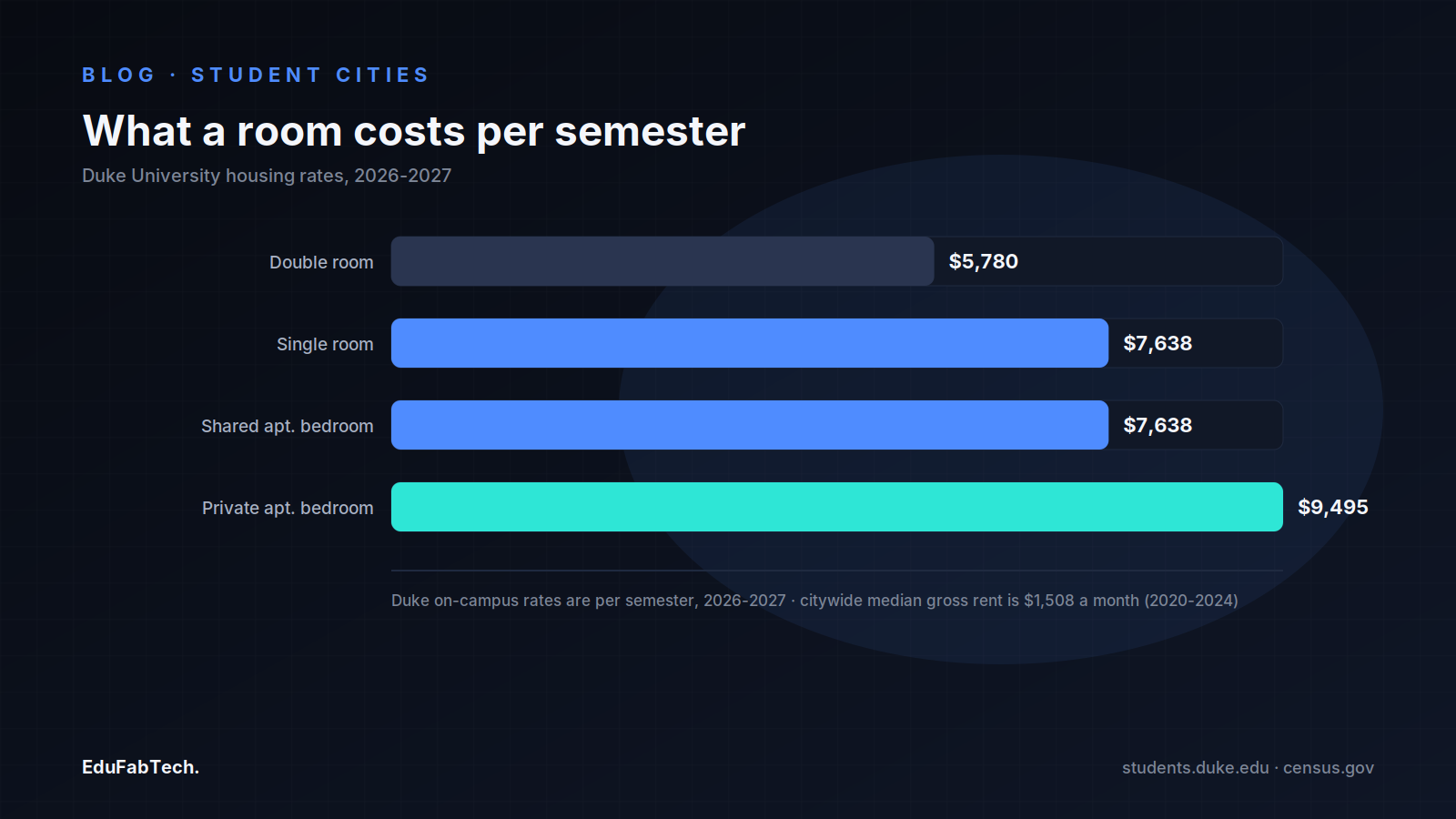
Most Duke undergraduates live on campus; graduate students, NCCU students and transfers do the real renting. If you want university housing, Duke's own 2026-2027 rates are the clearest benchmark: per semester, a single room is $7,638, a double $5,780, a shared apartment bedroom $7,638 and a private apartment bedroom $9,495 (students.duke.edu). For the private market, the U.S. Census Bureau's QuickFacts give a median gross rent across Durham city of $1,508 a month for 2020-2024 (census.gov) — that is the whole-city figure including family homes, so a room in a shared house usually comes in below it and a central one-bedroom above it. Start looking two to three months out for autumn, because leases in the walkable neighbourhoods near Duke turn over fast in July and August.
Durham's rental scams follow a national script but land in local places: a "listing" for a Trinity Park bungalow or a Ninth Street apartment, priced slightly under the market, from someone who is conveniently out of town and wants a deposit to "hold" it before you can see it. See the room in person, or have someone you trust see it, before any money changes hands; confirm the person collecting rent actually controls the property; and never send a deposit or first month by bank wire, gift card or cryptocurrency — those are the payment methods you cannot claw back, and no legitimate Durham landlord needs them to reserve a room. A normal arrangement here is a signed lease plus a security deposit (commonly about one month's rent) paid once you have keys or a dated move-in agreement. If you are comparing what is actually on offer, the EduFabTech listings for rooms in Durham and everything in the city are a place to start, as are listings near Duke University.
Furnishing a room cheaply, and the markets Durham is known for
Durham is unusually good for furnishing a room without buying new. The Scrap Exchange in the Lakewood Shopping Center on Chapel Hill Road is a nationally recognised creative-reuse centre, selling salvaged materials, housewares and craft supplies by the bin, with a thrift store for clothing and furniture (discoverdurham.com). For food and odds and ends, the Durham Farmers' Market runs at the Durham Central Park pavilion downtown, and the Durham Green Flea Market sets up on East Pettigrew Street at weekends for second-hand finds (discoverdurham.com). End-of-semester move-outs around Duke and NCCU — late April and early May — are when usable furniture appears on kerbs and in giveaway groups, so time a big furnishing push to then. The EduFabTech page for second-hand furniture in Durham collects what students are passing on locally.
Part-time work and the rules for international students
If you are on an F-1 student visa, the firm rule from the U.S. Department of Homeland Security is that on-campus employment is limited to a maximum of 20 hours per week while school is in session; you can apply for on-campus work up to 30 days before classes start, and you must go through your school's Designated School Official (DSO) rather than applying to USCIS yourself (studyinthestates.dhs.gov). Off-campus work for F-1 students is tightly restricted and tied to specific authorisations such as Curricular or Optional Practical Training — this is a summary, not legal advice, so check the official page above and talk to your DSO before you accept anything. Campus jobs at Duke and NCCU — libraries, dining, labs, administrative offices — are the realistic first option, and local openings are gathered under part-time work in Durham.
Libraries and places to study
Duke's library system is the region's deepest. On West Campus, the connected Perkins, Bostock and Rubenstein libraries stay open late — generally until the early hours on weeknights during term — with the Lilly and Music libraries over on East Campus; the current schedule is posted on the Duke Libraries calendar (duke.libcal.com). At NCCU, the James E. Shepard Memorial Library on Fayetteville Street is the campus's main library and holds the university's archives on Durham's Black history (discoverdurham.com). Off campus, the Durham County Library's Main Library on North Roxboro Street downtown is open to any resident and is a good neutral place to work if you want out of the campus bubble (durhamcountylibrary.org). Beyond the libraries, the coffee shops of Ninth Street and the American Tobacco Campus are the informal study spaces students actually use; more desks and rooms are listed under study spaces in Durham.
Getting around Durham and the Triangle
The city bus network, GoDurham, is fare-free: its 2026-2027 budget keeps the buses free through June 2027, so you board without a pass, card or ID (godurhamtransit.org). That makes the bus the obvious way to move within the city on a student budget, though routes thin out in the evenings and on the edges. To reach Chapel Hill, Raleigh or Raleigh-Durham International Airport you switch to the regional operator, GoTriangle, whose single-ride adult fare is $2.50, with free travel for riders aged 13-18 (gotriangle.org); Chapel Hill's own town buses are also fare-free. Durham is flat enough for cycling and has a growing network of greenways, but like most of the Triangle it was built around the car, and students living in the suburban south often decide a cheap used bike or a car is worth it. Duke runs its own campus shuttles between East, West and the medical centre.
What is good, and what is hard
The good is real: two universities with genuine resources, deep libraries, a downtown that reuses rather than demolishes its history, fare-free city buses, strong second-hand culture, and a regional job market anchored by Research Triangle Park and the hospitals. The hard parts are honest too. Housing costs have risen with the region's tech growth — Durham's median gross rent of $1,508 for 2020-2024 (census.gov) is well above what many students remember being quoted a few years ago — and the most walkable neighbourhoods near Duke are the priciest and the fastest to fill. The city is spread out, so a cheap room in south Durham can cost you an hour a day on buses that run less often at night. Summers are genuinely hot and humid. And the Duke campus and the rest of the city can feel like separate worlds unless you make the effort to cross between them.
A checklist for the first weeks
- Pick your neighbourhood by campus and commute first, price second: Trinity Park or Ninth Street for Duke on foot, the Fayetteville Street/Hayti area for NCCU, south Durham for space and a lower rent plus a bus ride.
- See any room in person before paying, confirm who actually controls the property, and never wire a deposit or pay in gift cards or crypto to "hold" a place.
- Expect a lease plus a deposit of roughly one month's rent — get both in writing before you hand over money.
- If you are an international student, meet your DSO before accepting any work and read the DHS Study in the States rules on the 20-hour limit.
- Get used to GoDurham while it is fare-free, and keep a GoTriangle plan for trips to Chapel Hill, Raleigh and the airport.
- Set a calendar note for the late-April and early-May move-out weeks, when furniture turns up free and second-hand near both campuses.
- Get out to local events early — it is the quickest way to stop living only on your own campus.
Durham rewards students who treat the whole Triangle as their campus rather than just one set of quads. Learn the free bus, learn the second-hand economy, and choose where you live with your weekly commute in mind, and the Bull City is one of the more livable mid-sized places to study in the American South.
A quick question for readers
Do you work part-time while you study?
Many students work to pay the bills. See how common it is — and how many hours people really do.
Pick an answer, create a free account in a minute, and your vote counts. Already a member? Sign in
Source: U.S. Census Bureau
Sources (5)
- Duke Student Affairs. 2026-2027 Housing Information. Duke University, 2026. students.duke.edu ↗ · checked 7 Oct 2026
- U.S. Census Bureau. QuickFacts: Durham city, North Carolina. U.S. Census Bureau, 2025. census.gov ↗ · checked 7 Oct 2026
- GoDurham. GoDurham is fare-free through June 2027. City of Durham Transportation, 2026. godurhamtransit.org ↗ · checked 7 Oct 2026
- U.S. Department of Homeland Security. Working in the United States. Study in the States, 2026. studyinthestates.dhs.gov ↗ · checked 7 Oct 2026
- North Carolina Central University. NCCU Fact Sheet. North Carolina Central University, 2026. nccu.edu ↗ · checked 7 Oct 2026