Studying in Erzurum: universities, housing and student life
A practical, honest guide to living and studying in Turkey's highest large city — its universities, neighbourhoods, second-hand markets, transport and the long mountain winter.
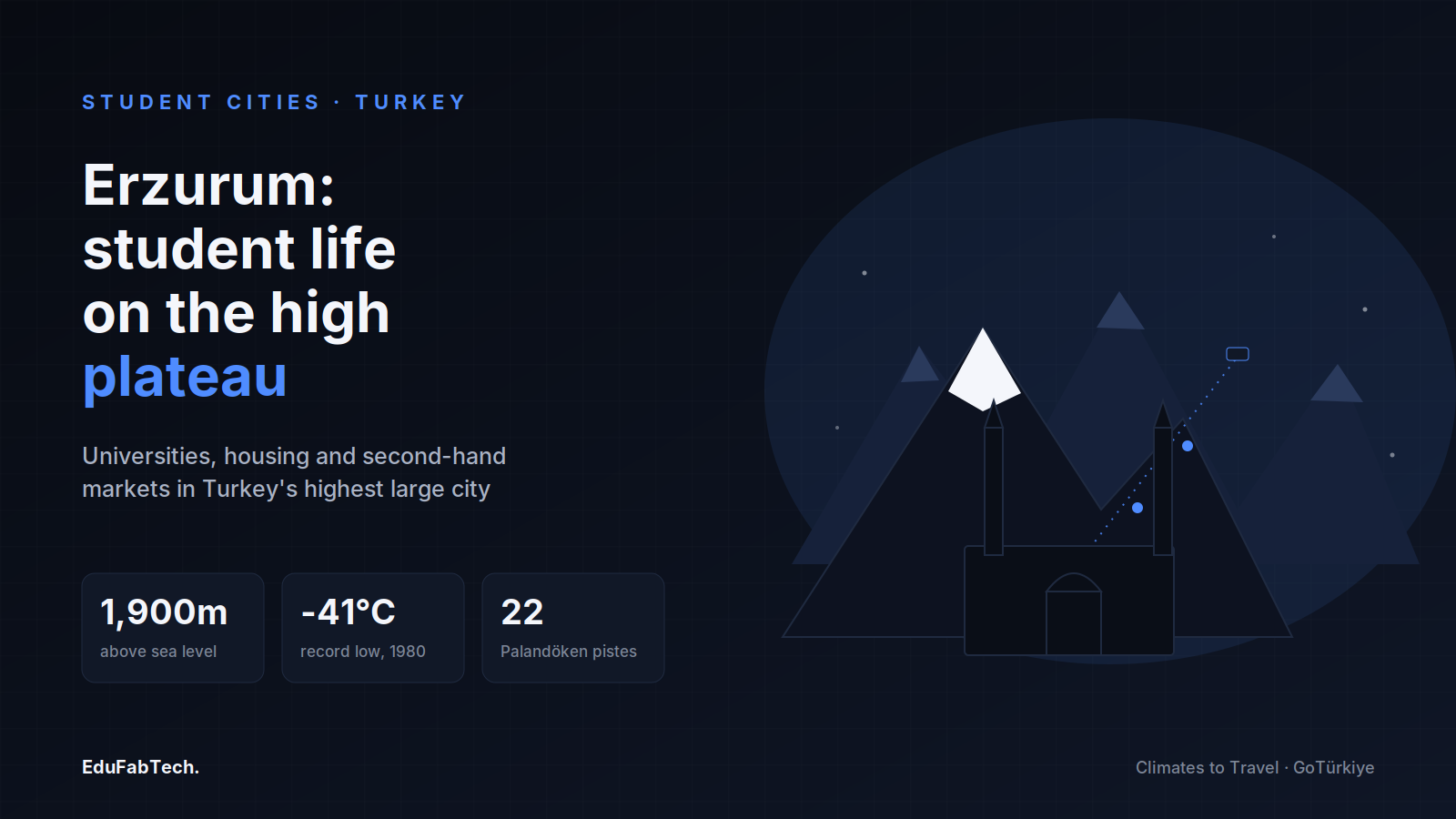
Erzurum sits on a high plateau in eastern Anatolia, and almost everything about student life here follows from that altitude. According to the 1991–2020 climate normals compiled by Climates to Travel, the city lies at roughly 1,900 metres above sea level, which makes it one of the highest large cities in the country. Locals call it the gateway to Anatolia, and the official tourism portal GoTürkiye describes it through its Seljuk and Ottoman monuments — the late-thirteenth-century Çifte Minareli Medrese (Twin Minaret Madrasa) that has become the city's symbol, the broad Yakutiye Madrasa, and the old citadel above the town.
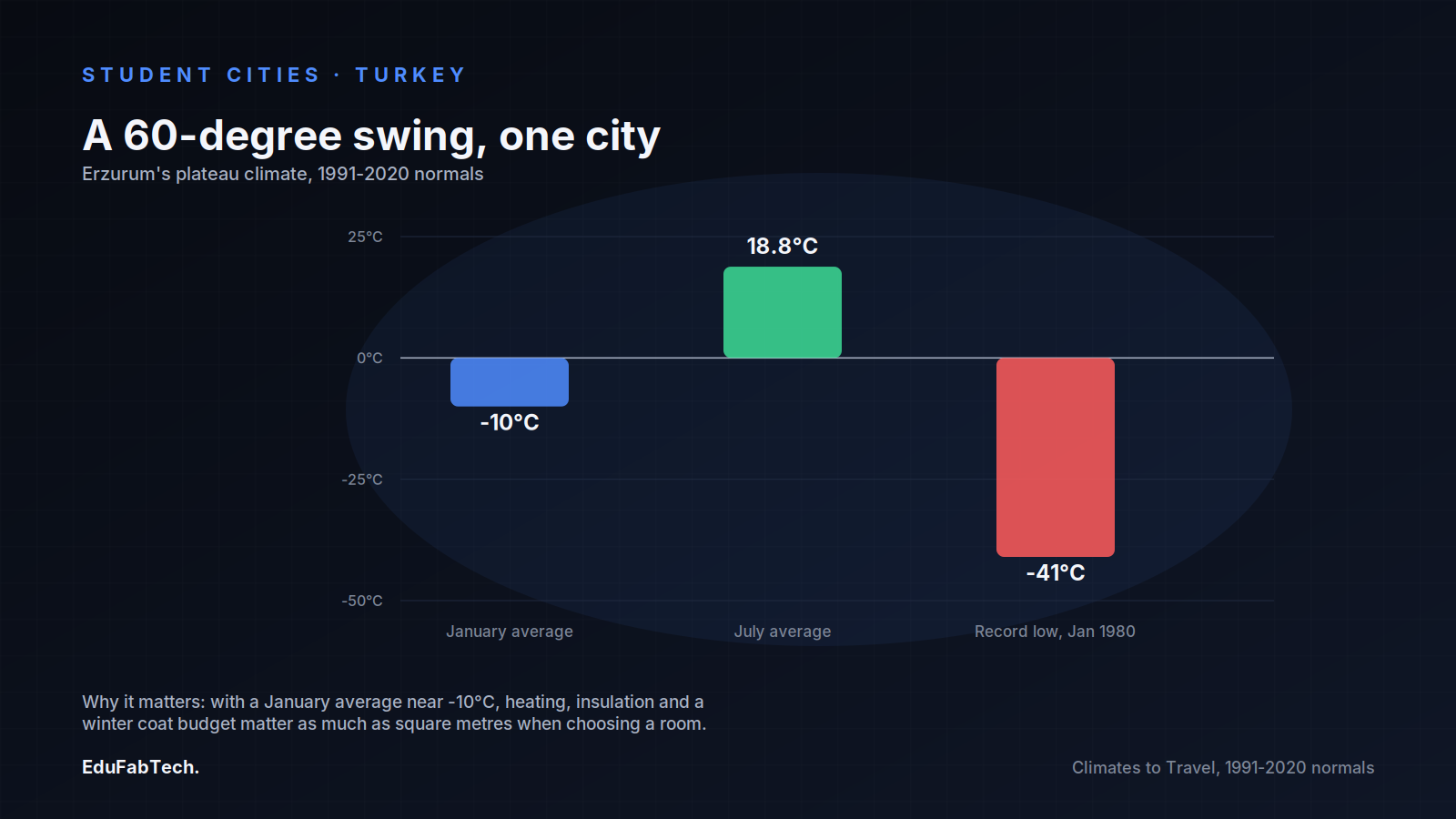
The plateau also sets the rhythm of the academic year. The same climate record gives Erzurum an average January temperature near −10 °C and a July average around 18.8 °C, with a documented record low of −41 °C in January 1980. Winter is long, dry and bright rather than merely grey, and snow that falls tends to stay. That is why GoTürkiye lists the Palandöken ski center — about 7 km from the centre, rising from a base of 2,200 m to a 3,176 m summit over 22 pistes served by a gondola and chairlifts — as one of the country's best mountains for confident skiers. Few student cities put a major ski slope within a short bus ride.
For a student, Erzurum is a compact, walkable, unmistakably student-heavy city where the cost of everyday life is lower than in the big coastal metropolises, but where the climate demands planning that a milder city never would. This guide walks through the universities, where people live and how to rent without being cheated, furnishing a room cheaply, getting around, working while you study, and the honest balance of what is good and what is hard. If you want to browse current listings as you read, EduFabTech keeps everything for the city on one page at /in/turkey/erzurum.
The universities
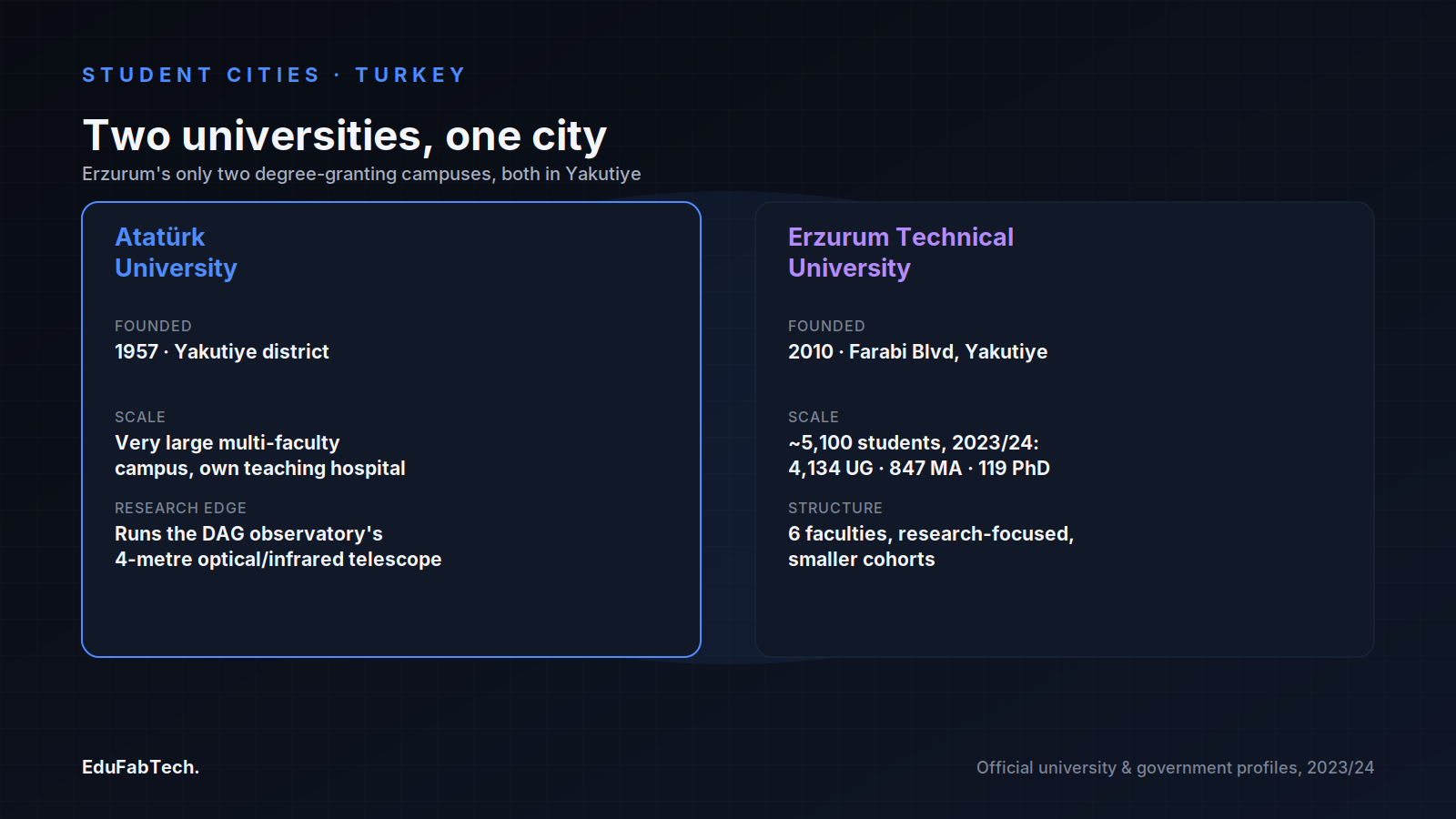
Atatürk University is the reason Erzurum is a university town. Founded in 1957 and based in the Yakutiye district, it grew into one of the largest teaching institutions in the east, with a broad spread of faculties, institutes and vocational schools on a single large campus, its own training and research hospital, and a wide programme of open and distance education. Studying here means being part of a very big student body: the campus functions almost as a self-contained district, with halls, sports facilities, clinics and libraries clustered together. The university also runs the Eastern Anatolia Observatory (DAG) through its Astrophysics Research and Application Center, a project its own news pages describe as hosting a 4-metre optical and infrared telescope on a peak above the plateau — a reminder that the high, dry sky is an academic asset as well as a hardship.
The city's second state institution is Erzurum Technical University, established in 2010 and also located in Yakutiye, on Farabi Boulevard near the airport road. It is a much smaller, research-focused place, organised into six faculties — Letters, Science, Economics and Administrative Sciences, Engineering and Architecture, Health Sciences and Sport Sciences — together with graduate institutes and a school of foreign languages. According to an official government profile of the university, it enrolled about 5,100 students in 2023/2024 — roughly 4,134 undergraduate, 847 master's and 119 doctoral. For a student choosing between the two, the practical difference is scale and atmosphere: the older university offers an enormous range of programmes and a busy campus city; the technical university offers smaller cohorts and a narrower, more specialised focus.
Other universities in and around Erzurum
Beyond the two state campuses, Erzurum does not host a private university of its own; students looking for other institutions generally travel to neighbouring provinces. Within the city, then, the realistic choice for a full degree is between Atatürk University and Erzurum Technical University, both in Yakutiye and both within reach of the same bus network and student neighbourhoods described below. Listings clustered around the larger campus are gathered at /near/ataturk-university.
Where students live
Most students cluster in a handful of areas. Yakutiye is the central district and the most convenient for those who want to be near shops, the old town and the bus lines. Dadaşkent, to the north, is popular with students and younger academics precisely because it is close to the Atatürk University campus and has an active rental market and regular buses into the centre. The newer Yenişehir and Yıldızkent areas, toward Palandöken, are where more modern apartment blocks have gone up. A room's value in Erzurum is measured as much by heating and exposure as by floor area: a flat that is cheap to rent but poorly insulated can cost a great deal to keep warm from October to April.
Housing itself comes in a few forms. Many first-year and international students start in the state dormitory system or in university-run halls, which are the cheapest option and remove the winter-heating gamble entirely; places are limited and allocated separately, so apply early through the relevant official channel. Beyond the halls there are private student residences and, most commonly, shared flats rented from the ordinary market. The rhythm of the rental year matters: demand peaks as the term approaches, so the calmest time to look is late summer, before the September rush, rather than after you arrive to freezing weather with nowhere to stay. Start by scanning what is currently available at /in/turkey/erzurum/rooms, then shortlist by district and by how each place is heated.
Before you pay anything, check the practical things that the photographs never show: how the flat is heated and who pays for it, whether the windows seal against the wind, the state of the boiler, the damp in north-facing rooms, the walk to the nearest bus stop in snow, and exactly what is included in the rent. Ask to see a written agreement, and keep a copy of whatever you sign.
Renting without being scammed
One rule protects you from almost every rental scam: never pay to "hold" a room you have not seen. See the place in person, or at the very least on a live video call where you can ask the person to move around the flat and show the street outside; photos and forwarded listings prove nothing. Do not send a deposit or first month's rent by bank transfer, gift card or cryptocurrency to someone you have not met, however plausible the story about being abroad or about another student "about to take it". A genuine landlord will let you visit, will meet you, and will give you a written contract. If you are pressed to pay immediately to secure a bargain, treat that pressure itself as the warning sign and walk away.
Furnishing a room cheaply
A cheap room usually arrives half-empty, and buying everything new is the fast way to ruin a student budget. Erzurum's weekly neighbourhood markets — the rotating open-air pazar that sets up in different districts through the week — are where locals buy household goods, kitchenware, bedding and winter clothing at a fraction of shop prices, and they are the first place to look for the small things that make a room livable. The city's historic covered market around the Rüstem Paşa bazaar (the Taşhan) is famous for Erzurum's own oltu taşı — the black jet stone worked into jewellery — and is worth seeing for the atmosphere as much as for buying.
For the larger items — a desk, a heater, a wardrobe, a decent mattress — second-hand is both cheaper and greener, and it is how most students here furnish a first flat. EduFabTech's local pages are built for exactly this: browse used goods and giveaways at /in/turkey/erzurum/second-hand, which fills up at the end of term when graduates are emptying their rooms. When you buy a used heater or electric blanket, test it before you hand over money; in this climate, heating equipment is not a luxury item.
Getting around
The centre of Erzurum is genuinely walkable, and for many students daily life runs between campus, a nearby flat and the shops on foot. For longer trips the city relies on its municipal bus network, which links the Yakutiye centre, the university, Dadaşkent and the outer neighbourhoods; fares are usually paid with a rechargeable city transport card, and discounted student cards are the norm across Turkish cities, so ask about the reduced fare and how to register your student status when you arrive. A light-rail line has been in planning and construction to connect the Yakutiye and Palandöken corridors, but treat it as a future convenience rather than something to rely on for this year's commute.
For travel beyond the city, Erzurum is a regional hub: it has its own airport with domestic connections, and it sits on the scenic eastern railway that has become a tourist route in its own right. The single most important transport fact for a newcomer, though, is the weather. Snow and ice shape the winter commute, buses can be delayed, and a flat that looks a pleasant ten-minute walk from campus in September can feel very different in January — factor the cold walk into where you choose to live.
Working part-time while you study
Rules for working as a student in Turkey are specific, and you should rely on official sources rather than word of mouth. As the international students' office at Middle East Technical University summarises the national regulations, undergraduates may take part-time work only after completing their first year, graduate students may work from their first year, and in every case the employer — not the student — must apply for the work permit, which is for jobs off campus. Your residence permit alone does not authorise you to work, and working without a permit carries real consequences. This is not legal advice; before you accept any job, confirm the current rules through the official channels of the national labour and migration authorities, and let a prospective employer handle the application. When you are ready to look, local openings are collected at /in/turkey/erzurum/jobs.
Libraries and places to study
In a city where winter drives everyone indoors, study space matters more than usual. Both universities run their own libraries, and the large Atatürk University campus in particular offers the most reading space and the longest opening hours during term; your student card is your entry. Beyond the campuses there are public library reading rooms and the ordinary network of cafés that double as study spots when the weather is against you. Because demand for a warm, quiet desk peaks exactly when the cold does, it is worth scouting a couple of options early in the term rather than in exam week; EduFabTech lists desks and study spaces for the city at /in/turkey/erzurum/study-spaces.
Costs and the honest trade-offs
Erzurum's headline advantage for students is that everyday costs — rent, food, transport — tend to run below those of Istanbul, İzmir or Ankara, which is a real part of why many students choose it. Reliable, sourced rental figures for the city change too quickly to quote responsibly here, so treat any single number you see online with caution and compare current listings directly; what is stable is the relative picture, and the one cost that is higher than in warmer cities is heating. Budget for a long, cold season and ask about heating costs before you sign, because a "cheap" flat that is expensive to warm is not cheap at all.
The honest balance looks like this. In its favour, Erzurum is affordable, compact and safe-feeling, with two universities, a strong student presence, a proper winter-sports mountain on its doorstep and a real sense of regional character rooted in its old town and cuisine. Against it, the winter is genuinely severe and long, the city is geographically remote from the western metropolises, nightlife and variety are more limited than in a big coastal city, and housing that is both affordable and well-insulated takes effort to find. For students who value low costs, a manageable scale and easy access to the mountains, the trade is often worth it; for those who need mild weather and a large, cosmopolitan scene, it will feel demanding.
| Season | What to expect | Source |
|---|---|---|
| Winter (Jan) | Average around −10 °C; record low −41 °C (Jan 1980) | Climates to Travel, 1991–2020 normals |
| Summer (Jul) | Average around 18.8 °C; warm, bright days | Climates to Travel, 1991–2020 normals |
| Altitude | Roughly 1,900 m — shapes cold, dry, snowy winters | Climates to Travel |
A checklist for your first weeks
- Confirm your enrolment and collect your student card — it is your key to library access and discounted bus fares.
- If you want a place in the state dormitory or a university hall, apply as early as possible through the official channel; do not assume a bed is guaranteed.
- For a private room, see it in person or on live video, check how it is heated and whether the windows seal, and never pay a deposit to hold an unseen flat.
- Sign a written contract and keep your copy.
- Register your student card for the reduced municipal transport fare and learn the bus lines between your flat and campus before the snow arrives.
- Furnish from the weekly markets and second-hand listings rather than buying everything new; test any used heater before you pay.
- If you plan to work and you are an international undergraduate, remember you must finish your first year first, and the employer applies for the permit — confirm the current rules through official sources.
- Prepare for the cold early: proper boots and a warm coat are practical study equipment here, not an afterthought.
Erzurum rewards students who plan for its climate and take its low costs seriously. Recognise the city for what it is — high, cold, compact and genuinely student-focused — and it becomes a place where a modest budget stretches a long way. For everything local as you settle in, from rooms to jobs to the things other students are giving away, start at /in/turkey/erzurum.
- Atatürk University. Atatürk University — Official Website (English). Atatürk University, 2025. link
- Erzurum Technical University. Erzurum Technical University — Official Website (English). Erzurum Technical University, 2025. link
- Study in Türkiye. Erzurum Technical University — Institution Profile and Student Numbers (2023/2024). Study in Türkiye (Republic of Türkiye), 2024. link
- Climates to Travel. Erzurum climate: averages, temperatures and record low (1991–2020 normals). Climates to Travel — World Climate Guide, 2024. link
- GoTürkiye. Palandöken Ski Resort Guide. GoTürkiye (official tourism portal), 2025. link
- GoTürkiye. Top Things to See in Erzurum. GoTürkiye (official tourism portal), 2025. link
- Middle East Technical University — International Students Office. Work Permits for International Students. Middle East Technical University, 2024. link
- Atatürk University. Eastern Anatolia Observatory (DAG) featured in Science. Atatürk University, 2020. link