Studying in Eskişehir: universities, housing and student life
A practical, sourced guide to Eskişehir's universities, neighbourhoods, rooms, second-hand markets, part-time work, study spaces, transport and costs — for students arriving from down the road or from abroad.
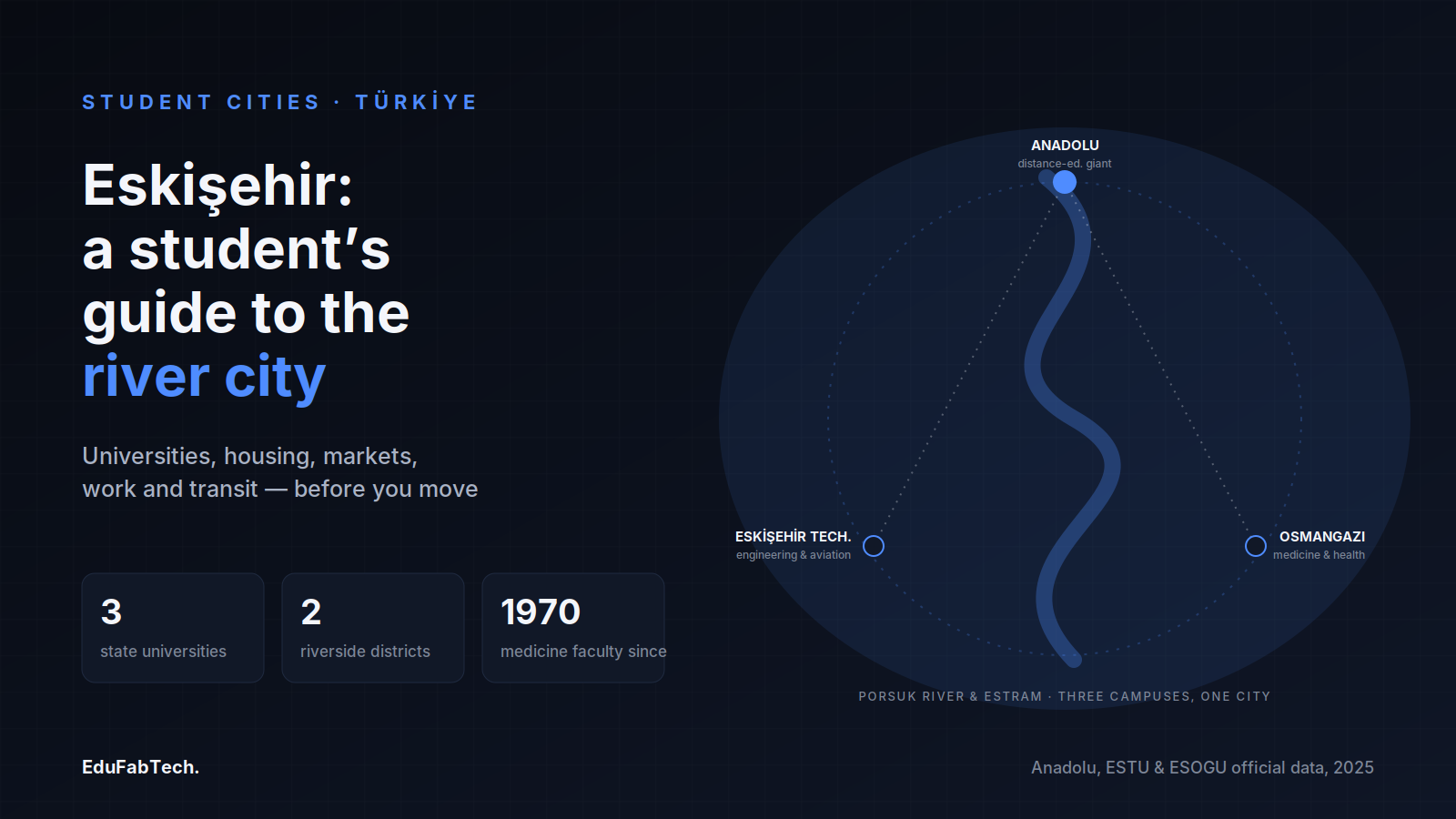
A compact city built around students and a river
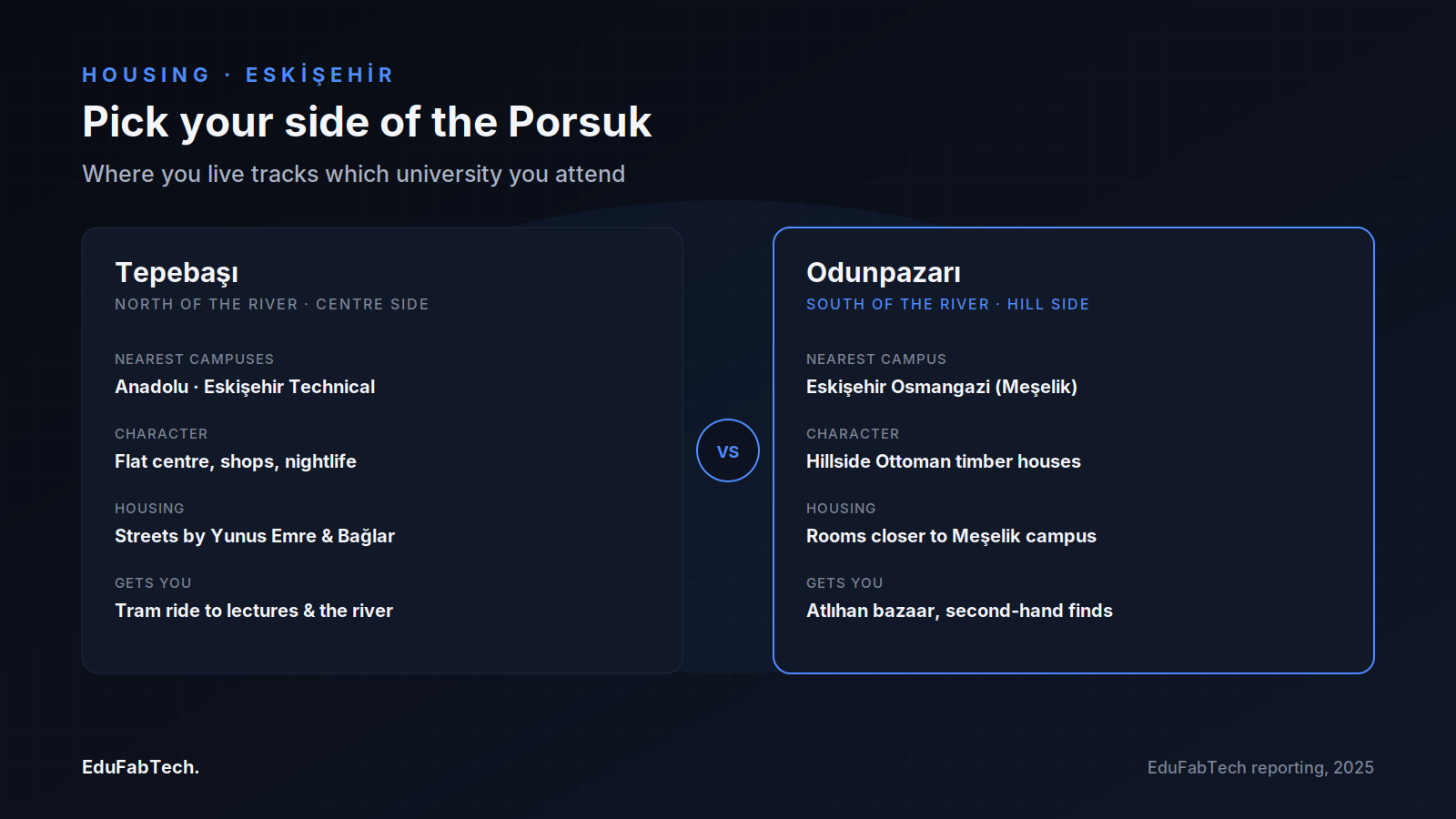
Eskişehir sits in a wide inland basin in north-western Anatolia, split by the slow green line of the Porsuk River. It is the kind of city that a first-year student can learn on foot in a week: the centre is flat, the river runs straight through it with cafés and rowing boats along both banks, and a tram network ties the campuses to the shops and the housing. Two administrative districts cover the built-up area — Tepebaşı to the north of the river, which holds the centre and most of the nightlife, and Odunpazarı to the south, climbing a hill of restored Ottoman timber houses. Between them they carry almost the whole of student life.
What makes the place unusual is the ratio. Three sizeable universities draw students from every province and a large international intake into a mid-sized city, so term-time Eskişehir feels younger and more studious than its size suggests. The result is a dense, walkable student economy — cheap kitchens, second-hand shops, print studios, book cafés — packed into a few square kilometres rather than scattered across a sprawling metropolis. That compactness is the single fact that shapes everything below, from rent to commuting to how quickly you meet people.
The trade-off is that the same compactness makes the good rooms scarce in September, and the winters are genuinely cold: this is a high, continental basin, not a mild coast. Come prepared for both, and Eskişehir is one of the easier Turkish cities to be a student in.
The universities, and what studying there is like
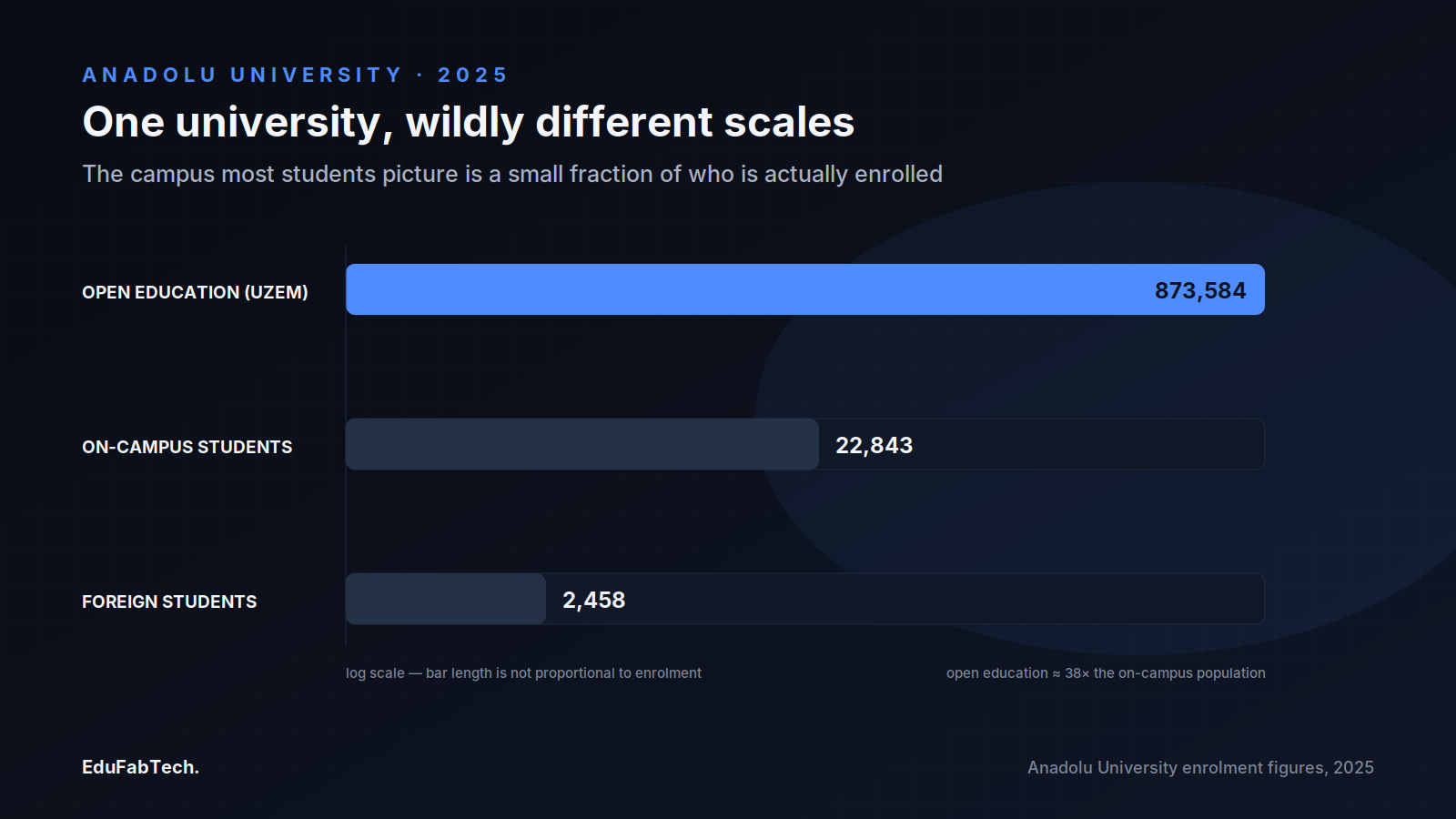
Anadolu University is the institution most people mean when they say "the university" in Eskişehir. Its Yunus Emre campus sits in the Tepebaşı side of the centre and holds theatres, concert and exhibition halls and a semi-olympic pool alongside the faculties. Anadolu's real distinction is scale: it runs one of the world's largest distance-education systems. The university's own figures put active open-education enrolment at 873,584 students, against 22,843 on-campus students and 2,458 foreign students (Anadolu University, 2025). For a student physically in Eskişehir that means strong programmes in communication, fine arts, education and the social sciences, and a campus culture built around performance and design.
Eskişehir Technical University is the newest of the three but not really new: it was created in 2018 when the technical faculties split away from Anadolu University (Eskişehir Technical University). Its İki Eylül campus lies about five kilometres from the centre in Tepebaşı, and the university is known for engineering, the sciences, architecture and design, and — unusually — aviation and railway systems, with its own airport on campus used by the aeronautics faculty for pilot training. If you want laboratories, workshops and a maker-oriented technical education, this is the campus that anchors it.
Eskişehir Osmangazi University occupies the large Meşelik campus on the Odunpazarı side, and it is the health-and-hard-sciences heavyweight of the city. It runs 13 faculties, 5 vocational schools and some 40 research centres (Eskişehir Osmangazi University, 2025), with its own university hospital on campus. Its Faculty of Medicine dates to 1970 and admits close to 200 new students a year (Eskişehir Osmangazi University Faculty of Medicine, 2025), and medicine, engineering and law are what the campus is best known for. Between these three, Eskişehir covers most of what a student might come to study; placement into state programmes is through the national university entrance examination, as elsewhere in the country.
Where students live, and how to find a room safely
Housing in Eskişehir splits roughly by campus. Students at Anadolu and at Eskişehir Technical University cluster in the Tepebaşı neighbourhoods around the centre — the streets behind the Yunus Emre campus, and areas like Bağlar and the blocks near the İki Eylül road — because they put you within a tram ride or a walk of lectures. Students at Eskişehir Osmangazi tend to look on the Odunpazarı side, closer to Meşelik. The typical options are a bed in the state dormitory system (cheapest, but allocated centrally and often full), a private student residence hall, or — the most common for anyone past first year — a shared flat rented from a landlord. You can browse current rooms and flatshares for the city on EduFabTech's Eskişehir rooms page.
Start looking early. The tightest weeks are late August through the end of September, when returning and new students compete for the same shared flats; if you can visit or line something up before that window, you will pay less and choose from more. Before you hand over any money, check the basics in person: that the heating actually works (winter bills matter here), that the boiler and windows are sound, who pays for water, gas, electricity and building dues, and whether the contract is written and in your name. Ask how far the nearest tram stop is — in a flat city it is easy to overestimate how walkable a place is in January. Listings near each campus are grouped at Anadolu University, Eskişehir Technical University and Osmangazi University.
On scams — read this before you pay anything. The oldest trick works the same everywhere: a room priced below the market, an owner who is conveniently "abroad" or "travelling", and a request to wire a deposit to "hold" it before you have seen it. Never do this. See the place in person, or on a live video call where the person shows you the actual flat and street, before any money changes hands. Never send a deposit by bank transfer, gift card or cryptocurrency to secure a room you have not physically seen, and be wary of anyone who refuses a written contract or pushes you to decide within the hour. A real landlord will let you view the property and sign a lease; pressure and secrecy are the warning signs.
Furnishing a room without overspending
Most shared flats come part-furnished at best, so the first fortnight usually involves finding a desk, a chair, a heater and kitchen basics. Buying all of that new is the expensive way to do it. Eskişehir has a strong second-hand culture: weekly neighbourhood markets (semt pazarı) rotate through the districts and are the place for cheap kitchenware, textiles and small appliances, while the restored artisan quarter of Odunpazarı — including the Atlıhan handicrafts bazaar — is better for meerschaum craft, gifts and browsing than for a bargain fridge. For furniture and appliances specifically, students mostly buy from each other at the end of each term, when leavers clear out. That trade lives on EduFabTech: check the second-hand listings in Eskişehir, where used furniture, appliances and even free-to-collect items from graduating students are often just a tram stop away. Buying second-hand in June and reselling in June is, in practice, how most people furnish a room here for almost nothing.
Working while you study
Part-time work is possible but rule-bound, and the rules differ sharply for local and international students. For international students the key point is that a student residence permit by itself does not grant the right to work: a separate work permit is required, and it is the employer — not the student — who files the application with the national labour authority. The official government guidance for international students (2025) notes that undergraduates can take part-time work alongside their studies, while graduate students have wider options such as research and assistantship roles. These conditions change from year to year, so treat this as orientation rather than legal advice and confirm your own situation on that official government page before you accept any job. Local student jobs — tutoring, cafés, campus roles, seasonal retail — turn over quickly in a city this student-heavy; current openings are collected on the Eskişehir jobs page.
Libraries and places to study
Each university runs its own central library open to its students, and these are the default quiet-study spaces during term. Eskişehir Osmangazi's central library sits on the Meşelik campus alongside the main faculties, and Anadolu's and Eskişehir Technical University's libraries serve their respective campuses. Beyond the libraries, the city's café density is a genuine study resource: the streets around the centre and along the Porsuk are full of places that tolerate a laptop and a long afternoon, and they fill up predictably during exam weeks. In winter, when walking across town loses its appeal, a warm library seat near your own campus is worth more than a fashionable café on the far bank.
Getting around: tram, bus and a flat city
Eskişehir's tram, EsTram, is the backbone of student transport and reaches all three university areas; a single card works across tram and bus. Both Eskişehir Osmangazi and Eskişehir Technical University students ride on the discounted student card integrated with their university ID: ESTRAM confirms it signed protocols folding the student Eskart into the university card so students travel on a single discounted pass (ESTRAM, 2023). Fares change periodically, so check the current tariff on the operator's own site rather than trusting an old figure. The other thing to know is that Eskişehir is flat and human-scaled: a lot of students never really commute, because they choose a room within a walk or a short ride of their faculty, and cycling is genuinely practical here in a way it is not in hillier cities. That flatness is one of the quiet reasons living costs here can stay low — you can simply avoid paying for daily transport.
The honest balance: what is good, what is hard
The good is real. Eskişehir is compact, walkable and organised around students, which makes it cheap to live in and easy to settle into — you are rarely far from a tram, a market or someone from your own faculty. The river, the parks and the restored old town give the city more character than most places its size, and OMM, the Odunpazarı Modern Museum housed in a striking timber building by the Japanese studio Kengo Kuma and Associates that opened in 2019 (Odunpazarı Modern Museum), is the kind of cultural anchor a student city is lucky to have. Because everything is close, your money stretches: short or no commute, cheap student kitchens, a deep second-hand market.
The hard parts are just as concrete. Rooms are scarce and pricier in the September rush, so late arrivals pay a real penalty; the winters are long and cold in this high basin, which pushes up heating bills and makes a badly insulated flat a genuine mistake; and a small city offers fewer graduate jobs and less big-city variety than Istanbul or Ankara, which some students find limiting by their final year. None of this is a reason to stay away — it is a reason to arrive early, choose a warm and well-connected room, and budget for the winter. On costs generally, the honest advice is to compare current listings rather than trust a headline number: rents and bills move with inflation, and a figure quoted a year ago can mislead more than it helps.
A short checklist for your first weeks
- Sort a room before the late-September crunch, and view it in person or on live video before paying — never wire a deposit to hold an unseen flat.
- Confirm in writing who pays for heating, water, gas, electricity and building dues, and test that the heating works.
- Get your university ID and load it as a student transport card so you ride EsTram and the buses at the discounted rate.
- Register with your campus library and scout one warm, close study spot for winter before exams make you need it.
- Furnish from the second-hand listings and the weekly markets, not new shops — and plan to resell when you leave.
- If you are an international student, read the official work-permit rules early: a student residence permit alone does not let you work, and it is the employer who applies for any permit — check the current rules before taking a job.
- Walk the centre and both riverbanks in your first fortnight. In a city this compact, knowing it on foot is half of settling in.
- Anadolu University. Anadolu at a Glance. Anadolu University, 2025. link
- Eskişehir Technical University. Eskişehir Technical University — About. Eskişehir Technical University, 2024. link
- Eskişehir Osmangazi University. About the University. Eskişehir Osmangazi University, 2025. link
- Eskişehir Osmangazi University Faculty of Medicine. Home — Faculty of Medicine. Eskişehir Osmangazi University, 2025. link
- Study in Türkiye. Work Opportunities for International Students. Study in Türkiye (Government of Türkiye), 2025. link
- ESTRAM. ESTÜ öğrencilerine ulaşımda büyük kolaylık. ESTRAM (Eskişehir tram operator), 2023. link
- Odunpazarı Modern Museum. The Building. Odunpazarı Modern Museum (OMM), 2019. link