Studying in Essen: universities, housing and student life
Essen sits at the centre of the Ruhr — a grounded guide to its universities, the districts students rent in, what a room and a semester ticket actually cost, where to work and study, and the honest trade-offs.
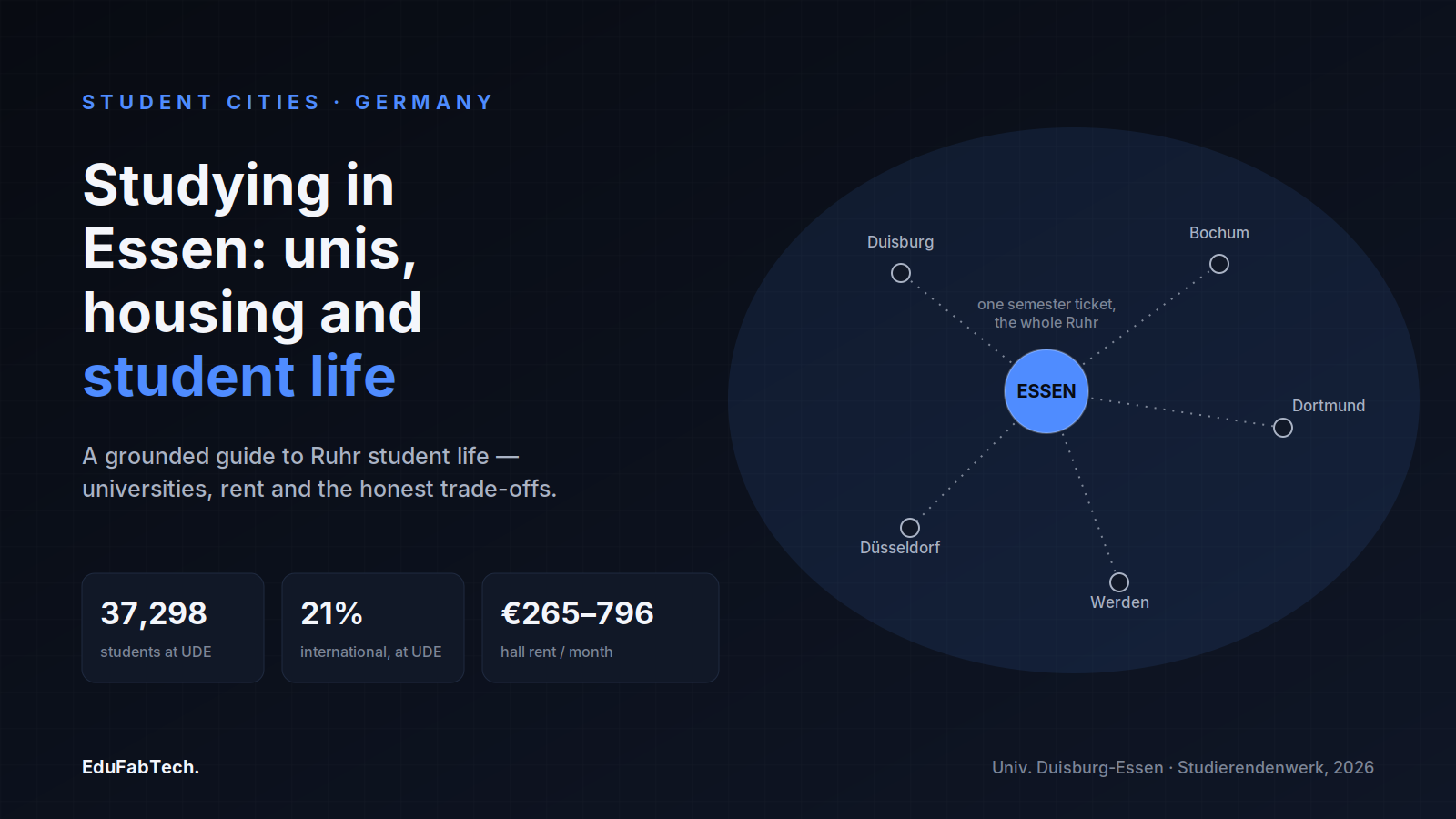
Essen grew up on coal and steel in the middle of the Ruhr, the belt of cities that runs along the north bank of the river for which the region is named. The Krupp works once employed much of the city; today the shafts are quiet, and the Zollverein colliery in the north — a UNESCO World Heritage site since 2001 — is a museum, a design school and a swimming pond in a flooded cooling basin. A student arriving now finds a flat, walkable centre wrapped around the Hauptbahnhof, leafy southern districts falling toward the Ruhr valley and the Baldeneysee, and two institutions that grant degrees from inside the city itself.
What makes Essen unusual is that you rarely stay in one city. The Ruhr is a continuous urban area knitted together by trams, U-Bahn and regional trains, and a single semester ticket carries you across all of it. So the practical question is less "which university in Essen" than "where do I live, and how far is the campus by rail" — and the answer stretches from Duisburg to Dortmund.
Two universities inside the city, and a ring of others on the same ticket
The University of Duisburg-Essen is the big one. Its own figures list 37,298 students as of 31 December 2025, with international students making up 21 per cent, spread across 315 degree programmes of which 184 are teacher-training routes (University of Duisburg-Essen, Daten & Fakten, 2025). It was formed in 2003 by merging the former Duisburg and Essen universities and runs on two campuses; the Campus Essen alone holds 24,545 students according to the CHE ranking data published through the DAAD for 2026/2027 (DAAD, CHE University Ranking, 2026/2027). Campus Essen sits just north of the Hauptbahnhof along Universitätsstraße, a compact 1970s campus you can walk to from the station; the university hospital is a few kilometres west in Holsterhausen.
The city's second degree-granting institution is the Folkwang University of the Arts, an art school for music, theatre, dance and design. Its main campus occupies a baroque Benedictine abbey at Essen-Werden, Klemensborn 39, on a monastic site founded in 799 AD and about ten minutes south of the centre by S-Bahn; the building also holds the Pina Bausch Theatre and a musicology library, while the design faculty works out of the Zollverein site in the north (Folkwang University of the Arts, Essen-Werden Campus, 2026).
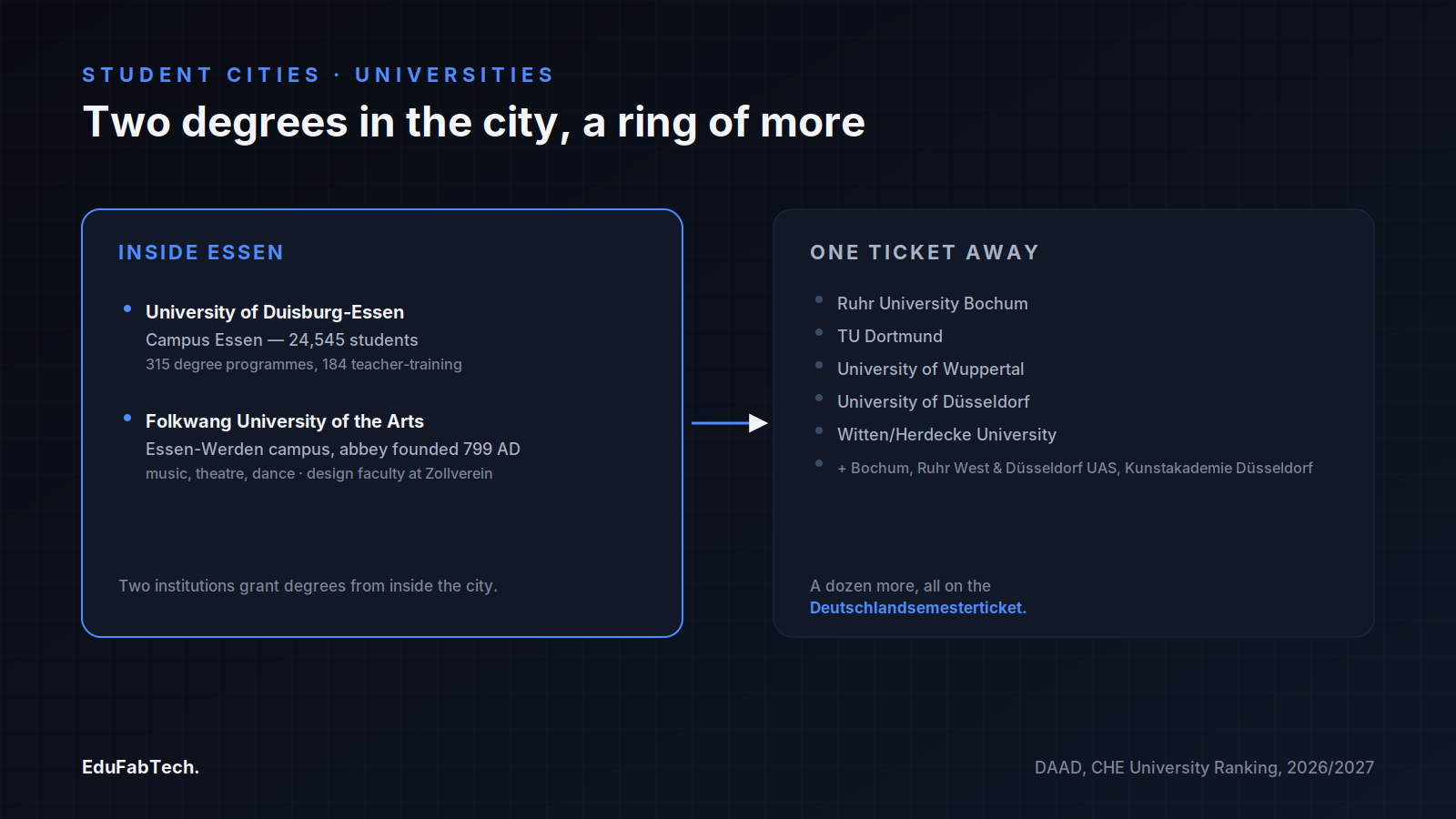
Because the Deutschlandsemesterticket covers regional trains nationwide, a dozen more universities are a train ride away and worth naming, since many Essen residents study at them: Ruhr University Bochum, the Technical University of Dortmund, the University of Wuppertal, the University of Düsseldorf, and the private Witten/Herdecke University. On the applied-sciences side there are Hochschule Düsseldorf, Bochum University of Applied Sciences (rendered in English on some pages as the University of Applied Sciences Bochum), the Ruhr West University of Applied Sciences with campuses in Mülheim an der Ruhr and Bottrop, and the Westphalian University of Applied Sciences Gelsenkirchen Bocholt Recklinghausen, whose three campuses are named in its title. For the arts there is the Kunstakademie Düsseldorf, and in Witten the Institute for Waldorf Education runs a Waldorf teacher-training course whose Bachelor is awarded through a cooperation with Alanus Hochschule. If you are weighing a commute, our listings around Ruhr University Bochum show what rooms near one of those campuses look like.
The districts students actually pick
The Universitätsviertel and Nordviertel wrap around Campus Essen between the Hauptbahnhof and the university. This is the newest-feeling part of the centre, built partly on old rail land, and the obvious choice if you want to roll out of bed into a lecture. Rooms here fill fastest for exactly that reason.
Rüttenscheid — "Rü" to everyone local — runs south from the centre and is the social heart of student Essen: cafés, bars and restaurants line the long Rüttenscheider Straße, and the city's largest weekly market sets up on Rüttenscheider Platz. It is lively and correspondingly the pricier end of the market.
Holsterhausen, just west, is popular with medical and health students because the university hospital is on its doorstep; it is residential, well connected by tram and generally better value than Rü. Frohnhausen, further west toward Mülheim, is quieter, family-leaning and cheaper again, with big apartment blocks and frequent trams into the centre. Werden, in the green south by the Ruhr, suits Folkwang students and anyone who wants the Baldeneysee nearby, though it is calmer and the commute to Campus Essen is a real S-Bahn ride rather than a walk. Steele in the east has its own busy centre and an S-Bahn and regional hub, and tends to be more affordable than the southern districts. Browse what is currently on offer across the city on rooms in Essen.
Finding a room before term starts — and the deposit trap to avoid
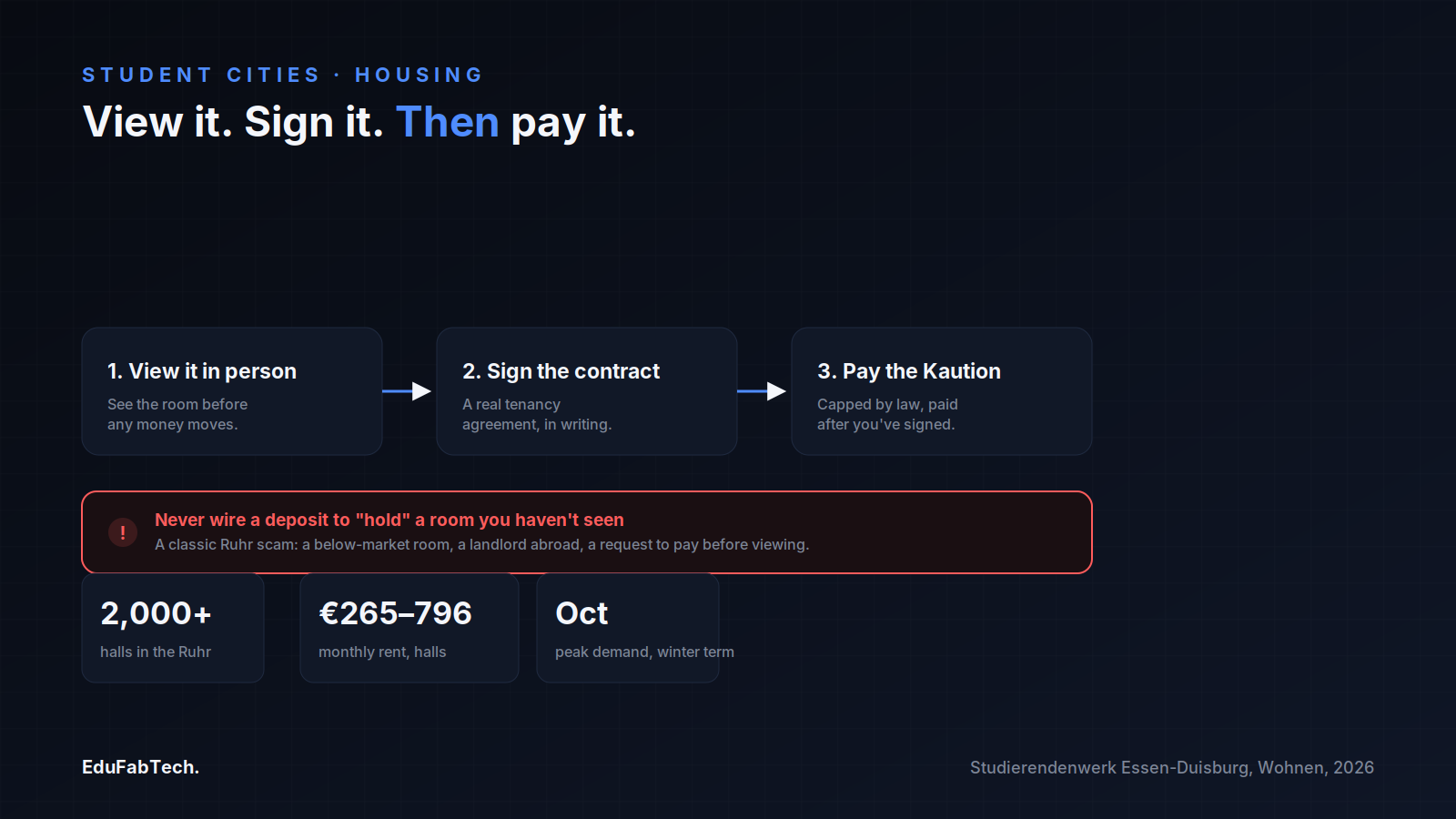
The cheapest reliable route is a hall place through the Studierendenwerk Essen-Duisburg, the public body that runs student housing and the canteens. It operates more than 2,000 residential places across Essen, Duisburg and Mülheim an der Ruhr; for its Essen houses it lists monthly rents from €264.82 to €796.00 depending on room type, from single rooms in shared flats up to small apartments (Studierendenwerk Essen-Duisburg, Wohnen, 2026). Demand peaks sharply for the October winter semester, so apply through their portal as early as you can and treat a hall place as a first foothold rather than a guarantee.
On the private market — mostly shared flats, the Wohngemeinschaft or WG — the risk in Essen is the same one that catches students across the Ruhr: a too-good room advertised below the going rate, a "landlord" who is conveniently abroad, and a request to wire a deposit to "hold" it before you have seen the place. Do not do this. View the room in person, or have someone you trust view it, before paying anything; meet the person letting it; and never send a deposit by bank transfer, gift card or cryptocurrency to secure a room you have not stood inside. A normal German deposit (Kaution) is paid after you sign a contract, not to reserve a viewing, and it is legally capped at a few months' cold rent. If a listing pressures you to move money first, walk away.
Furnishing it cheaply, and shopping the markets
You can fit out a room without buying anything new. Essen runs a dense network of municipal weekly markets, and the one students gravitate to is the Rüttenscheider Markt on Rüttenscheider Platz, the largest in the city, open Wednesdays 08:00–13:00 and Saturdays 08:00–14:00 (Essener Wochenmärkte, Märkte & Händler, 2026). Smaller markets run most days across the districts — among them Frohnhausen, Holsterhausen, Steele and Werden — so wherever you land, fresh produce is a short walk away. For furniture, kitchen kit and bikes, the cheapest supply is other students clearing out at term's end; see second-hand furniture in Essen, general second-hand things, and items people are simply giving away free. The pattern across the Ruhr is that a WG often comes part-furnished, and the gaps get filled from exactly these channels rather than a shop.
Working alongside your studies
This is general information, not legal advice, and the rules differ by nationality. For students from outside the EU, the DAAD states that you may work 140 full days or 280 half days per year, with self-employed or freelance work possible only if the Ausländerbehörde (the foreigners' office) permits it; going beyond that allowance needs approval from both the Agentur für Arbeit and the Ausländerbehörde (DAAD, Side jobs, 2026). Working as an academic assistant at the university is treated as an exception to the day limit, but you still have to inform the foreigners' office. EU and EEA students work on broadly the same footing as German students. Your actual permission is written in your residence permit, so check it; the University of Duisburg-Essen runs its own immigration-office appointments for students who need to confirm the details. Term-time jobs cluster in the campus canteens, retail, logistics around the Ruhr, and tutoring; many require functional German. See what is currently posted under jobs in Essen.
Libraries and places to study
The main workspace for most students is the University Library Duisburg-Essen, which on Campus Essen runs the GW/GSW library on Universitätsstraße plus a medical library at the hospital; its recently reopened MNT library offers 170 study spaces with group rooms and high tables (University Library Duisburg-Essen, 2026). Beyond the campus, the municipal Stadtbibliothek Essen occupies the Gildehof block right by the Hauptbahnhof, which is handy if you want a change of desk near the trains. In exam season both fill up, so the quieter branch libraries and early mornings are worth knowing; our listing of study spaces in Essen collects desks and quiet rooms beyond the two big buildings.
Getting around on one ticket
Essen's trams, U-Bahn lines and buses are run by Ruhrbahn, the operator formed from the old Essen and Mülheim companies, and everything sits inside the Verkehrsverbund Rhein-Ruhr (VRR) fare network together with the S-Bahn and regional trains. Enrolled students are issued the Deutschlandsemesterticket, a student version of the nationwide Deutschlandticket, which the VRR prices at €37.80 per month, or €226.80 for the semester, and which covers local and regional public transport across all of Germany — buses, trams, U- and S-Bahn and second-class regional trains, though not ICE, IC or long-distance services (VRR, Deutschlandsemesterticket, 2026). It is bundled into the semester fee rather than bought separately, and it is the reason studying in the Ruhr means treating Bochum, Dortmund and Düsseldorf as part of your everyday map. The flat terrain and dense tram grid also make Essen a genuine cycling city, and a second-hand bike pays for itself fast.
What is good, and what is hard
The good is real: cheaper rooms than Munich or Hamburg, a transport ticket that opens an entire region, a lot of green once you move south toward the Ruhr and the Grugapark, and a student body spread across half a dozen nearby universities so you are never short of people in the same situation. The hard parts are also honest. Rooms are tight at the start of the winter semester and the best central ones go quickly. Parts of the city are plainly post-industrial, and Campus Essen is functional concrete rather than a postcard. The weather is grey Ruhr weather for much of the year. Nightlife is concentrated — mainly Rüttenscheid — so if you live out east you will commute to it. And bureaucracy, from the Ausländerbehörde to the WG market, generally runs in German, which shapes how smooth your first months feel.
A checklist for your first weeks
- Apply for a Studierendenwerk Essen-Duisburg hall place as early as possible, and keep a private WG search running in parallel.
- Never send a deposit for a room you have not seen in person; pay the Kaution only after signing a contract.
- Register your address (Anmeldung) at the city's Bürgeramt soon after moving in — most other paperwork depends on it.
- Confirm your work permission against your residence permit and, if non-EU, against the 140-full-day rule before taking a job.
- Collect your Deutschlandsemesterticket through enrolment and learn the S-Bahn lines to the campuses you actually use.
- Get a library card, find your quietest branch, and pick up a cheap second-hand bike for the flat city centre.
For everything current in one place — rooms, jobs, second-hand listings and events — start from EduFabTech's Essen page.
A quick question for readers
Do you work part-time while you study?
Many students work to pay the bills. See how common it is — and how many hours people really do.
Pick an answer, create a free account in a minute, and your vote counts. Already a member? Sign in
Comments 3
Comment-
The number that jumps out is the Studierendenwerk spread: €264.82 to €796.00 depending on room type, which is a near-threefold gap for "publ…
-
The number that actually tells you something is the library capacity: 170 study spaces in the reopened MNT building, against 24,545 students…
-
The number that'd actually save someone money here is the deposit cap — "a few months' cold rent" is doing a lot of work in that sentence an…
Join free to read the full comments and reply Comments are between members; an account takes a minute.
Source: University of Duisburg-Essen
Sources (5)
- University of Duisburg-Essen. Daten & Fakten. uni-due.de, 2025. uni-due.de ↗ · checked 14 Nov 2026
- Verkehrsverbund Rhein-Ruhr (VRR). Deutschlandsemesterticket: The DeutschlandTicket for students. vrr.de, 2026. vrr.de ↗ · checked 14 Nov 2026
- Studierendenwerk Essen-Duisburg. Wohnen. stw-edu.de, 2026. stw-edu.de ↗ · checked 14 Nov 2026
- DAAD. Side jobs. Deutscher Akademischer Austauschdienst, 2026. daad.de ↗ · checked 14 Nov 2026
- Folkwang University of the Arts. Essen-Werden Campus. folkwang-uni.de, 2026. folkwang-uni.de ↗ · checked 14 Nov 2026