Studying in Eugene: universities, housing and student life
A practical, sourced guide to being a student in Eugene, Oregon — the universities, where people live, what a room costs, how work rules apply to international students, and what is genuinely hard about the city.
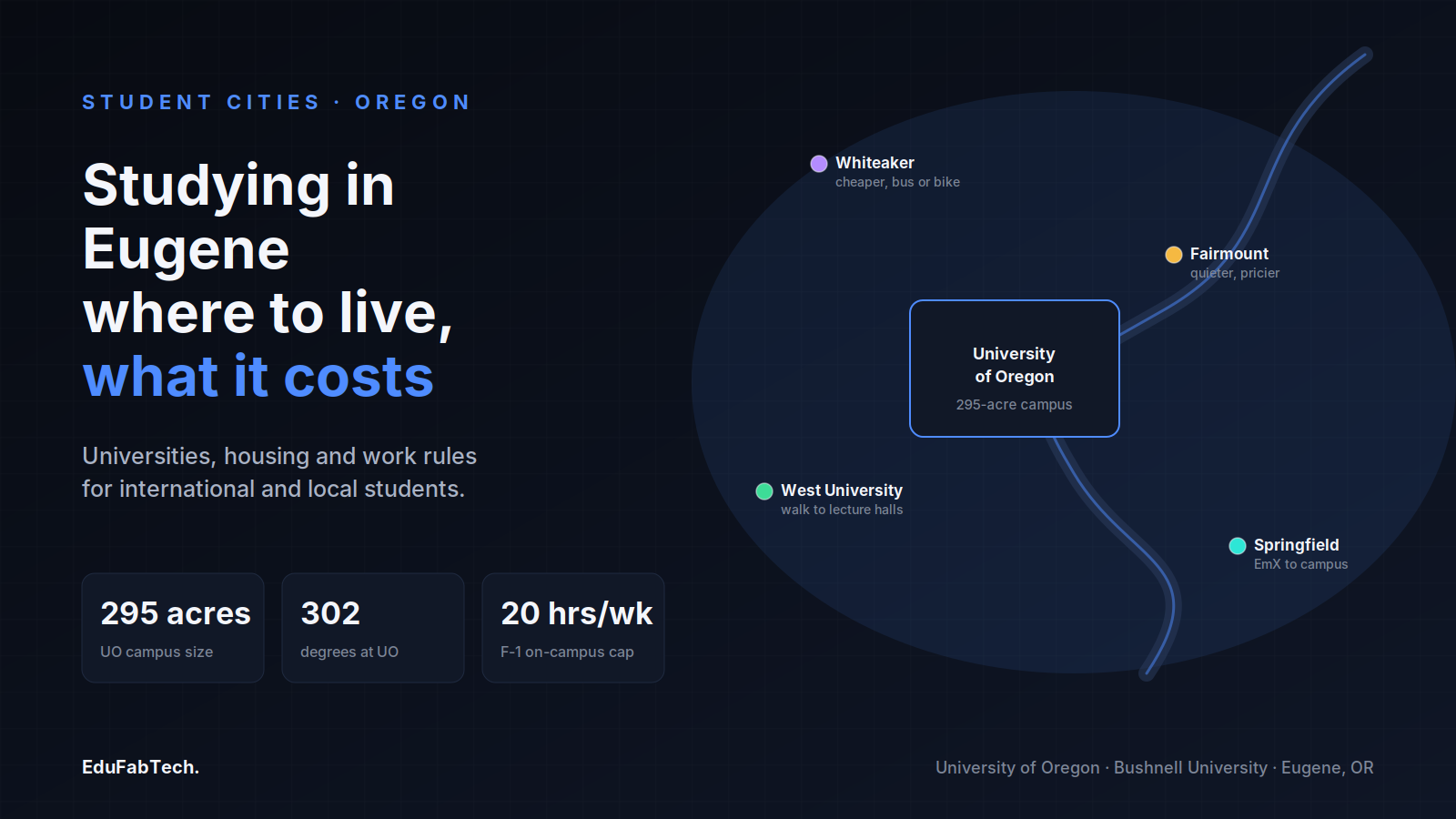
Eugene sits at the southern end of Oregon's Willamette Valley, on the river of the same name, with the forested ridges of Spencer Butte and Skinner Butte closing off the skyline. Bushnell University, one of the schools in town, describes the setting plainly: about 100 miles south of Portland and 50 miles from the Oregon Coast. It is a green, flat, rain-soaked city that empties and fills with the academic calendar, and for a student the practical questions are the same ones they would be anywhere — where to live, what it costs, how to get across town, and whether the place suits you once the novelty wears off. This guide answers those for Eugene specifically, with every figure tied to the body that published it.
The universities and colleges in town
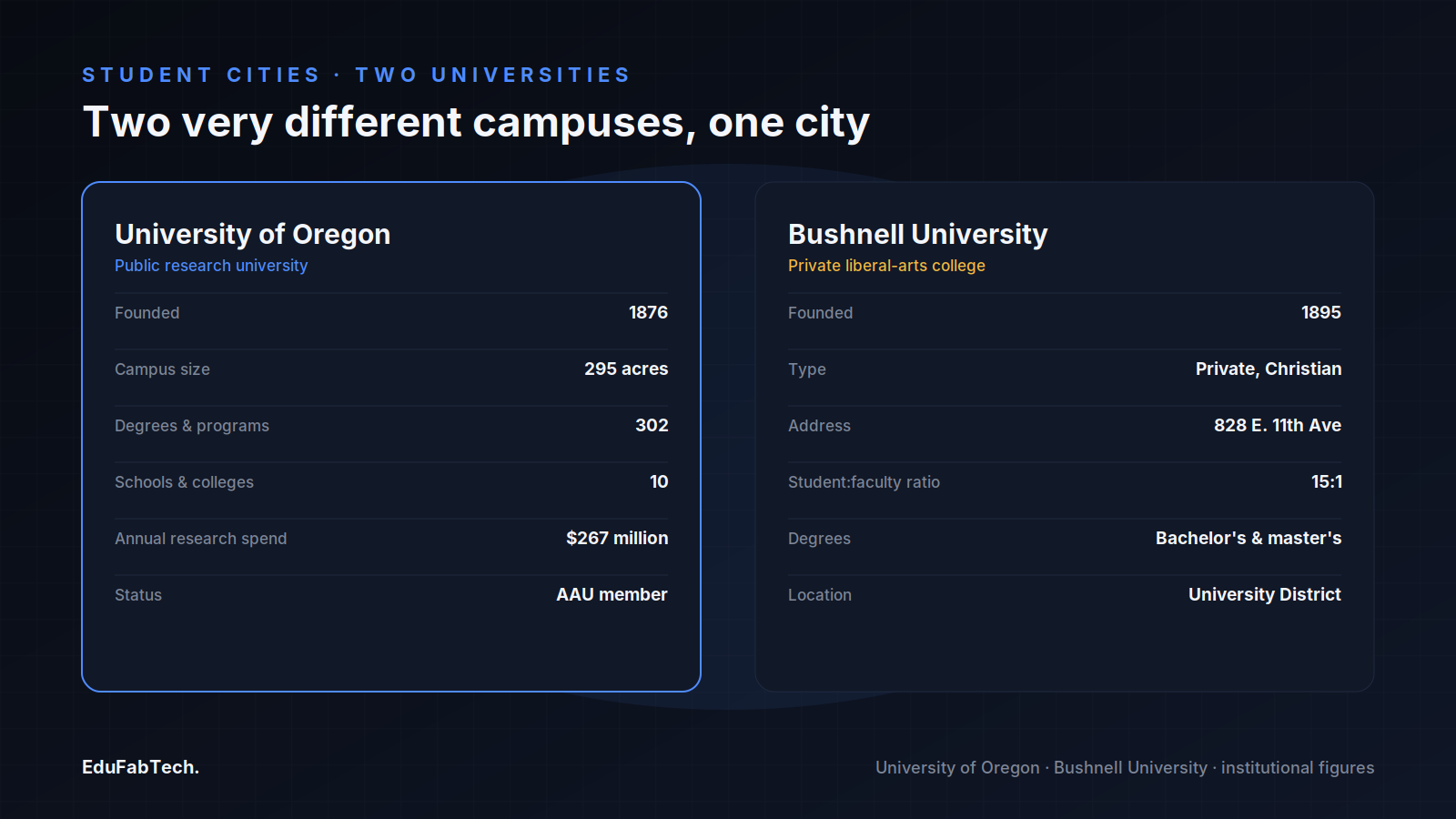
The University of Oregon is the reason most students come. Its own figures describe a public research university founded in 1876, on a 295-acre flagship campus in Eugene, offering 302 degrees and programs across ten schools and colleges, with annual research expenditures the university reports at $267 million and membership in the Association of American Universities. The campus runs east of downtown behind the Knight Library and Hayward Field, and the academic year is built on ten-week quarters rather than semesters — a rhythm that catches out students arriving from semester systems, because terms move fast and midterms arrive before you have unpacked. UO's schools and colleges span journalism and communication, business, design and the sciences, and the newer Phil and Penny Knight Campus for Accelerating Scientific Impact sits at the north edge of campus near the river.
Bushnell University is the other degree-granting university inside the city. It is a private Christian liberal-arts institution that, by its own account, has run since 1895 and sits at 828 E. 11th Avenue, a short walk from the UO campus in the same University District; it reports a 15:1 student-to-faculty ratio and grants bachelor's and master's degrees. It is a small school, and its scale is the point for students who want one.
Three further options round out the picture. Lane Community College runs its main campus on East 30th Avenue in south Eugene and grants associate degrees and certificates across a wide range of trades and transfer paths; it is the usual route for students who want to start cheaply and transfer into UO or elsewhere. Gutenberg College is a very small Great Books college at 1883 University Street, offering a single accredited Bachelor of Arts in Liberal Arts taught entirely through discussion rather than lectures. New Hope Christian College is a small Bible college also based in Eugene. None of these three is a substitute for a large university, but each is a real, operating, degree-granting institution, and the community college in particular changes the arithmetic for a budget-conscious student.
From West University to the Whiteaker: where students live
The densest student area is the West University neighbourhood, the grid of older houses and low apartment blocks immediately west and south of campus between Franklin Boulevard and roughly 19th Avenue. It is walkable to lecture halls, which is its whole appeal, and it is also the most churned-over rental stock in the city — expect worn houses split into rooms. East of campus, the Fairmount neighbourhood climbs toward Hendricks Park and is quieter and a little pricier. North across the river, the River Road corridor and the Whiteaker district (west of downtown, Eugene's brewery-and-mural quarter) draw students who want cheaper rent and do not mind a bus or bike commute. Many students also live in Springfield, the adjoining city to the east, which the EmX bus line connects directly to campus. First-year undergraduates at UO are generally expected to live in university housing, so the private-rental hunt mostly matters from the second year on and for graduate and transfer students.
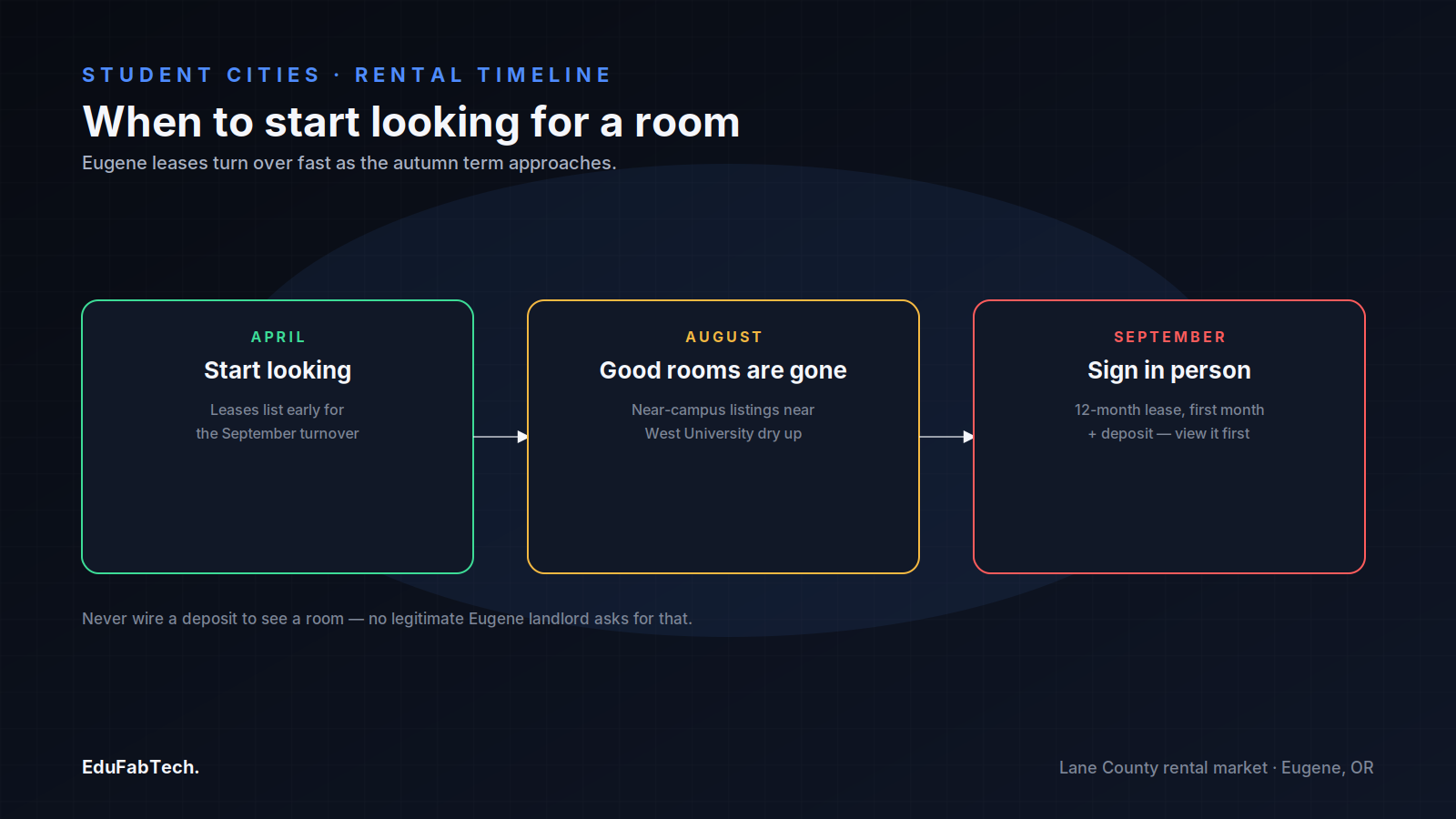
Eugene's rental market tightens sharply in late summer as leases turn over for the autumn, so the realistic window to look for a September move-in is roughly from April onward; by August the good rooms near campus are gone. Oregon leases are typically twelve months, and a landlord will usually ask for first month's rent plus a security deposit, sometimes a last month's rent as well. Before you pay anything, see the actual unit in person or have someone you trust see it, check that the name on the lease matches the person collecting the money, and confirm who pays for heating — older Eugene houses can be expensive to keep warm through a damp valley winter.
Seeing a room before you pay: rental scams in Eugene
The scams that appear in Eugene follow the student calendar: listings for rooms near campus that are cheaper than everything around them, posted by someone who is conveniently "out of town" and wants a deposit to "hold" the place before you can view it. That is the pattern to distrust. A genuine local landlord expects you to see the room and sign a paper lease in Lane County; they do not need the money wired first. Never send a deposit or "holding fee" by bank transfer, gift card or cryptocurrency — those payments cannot be reversed, and no legitimate Eugene landlord requires them to reserve a room. If a room is advertised as right beside campus but the person steers you away from an in-person viewing, treat that as the warning sign, not the bargain. EduFabTech's own rooms listings for Eugene and the wider Eugene student listings are a place to start; so are the pages for places near the University of Oregon and near Bushnell University.
Furnishing a room, and the markets Eugene is known for
Eugene has a strong second-hand and handmade culture, and the cheapest way to fill a room is to buy almost nothing new. The city's signature event is the Eugene Saturday Market, the downtown crafts-and-food market that the organisers record began on 9 May 1970, and now runs on the Park Blocks at 8th and Oak every Saturday from the first Saturday in April through mid-November, 10 a.m. to 4 p.m. It is crafts and food rather than furniture, but it is the best weekly introduction to the city's makers. Alongside it on the same downtown blocks is the Lane County Farmers Market, which operates 9 a.m. to 2 p.m. on Saturdays at the Farmers Market Pavilion, 85 E. Eighth Avenue — the place to buy produce cheaply in season. For actual furniture and kitchen kit, the reliable student move is to catch the end-of-term clear-outs when leases end in June, and to browse local second-hand channels: EduFabTech keeps Eugene pages for second-hand things, used furniture and things given away free.
Working while you study
Local part-time work clusters where students already are — campus jobs, cafés and restaurants along 13th Avenue and in the Whiteaker, retail, and seasonal work. For international students the rules are set federally, not by the city, and they are strict. The Student and Exchange Visitor Program, run by U.S. Immigration and Customs Enforcement, states that an F-1 student may work up to 20 hours per week on campus while school is in session, and full-time during breaks, and automatically has permission to work on campus but must work with a Designated School Official to confirm the job qualifies; off-campus employment, by contrast, requires separate authorisation. This is general information rather than legal advice — your exact situation depends on your visa and your school's international office, and you should confirm with them and with the official SEVP guidance before accepting any job. UO students on an F-1 visa will deal with the university's international student and scholar services office for this. EduFabTech's Eugene jobs listings can show what is around.
Libraries and places to study
The University of Oregon's Knight Library is the main academic workhouse and, by the library's own description, the largest library facility in Oregon, housing almost 2 million volumes, with reservable group rooms, graduate study space and a range of quiet areas; it opens to current UO students and staff from 7:30 a.m. to midnight. The Allan Price Science Commons and Research Library, partly underground near the science buildings, is the companion space for STEM students and keeps its own reservable rooms. Off campus, the Eugene Public Library runs a downtown building at 100 W. 10th Avenue plus branches in the Bethel and Sheldon neighbourhoods (hours and addresses are listed on the city library's hours and locations page), which matters because the public library is open to everyone, not only to enrolled students, and is useful in the gaps between terms when campus access tightens. For a desk away from both, EduFabTech lists study spaces in Eugene.
Buses, the EmX and getting around on two wheels
Eugene's public transport is run by the Lane Transit District, and its EmX bus rapid-transit line is the spine that connects Eugene and Springfield through downtown and past campus. The single most useful fact for a UO student is that the bus is effectively already paid for: UO Transportation Services explains that students get a free bus pass, redeemed through a benefit code in the Umo app or on a physical tap card, covering the more than two dozen LTD routes in Lane County, with the current passes valid from 29 June 2026 to 15 October 2027. That removes most of the argument for keeping a car as a student. The other half of getting around is the bicycle: Eugene is flat, compact and laced with riverside paths along the Willamette, and a large share of students ride year-round — which does mean riding in winter rain, with lights and mudguards, rather than in postcard sunshine.
What it costs, and the honest trade-offs
Start with the figures the university publishes. For 2026–27, the University of Oregon's financial-aid office lists a full cost of attendance of $40,236 for an Oregon resident undergraduate and $71,256 for a non-resident, with housing and food estimated at $18,183 in both cases (based on an average common room type and a standard meal plan), and tuition and fees of $17,475 for residents against $47,466 for non-residents, excluding a one-time $570 matriculation fee. On-campus housing specifically ranges widely by building and room type: University Housing's 2026–27 rates run from $12,039 a year for a four-bedroom apartment-style space in Yasui Hall up to $23,311 for a single with bath in Carson Hall, each including $50 in Duck Bucks per term. Those are the most reliable, dated housing numbers for the city; private-market rents vary too much month to month to quote a single trustworthy figure here, which is why the second-hand and shared-room routes above matter.
What is good about Eugene for a student is real: a serious research university and several smaller schools in one walkable district, a transport pass that is already bought, a flat and bikeable city, and a strong local culture of markets and second-hand trade that keeps the cost of setting up a room low. What is hard is also real. The valley winters are long, grey and wet, and the rain is the thing new arrivals most often underestimate. The rental market near campus is tight and turns over on a brutal late-summer schedule, so a late start can leave you commuting from Springfield whether you meant to or not. The quarter system is fast and unforgiving of a slow first few weeks. And the city empties noticeably when UO is out of session, which some students find peaceful and others find flat.
A short checklist for the first weeks
- If you are a new UO student, register for classes and then claim your free LTD bus pass benefit code through UO Transportation Services and load it into the Umo app.
- If you are hunting for a room, start early — from spring for an autumn move-in — and never pay a deposit before seeing the unit in person; never wire money or pay by gift card or crypto to "hold" a place.
- Get a Knight Library or Price Science Commons routine going in week one, and reserve group rooms in advance when you need them.
- Furnish from second-hand and free listings and end-of-term clear-outs rather than buying new; visit the Saturday Market and the Lane County Farmers Market to learn the city.
- International students: confirm your work options with your school's international office and the official SEVP employment guidance before taking any job.
- Buy rain gear and bike lights before November, and check what the EduFabTech Eugene events page lists for the start of term.
A quick question for readers
Do you work part-time while you study?
Many students work to pay the bills. See how common it is — and how many hours people really do.
Pick an answer, create a free account in a minute, and your vote counts. Already a member? Sign in
Comments 0
CommentNo comments yet. Members start the conversation.
Source: University of Oregon
Sources (5)
- University of Oregon Office of Student Financial Aid and Scholarships. Cost of Attendance 2026–27. University of Oregon, 2026. financialaid.uoregon.edu ↗ · checked 9 Oct 2026
- University of Oregon University Housing. Room and Meal Plan Costs. University of Oregon, 2026. housing.uoregon.edu ↗ · checked 9 Oct 2026
- UO Transportation Services. Bus Pass. University of Oregon, 2026. transportation.uoregon.edu ↗ · checked 9 Oct 2026
- U.S. Immigration and Customs Enforcement, Student and Exchange Visitor Program. Employment. ICE, 2026. ice.gov ↗ · checked 9 Oct 2026
- Bushnell University. About Bushnell University. Bushnell University, 2026. bushnell.edu ↗ · checked 9 Oct 2026