Studying in Exeter: universities, housing and student life
A practical, sourced guide to the University of Exeter, where students live, what a room costs, part-time work rules, markets, libraries and getting around a compact Devon city.
Exeter is a cathedral city on the River Exe, the county town of Devon in the south-west of England, sitting between the high moorland of Dartmoor to the west and the Exe estuary and the East Devon coast to the south. It is small enough to cross on foot in half an hour, old enough to keep fragments of Roman and medieval walls and a set of underground passages beneath the high street, and — for the student who lands here — organised almost entirely around one institution.
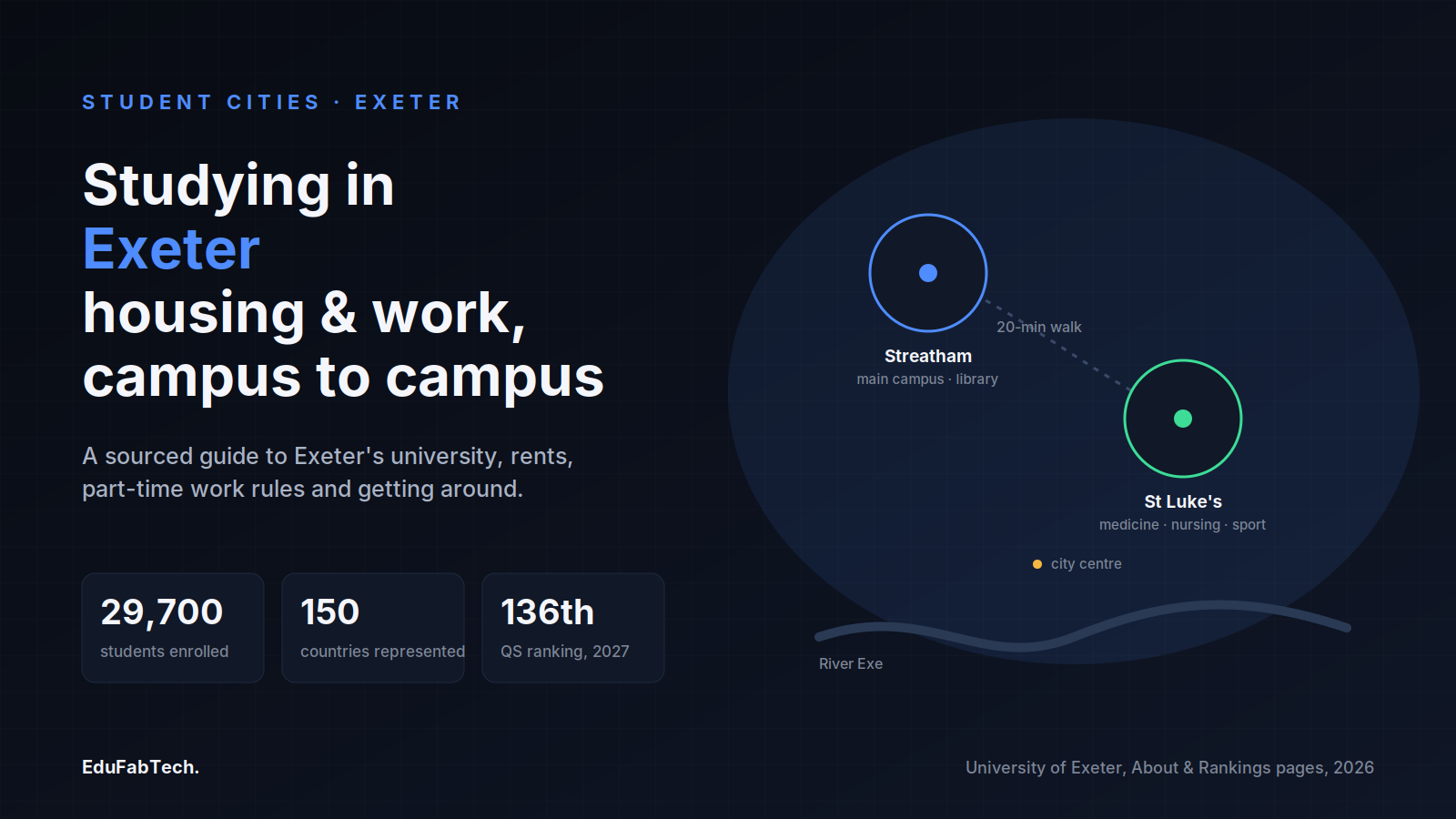
That institution is the University of Exeter. On its own About pages (2026) the university describes itself as a world-leading Russell Group university with 29,700 students from 150 countries, and lists its position as 136th in the 2027 QS World University Rankings and =170th in the 2026 Times Higher Education World University Rankings. For a city of Exeter's size, that is a very large student body, and it shapes the housing market, the buses and the shops in ways a newcomer feels quickly.
One other degree-awarding institution sits in the wider area. Bicton College, at Bicton near Budleigh Salterton, is a land-based college within The Cornwall College Group; its own course pages say it runs further-education courses, apprenticeships and higher education including foundation degrees and higher national certificates and diplomas in subjects such as agriculture, animal and veterinary nursing, equine studies, horticulture and wildlife conservation. It is a bus ride out of the city rather than part of it, so most of what follows is about the university in Exeter itself. You can see local listings gathered on EduFabTech at /in/united-kingdom/exeter.
Two campuses, and what studying across them is like
The university's main site is Streatham Campus, on rising ground just north of the city centre — a parkland campus of gardens, lakes and woodland threaded with teaching buildings, where most faculties, the main library and the students' guild are based. A short way across the city to the east is St Luke's Campus. The university's St Luke's page notes it was founded in 1854 as a teacher training college, sits just over a mile from Streatham, and is home to the Medical School, Sport and Health Sciences, the Academy of Nursing, Allied Health Professions and the School of Education with its PGCE students. If your course is in medicine, teaching, nursing or sport, you will spend much of your time at St Luke's; for most other subjects, Streatham is the centre of gravity.
The practical consequence is a daily commute that depends entirely on your degree. Walking between the two campuses takes a little over twenty minutes; a frequent university-linked bus runs the route. Where you choose to live is often a compromise between the two, and between campus and the city centre below. Listings close to each site are collected at /near/university-of-exeter and /near/university-of-exeter-st-luke-s-campus, with Bicton at /near/bicton-college.
The neighbourhoods students fill up
First-year students are mostly in halls. After that, the shared-house market concentrates in a few areas. The slopes immediately around Streatham — St James, Pennsylvania and Mount Pleasant — are the classic undergraduate streets, within walking distance of lectures and packed with terraced houses let room by room. Closer to St Luke's, students spread into Heavitree and St Leonard's. Newtown and the streets around Longbrook Street and Sidwell Street put you between the campuses and the shops. Nowhere in Exeter is genuinely far from anywhere else, but the hills are real: a flat on the quay is cheaper to reach on foot going down than coming back up.
Start the house hunt earlier than feels reasonable. Because so many students compete for a limited stock of terraces in the same few postcodes, viewing season for the following September often opens in the winter and the best houses go within weeks. That urgency is exactly what a scammer exploits, so treat speed as a reason to be more careful, not less. Rooms and shared houses posted on EduFabTech are at /in/united-kingdom/exeter/rooms.
Paying for a room without being caught out
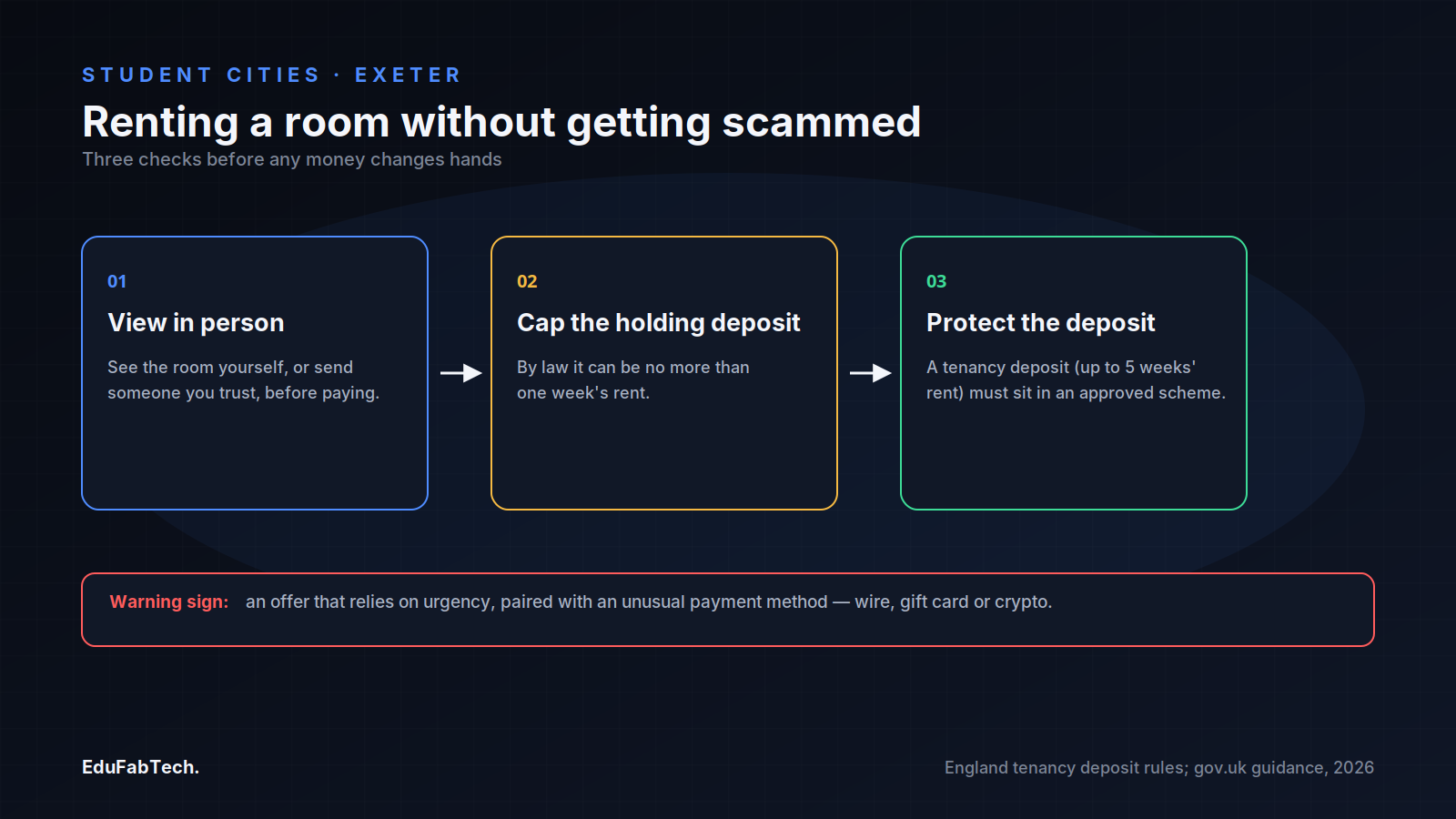
The scams that appear in Exeter are the ones that appear in any tight student market: a room advertised below the going rate, a landlord who is conveniently abroad, and pressure to pay a "holding deposit" before you have seen the place. The defences are simple and worth repeating. View the property in person, or send someone you trust, before any money changes hands. Never send a deposit or first month's rent by bank transfer, gift card or cryptocurrency to "hold" a room for someone you have not met at the address. In England a landlord or agent can take a holding deposit of no more than one week's rent, and a tenancy deposit is usually capped at five weeks' rent and must by law be placed in a government-approved deposit protection scheme — ask which scheme and get the reference. If an offer relies on urgency and an unusual payment method, those two things together are the warning.
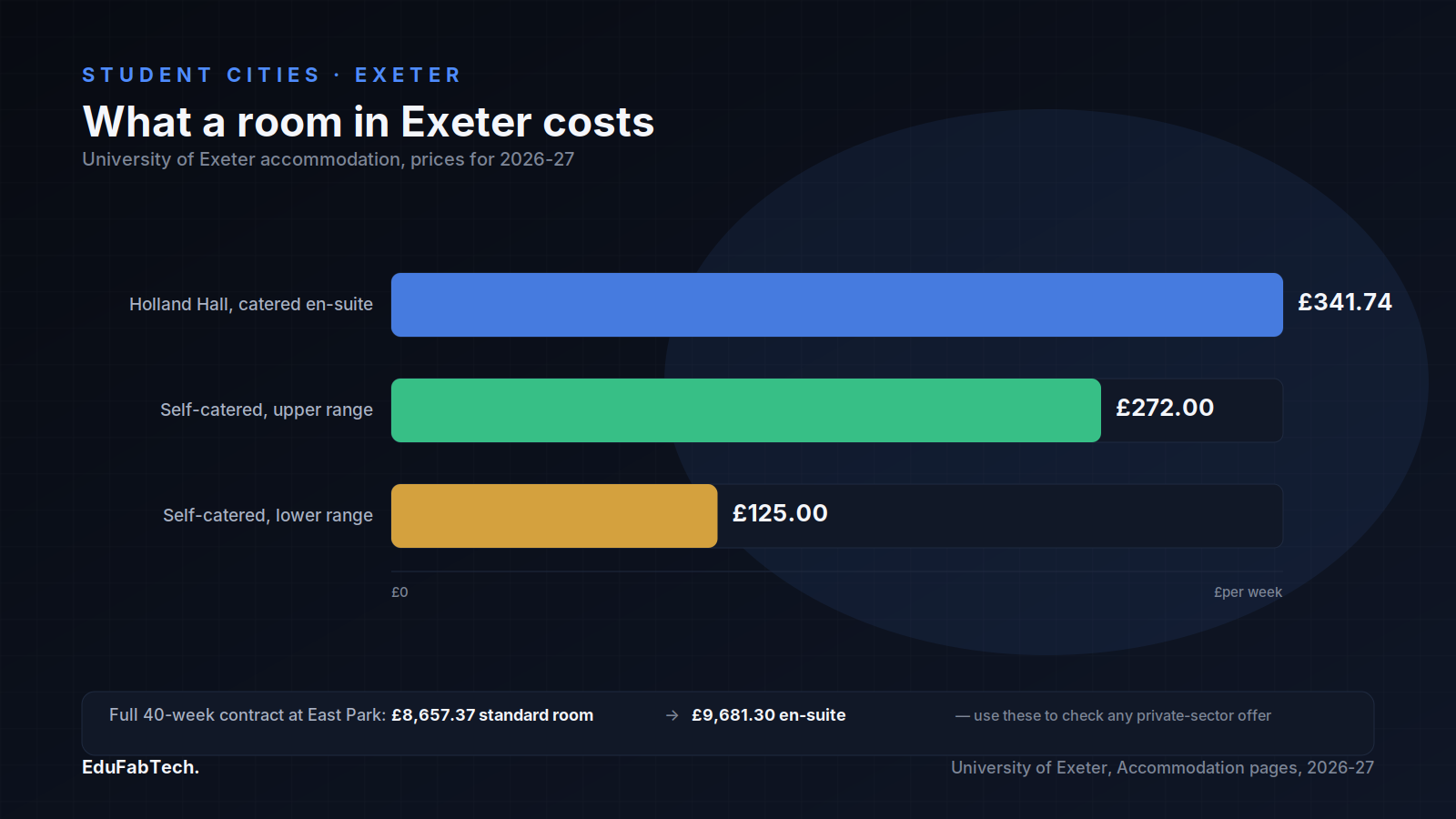
Student halls remove most of that risk, which is part of why first-years take them. The university's accommodation room finder lists its halls with 2026-27 prices: catered en-suite rooms at Holland Hall at £341.74 per week, and self-catered rooms running from roughly £125 to £272 per week depending on the residence and room type. To put one full contract in plain figures, the university's East Park page (2026-27) lists a standard room at £8,657.37 and an en-suite at £9,681.30 for a 40-week contract. Those are the numbers to hold a private-sector offer against.
Furnishing a room on next to nothing
A room in a shared house is often half-furnished, and kitting it out is where second-hand Exeter earns its keep. The city has a dense run of charity shops — Sidwell Street and Fore Street are the places to walk — including larger furniture and homeware stores where you can find a desk lamp, crockery and a bookshelf for a few pounds. For food and local produce, the Exeter Farmers' Market runs at the junction of Fore Street and South Street on Thursdays from 9am to 2pm, according to Visit Exeter; the quayside and the Corn Exchange area host periodic craft and antiques markets worth a browse for a cheap frame or a second-hand book.
Before you buy anything new, check what other students are giving away at the end of each term — move-out weeks produce a glut of free kettles, lamps and desks. EduFabTech collects second-hand items at /in/united-kingdom/exeter/second-hand, furniture at /in/united-kingdom/exeter/furniture and things being given away at /in/united-kingdom/exeter/free-stuff. A single trip to a charity shop plus a free hand-me-down desk will usually furnish a room more cheaply than any flat-pack order.
Part-time work, and the rules that bind it
Many students work part-time, and in a service-and-tourism city like Exeter the jobs are mostly in cafés, pubs, shops, the two universities themselves and seasonal roles. If you are an international student, the hours you may work are not a matter of what an employer offers — they are set by your visa. The UK Council for International Student Affairs (UKCISA) states that Student visa holders at an institution with a track record of compliance can work up to 20 hours a week in term time if studying at degree level or above, and up to 10 hours a week if studying below degree level, with full-time work allowed during vacations. The 20-hour cap is a total across all jobs in any Monday-to-Sunday week, and it cannot be averaged. Confirm the conditions printed on your own visa against the official gov.uk Student visa guidance before you accept shifts; this is a summary, not legal advice. Local vacancies on EduFabTech are at /in/united-kingdom/exeter/jobs.
Libraries and places to read
The anchor for study is the Forum Library on Streatham Campus. The university's library guide states it is open 24/7 for students and staff, with swipe access in the late hours, and is zoned by floor: group study on Level -1, quiet study on Level 0 and silent study on Level +1, with group rooms, pods and silent desks that can be booked online. St Luke's has its own library for the medical, education and health courses based there. When the university libraries are busiest around exams, Exeter's public library in the city centre, run by Libraries Unlimited, gives you evening and weekend desks away from the campus crowd, and the city's cafés fill the gaps. EduFabTech also lists bookable desks and quiet rooms at /in/united-kingdom/exeter/study-spaces.
Moving around a compact city
Exeter is walkable, and most undergraduates get by on foot and the bus. Buses are run by Stagecoach South West; the university's travel page points students to Stagecoach's termly Termrider pass for unlimited travel on local services at a reduced rate, and notes the government's £3 cap on single bus fares across Devon running to 31 December 2026, and a PlusBus option that adds bus travel for no more than £4.30 a day when bought with a train ticket and a Railcard. For trains, the city has two central stations — Exeter St Davids and Exeter Central — with Great Western Railway and South Western Railway services north to London and out to the Devon coast and Cornwall; a 16-25 or Student Railcard pays for itself quickly if you travel home in the holidays. For most day-to-day student life, you will rarely need more than your feet and a bus app.
What it costs, and the honest trade-offs
Exeter is not a cheap city for its size. The Office for National Statistics reports that the average monthly private rent in Exeter was £1,318 in September 2026, with one-bedroom homes at £914 and three-bedroom homes — the shape of a typical student house — at £1,362 a month, which split three or four ways is the real benchmark for a room. Rents were broadly flat over the year to September 2026 on that data, but the starting level is high for the South West, driven by a student population pressing on a limited housing stock.
The honest balance for a student runs like this. In its favour: Exeter is compact and safe-feeling, you can walk between home, campus and the centre, and Dartmoor, the Jurassic Coast and the beaches at Exmouth and Dawlish are a short train or bus ride away — the setting is a genuine part of the appeal. The parkland Streatham Campus is pleasant to study on, and a single large university gives the city a steady student culture. Against it: housing is tight and relatively expensive, the hilly terrain makes some "cheap" areas a daily climb, the Devon weather is mild but wet, and a small city has a quieter nightlife and fewer big-city amenities than Bristol or Manchester. Whether that reads as peaceful or limiting depends on what you want from three years.
A short checklist for the first weeks
- Register with the university and collect your campus card; if you are on a Student visa, check the exact work conditions printed on it against gov.uk before taking any job.
- Register with a local GP and a dentist early — surgeries near campus fill up at the start of term.
- Set up a Stagecoach bus app or buy a Termrider pass, and get a Student or 16-25 Railcard before your first trip home.
- If you are already house-hunting for next year, view in person, confirm the deposit is in a government-approved protection scheme, and never transfer money to hold a room you have not seen.
- Walk the charity shops on Sidwell Street and Fore Street and check free-stuff and second-hand listings before buying anything new for your room.
- Find your study spot: the Forum is open around the clock, but learn the public library and a quiet café too, for when exam season fills the campus.
A quick question for readers
Do you work part-time while you study?
Many students work to pay the bills. See how common it is — and how many hours people really do.
Pick an answer, create a free account in a minute, and your vote counts. Already a member? Sign in
Comments 0
CommentNo comments yet. Members start the conversation.
Source: University of Exeter
Sources (5)
- University of Exeter. About the University of Exeter. University of Exeter, 2026. exeter.ac.uk ↗ · checked 8 Nov 2026
- University of Exeter. Accommodation room finder (East Park, 2026-27 fees). University of Exeter, 2026. exeter.ac.uk ↗ · checked 8 Nov 2026
- Office for National Statistics. Housing prices and private rents, Exeter (E07000041). Office for National Statistics, 2026. ons.gov.uk ↗ · checked 8 Nov 2026
- UKCISA. Working as an international student. UK Council for International Student Affairs, 2026. ukcisa.org.uk ↗ · checked 8 Nov 2026
- University of Exeter Library. Forum Library. University of Exeter, 2026. libguides.exeter.ac.uk ↗ · checked 8 Nov 2026