Studying in Florence, Alabama: universities, housing and student life
A practical, sourced guide to studying in Florence, Alabama — the University of North Alabama and Heritage Christian University, where students live, what it costs, and how to get around a city with no fixed bus route.
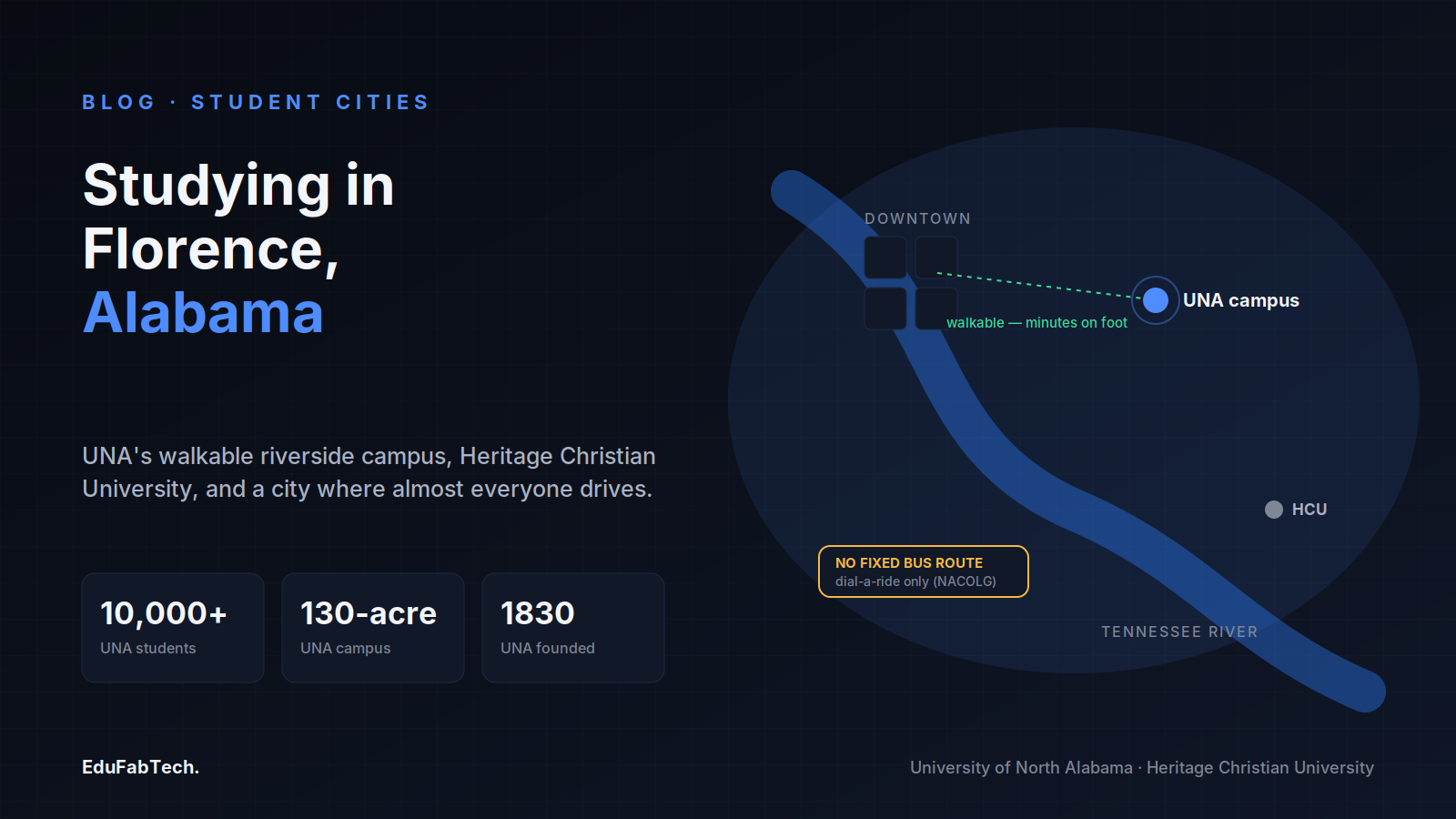
Florence sits on the north bank of the Tennessee River in the far northwest corner of Alabama. It is the largest of four towns — with Muscle Shoals, Sheffield and Tuscumbia across the water — that locals call the Shoals, a place the University of North Alabama's own pages describe as the home of the famous Muscle Shoals sound. For a student, the practical shape of the city is this: a compact, walkable historic downtown; a university grafted onto the edge of it; and, beyond that, a spread-out small city where almost everyone drives.
The University of North Alabama anchors the whole thing. Its About page describes a 130-acre campus in historic Florence that is within walking distance of downtown restaurants and shops, enrolling more than 10,000 students. That proximity is unusual and worth understanding before you choose where to live: at UNA you can realistically walk from a residence hall to a coffee shop, a river overlook and a lecture hall, which is not true of most American campuses this size.
The city carries more history than its size suggests. The Frank Lloyd Wright-designed Rosenbaum House, built in 1940, faces the Tennessee River near downtown and is described by the Muscle Shoals National Heritage Area as the only Wright structure in Alabama open to the public; a short walk away is the birthplace of W.C. Handy, the composer remembered as the father of the blues. None of this pays your rent, but it tells you the kind of town Florence is — small, river-facing, and more culturally dense than its population implies.
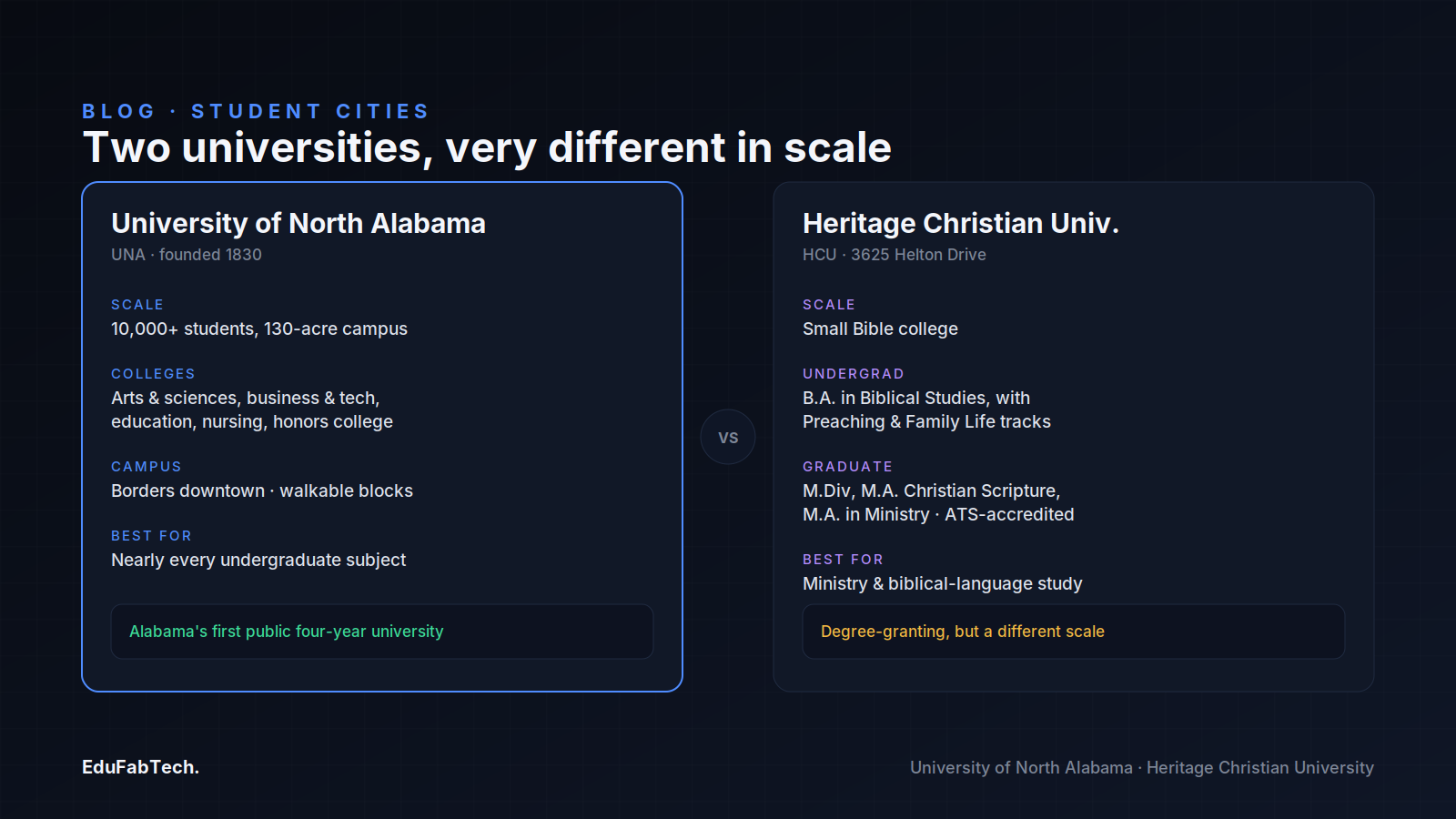
Two universities, very different in scale
The University of North Alabama (UNA) is the one most students mean when they say they study in Florence. Its About page dates the institution to 1830 and calls it Alabama's first public four-year university, now organised into colleges spanning arts, sciences and engineering; business and technology; education and human sciences; and nursing and health professions, alongside an honors college. The campus is built around restored nineteenth-century buildings, and because it borders downtown, the line between "on campus" and "in town" is genuinely blurry.
Heritage Christian University (HCU) is the other degree-granting institution in the city, and it is a different kind of place entirely: a small Bible college at 3625 Helton Drive. Its undergraduate programme centres on a Bachelor of Arts in Biblical Studies, with concentrations such as Preaching Ministry and Family Life Ministry, as the university describes. Its Graduate School of Theology is listed by the Association of Theological Schools as accredited in good standing and offering the Master of Divinity, Master of Arts in Christian Scripture and Master of Ministry. If you are not studying ministry or biblical languages, UNA is almost certainly your campus; HCU is named here because it is real, operating and granting degrees, not because it overlaps with the general student experience.
Where students live
At UNA, first-year undergraduates typically start in the residence halls, and the university runs a wide range of them — from older community-style buildings with shared bathrooms (Rice, Rivers, Lafayette) to cluster- and hotel-style halls and a set of university apartments. UNA also operates apartment communities with their own monthly rents, which is unusual and useful: it means you can stay inside the university system past first year rather than jumping straight into the private market.
Off campus, the two names to know are downtown and Cloverdale. The blocks immediately around campus and along North Court Street put you within walking distance of class, which matters a great deal in a city with no scheduled bus. The historic Cloverdale area to the south is quieter and greener but assumes you have a car or a bike. Because the university sits on the edge of downtown rather than in a distant campus bubble, "near UNA" and "near the city centre" are largely the same search — you can browse what is currently listed around campus on EduFabTech's University of North Alabama listings and the city's rooms page.
Start looking early. Demand for the walkable blocks near campus peaks in late spring and summer before the autumn term, and the closer you want to be to UNA, the earlier you should be searching — by June the best-placed rooms for a September start are often gone.
Renting off campus without getting cheated
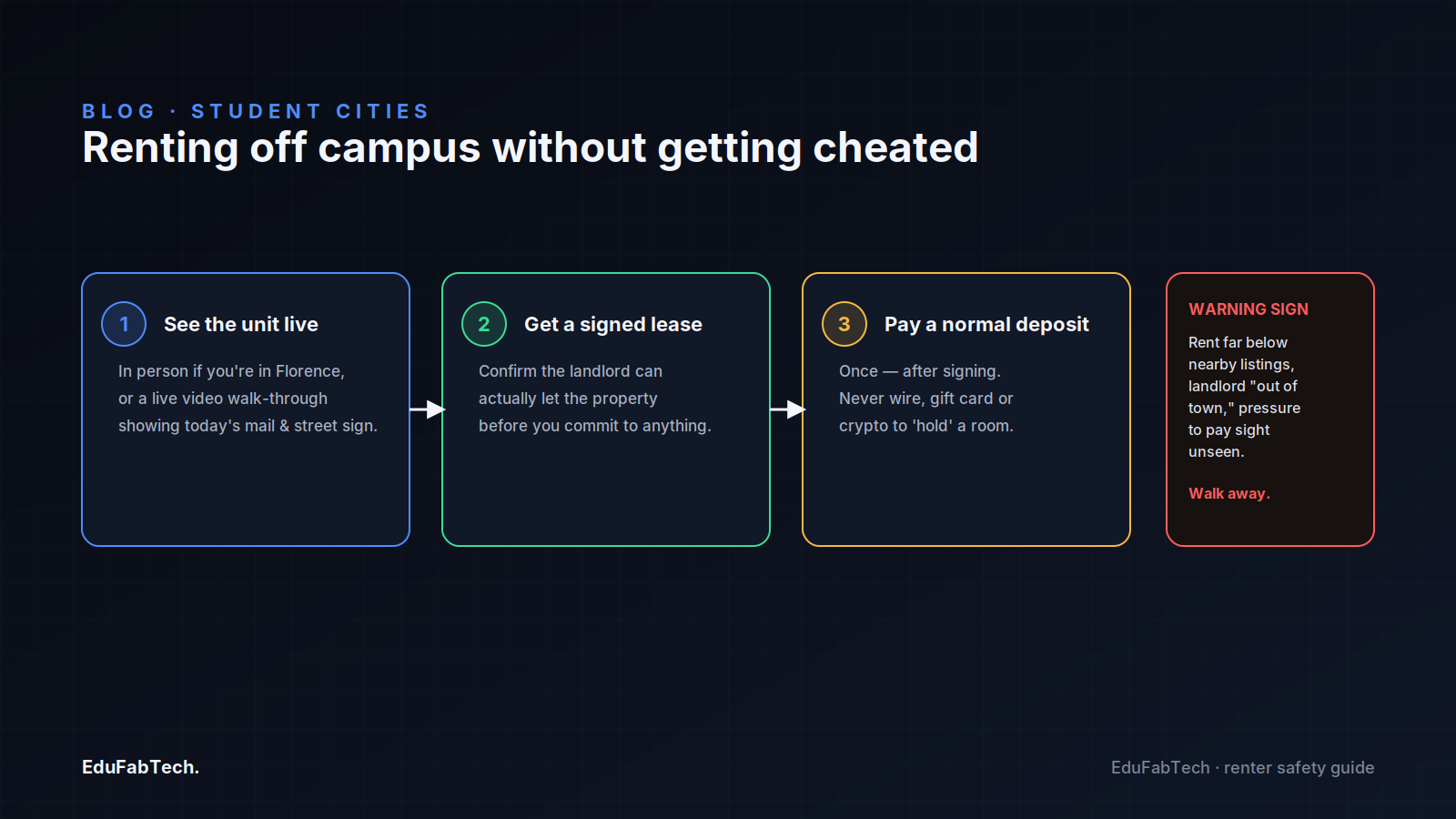
Florence is small enough that most off-campus rentals are advertised locally — on campus noticeboards, through word of mouth, and on general classified sites that cover the Shoals. That informality is where scams appear: a listing near campus priced below everything comparable, a "landlord" who is conveniently out of town, and pressure to send money to hold the place sight unseen. The pattern is the same everywhere, but in a market this small an unusually cheap room three blocks from UNA should raise your suspicion, not your hopes.
Two rules protect you. First, see the actual unit — in person if you are already in Florence, or by a live video walk-through with someone who can show you today's mail and the street sign if you are still abroad. Second, never send a deposit by bank wire, gift card or cryptocurrency to "reserve" a room before you have a signed lease and have confirmed the person can actually let the property. Legitimate local landlords expect a normal security deposit paid once you sign, not an untraceable transfer to a stranger. If a listing exists only as photos and a request for money, walk away. EduFabTech does not name private landlords or agencies, and neither should anyone pressuring you to pay fast.
Furnishing a room on the cheap
Florence is a good second-hand town because downtown has a cluster of antique and resale shops on and around North Court Street. The city's tourism directory lists, among others, Reclaimed Spirit at 416 North Court Street and Southern Trash at 1134 North Wood Avenue in its antiques and home decor listings — both within the walkable core. For cheap, functional furniture rather than antiques, the city's charity thrift stores are the usual first stop, and students routinely furnish a first room from a mix of these and hand-me-downs from graduating tenants in August.
If you are arriving with nothing, time your move for the end of the previous academic year, when outgoing students give away or sell desks, mini-fridges and shelving cheaply. EduFabTech keeps running local lists of second-hand things and used furniture in Florence; check them alongside the downtown shops before buying anything new.
Part-time work, and what the rules actually are
For domestic students, part-time work in Florence looks like most small university towns: on-campus jobs through UNA, plus service and retail work downtown and along the commercial strip. The job market here is modest, so apply early in the term.
For international students the rules are stricter and set by federal law, not by the university or the city. U.S. Citizenship and Immigration Services states that F-1 students may accept on-campus employment subject to conditions, and that any off-campus work — through Curricular Practical Training or Optional Practical Training — must relate to your field of study and be authorised in advance by your Designated School Official, as its Students and Employment page explains. This is not legal advice: before accepting any paid work, confirm your specific situation with UNA's international office, which houses your DSO. EduFabTech's Florence jobs page lists what is currently advertised locally, but it cannot authorise you to work.
Libraries and places to study
UNA's Collier Library is the main academic study space; the library's own history pages note the building first opened in 1940 and was named Collier in 1949 after a former dean, and it offers study rooms, databases and archives. Usefully for the wider student community, Collier issues a community card to Florence-Lauderdale Public Library patrons, giving access to its public spaces and computers — which matters if you are at HCU or living in town rather than enrolled at UNA.
Off campus, the Florence-Lauderdale Public Library at 350 North Wood Avenue is the free, neutral study option. Its catalogue lists opening hours of Monday to Thursday 10:00–19:00, Friday and Saturday 10:00–17:00, and Sunday 13:00–17:00 on its hours page — longer weekday evenings than many small-city libraries, which is worth knowing when campus buildings close. Downtown's cafés fill the gaps, and EduFabTech tracks additional desks and bookable rooms on the Florence study spaces page.
Getting around, and what things cost
Here is the single most important practical fact about Florence: there is no scheduled city bus. Public transport in the Shoals is a demand-responsive dial-a-ride operated by the Northwest Alabama Council of Local Governments (NACOLG Transit), where riders book trips in advance rather than catching a fixed route. Its page lists one-way fares starting at $3 for up to 1.5 miles outside city limits, rising to $6 and then $9 for longer trips, with rides bookable up to two weeks ahead. That makes it a reservation service, not something you lean on to get to a 9 a.m. class. If you live near campus you can walk; otherwise, plan around a car, a bike or lifts from classmates.
On cost, the firmest figures come from UNA itself. For 2026-2027 the university's housing page lists community-style residence hall rooms from $1,970 per semester for a double in Rice up to roughly $4,640 for a hotel-style single, with cluster-style doubles at $3,445, on its housing rates page; its university apartments are priced monthly, from $485 a month for a shared Twin Oaks unit upward. Tuition, effective Fall 2026, is listed by the Office of Student Accounts at $350 per credit hour for in-state or fully online undergraduates (a $5,250 flat rate at 12–18 hours) and $700 per credit hour for out-of-state and international undergraduates (a $10,500 flat rate at 12–18 hours), as its tuition page states.
For the private rental market, the independent benchmark is the U.S. Department of Housing and Urban Development, whose FY2026 Fair Market Rents schedule puts the Florence–Muscle Shoals, AL metropolitan area at $775 for a one-bedroom and $1,000 for a two-bedroom unit, including utilities, in its FY2026 figures. Those are HUD's reference rents for the whole metro, not quotes for a specific flat, but they are a reasonable sanity check: a room advertised far below them deserves scrutiny, not excitement.
The honest trade-offs
What is good about Florence for a student is real. Housing and tuition are low by national standards, the campus sits inside a walkable historic downtown rather than on a ring road, and the Shoals' music and river heritage give a small city genuine character. For someone who wants to live without a car, the blocks around UNA are one of the few places in Alabama where that is plausible.
What is hard is mostly about scale and transport. The absence of a fixed-route bus means that if you live more than a walk from campus, you effectively need a car — and that reshapes your budget. The local part-time job market is small, the nightlife is modest, and winters, while mild by northern standards, are wetter and greyer than the tourist-season image of the river suggests. Florence rewards students who settle near the centre and accept a quieter, more self-directed pace; it frustrates those expecting big-city transit and amenities.
A checklist for your first weeks
- If you are at UNA, sort housing through the university first — residence halls and university apartments spare you the private-market scam risk entirely.
- If you rent off campus, prioritise the walkable blocks near downtown and campus; view the unit live before paying anything, and never wire a deposit to hold a room.
- Assume you will walk or need a car. Treat NACOLG dial-a-ride as a booked service, not a daily commute.
- Get a Collier Library login if you are at UNA, or a Florence-Lauderdale Public Library card if you are not — both give you reliable study space.
- International students: see UNA's international office and your DSO before taking any job, and read the USCIS Students and Employment page first.
- Furnish from downtown's Court Street resale shops and end-of-year giveaways before buying anything new, rather than buying new on arrival.
A quick question for readers
Do you work part-time while you study?
Many students work to pay the bills. See how common it is — and how many hours people really do.
Pick an answer, create a free account in a minute, and your vote counts. Already a member? Sign in
Comments 3
Comment-
The tuition split is the number worth sitting with: $350 per credit hour in-state, exactly $700 out-of-state and international. Not 1.5x, no…
-
The dial-a-ride fares are the part that actually deserves scrutiny: $3 for under 1.5 miles, scaling to $9, with bookings up to two weeks out…
-
The transit framing is the bit worth sitting with: NACOLG's dial-a-ride starts at $3 and climbs to $6 then $9 depending on distance, and you…
Join free to read the full comments and reply Comments are between members; an account takes a minute.
Source: University of North Alabama
Sources (5)
- University of North Alabama. Housing Rates (2026-2027). University of North Alabama, 2026. una.edu ↗ · checked 29 Oct 2026
- University of North Alabama. Office of Student Accounts — Tuition. University of North Alabama, 2026. una.edu ↗ · checked 29 Oct 2026
- U.S. Department of Housing and Urban Development. FY2026 Fair Market Rents Schedule. HUD User, 2025. huduser.gov ↗ · checked 29 Oct 2026
- Northwest Alabama Council of Local Governments. Public Transit (NACOLG Transit). NACOLG, 2026. nacolg.org ↗ · checked 29 Oct 2026
- Florence-Lauderdale Public Library. Library Hours. Florence-Lauderdale Public Library, 2026. catalog.flpl.org ↗ · checked 29 Oct 2026