Studying in Frankfurt am Main: universities, housing and student life
A practical, honest guide to the universities in and around Frankfurt, where students rent, how to avoid housing scams, and what it costs — with the figures sourced.
Frankfurt am Main packs a lot into a small footprint. The glass towers of the European Central Bank and the commercial banks stand a short walk from the half-timbered Römerberg, the river Main cuts through the middle with a row of museums along its southern bank, and one of Europe's busiest airports sits at the edge of the city. It is among Germany's most international places — a financial centre and trade-fair host where more than a hundred nationalities mix — and that shapes student life, from the make-up of a lecture hall to the pressure on rooms.
For a student the city is compact and very well connected, which matters because its main university is not on one site but spread across several. What follows walks through the universities in and around Frankfurt, the districts students actually rent in, how to rent a room safely, where to furnish it cheaply, the libraries worth a desk, how the transport and semester ticket work, and what it honestly costs.
The universities in and around Frankfurt
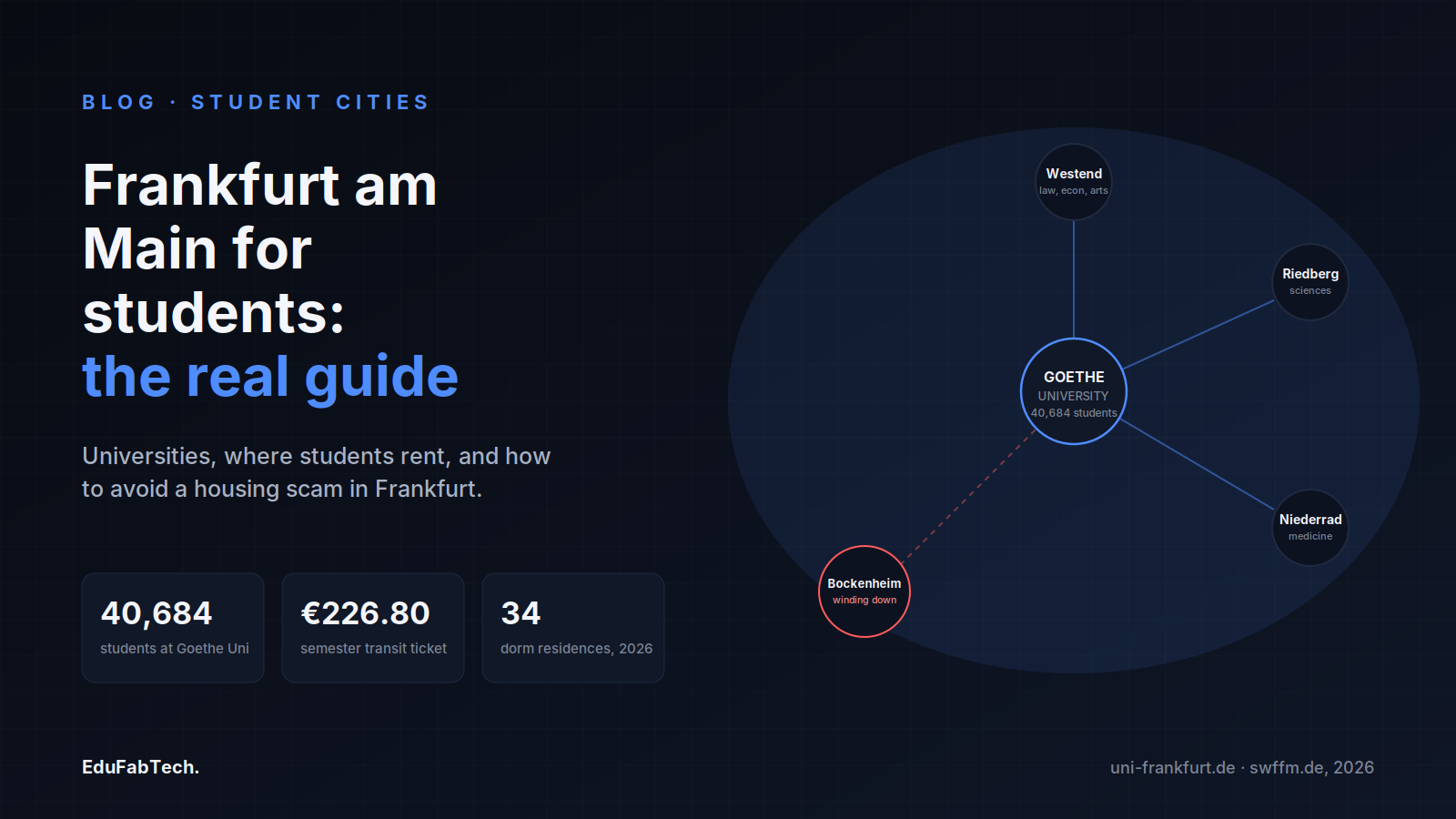
The largest by far is Goethe University Frankfurt. Its own figures record 40,684 students, 16 faculties, 159 study programmes and 607 professors in the winter semester 2025/26 (uni-frankfurt.de, as of 1 December 2025). It is a multi-campus university: humanities, law, economics and the social sciences sit at Campus Westend around Grüneburgplatz; the natural sciences are out at Campus Riedberg in the north; medicine is at the university hospital in Niederrad; and Campus Bockenheim, the historic original site, is being wound down, with mathematics and computer science among the last departments still there. If you want to see what is nearby before you arrive, EduFabTech collects listings near Goethe University Frankfurt.
A short regional-train ride south, in the separate city of Darmstadt, are two more institutions the semester ticket brings within reach. Technical University of Darmstadt is one of Germany's established technical universities, strong in engineering, computer science and physics; Darmstadt University of Applied Sciences (Hochschule Darmstadt) is one of the country's larger universities of applied sciences. Students heading that way can browse listings near Technical University of Darmstadt.
Within Frankfurt itself the specialist and applied schools are worth knowing. The Frankfurt University of Music and Performing Arts is Hesse's state conservatoire for music, drama and dance. The Städelschule is the city's state academy of fine arts. Fachhochschule Frankfurt, renamed Frankfurt University of Applied Sciences in 2014, teaches engineering, business and social work on a campus north of the centre. Sankt Georgen Graduate School of Philosophy and Theology is a Jesuit college for theology and philosophy. The union-backed University of Labour (Hochschule der Arbeit), state-recognised in 2021, awards management and engineering degrees, and Provadis School of International Management and Technology runs work-integrated degrees from the Höchst industrial park in the city's west.
A ring of smaller institutions sits in the surrounding towns, all on the semester-ticket map: Hochschule Fresenius University of Applied Sciences, a private university of applied sciences with its original seat in Idstein; Accadis Business School Bad Homburg, a private management school in Bad Homburg vor der Höhe; the International University of Cooperative Education (iba) in Darmstadt, which awards dual bachelor's degrees; and Hochschule für Gestaltung Offenbach, Hesse's state university of art and design, just across the city line in neighbouring Offenbach am Main.
Where students live
Bockenheim is the traditional student quarter, wrapped around the old Bockenheim campus and a short hop from Westend. Rents are moderate by Frankfurt standards, shared flats (Wohngemeinschaften, or WGs) turn over often, and the Bockenheimer Warte interchange, markets and cheap kebab-and-falafel places keep it practical.
Westend is leafy and elegant, built around Campus Westend and the Palmengarten botanical garden. It has some of the city's priciest streets, so a student here usually means a dormitory place or a room in a shared flat rather than a whole apartment.
Nordend is central, residential and well liked by students and young professionals, with good tram and U-Bahn links toward both Westend and the centre; rents have climbed with its popularity. Next door, Bornheim is livelier still, strung along the bars and shops of Berger Straße.
Sachsenhausen, on the south bank of the Main, runs from the museum embankment and the old Apfelwein (cider) taverns of Alt-Sachsenhausen to expensive riverside blocks — student-friendly in pockets, dear along the water. Gallus and the western districts toward Höchst are cheaper and more industrial, handy for anyone studying at Provadis or Frankfurt UAS. Far to the north, Riedberg is a newly built district reached by the U8 and U9 lines, where a room near Campus Riedberg saves science students a long daily commute.
Finding a room without losing a deposit
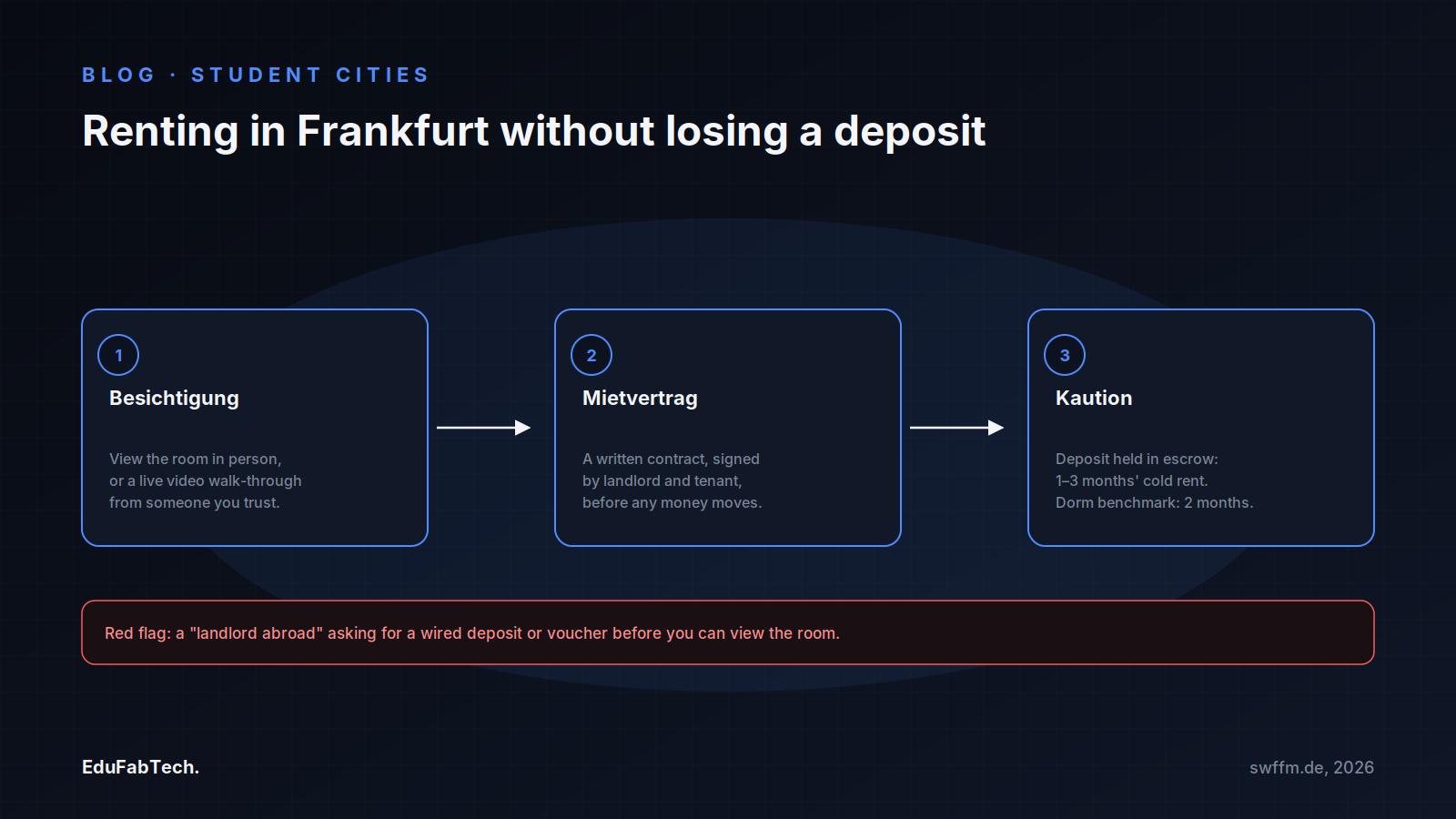
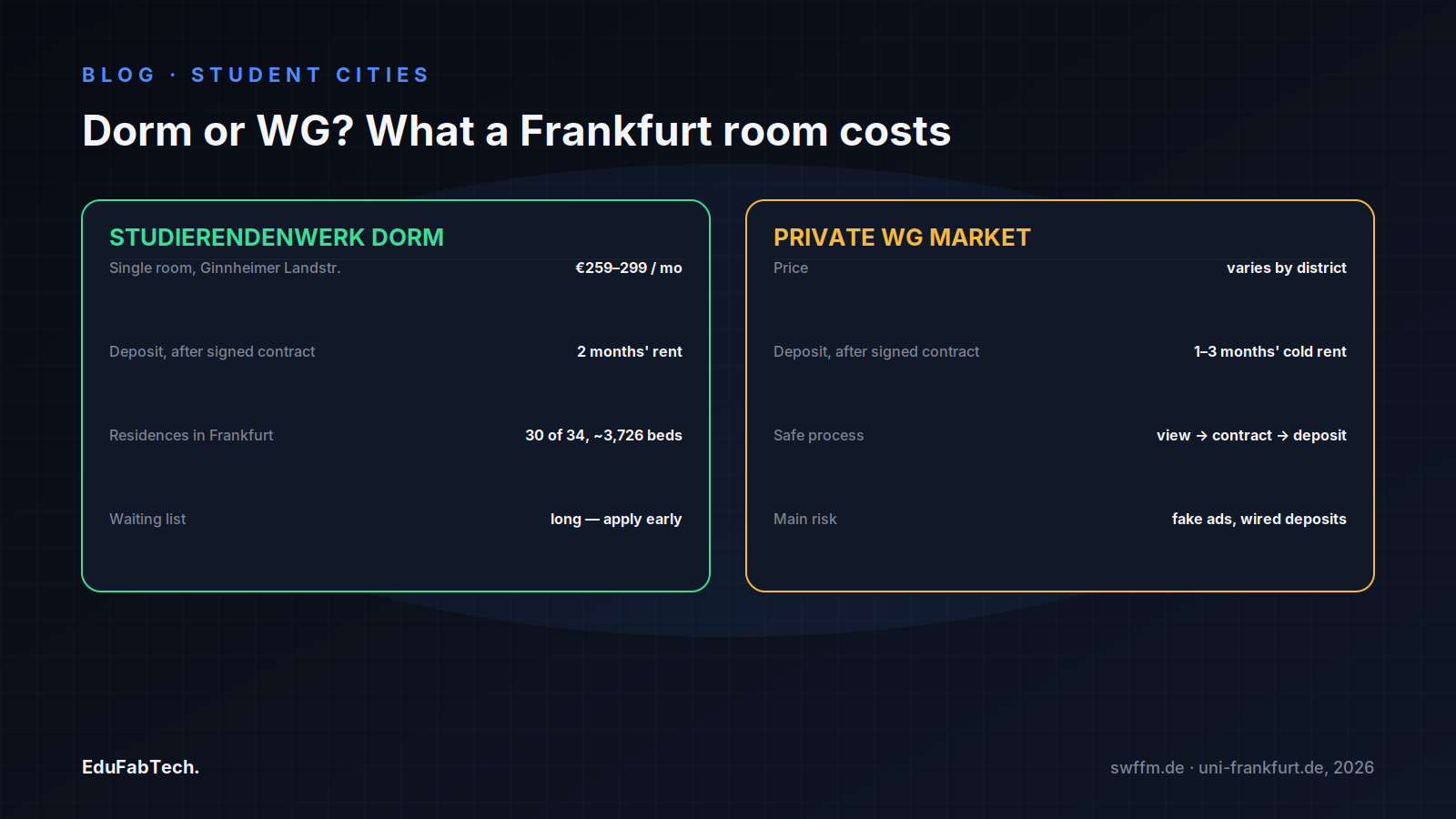
Start early and apply in parallel. Studierendenwerk Frankfurt am Main runs the public dormitories near the campuses — 34 residences with roughly 3,726 places, 30 of them in Frankfurt (swffm.de, 2026) — and its waiting lists are long, so apply well before the semester. On the private market most students chase a WG room, and you can see what is open on EduFabTech's rooms and places to stay for the city. The normal German rhythm is a viewing (Besichtigung), a written contract (Mietvertrag), and only then a deposit (Kaution) of one to three months' cold rent held in a separate account.
Scams here follow the national pattern and cluster where demand is highest and newcomers are most rushed: fake adverts for cheap, central rooms in Bockenheim, Nordend or Sachsenhausen, often with a "landlord" who is conveniently abroad and wants a deposit wired, or vouchers bought, to "reserve" the room before you can view it. Do not send money by bank transfer, gift card or cryptocurrency to hold a place you have not seen. View the flat in person — or get a live video walk-through from someone you trust — meet the landlord or current tenants, confirm the address exists, and pay only after a signed contract. The Studierendenwerk's own deposit, two months' rent paid after signing, is the safe benchmark to measure any private offer against.
Furnishing a room on a budget
Frankfurt's flea markets are the obvious first stop. HFM Frankfurt, the city's market company, runs the Frankfurter Flohmarkt every Saturday except public holidays from 9:00 to 14:00, alternating between the Schaumainkai on the museum embankment and Lindleystraße by the Osthafen (hfm-frankfurt.de). Bring cash, come early, and expect the full range from furniture and lamps to kitchenware. For food and daily supplies, the Kleinmarkthalle in the old town is the city's long-standing covered market, and the farmers' market (Erzeugermarkt) on Konstablerwache sets up midweek and Saturdays.
Beyond the markets, charity shops, second-hand furniture dealers and the end-of-semester giving-away culture — departing students offloading desks, shelves and bikes — make it cheap to fill a room. On EduFabTech you can scan second-hand things and furniture, and items people are giving away free around the city.
Libraries and places to study
The Universitätsbibliothek Johann Christian Senckenberg is Goethe University's central library, on Bockenheimer Landstraße at the edge of the old Bockenheim campus, with branch libraries on the Westend and Riedberg campuses for law, economics, the humanities and the sciences. Frankfurt is also one of the two sites of Germany's national library, the Deutsche Nationalbibliothek, on Adickesallee in the Nordend; its reading rooms are open to registered users and make a quiet, serious place to work. For cafés, co-working spots and bookable desks beyond the campuses, EduFabTech lists study spaces across the city.
Getting around on the RMV
Public transport in Frankfurt runs within the Rhein-Main-Verkehrsverbund (RMV): U-Bahn and trams, city buses, and the S-Bahn network that reaches the airport and the surrounding towns. Enrolled students pay for mobility through the semester fee rather than buying monthly tickets. At Goethe University the semester fee for winter semester 2026/27 is €408.28, of which €226.80 is the Deutschland-Semesterticket (uni-frankfurt.de) — a nationwide ticket the student union (AStA) negotiates that covers RMV services and regional public transport across Germany, including the trains to Darmstadt, Mainz, Offenbach and beyond. That single ticket is one of the strongest practical reasons the whole Rhine-Main region is open to a Frankfurt student.
What it costs
Housing is the biggest line and the hardest. The dormitories are the cheapest reliable option: at the Studierendenwerk's Ginnheimer Landstraße residence, single rooms run €259–€299 a month in 2026, with operating costs, TV and internet included and a deposit of two months' rent (swffm.de). Open-market rooms are considerably dearer, and the City of Frankfurt publishes an official rent index, the Mietspiegel, that documents local comparative rents. On top of rent, Goethe University — like other public universities — charges the semester contribution rather than tuition, so the €408.28 fee above is close to the full compulsory cost of enrolment, with the semester ticket already inside it.
Part-time work
Frankfurt's economy — banking, consulting, the airport, trade fairs, hospitality — generates a lot of student work, and on-campus assistant posts (HiWi jobs) are common; current openings sit under EduFabTech's jobs and part-time work. The rules depend on where you are from. The German government's Make it in Germany portal states that international students may work 140 full days or 280 half days per year alongside their studies, that student-assistant jobs at the university are exempt from this limit, and that self-employment or working beyond the limit needs permission from the foreigners authority (Ausländerbehörde) (make-it-in-germany.com). Always check the conditions printed on your own residence permit and ask the Ausländerbehörde before taking a job; this guide is not legal advice.
The honest trade-offs
What is good: Frankfurt is genuinely international, so arriving without German is less isolating than in many German cities; it is compact and flat enough to cycle; the transport is excellent and the semester ticket opens the whole country; and for all its concrete the city is green, with the Palmengarten, Grüneburgpark, the Stadtwald forest and the riverbanks. Part-time and graduate work in finance, consulting and logistics is unusually plentiful.
What is hard: housing is expensive and the market is tight, which is the single biggest strain on a student budget and worth starting months ahead of time. The banking core empties at weekends and can feel lifeless away from Sachsenhausen, Bornheim and the student districts. The Bahnhofsviertel around the main station is lively and full of cheap food but has a visible street drug-and-poverty scene. And the summers in the Rhine-Main basin can be hot and muggy. None of this is a reason to stay away — but it is the city as it is, not a brochure.
A checklist for your first weeks
- Register your address (Anmeldung) at a Bürgeramt soon after you move in, and keep the confirmation — you will need it for almost everything else.
- Open a German bank account and arrange statutory or private health insurance before you try to enrol.
- Complete matriculation and pay the semester fee; your Deutschland-Semesterticket is activated through it.
- Keep applying to Studierendenwerk dormitories while you search for a WG room, and never pay a deposit for a place you have not seen.
- Learn your core U-Bahn and S-Bahn lines between home, your campus and the Hauptbahnhof; the ticket already covers the regional trains to Darmstadt and Mainz.
- Register with a GP (Hausarzt), note where your campus library and the Deutsche Nationalbibliothek are, and set a date for the Saturday flea market to furnish your room.
A quick question for readers
Do you work part-time while you study?
Many students work to pay the bills. See how common it is — and how many hours people really do.
Pick an answer, create a free account in a minute, and your vote counts. Already a member? Sign in
Comments 3
Comment-
The part-time work numbers get stated flat but the gap is what matters: 140 full days a year for international students, except HiWi jobs wh…
-
The gap that jumps out is between the dorm figures and the open-market ones. You get precise numbers for Studierendenwerk capacity: 34 resid…
-
The number that actually gets me is the 140 full days / 280 half days rule sitting right next to "student-assistant jobs at the university a…
Join free to read the full comments and reply Comments are between members; an account takes a minute.
Source: Goethe University Frankfurt
Sources (5)
- Academic Controlling, Goethe University Frankfurt. Facts and Figures. Goethe University Frankfurt, 2025. uni-frankfurt.de ↗ · checked 12 Nov 2026
- AStA / Goethe University Frankfurt. Semester Fee and Semester Ticket. Goethe University Frankfurt, 2026. uni-frankfurt.de ↗ · checked 12 Nov 2026
- Studierendenwerk Frankfurt am Main. Wohnheim Ginnheimer Landstraße 42 and Wohnen Übersicht. Studierendenwerk Frankfurt am Main, 2026. swffm.de ↗ · checked 12 Nov 2026
- Federal Government of Germany. Studying in Germany: Requirements, Visas and Prospects. Make it in Germany, 2026. make-it-in-germany.com ↗ · checked 12 Nov 2026
- HFM Managementgesellschaft für Hafen und Markt mbH. Flohmärkte in Frankfurt. HFM Frankfurt, 2026. hfm-frankfurt.de ↗ · checked 12 Nov 2026