Studying in Frankfurt (Oder): the Viadrina, housing on the Polish border, and student life
A practical, sourced guide to studying at the European University Viadrina in Frankfurt (Oder) — where students live, what rooms cost, how to work legally, and the honest trade-offs of a small city on the German–Polish border.
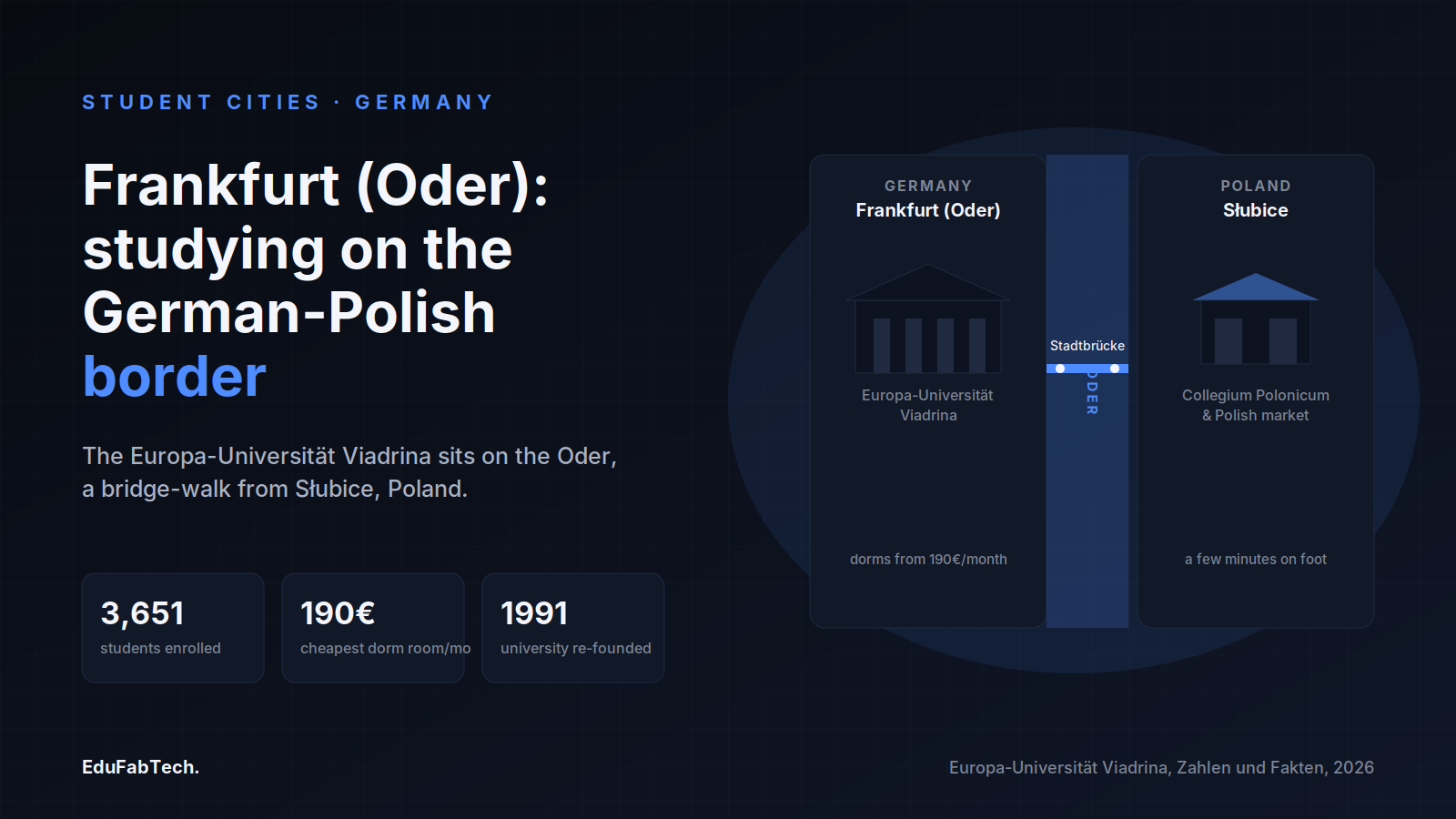
Frankfurt (Oder) is the smaller, eastern Frankfurt: a Brandenburg city on the west bank of the Oder, with the Polish town of Słubice directly across the river and a road bridge, the Stadtbrücke, that you can walk over in a few minutes. For students, that border is the defining fact. The European University Viadrina was rebuilt here precisely to sit on the seam between Germany and Poland, and much of what makes the city distinctive — the bilingual street life, the Polish market across the water, the quietness of a town that lost population after 1990 — follows from where it stands.
This guide is for anyone weighing up a place here, whether you grew up in Brandenburg or are arriving from abroad. It sticks to things that can be checked: what the university actually is, what a room costs, what the semester fee buys, how the work rules read, and where studying in a small border city helps you and where it will frustrate you. Every figure below names its source and the year it was published.
If you want to see current rooms, jobs and second-hand listings in the city while you read, EduFabTech keeps them together at /in/germany/frankfurt-oder.
The Viadrina: small, bilingual, built on the border
There is one degree-granting university in the city, and its scale shapes everything. According to the Viadrina's own Zahlen und Fakten page, the university enrolled 3,651 students as of 13 August 2026, of whom 2,050 were German and 1,601 international. The same page lists 609 employees including 68 professors (as of 1 October 2026) and a total 2025 budget of 62.3 million euros. By German standards that is tiny — closer to a large faculty elsewhere than to a full university — and the Viadrina presents that smallness as the point, with teaching spread across three faculties: Law, Cultural Studies, and Business and Economics, plus the European New School of Digital Studies.
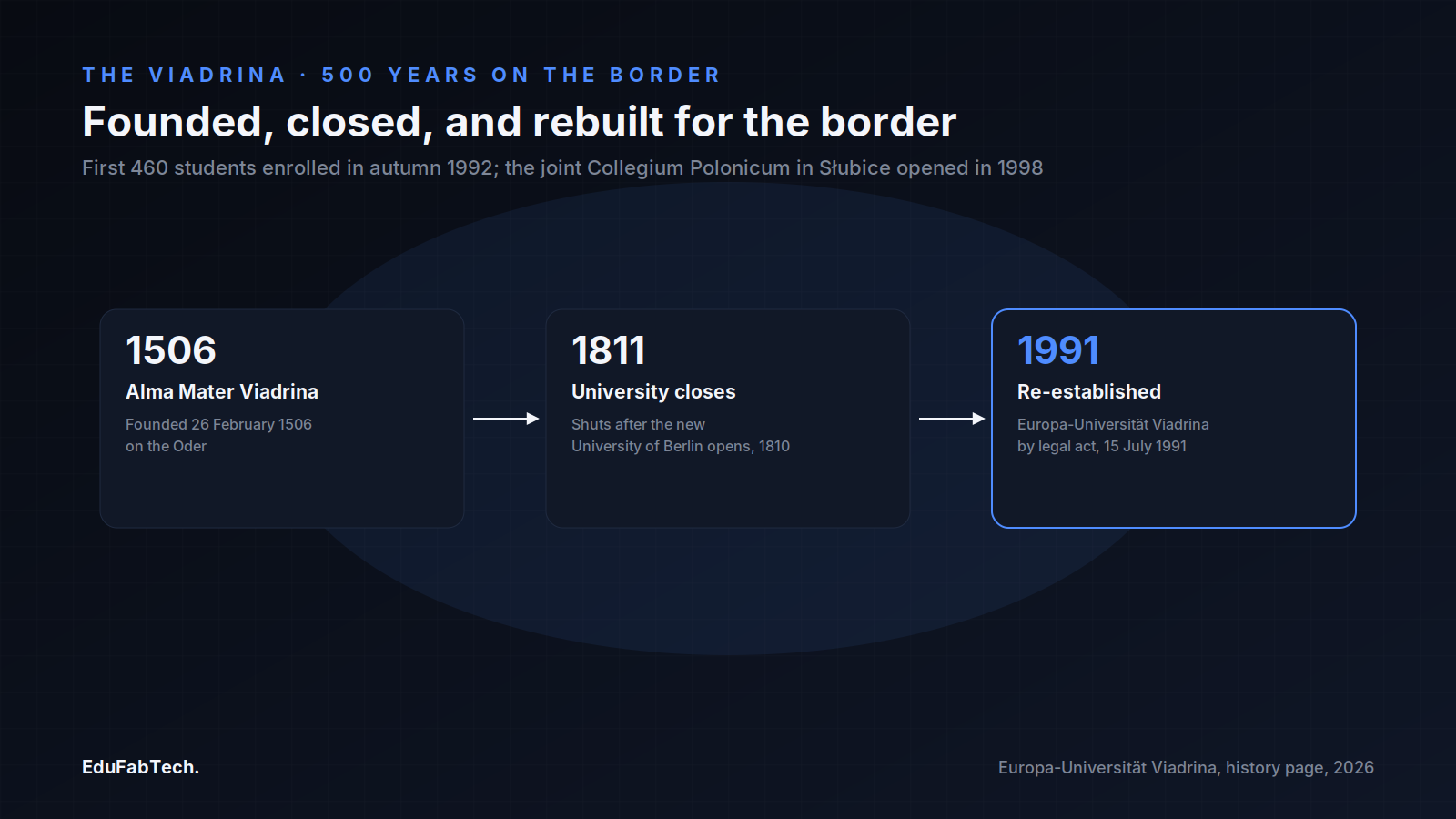
The institution is older than it looks and younger than it claims. The Viadrina's history page dates the original Alma Mater Viadrina to its founding on 26 February 1506, records that it closed in 1811, after the new University of Berlin was founded in 1810, and states that the modern Europa-Universität Viadrina was re-established by legal act on 15 July 1991, its first 460 students enrolling in autumn 1992. The cross-border mission is institutional, not decorative: the same page describes the Collegium Polonicum in Słubice, run jointly with Adam Mickiewicz University in Poznań, whose main building opened on 10 June 1998. Some Viadrina teaching and much of its Polish-studies work happen on the Polish side of the river.
Studying here means seminars rather than overflowing lecture halls, a strong law and cultural-studies tradition, and a student body where German and Polish mix daily. It also means a limited subject range — there is no medicine, no large engineering school, no sprawling science campus. If your field is narrow or lab-heavy, check the programme list before you commit; if you want languages, law, culture or economics in a close-knit setting, the fit is obvious.
Where you'll live: dorms, low rents and the Słubice option
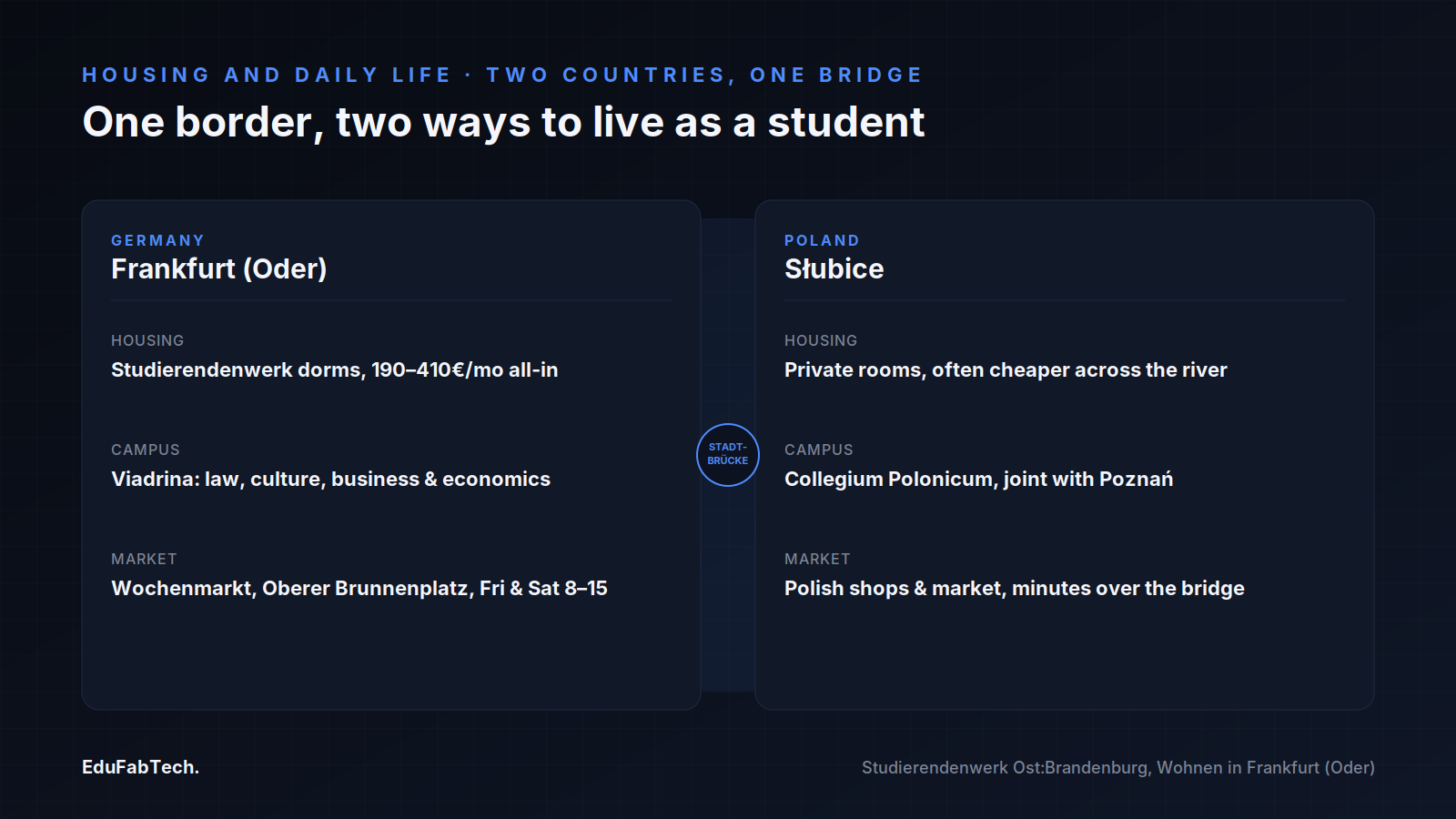
Housing is one of Frankfurt (Oder)'s genuine advantages, because the student-services body runs a lot of it and the city's rents are low by German standards. The Studierendenwerk Ost:Brandenburg lists six halls of residence in the city on its Wohnen in Frankfurt (Oder) page, and states that the rents include all utilities, electricity included. The ranges it publishes run from roughly 190 euros a month for a room in a shared flat at Birkenallee 43–49 up to 370–410 euros for a studio at Große Oderstraße 50, with houses such as August-Bebel-Straße, Logenstraße, Mühlenweg and the Max-Kade-Haus on Berliner Straße in between. The deposit (Kaution) on that page is listed as 300 euros for each house.
Those are full, furnished, all-in prices, which is why a dorm room here is usually the cheapest and least stressful way to start. The halls sit at different points of the city — some a short tram ride from the main campus, some within walking distance — so when you apply it is worth saying which you prefer rather than taking the first offer. Because the Collegium Polonicum is in Słubice, some students also live on the Polish side, where rents can be lower again; that is a real option here in a way it is nowhere else in Germany, but it means crossing a national border for your daily commute.
For the private market and current room offers, EduFabTech collects local listings at /in/germany/frankfurt-oder/rooms, and anything being given away near campus at /near/european-university-viadrina.
Deposits and rental scams on the Oder
Frankfurt (Oder) is not a high-demand, bidding-war housing market, which removes the panic that drives scams in cities like Munich or Berlin — but it does not remove the scams themselves. The pattern to watch for here is the remote "landlord": a cheap, well-photographed flat advertised by someone who says they live in another city or abroad, cannot meet you, and asks you to transfer a deposit or the first month's rent to "reserve" the place before you have seen it. That request is the warning sign, whatever the reason given.
A few habits keep you safe. See the room in person, or have someone you trust see it, before any money moves — the city is compact and a viewing is easy to arrange. For a Studierendenwerk hall, the deposit is the published 300 euros and it is handled through the official process, not by private transfer to an individual. Never send money by bank transfer to hold a room you have not entered, and never pay by gift card or cryptocurrency; no legitimate landlord or hall in Frankfurt (Oder) asks for either. Get a written contract and a receipt for the deposit before you hand over money. If a deal feels unusually cheap and unusually urgent, treat the urgency itself as the problem.
Furnishing a room cheaply, and the market across the river
A dorm room is let furnished, but you will still want household bits, and here the small-city scale helps: things circulate cheaply and informally. The anchor for second-hand furniture is the Bürgerladen and Sozialkaufhaus run by the Frankfurter Arbeitsloseninitiative e.V., which the city of Frankfurt (Oder)'s own listing places at Fürstenwalder Straße 48/49 and describes as handling furniture of all kinds, clothing, household textiles, lamps and electrical appliances. A social department store like this sells donated goods at low prices and is the obvious first stop for a desk, a lamp or a set of pans.
For food and everyday shopping, the weekly market is a fixture: the Wochenmarkt at the Oberer Brunnenplatz runs, according to the regional Brandenburger Landpartie listing, on Fridays and Saturdays from 8 to 15 Uhr, with baked goods and meat among the stalls. And then there is Słubice: the Polish market and shops a short walk over the Stadtbrücke are part of normal student life here, used for cheaper groceries, cigarettes, haircuts and the occasional bargain. It is one border crossing that costs nothing and takes minutes.
EduFabTech tracks local second-hand furniture and household goods at /in/germany/frankfurt-oder/second-hand.
Working alongside your studies
Many students here take a part-time job, and for international students the rules are national, not local. The Viadrina's own Career Center guidance for international students states that non-EU students are permitted to work up to 140 full days or 280 half days per year, and that working beyond this requires approval from both the Federal Employment Agency and the Immigration Office; students from EU or EFTA countries may work up to 20 hours per week without prior authorisation. Mandatory internships that are part of your degree, the same page notes, do not count against the annual limit.
This is general information, not legal advice, and the counting rules matter — so treat the Career Center page and the local Ausländerbehörde (the foreigners' authority, which handles your residence permit) as the authorities on your own case rather than anything you read second-hand. If your German is limited, note that work options in a small city are thinner than in a metropolis; university jobs as a student assistant, and roles that use Polish or English, are worth looking for first. Current openings are listed at /in/germany/frankfurt-oder/jobs.
Libraries and places to study
For a university this size the main study space is the university library. The Universitätsbibliothek gives its address as Große Scharrnstraße 59 in the city centre and its opening hours as Monday to Friday 9:00–21:00 and Saturday and Sunday 10:00–18:00 — weekend opening that a lot of larger universities do not offer, and a real asset during exam weeks. Being open seven days a week in a compact city means you are rarely far from a desk.
Beyond the library, the faculty buildings and the Gräfin-Dönhoff-Gebäude provide seminar rooms and quiet corners, and the Collegium Polonicum in Słubice has its own library resources for cross-border work. Cafés and the riverside fill in the rest. More study spots as students find them are collected at /in/germany/frankfurt-oder/study-spaces.
Getting around, and the trip to Berlin
The city is small enough to cross on foot or by bike, and its public transport is run by the Stadtverkehrsgesellschaft Frankfurt (Oder), the SVF, which operates the tram and bus network; a tram line connects the station and centre with the Europa-Universität. For most students the key document is the semester ticket. The Viadrina's Semesterbeitrag page sets the fee for the winter semester 2026/27 at 402.80 euros for new students and 396.80 euros for enrolled students, and lists the semester ticket within it at 226.80 euros, alongside a 100-euro student-services contribution, a 19-euro student-body contribution and a 51-euro re-registration fee.
That ticket is a Deutschlandsemesterticket, the student version of the nationwide Deutschlandticket, so it is valid on regional and local public transport across Germany, not only in Brandenburg. In practice that turns the regional trains to Berlin — a little over an hour to the west — into part of your everyday range at no extra fare, which matters a great deal in a town this quiet. The capital's concerts, archives and nightlife are a train ride you have already paid for.
The honest balance for a student
What is good here is concrete. Rent is low and much of it is run by the Studierendenwerk, so housing is less of an ordeal than almost anywhere else in Germany. The university is small enough that staff know your name. The border makes daily life genuinely binational, and the semester ticket puts Berlin within reach. For a quiet, affordable, close-contact place to study law, culture, languages or economics, Frankfurt (Oder) delivers.
What is hard is equally concrete. The city is small and, in parts, visibly shrank after 1990; nightlife and the private job market are thin, and if you do not speak German your options for casual work narrow further. Winters on the Oder are grey and cold. The subject range is limited, so this is the right city for some fields and the wrong one for others. And while the border is an asset, relying on Słubice for cheaper living means organising your life across two countries. None of this is hidden — it is simply the trade you make for low costs and a human scale.
A checklist for your first weeks
- Apply early for a Studierendenwerk Ost:Brandenburg room and name the halls you prefer; the all-in rents and the 300-euro deposit are published on the official housing page.
- Never transfer a deposit or rent for a private room you have not seen — in person or through someone you trust — and never pay by gift card or cryptocurrency.
- Complete your enrolment and pay the semester fee so your Deutschlandsemesterticket is active for trams, buses and regional trains.
- Register your address (Anmeldung) at the city office and, if you are an international student, book your appointment with the Ausländerbehörde for your residence permit.
- If you plan to work, read the Viadrina Career Center's rules first and confirm your own limits with the foreigners' authority.
- Furnish cheaply from the Sozialkaufhaus on Fürstenwalder Straße and the weekend market at the Oberer Brunnenplatz, and get a library card for Große Scharrnstraße 59.
- Walk across the Stadtbrücke to Słubice in your first week — it is the fastest way to understand the city you have moved to.
A quick question for readers
Do you work part-time while you study?
Many students work to pay the bills. See how common it is — and how many hours people really do.
Pick an answer, create a free account in a minute, and your vote counts. Already a member? Sign in
Comments 3
Comment-
The semester fee breakdown doesn't quite close. Add up the ticket, the student-services contribution, the student-body fee and re-registrati…
-
The semester fee breakdown doesn't add up and nobody flags it. 226.80 (ticket) + 100 (student-services) + 19 (student-body) + 51 (re-registr…
-
The detail that catches my eye is the flat 300-euro deposit across all six halls, whether you're paying 190 a month at Birkenallee or 410 fo…
Join free to read the full comments and reply Comments are between members; an account takes a minute.
Source: European University Viadrina
Sources (5)
- European University Viadrina. Zahlen und Fakten (Facts and Figures). Europa-Universität Viadrina, 2026. europa-uni.de ↗ · checked 20 Nov 2026
- European University Viadrina. Semesterbeitrag (Semester Fee). Europa-Universität Viadrina, 2026. europa-uni.de ↗ · checked 20 Nov 2026
- Studierendenwerk Ost:Brandenburg. Wohnen in Frankfurt (Oder). Studierendenwerk Ost:Brandenburg, 2026. studentenwerk-frankfurt.net ↗ · checked 20 Nov 2026
- European University Viadrina. History and tradition. Europa-Universität Viadrina, 2026. europa-uni.de ↗ · checked 20 Nov 2026
- Stadt Frankfurt (Oder). Sozialkaufhaus mit Begegnungsstätte der Frankfurter Arbeitsloseninitiative e.V.. Stadt Frankfurt (Oder), 2026. frankfurt-oder.de ↗ · checked 20 Nov 2026