Studying in Gainesville, United States: universities, housing and student life
A practical, sourced guide to the University of Florida's home city — where students live, what rooms and the term cost, how to furnish a place cheaply, and how to get around without a car.
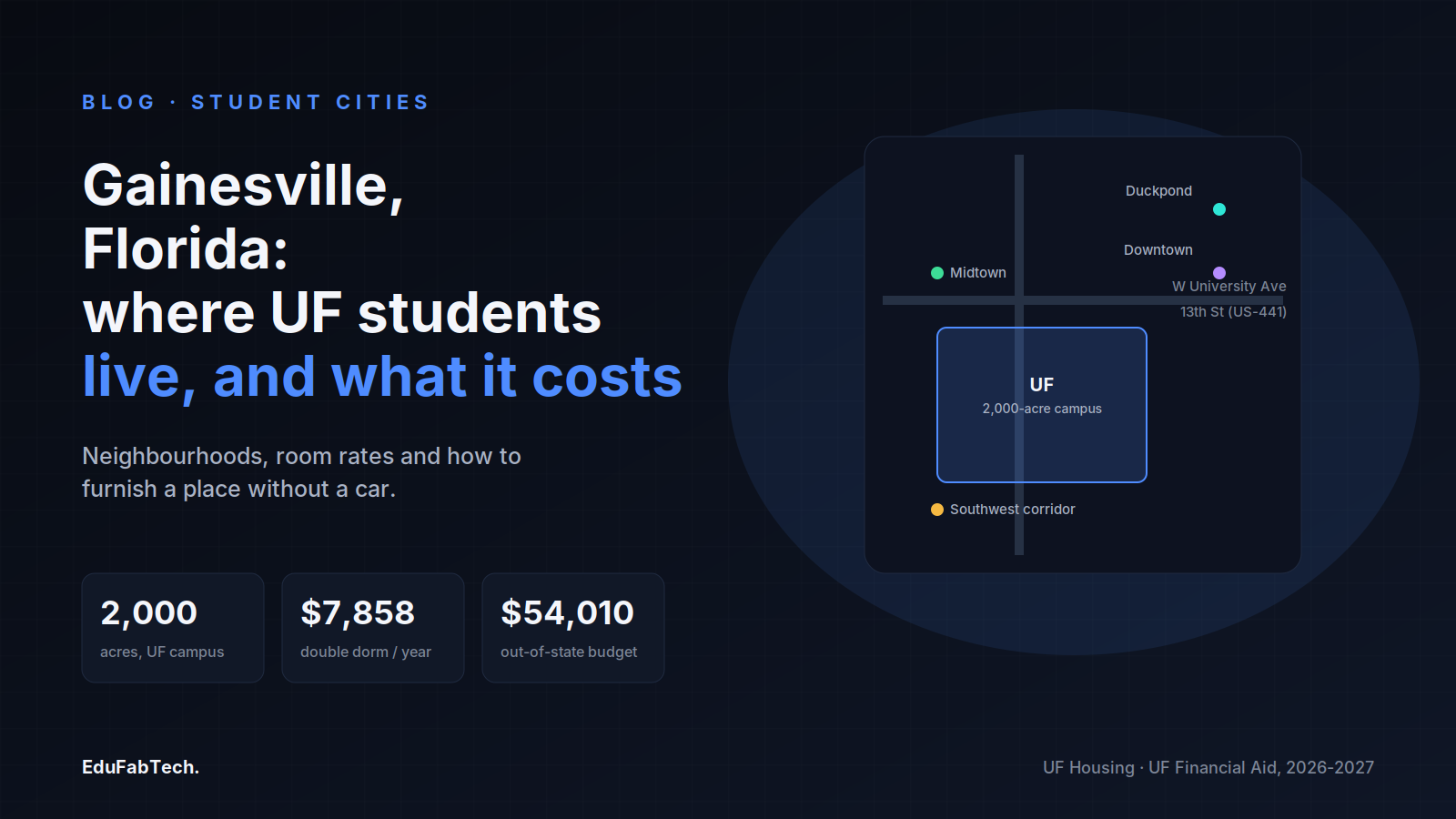
Gainesville sits in the flat, green middle of north-central Florida, roughly halfway between the Atlantic and the Gulf, and it is a city organised around a single institution. The University of Florida occupies about 2,000 acres on the city's west side, and its two great arteries — West University Avenue running east to west, and 13th Street (US 441) running north to south — meet at the campus's busy northeast corner. Alachua County grew up around the school; the street grid, the bus network and the rental market all bend toward it.
Studying here means living inside a subtropical climate. Summers are hot and humid with near-daily afternoon thunderstorms, the official Atlantic hurricane season runs June through November, and the terrain is flat enough that a bicycle is often faster than a car near campus. Just south of town, Paynes Prairie Preserve State Park spreads out as open wet savanna where wild bison and alligators live; on campus, Lake Alice has its own resident alligators. It is a genuinely green place, and that shapes the texture of student life as much as the lecture halls do.
What follows is a practical account for anyone deciding whether to come here to study, whether from elsewhere in Florida, elsewhere in the United States, or from abroad. Every cost and rule below is tied to the page that states it, because those pages change each year and you should check them against your own start date.
The University of Florida — and Santa Fe College
The University of Florida traces its origins to 1853 and is Florida's land-grant university, assembled from predecessor schools including the East Florida Seminary; it describes itself on its own site as the state's most comprehensive university, with more than 300 degree options across 16 academic colleges, and as the only U.S. university with six health-sciences colleges on one campus. Gatorade, the sports drink, was invented here in 1965 for the football team. The football stadium, Ben Hill Griffin Stadium — "the Swamp" — turns autumn Saturdays into citywide events that fill the roads and the bars.
Studying at UF means being part of a large public flagship whose two long semesters, fall and spring, set the rhythm of the whole city: move-in week, football season, finals and the spring exodus are all felt well beyond campus. Its agriculture, engineering, health and area-studies programmes draw students from across Florida and abroad, and a great deal of the city's part-time work, housing and nightlife exists to serve that population. If you are new, the practical landmarks matter more than the rankings — which bus reaches your college, which library stays open late, and when leases turn over.
Gainesville is not a one-college town in the strict sense. Santa Fe College, whose main Northwest Campus opened in 1972 on NW 83rd Street, grants associate and bachelor's degrees and is accredited by the Southern Association of Colleges and Schools Commission on Colleges; many students begin there and transfer to UF, and the two institutions share the city and its buses.
The neighbourhoods students choose
Where you live in Gainesville is mostly a question of how close to campus you want to be and how much noise you will tolerate for it.
Midtown and College Park sit immediately north and northwest of campus, across West University Avenue. This is the closest you can live and still walk to class in minutes; it is also the loudest, lined with bars along West University Avenue and dense with high-rise student apartments. Rents per bed are among the highest in the city, and football weekends are chaos. It suits undergraduates who want to be in the middle of everything.
The southwest corridor — along Archer Road, SW 34th Street and SW 20th Avenue — is where most of the large purpose-built student complexes stand. It wraps around UF Health and the medical and veterinary campuses and sits near Butler Plaza, one of the largest shopping districts in the region. You will usually rely on the bus here, but routes are frequent, per-bed rents are gentler than Midtown, and the trade is a ten-to-twenty-minute commute for more space.
Downtown, east of campus along East University Avenue, is the city's older civic heart: Bo Diddley Plaza, the Hippodrome State Theatre, and Depot Park. It draws students who want lofts and nightlife and who do not mind a bus ride or a longer walk to the main campus; Santa Fe College's downtown centre is here too.
Duckpond, just northeast of downtown, is a historic district of brick streets, live oaks and early-twentieth-century bungalows. It is quieter and more expensive to rent a whole house in, and it tends to attract graduate students, faculty and professionals rather than first-years. A bicycle reaches campus comfortably.
The Pleasant Street Historic District, northwest of downtown, is one of Gainesville's oldest historically Black neighbourhoods, with smaller older houses and an easy reach to downtown. Haile Plantation and the southwest suburbs around Tower Road are different again: a planned, leafy, car-oriented area well out from campus, built around Haile Village Center and its Saturday market, favoured by those — often graduate students or people with families — who want calm and space over a short commute.
Finding a room without losing your deposit
The on-campus route is run by the University of Florida's Housing and Residence Life office, whose residence halls range from traditional corridor-style rooms to suites and the Beaty Towers and Honors Village apartments. Off campus, the student rental year in Gainesville starts early: leases for the following August are often signed the previous autumn and winter, and the best-located places in Midtown and near the health campus go first. If you are arriving from abroad and cannot visit, that timing works against you, so start looking the moment you have an admission decision.
Rental scams in a student market like this one tend to follow a pattern. A "listing" appears cheaper than everything comparable, the person cannot meet you because they are conveniently out of town, and they ask you to send a deposit to "hold" the room before you have seen it. Do not send money by bank wire, gift card or cryptocurrency to hold anything — those payments cannot be reversed, and a real Gainesville landlord or management office will not ask for them. See the actual unit, in person or by a live video walk-through with someone who can show you the exact apartment number, before you pay. Read the lease for who pays for water, electricity and internet, and check whether a complex bills "by the bed" (each roommate on a separate contract) or by the unit, because that changes what happens if a roommate leaves. If you cannot visit, ask a current student or a UF office to look on your behalf rather than trusting photographs. EduFabTech lists rooms and places to stay in Gainesville, and a broader set of student listings across the city, which is a reasonable place to start comparing what is normal before you commit.
What a room and a term actually cost
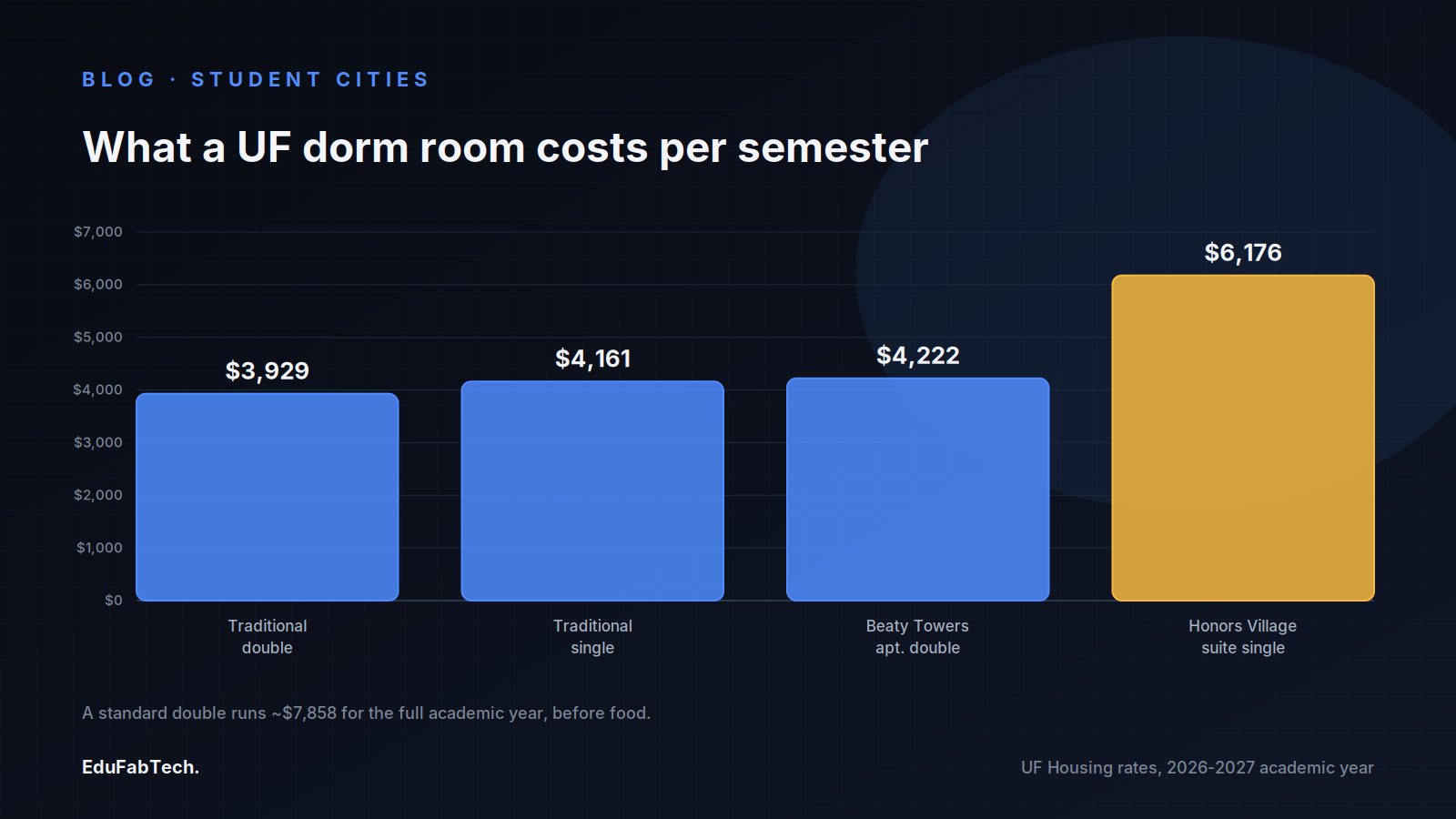
On-campus prices are published and dated, which makes them a useful anchor. For the 2026-2027 year, University of Florida Housing lists a traditional double room at most halls at $3,929 per semester and a traditional single at $4,161 per semester, with suite and apartment styles higher — a Beaty Towers apartment double at $4,222, and an Honors Village suite single at $6,176 per semester. Those are per-semester figures for fall and spring, so a standard double works out to roughly $7,858 for the academic year before food.
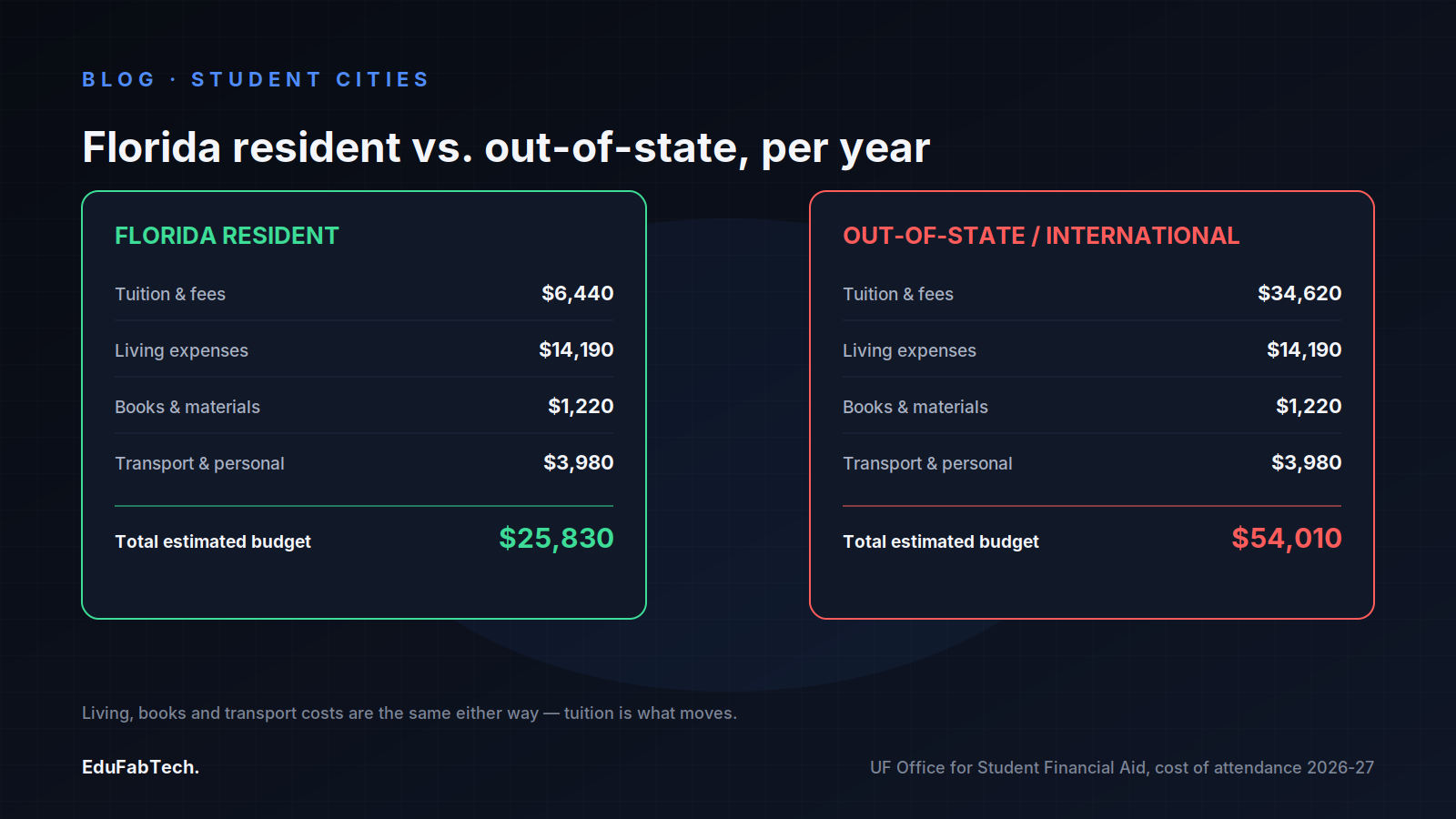
For the full picture, the University of Florida's Office for Student Financial Aid and Scholarships publishes a cost-of-attendance budget for 2026-27. It estimates living expenses at $14,190 and books and course materials at $1,220 for the year, with tuition and fees of $6,440 for Florida residents and $34,620 for out-of-state students. Once transportation and personal expenses are added in, the university puts the total estimated budget at $25,830 for an in-state undergraduate and $54,010 for an out-of-state one. International students pay the out-of-state rate. These are the university's own planning estimates, not a bill, but they are the most reliable dated numbers to budget against.
Furnishing a room for very little
Gainesville has an unusually strong reuse culture, partly because tens of thousands of students arrive and leave each year and leave furniture behind. The Repurpose Project, a non-profit creative-reuse centre, runs three stores: its art-and-materials shop at 1920 NE 23rd Avenue, Reuse Planet at 1540 NE Waldo Road for used furniture, appliances and household goods, and Renovator Reuse at 1814 NE 23rd Avenue for building materials, tools and hardware. For a bed frame, a desk or a lamp, these are cheaper and more interesting than any big-box store.
The city's markets are worth knowing too. The Haile Farmers Market runs Saturday mornings, roughly 8:30 to noon, at Haile Village Center in the southwest, and the Union Street Farmers Market sets up Wednesday evenings at Bo Diddley Plaza downtown — good for groceries and for getting a feel for the city rather than for furniture. For bulkier second-hand goods, the long-running Waldo Farmers and Flea Market, northeast of the city near the town of Waldo, runs on weekends. End-of-semester move-out, in late April and early December, is when the best free furniture appears on kerbs around Midtown and the southwest complexes. EduFabTech also collects second-hand furniture around Gainesville for the same purpose.
Working while you study
If you hold an F-1 student visa, the rules on work are specific and worth reading from the source rather than from hearsay. The University of Florida International Center states that F-1 students maintaining status may work part-time on campus while classes are in session, where "part-time" means up to 20 hours per work week across all on-campus positions, and that no separate authorisation is needed for this on-campus work. During official breaks — Thanksgiving, winter, spring and summer — students may work more than 20 hours on campus if they are returning the following term. Any off-campus work, paid or unpaid, requires consulting an International Student Advisor first. This is not legal advice; treat the International Center's page, and your own advisor, as the authority for your situation. Domestic students face no such cap, and on-campus jobs — dining, the libraries, labs, the recreation centre — are the usual starting point. EduFabTech lists part-time work around Gainesville.
Libraries and places to study
The George A. Smathers Libraries are UF's library system, and two of its buildings carry most of the studying. Library West, on the northwest side of campus, is the humanities and social-sciences library and the busiest; Marston Science Library, near the centre of campus, supports engineering, the sciences, agriculture and mathematics, and its ground-floor Collaboration Commons seats several hundred, with bookable group-study rooms. Both extend their hours heavily around finals, and Marston has historically offered overnight access during the week in term. Beyond campus, the Alachua County Library District's Headquarters Branch downtown is open to everyone and gives you a quiet, free alternative off university land. EduFabTech also indexes study spaces and desks in Gainesville for when the libraries fill up.
Getting around Gainesville
The single best thing about student transport here is the bus. The Regional Transit System (RTS) is the city operator, and the UF Transportation and Parking Services page states that the university contracts annually with RTS to provide fare-free transportation for current students, faculty and staff. In practice you show your GatorOne ID and ride at no extra cost; RTS routes fan out from campus through the southwest complexes, Midtown and downtown. (The city separately runs a fare-free programme for riders 65 and older and 18 and younger, which, the City of Gainesville notes, requires its own RTS ID card — that is a different scheme from the UF student benefit.)
Gainesville is also a cycling city. The land is flat, there are marked bike routes and paths, and for the dense ring of neighbourhoods around campus a bicycle usually beats both the bus and a car in traffic and parking hassle. If you bring a car, student parking permits on campus are limited and the garages fill, so many students who live within a mile or two simply do not drive to class. The Gainesville Regional Airport handles regional flights; for longer trips most students connect through Orlando or Jacksonville.
What is good, what is hard — and a first-weeks checklist
The good is real. For a mid-sized city, Gainesville gives students an unusual amount: free buses, a strong research university, a walkable and bikeable core, cheap reuse culture, live music and theatre downtown, and nature — prairie, springs, lakes — within minutes. The cost of living is lower than in Florida's big coastal cities, and the city's whole rhythm is built around the academic calendar, so almost everything is set up for students.
The hard parts are also real, and worth naming before you arrive. The housing market moves early and the closest neighbourhoods are expensive and noisy; if you wait until summer to look, you will have fewer and worse options. The summer heat and humidity are heavy, the afternoon storms are frequent, and hurricane season can disrupt a term. On football Saturdays the city's roads and bars are overwhelmed. And Gainesville is a relatively isolated inland city — there is no large metropolis next door, so a car or a willingness to take long bus and coach trips matters for getting out of town. As with any large student population, pay attention to where you live at night and travel with the free late buses or in groups.
A short checklist for the first weeks:
- Get your GatorOne ID early — it is your bus pass, library card and building key in one.
- Never pay a deposit before you have seen the exact unit, and never by wire, gift card or crypto.
- Download an RTS tracking app and learn the one or two routes between your room and campus.
- If you are on an F-1 visa, read the International Center's employment page and meet an advisor before accepting any work.
- Furnish from Reuse Planet and the end-of-semester kerb piles before buying anything new.
- Find your study building — Library West or Marston — in the first week, before the finals crowds teach you the hard way.
- Keep the listings near the University of Florida handy for rooms, work and settling in.
Gainesville rewards students who plan the dull parts early — the room, the bus route, the budget — and then let the rest of the city, which is genuinely easy to live in, take care of itself.
A quick question for readers
Do you work part-time while you study?
Many students work to pay the bills. See how common it is — and how many hours people really do.
Pick an answer, create a free account in a minute, and your vote counts. Already a member? Sign in
Source: University of Florida
Sources (5)
- University of Florida. About UF. University of Florida, 2026. ufl.edu ↗ · checked 6 Oct 2026
- University of Florida Housing and Residence Life. 2026-2027 Residence Hall Rental Rates. University of Florida, 2026. housing.ufl.edu ↗ · checked 6 Oct 2026
- University of Florida Office for Student Financial Aid and Scholarships. Undergraduate Cost of Attendance 2026-27. University of Florida, 2026. sfa.ufl.edu ↗ · checked 6 Oct 2026
- University of Florida International Center. Employment or Training for F-1 Students. University of Florida, 2026. internationalcenter.ufl.edu ↗ · checked 6 Oct 2026
- The Repurpose Project. Creative reuse centre and stores. The Repurpose Project, 2026. repurposeproject.org ↗ · checked 6 Oct 2026