Studying in Gaziantep: universities, housing and student life
A practical, sourced guide to the universities, the neighbourhoods students actually live in, finding a room safely, markets, study spaces, transport and the honest costs of student life in Gaziantep.
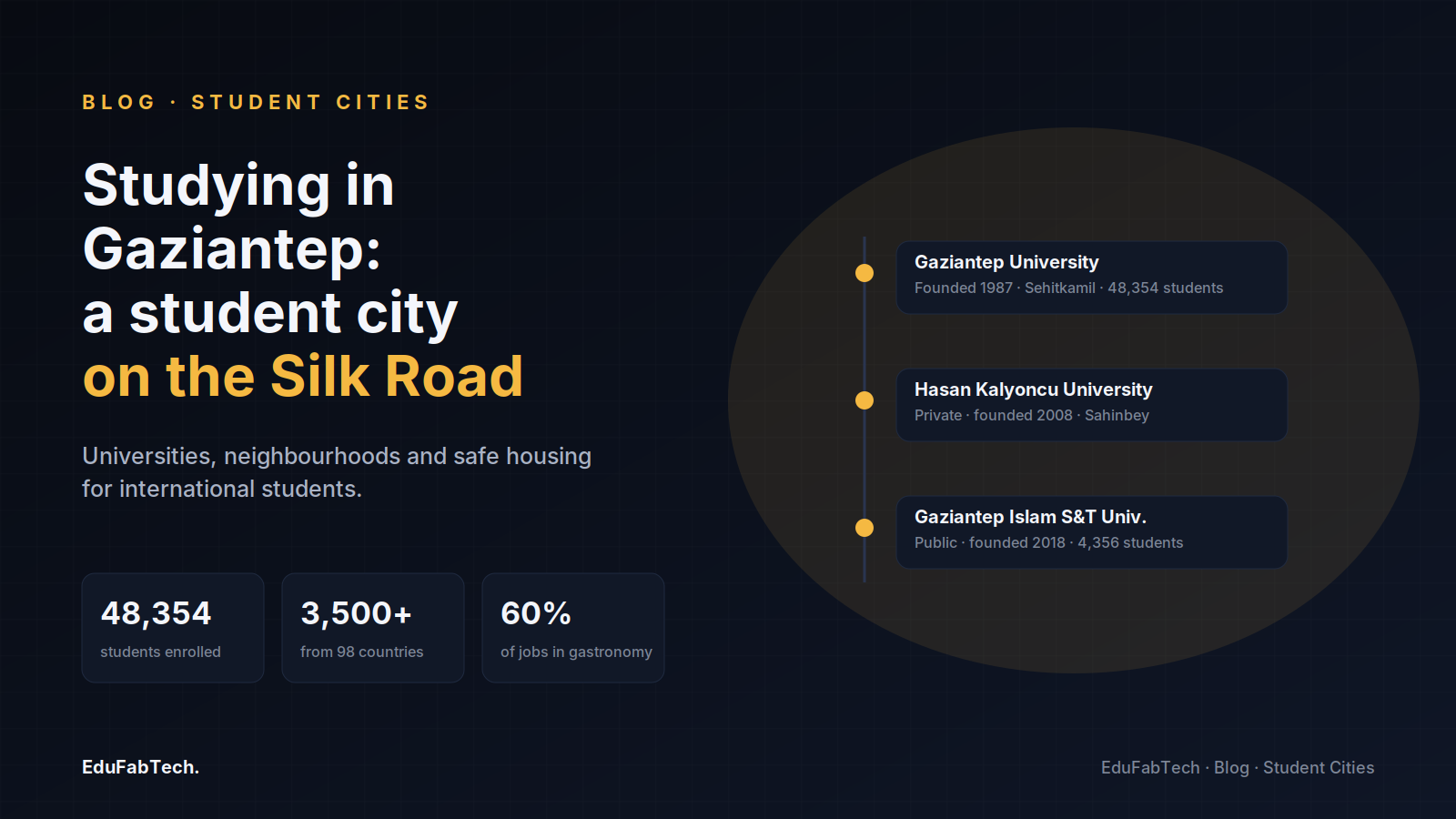
Gaziantep sits in the southeast of Turkey, on the plains between the Taurus foothills and the Syrian border, roughly an hour's drive from Aleppo and a long way from the country's western coast. It is one of the largest cities in the region and one of the oldest continuously inhabited places anywhere: a trading town on the old Silk Road that has spent millennia moving pistachios, copper, textiles and food. In 2015 it joined UNESCO's Creative Cities Network as a City of Gastronomy — a formal recognition of a food culture that, according to its UNESCO City of Gastronomy profile, employs some 60% of the active local population and accounts for about 49% of the city's enterprises.
For a student, that mix matters more than it sounds. Gaziantep is a working industrial city, not a resort or a capital, and it is noticeably cheaper to live in than Istanbul, Ankara or İzmir. It has a very large public university, two younger institutions — one private, one public — and a big, visible international-student community, drawn partly by instruction available in more than one language. If you want a place where your money stretches, where the food is extraordinary and where campus life is embedded in a real regional economy rather than a tourist bubble, it repays a serious look. You can browse what current students are posting across the city on EduFabTech's Gaziantep listings.
It is also a city with a distinct character. Summers are long, dry and genuinely hot; winters are short but can turn cold, with occasional snow. Life is organised around neighbourhoods, tea, and long meals, and the pace is more conservative than in coastal Turkey without being unwelcoming — hospitality here is close to a civic identity. The old town, with its stone houses and covered bazaars, sits a short ride from wide, planned new districts full of apartment towers. Deciding where you fit between those two Gazianteps is most of the housing question.
The universities
Gaziantep University is the anchor. Founded in 1987, its main campus runs along Üniversite Bulvarı in the Şehitkamil district on the northern side of the city, a large green campus with faculties spanning engineering, medicine and dentistry, the sciences, law, economics, education and a Turkish music conservatory, plus satellite campuses in surrounding towns. It is a big institution by any measure: its profile on the national study-abroad portal (accessed September 2026) records 48,354 students and around 3,500 international students from 98 countries, with teaching offered in Turkish, English and Arabic depending on the programme. Its teaching hospital, long known by the Şahinbey name, is one of the region's main referral centres, which makes the health faculties a particular draw.
Hasan Kalyoncu University is the city's established private ("foundation") university. It opened in 2008 as Gazikent University and took its current name in 2012, and its campus lies out along the airport road in the Şahinbey district (Şahinbey İlçesi), about eight kilometres from the centre. It is a compact, modern campus known for engineering and architecture, law, health sciences, and communication, and it markets itself on small classes and international partnerships. Because it is private, tuition applies — check the current fees and any scholarships directly with the university before you count on a place.
Gaziantep Islam Science and Technology University is the newcomer and a public institution. It was established in 2018 on the Şahinbey campus that had belonged to the former Zirve University, and it has grown quickly: the national study-abroad portal's profile (accessed September 2026) lists 4,356 students across eight faculties, including medicine, dentistry, engineering and natural sciences, law, and theology. As a young, thematically-focused university it is still building its reputation, but it has full campus facilities and a growing research profile.
Other universities in Gaziantep
The city has one more institution worth naming. SANKO University, a private foundation university in Şehitkâmil, was established in 2013 as a thematic university focused on medicine and health sciences, backed by a long-standing local industrial foundation. For completeness: Zirve University, once a private university in the city, was closed in 2016 and no longer exists — its campus is now used by Gaziantep Islam Science and Technology University, so you may still see the old name attached to that site in older listings and maps.
Where students actually live
Gaziantep is a big, spread-out city, and the district you choose decides your rent, your commute and your evenings. A few neighbourhoods do most of the student housing.
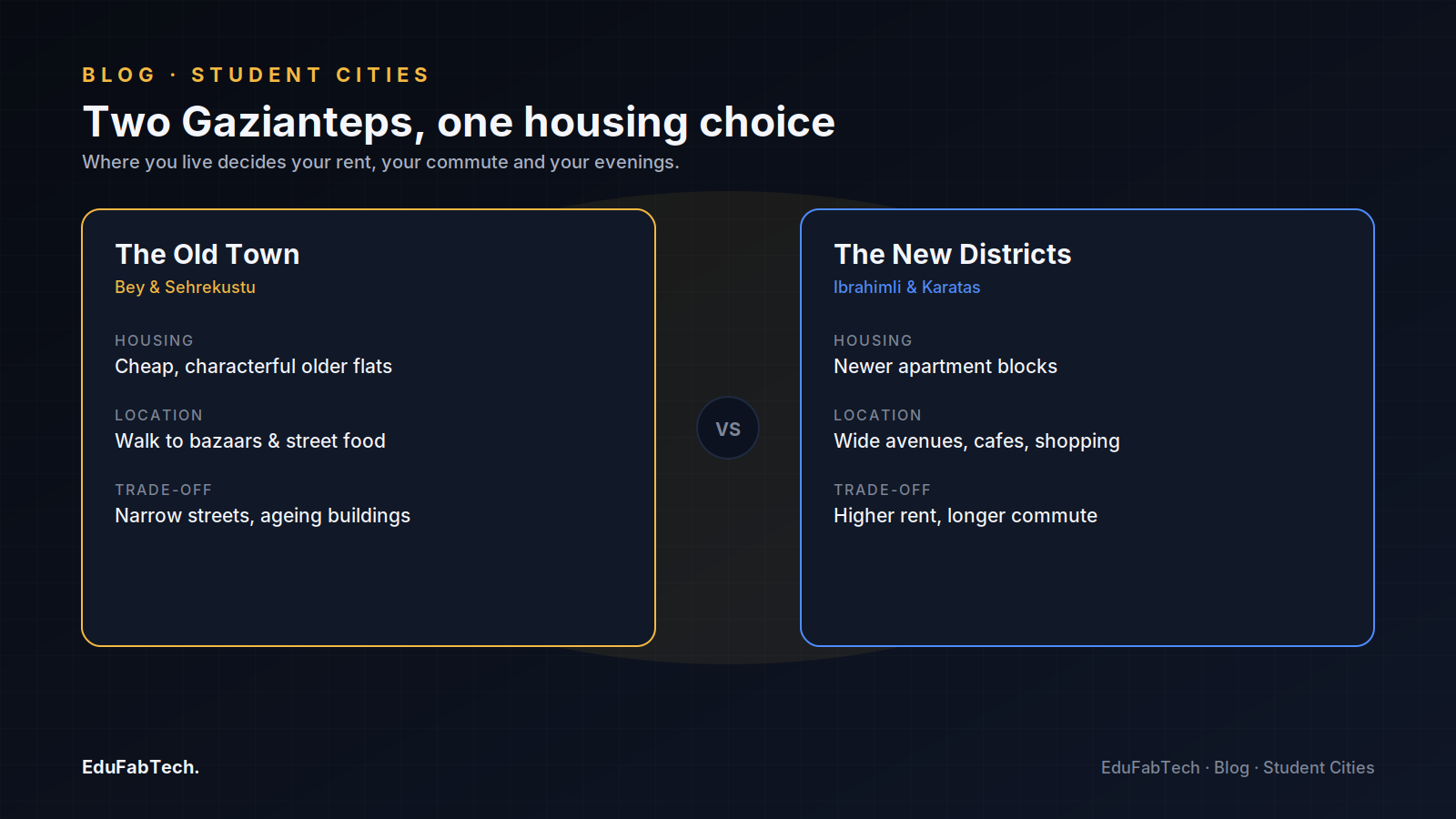
Emek and Değirmiçem (Şehitkamil) sit closest to Gaziantep University's main campus. These are established, walkable areas with older mid-rise flats, cheap eateries, bookshops and photocopy shops geared to students — the classic "next to the faculty gates" choice, and popular for exactly that reason. İbrahimli (Şehitkamil) is the modern, planned face of the city: wide roads, newer apartment blocks, cafés and shopping, middle-class and correspondingly a little pricier, but well connected and comfortable. Batıkent, nearby, has a similar newer-build character.
Karataş (Şahinbey) is one of the largest and most planned residential districts, with wide avenues, mass-housing estates and good transport links; rents tend to be gentler than in the fashionable Şehitkamil pockets, at the cost of a longer trip to the older campuses. Yeşilkent (Şahinbey), further out along the airport road, is the natural base for Hasan Kalyoncu University students — quieter and newer, but a real commute if your classes or social life are downtown. Around Beştepe (Şahinbey) you are close to the Gaziantep Islam Science and Technology University campus. Finally, the old city around Bey and Şehreküstü offers cheaper, characterful older flats within walking distance of the bazaars and street food, if you can live with narrow streets, crowds and ageing buildings. To compare specific rooms near the biggest campus, EduFabTech keeps listings near Gaziantep University.
Finding a room without getting burned
Students here generally choose between three kinds of housing: a bed in a dormitory (the public and private dormitory systems, plus university-run halls, tend to be the cheapest option and fill early); a room in a shared flat with other students; or a small private flat, often a one-plus-one, taken alone or with a friend. Shared flats are the middle path and the easiest to leave. Whichever you pick, the practical advice is the same: start looking early. Demand peaks sharply in the weeks around the start of the autumn term, and the best-value rooms near campus go first, so begin your search a month or two ahead if you can and browse rooms and shared flats in Gaziantep before you arrive.
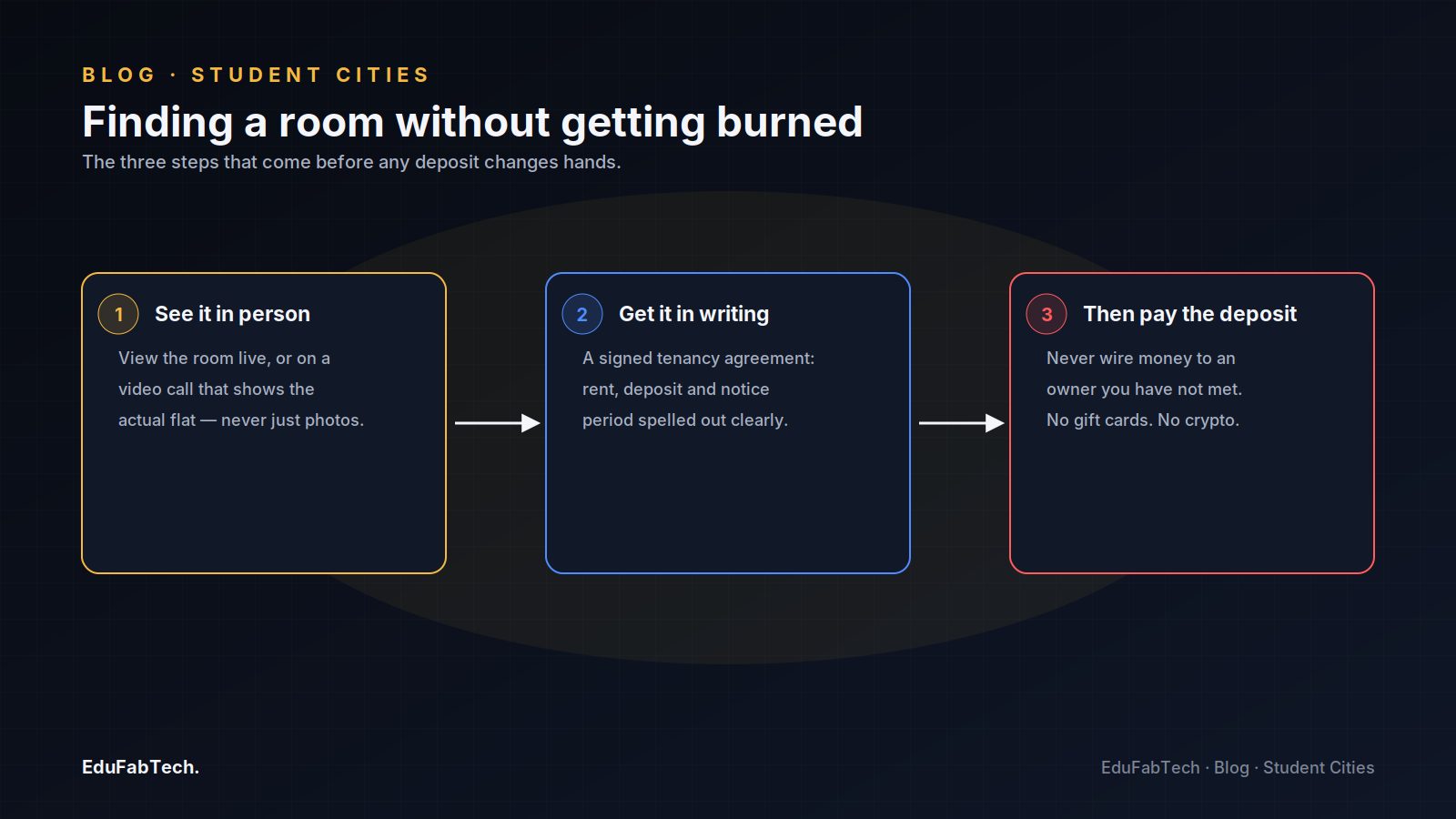
Before you pay anything, check the concrete things. See the actual room, not just photos. Confirm what the rent includes and what it does not — heating and hot water in particular, since winters bill you for them. Ask about the building's water, damp and how the flat is heated. Get a written tenancy agreement with the rent, the deposit and the notice period spelled out, and make sure the person signing is genuinely the owner or an authorised agent. Photograph the meters and any existing damage on the day you move in.
On scams, be blunt with yourself. The single most common rental fraud is a listing for a room that the "landlord" cannot show you in person because they are conveniently abroad, followed by a request to wire a deposit to "hold" it. Never do this. See the place in person, or at the very least on a live video call where the person walks you through the actual flat, before you part with money — and never send a deposit by bank transfer to a stranger, and never by gift card, voucher or cryptocurrency, which are the hallmarks of a scam and cannot be recovered. A price far below everything else in the neighbourhood is a warning sign, not a bargain. Pay a deposit only once you have a signed agreement and have met the owner.
Furnishing a room cheaply
Gaziantep is an unusually good city for kitting out an empty room without spending much, because it is a city of markets and makers. The old town's covered bazaars are the heart of it: the Bakırcılar Çarşısı, the centuries-old coppersmiths' bazaar, still rings with hammers and sells handmade trays, pots and the tinned copper coffee pots that end up in every student kitchen, while the surrounding Zincirli Bedesten and spice and dried-fruit markets are where you buy pistachios, spices, olives and cheese far more cheaply than in any supermarket. For the practical business of furnishing — a desk, a heater, a small fridge, a kettle — look to the city's second-hand and flea markets (the local bit pazarı and used-goods dealers), where price is expected to be negotiated.
The fastest route, though, is often other students. At the end of each term, people leaving the city give away or sell off furniture, appliances and kitchenware cheaply, and picking these up secondhand is both frugal and less wasteful. EduFabTech runs a local board for exactly this — second-hand goods across the city, from desks and heaters to kitchenware. Furnish gradually, buy the heater and the bedding first, and let the rest accumulate.
Libraries and study spaces
Term-time study space is real and mostly free. Gaziantep University's central library, run by its Library and Documentation Department, advertises itself as open around the clock and provides reading rooms, subject collections, a thesis archive and remote access to electronic databases for enrolled students — the natural default if you are on that campus. The private and newer universities run their own libraries and study centres for their students. Beyond the campuses, the city and its district municipalities operate public libraries and youth study halls, and the newer shopping districts are full of the study-friendly cafés that have become the informal reading rooms of Turkish student life. If you want a quiet desk near where you live rather than near your faculty, EduFabTech lists study spaces and desks around Gaziantep.
Money: transport, costs and part-time work
Getting around is straightforward and cheap. The backbone is the city's tram network, which has grown to three lines, complemented since 2022 by the Gaziray commuter-rail line that threads the centre partly in a tunnel, plus an extensive municipal bus network. Fares are paid with the city's rechargeable transit card, and the metropolitan transit operator offers discounted student fares to holders of a valid student card — check the current prices on the operator's own fare page before you buy, since they are revised regularly. Many students near their faculty simply walk, which is free and often faster than fighting traffic.
On overall costs, Gaziantep is one of the more affordable large Turkish cities for a student, with rent, eating out and transport all lower than in the western metropolises — but Turkey's rents and prices have moved a great deal in recent years, so any figure you read online dates quickly. Rather than trust a stale number, price your own basket when you arrive: a month's rent for your target neighbourhood, a monthly transit fare, a week of groceries, and a couple of meals out. The one genuine luxury that is cheap here is the food.
Part-time work is possible but rule-bound for international students, and the rules are national, not local. Broadly, as summarised by university international offices such as the Middle East Technical University International Students Office, students on associate or undergraduate programmes may work only after completing their first year and only part-time, in jobs off campus, and the employer — not the student — applies for the permit, which is tied to that specific job; graduate students have more latitude. Working without the correct permit can put your residence status at risk. Because these rules change and the details matter, do not rely on this paragraph or on second-hand advice: confirm the current position against the national labour authority's own guidance on the official work-permit portal before you take any job. This is not legal advice. When you are ready to look, EduFabTech collects student jobs and part-time work in Gaziantep.
The honest trade-offs
What is good about Gaziantep for a student is easy to state: it is affordable, the food culture is world-class and cheap, the public university is large and internationally connected, and the city is a functioning regional economy with real jobs and real markets rather than a student monoculture. Hospitality is genuine, and a newcomer is folded into neighbourhood life quickly.
What is hard should be said just as plainly. The summers are punishingly hot, which shapes when you can comfortably do anything outdoors. The city is sprawling, so a cheap room far out can cost you an hour a day on the tram and bus. Housing near the popular campuses is competitive at term-start, and older flats can be cold and damp in winter with heating bills to match. It is a more conservative city than coastal Turkey, which suits some students and not others. And it is close to the border, in a region that has absorbed a great deal over the past decade — most students find daily life calm and ordinary, but it is honest to name the context rather than pretend the map does not exist. Weigh these against the price and the food, and for many people the balance tips in Gaziantep's favour.
A checklist for your first weeks
- Confirm your enrolment and, if you are an international student, your residence-permit steps and deadlines through your university's international office.
- Start the room search early; view any place in person or on live video, and pay a deposit only after a signed agreement — never by transfer, gift card or crypto to someone you have not met.
- Get the city transit card and register the discounted student fare once your student status is verified.
- On move-in day, photograph the meters and any existing damage, and confirm what the rent includes.
- Register for your campus library and Wi-Fi; scout one quiet study spot near home and one near your faculty.
- Furnish gradually from second-hand and free boards and the flea market; buy heating and bedding first.
- Do one loop of the old-town bazaars in your first week — for the pistachios, the copper coffee pot, and to learn the city on foot.
- If you plan to work, read the national work-permit rules first and remember the first-year restriction for undergraduates.
- Study in Türkiye. Gaziantep University — university profile. Republic of Türkiye national study-abroad portal, 2026. link
- Hasan Kalyoncu University. Hasan Kalyoncu University — homepage and profile. Hasan Kalyoncu University, 2026. link
- Study in Türkiye. Gaziantep Islam Science and Technology University — university profile. Republic of Türkiye national study-abroad portal, 2026. link
- UNESCO. Gaziantep — Creative Cities Network (Gastronomy). United Nations Educational, Scientific and Cultural Organization, 2015. link
- Railway Gazette International. Gaziantep tram Line 3 contract announced. Railway Gazette International, 2013. link
- GaziantepKart. Public transport fares, including student fares. Gaziantep Metropolitan Municipality transit card, 2026. link
- Middle East Technical University, International Students Office. Work Permits for international students. Middle East Technical University, 2026. link
- Uluslararası İşgücü Genel Müdürlüğü. International Labour Force General Directorate — official portal. Republic of Türkiye Ministry of Labour and Social Security, 2026. link
- Gaziantep University. Library and Documentation Department. Gaziantep University, 2026. link