Studying in Georgetown, Kentucky: universities, housing and student life
A practical guide to being a student in Georgetown, Kentucky — the college in town, the universities a short drive away, where to live, what it costs, and why getting around usually means a car.
A college town that is also a car town
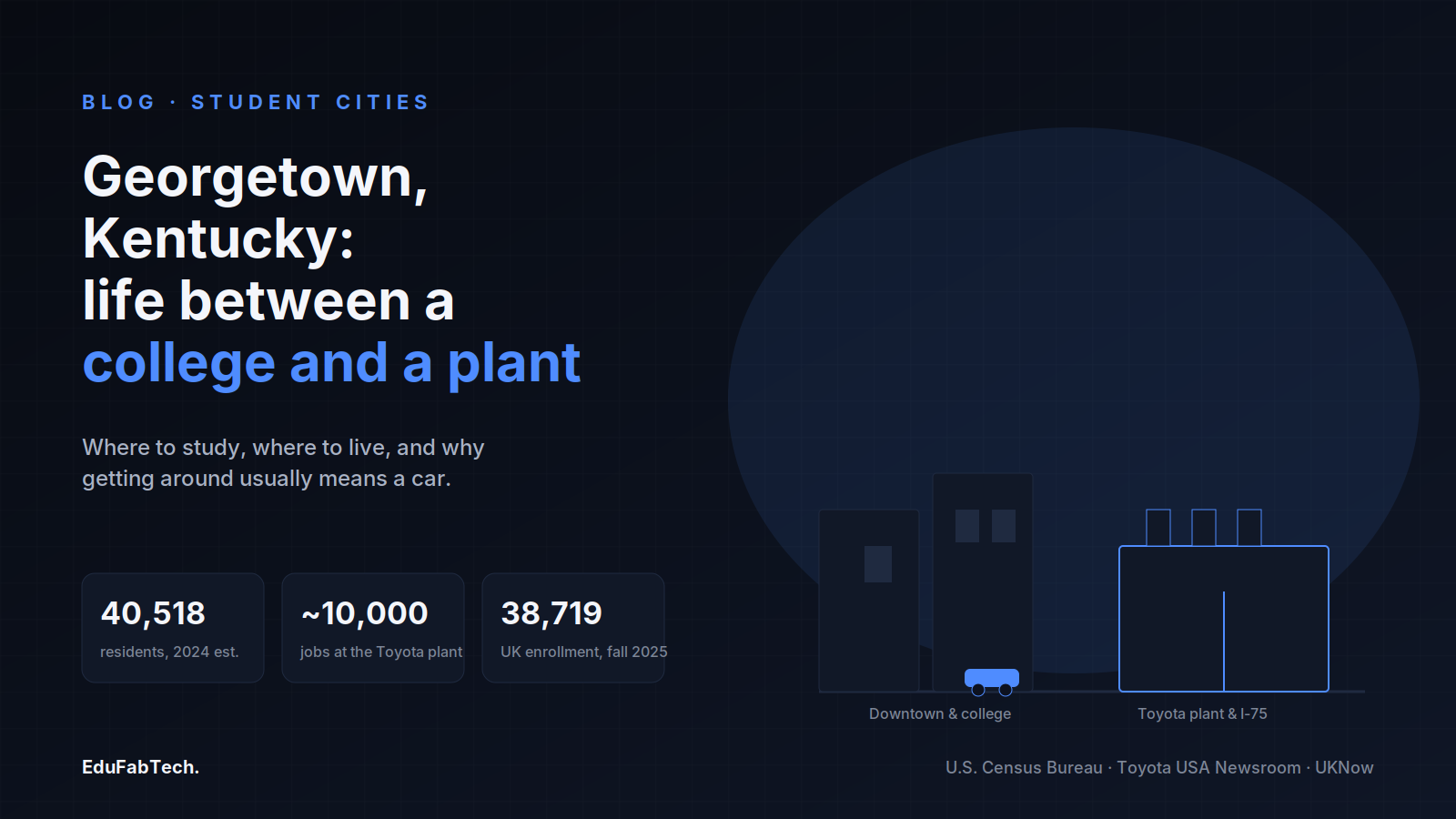
Georgetown is the seat of Scott County, in the Bluegrass region of central Kentucky, just north of Lexington. It is a genuinely small city — the U.S. Census Bureau's QuickFacts puts its population at 40,518 as of the 1 July 2024 estimate (census.gov) — with a compact historic downtown of brick storefronts around Main and Broadway, and subdivisions spreading out from there. What sets Georgetown apart from most towns its size is the plant on its edge: Toyota Motor Manufacturing Kentucky built its first Camry here in 1988 and now describes the Georgetown site as the company's largest plant in the world, with full-time employment of around 10,000 people (Toyota USA Newsroom).
That matters to a student for two reasons. The plant and its suppliers keep the local economy busy and the town growing, which supports part-time and seasonal jobs but also keeps pressure on rents and traffic on the I-75 corridor. And the character of the place is split: a quiet, walkable old centre and a Baptist-founded college on one side, a working industrial economy and big-box retail along the highway on the other. A student here lives between the two.
Georgetown also had a brush with the national spotlight that older residents still mention. From 1997 to 2011 Georgetown College hosted the Cincinnati Bengals' summer training camp, before the NFL team moved camp back to Cincinnati in 2012 (NFL). The practice fields are still part of campus life; the crowds are not.
The college in town, and the universities down the road
The institution actually in Georgetown is Georgetown College, a private Christian liberal-arts college on East College Street. By its own history, it was chartered in 1829 as the first Baptist college west of the Alleghenies, and it formally separated from the Kentucky Baptist Convention in 2005 to protect its academic independence (Georgetown College). It is small and residential, with teaching mostly in small classes and athletics at the NAIA level in the Mid-South Conference — the kind of place where the campus and the town overlap rather than compete.
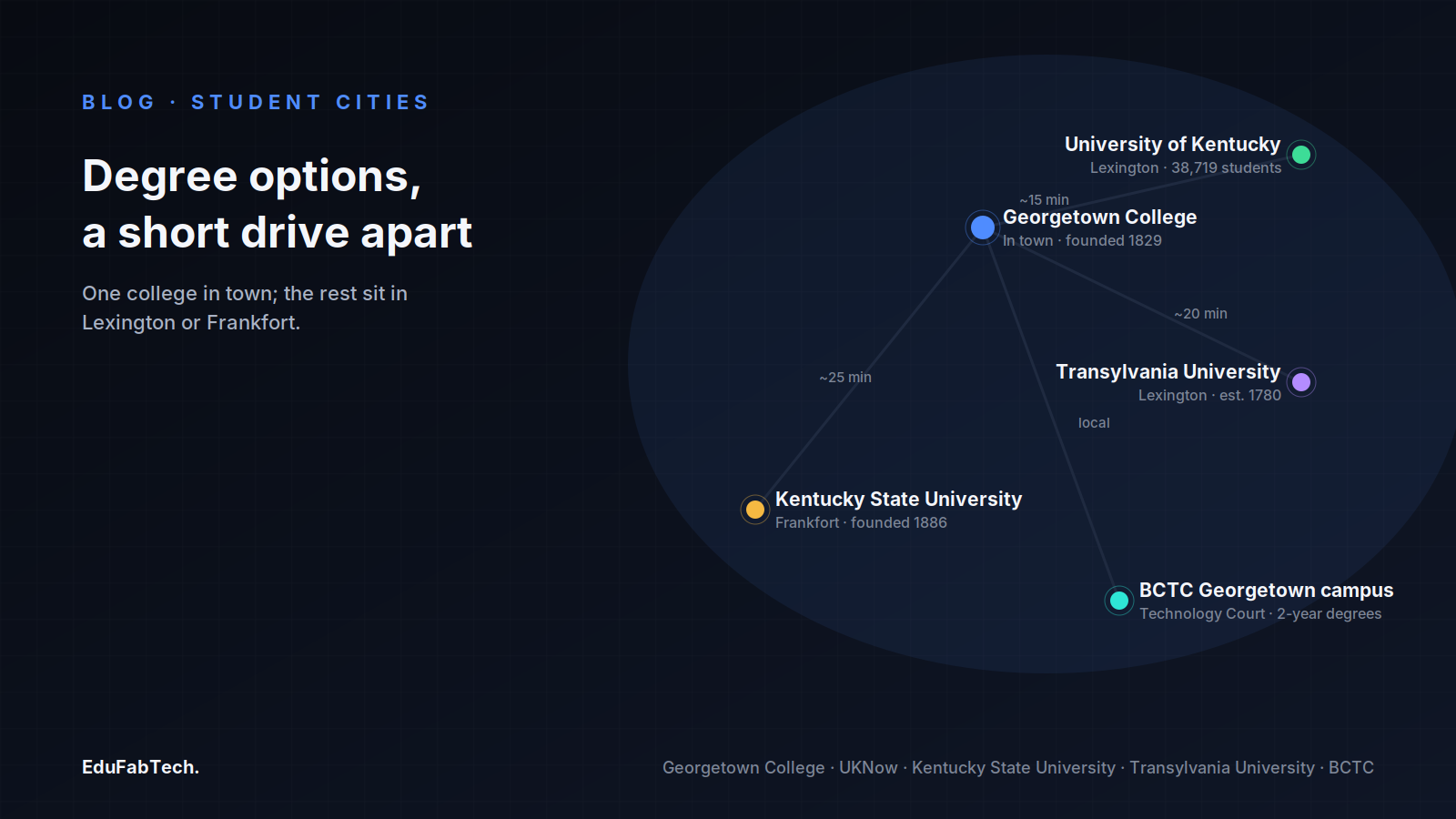
Most of the degree choices a Georgetown student will weigh, though, sit a short drive south in Lexington or west in Frankfort. The biggest is the University of Kentucky, the state's public land-grant flagship, established in 1865. The University of Kentucky reported a preliminary fall 2025 enrollment of 38,719 students, with a first-year class of 7,012 (UKNow); its colleges include the Gatton College of Business and Economics and the William T. Young Library on the Lexington campus. For a narrow, professional track, the Patterson School of Diplomacy and International Commerce — a graduate school within the University of Kentucky — runs a selective master's degree in diplomacy and international commerce, built around three semesters of coursework for a small cohort each year (Patterson School).
Two more institutions round out the choices. Kentucky State University, about 25 minutes west in Frankfort, is Kentucky's public historically Black land-grant university, founded in 1886, on a campus that includes an agricultural research farm (Kentucky State University). And Transylvania University, a private liberal-arts college in downtown Lexington, describes itself as established in 1780 and the oldest university west of the Allegheny Mountains (Transylvania University). For technical and two-year paths close to home, Bluegrass Community and Technical College runs a Georgetown–Scott County Campus on Technology Court, with two-year associate degrees and a strong advanced-manufacturing focus — including a new additive (3D-printing) technology programme launched in 2025 and tied to the region's industrial base (BCTC).
You can browse what EduFabTech has across the city on the Georgetown listings page, and there is a separate feed of listings near the University of Kentucky in Lexington for anyone planning to commute.
Where a room comes from here
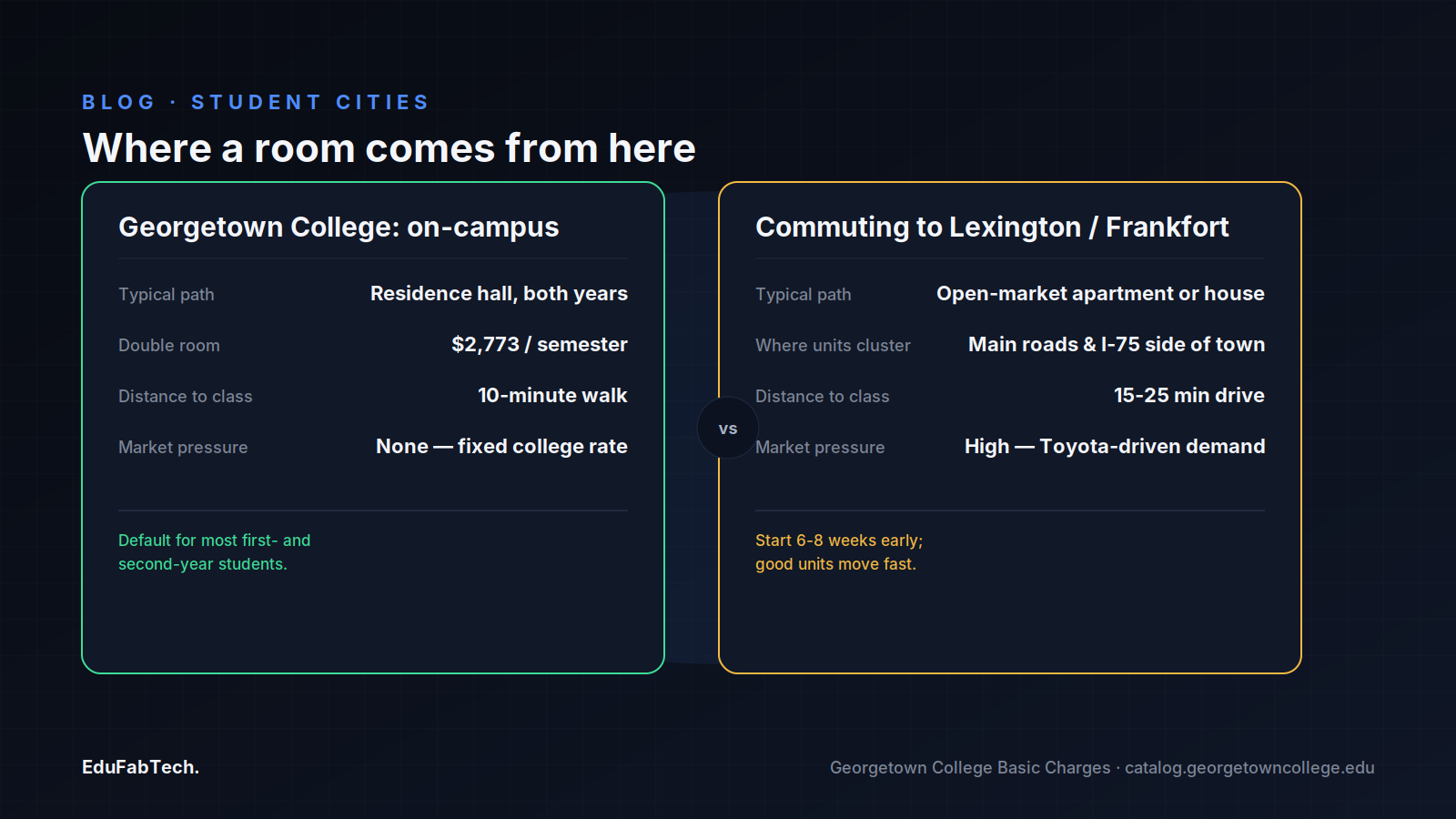
Housing in Georgetown divides sharply by which institution you attend. If you study at Georgetown College, the default is on-campus: its residence halls, apartments and the East Campus units are the normal first- and second-year housing, and the college publishes room charges on its Basic Charges page — for example, a dual-occupancy residence-hall room is listed at $2,773 per semester (catalog.georgetowncollege.edu). Living in means you are inside a ten-minute walk of class, the library and downtown, which in a town with little transit is worth more than it sounds.
If you commute to Lexington or Frankfort, you are renting on the open market, and Georgetown behaves like a growing exurb rather than a student quarter. There is no dense off-campus student district; apartment complexes cluster along the main roads and the I-75 side of town, with older houses and smaller units nearer downtown. The town's growth is the catch — new arrivals for the plant and its suppliers compete for the same rentals, so good units move quickly and genuine bargains are rare close to the centre.
Start looking early — six to eight weeks before your term — and protect yourself the way you would anywhere, but with Georgetown's own pattern in mind. Rental scams here tend to appear as houses or apartments advertised online at a price that undercuts everything else, posted by someone who says they have moved away for work (easy to make plausible in a town people relocate to for Toyota). See the actual unit in person, or have someone you trust see it, before paying anything. A normal arrangement is a security deposit plus first month's rent, paid once you have a signed lease and have met the landlord or a named property manager. No legitimate landlord in Georgetown needs a deposit wired by bank transfer, loaded onto a gift card, or sent in cryptocurrency to "hold" a room — every one of those is a scam signal, because none can be reversed. EduFabTech's rooms listings for Georgetown are a place to start, not a substitute for seeing the place.
Furnishing a room without buying new
For a one- or two-year stay, furnishing second-hand is the sane option. Goodwill has a store on Lexington Road, useful for clothes, kitchenware and household basics, and the Georgetown Peddlers Mall is a large indoor floor of individual vendor booths where you can turn up a cheap desk, a lamp or the odd bookshelf. Downtown has a scatter of resale and antique shops along and off Main Street if you want to hunt. For produce and a sense of the town's weekend rhythm, the Scott County Farmers' Market sets up Saturday mornings in the warm months at the corner of North Broadway and Washington Street (Scott County Farmers' Market).
Online, check EduFabTech's local feed of second-hand things in Georgetown before you buy anything new — a departing student's desk and chair beats a flat-pack set every time, and cuts what you have to haul out at the end of the year.
Working while you study
Term-time work is realistic here because the local economy is busy — retail along the highway, food service, the college itself, and the broader manufacturing cluster. The rules depend on who you are. Domestic students can work subject only to ordinary employment law and their own schedules.
International students on an F-1 visa face specific limits, and the authoritative source is the U.S. government's Study in the States, run by the Department of Homeland Security. It states that an F-1 student in on-campus employment "may not work more than 20 hours per week when school is in session," and that you apply through your Designated School Official (DSO), who issues a letter of approval if you qualify (Study in the States). Off-campus work, including practical training, has its own rules and needs authorisation before you start — so treat your international-student office as the first stop, not an afterthought, and do not rely on second-hand advice. This is a pointer to the official source, not legal advice. Local openings, including on-campus roles, show up on the Georgetown jobs feed.
Libraries and places to study
On the Georgetown College campus, the Anna Ashcraft Ensor Learning Resource Center is the main study building — it houses the college library along with group study rooms, computers and a café, and its academic resources are described on the college catalog (catalog.georgetowncollege.edu). For a change of scene, the Scott County Public Library downtown is open to residents and a quieter alternative for long reading days. Commuters at the University of Kentucky have the William T. Young Library in Lexington, which is one of the larger academic libraries in the region. If you want somewhere off-campus and close to home, EduFabTech keeps a running list of study spaces and desks in Georgetown.
Getting around a town that assumes a car
This is the honest weak point of student life in Georgetown. The city does not have its own fixed-route public transit, and Lextran, Lexington's bus operator, runs inside Lexington rather than out to Georgetown. A direct Georgetown–Lexington regional bus is on the way but not yet running: Bluegrass RIDE, operated by the Blue Grass Community Action Partnership, lists a Georgetown–Lexington route as "Coming Soon," while its only live regional line currently connects Danville, Nicholasville and Lexington (Bluegrass RIDE).
In practice, that means a car is close to essential if you commute to Lexington or Frankfort, and very useful even for a Georgetown College student who wants to leave campus. The town is flat and compact enough that living on or near campus lets you walk to class, downtown and the grocery run; cycling is workable in good weather but there is no dedicated student cycling network. If you cannot drive, choosing housing within walking distance of your campus is not a preference here — it is the plan.
What it costs
Two anchored figures are worth keeping in mind. For off-campus renting, the U.S. Census Bureau's QuickFacts reports a median gross rent in Georgetown of $1,255 for the 2020–2024 period (census.gov) — a townwide figure covering all housing, so student rooms and shared units will sit on either side of it, and current asking rents in a growing market run higher than a five-year average. For on-campus living at Georgetown College, the $2,773 per-semester dual-occupancy residence-hall charge on the college's Basic Charges page (catalog.georgetowncollege.edu) is the cleanest dated comparison; add a meal plan and the per-term cost rises accordingly.
Beyond rent, budget for the thing transit does not cover: a car, or the cost of lifts and occasional taxis if you go without one. Groceries and everyday goods are cheaper in Georgetown than in a big city, and buying furniture and household basics second-hand — through the shops and local feeds above — is the single easiest way to keep first-term costs down.
The honest trade-offs, and a first-weeks checklist
What is good about Georgetown for a student: it is small, safe-feeling and walkable at its core; on-campus housing at Georgetown College puts everything within a short walk; the cost of living is moderate by national standards; and three universities plus a technical college sit within a half-hour, so your options are wider than the town's size suggests. The Toyota-anchored economy means term-time jobs exist in a way they do not in many college towns.
What is hard: the lack of city transit makes a car close to mandatory if you study in Lexington or Frankfort, and that is a real expense; there is no concentrated off-campus student neighbourhood, so social life outside Georgetown College can feel dispersed; the growing population keeps rents firm and the best rentals scarce; and Kentucky's weather gives you humid summers and genuinely cold, sometimes icy winters that complicate a car-dependent commute. Decide early whether you are a walk-to-campus student or a car-owning commuter, because almost everything else follows from that one choice.
A short checklist for the first few weeks:
- Fix your housing logic first: either secure on-campus housing, or rent within walking distance of your campus unless you are certain you will have a car.
- See any off-campus unit in person before paying, and pay a deposit plus first month's rent only after signing a lease — never by wire, gift card or crypto.
- If you are an international student, meet your DSO in the first week and confirm your work options through Study in the States before taking any job.
- Get a library account — the Ensor Learning Resource Center on campus and the Scott County Public Library downtown — and find your reliable study spot.
- Furnish second-hand: Goodwill on Lexington Road and the Georgetown Peddlers Mall, then check the city's online second-hand and free-stuff feeds before buying anything new.
- Sort out transport honestly: budget for a car, or map your walking radius and plan around the fact that regular buses to Lexington are not running yet.
A quick question for readers
Do you work part-time while you study?
Many students work to pay the bills. See how common it is — and how many hours people really do.
Pick an answer, create a free account in a minute, and your vote counts. Already a member? Sign in
Comments 0
CommentNo comments yet. Members start the conversation.
Source: U.S. Census Bureau
Sources (5)
- U.S. Census Bureau. QuickFacts: Georgetown city, Kentucky. U.S. Census Bureau, 2024. census.gov ↗ · checked 25 Oct 2026
- Georgetown College. History. Georgetown College, 2026. georgetowncollege.edu ↗ · checked 25 Oct 2026
- University of Kentucky. UK enrollment breaks new record. UKNow, University of Kentucky, 2025. uknow.uky.edu ↗ · checked 25 Oct 2026
- U.S. Department of Homeland Security. Working in the United States. Study in the States, 2025. studyinthestates.dhs.gov ↗ · checked 25 Oct 2026
- Blue Grass Community Action Partnership. Bluegrass RIDE Regional Routes. Bluegrass RIDE, 2026. bluegrassride.org ↗ · checked 25 Oct 2026