Studying in Gießen: universities, housing and student life
A practical guide to Gießen for students — its two universities and the Marburg colleges nearby, where rooms come from, what they cost, how the semester ticket works, and the honest trade-offs of a small city carrying a very large student body.
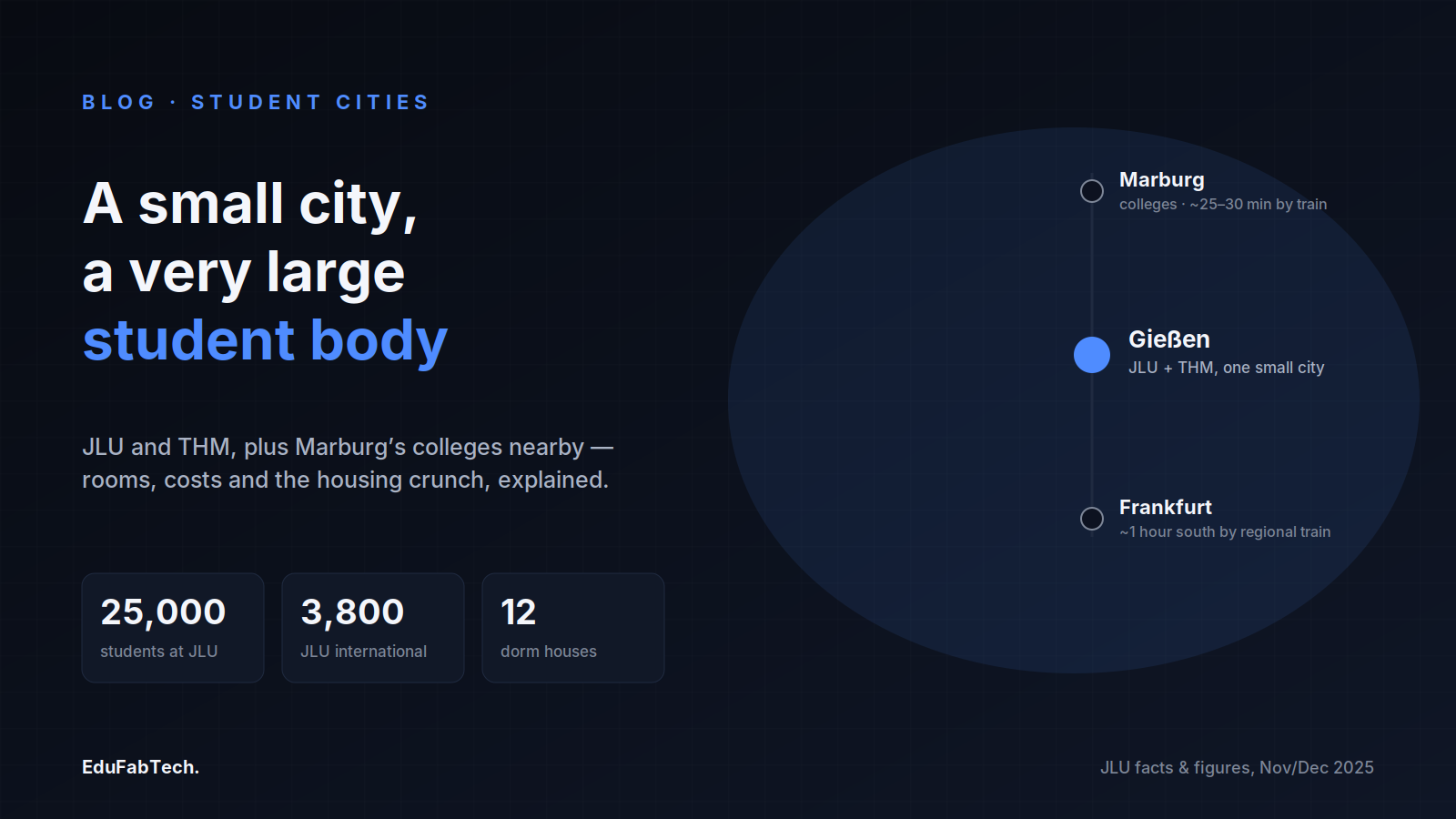
Gießen is a small city on the river Lahn in Middle Hesse (Mittelhessen), roughly an hour north of Frankfurt am Main by regional train and a short ride south of Marburg. It is not a place people visit for its skyline — much of the centre was rebuilt after the war — but it carries a student body out of all proportion to its size. Two institutions set the rhythm of the streets: Justus-Liebig-Universität Gießen (JLU), the full university, and the Gießen campus of the Technische Hochschule Mittelhessen (THM), a large university of applied sciences. Between them, term-time Gießen is a town where the pedestrian Seltersweg, the cafés near the Bahnhof and the regional trains all run on the academic calendar.
Because the campuses are threaded through the city rather than fenced off on a hill, studying here feels less like arriving at a self-contained university and more like moving into a working town that happens to be full of students. That shapes everything below — where rooms are, how far you walk or cycle, and why the housing crunch bites hardest in the two weeks before each semester starts.
Two universities in the city, and the Marburg colleges up the line
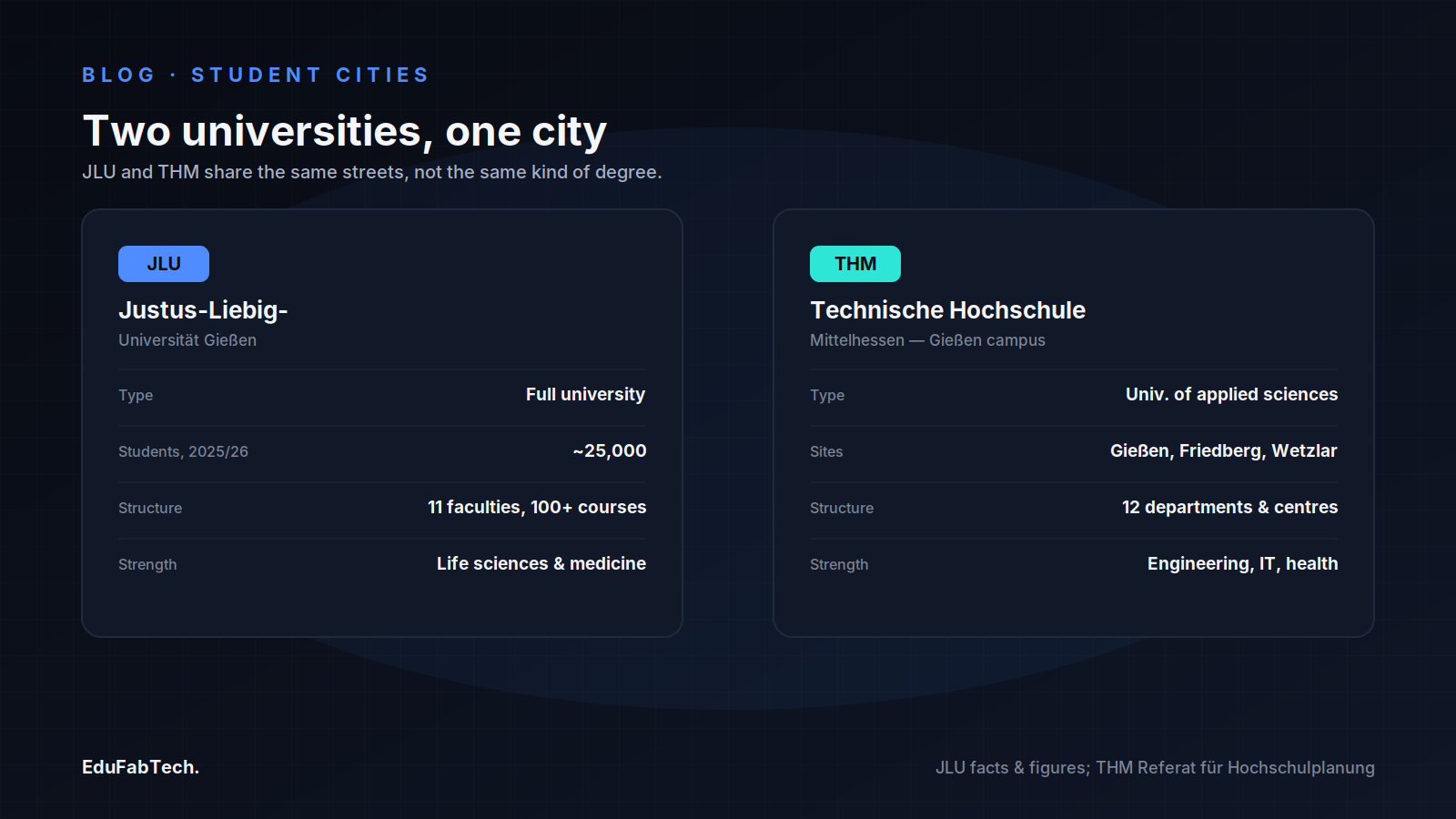
Justus-Liebig-Universität Gießen is the larger of the two. Its own figures report around 25,000 students for winter semester 2025/26, about 3,800 of them international (as of November 2025), taught across 11 faculties with more than 100 courses of study and some 5,825 employees, including 422 professors (as of December 2025), according to the university's facts and figures page. JLU has no single campus; buildings are grouped by subject — the humanities around the Philosophikum, the life sciences and medicine in their own clusters. The university is named after the chemist Justus von Liebig and is unusually strong in the life sciences, keeping both human and veterinary medicine alongside agricultural, nutritional and environmental sciences, a combination few German universities still hold together. For listings close to its buildings, see near University of Giessen.
THM is the applied-sciences counterpart, and Gießen is its base, with further campuses up the valley in Friedberg and Wetzlar. Its statistics office, the Referat für Hochschulplanung, organises the school into twelve departments and scientific centres across the three sites. THM's weight is in engineering, computer science, health and management, and it runs degrees in close contact with regional industry. If applied, hands-on study is what you are after, THM's Gießen campus is the anchor — its surroundings are indexed under near Mittelhessen University of Applied Sciences.
Two smaller Gießen institutions grant their own degrees. The Freie Theologische Hochschule Gießen (the Giessen School of Theology) is a state-recognised university at Rathenaustraße 5–7 that awards Bachelor and Master degrees in Protestant theology, as its own site sets out. The remaining institutions in this academic region sit up the Lahn valley in Marburg an der Lahn. Philipps-Universität Marburg, founded in 1527 and organised into 16 departments, is one of Germany's oldest universities and is known for virology and the life sciences as well as a broad humanities tradition, per its profile page. Also in Marburg are the Archivschule Marburg — the Hochschule für Archivwissenschaft, which trains academic archivists through a two-year programme described on its own pages — and the Evangelische Hochschule Tabor (the Protestant College of Tabor), whose state-recognised Bachelor in Protestant theology runs over eight semesters, as the college confirms. Marburg is a 25–30 minute regional train ride, close enough that students sometimes live in one city and study in the other; listings there sit under near University of Marburg.
Where a room comes from, and when to start
The purpose-built option is the Studierendenwerk Gießen, the public student-services body that runs the dormitories. It lists twelve houses in Gießen, from the Eichendorffring and Grünberger Straße out east to the Leihgesterner Weg cluster and the central Ludwigstraße and Stephanstraße addresses, on its Wohnheime overview. A dorm place is applied for directly through the Studierendenwerk — there is no private middleman and no deposit paid to a stranger — but demand outruns supply, so apply as early as you have an admission or enrolment in hand.
Most students end up in a WG (Wohngemeinschaft, a shared flat) on the private market, or in a single rented room. The Studierendenwerk runs a Wohnbörse, a board matching rooms with seekers, which is a sensible first stop because it is tied to a public institution rather than an anonymous platform. Our own city listings collect rooms, shared flats and sublets at rooms in Gießen, with the full local index at everything in Gießen.
Timing matters more than anything else. Both the winter semester (rooms needed from October) and the summer semester (from April) bring a wave of arrivals into the same small market at the same moment, and the weeks just before the winter start are the hardest. Start looking a month or two ahead; if you arrive without a room, budget for a hostel or temporary stay while you search in person rather than signing something unseen from abroad.
Paying a deposit without being cheated
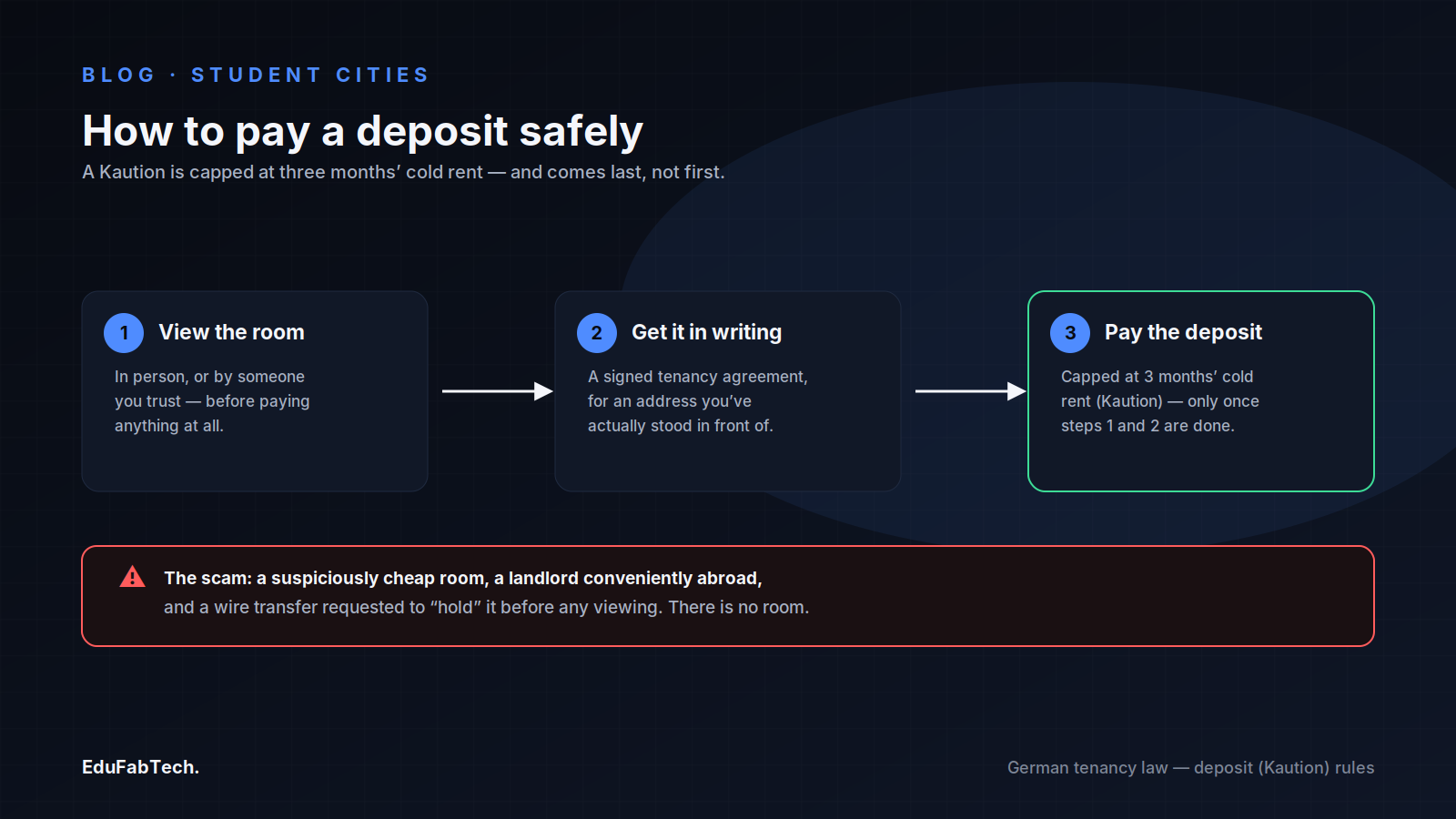
The scam that catches students in Gießen is the same one that works on every tight German rental market, dressed in local detail: a room near the Philosophikum or a WG off the Seltersweg is advertised at a suspiciously fair price, the "owner" is conveniently abroad and cannot show it in person, and you are asked to wire a deposit or send a code — by bank transfer, Western Union, gift card or crypto — to "hold" it before a viewing. There is no room. In Germany a deposit (Kaution) is legally capped at three months' cold rent and is meant to sit in a separate account, released at the end of the tenancy; a landlord who wants cash up front, before any contract and before you have seen the place, is the warning sign.
The defences are concrete. View the room — or have someone you trust view it — before paying anything, and be especially wary of listings that forbid viewings. Never send money to reserve a flat you have not seen. Prefer the Studierendenwerk dorms and Wohnbörse, where you deal with an institution, and treat a landlord who refuses a written contract as a reason to walk away. Pay the deposit only once you have a signed tenancy agreement and an address you have stood in front of.
Furnishing a room for not much
A bare room is the usual starting point, and Gießen has cheap ways to fill it. The city's social second-hand store, DAS KAUFHAUS der Jugendwerkstatt, is a used-goods department store at Alter Krofdorfer Weg 4 that sells furniture, household items and textiles at low prices, listed in the city's own directory at giessen.de. For food and everyday staples, the Gießener Wochenmarkt runs every Wednesday and Saturday from 7:00 to 14:00, spread between the Botanical Garden at Brandplatz, Marktlaubenstraße and the Linden- and Kirchenplatz, according to the market's own site — a useful habit for fresh produce once you are settled.
Beyond that, much of a first flat gets assembled from what other students leave behind at the end of each semester. Our local boards track second-hand goods at second-hand things in Gießen, larger items at second-hand furniture, and giveaways at free stuff in Gießen, where departing tenants often post a desk or a shelf for collection rather than carrying it to the recycling centre.
Working alongside your studies
Student jobs are common here — in the university clusters, in hospitality on the Seltersweg, and as academic assistants within JLU and THM. The rules depend on where you are from. The DAAD states that students from non-EU countries may work 140 full days or 280 half days per year, and that work as an academic assistant does not count toward that limit, though you must still inform the foreigners' office (Ausländerbehörde). EU and EEA students are broadly treated like German students. These limits and your residence-permit conditions are the binding word, and they change: confirm your own situation with the Ausländerbehörde and the DAAD page above rather than relying on a summary — this is general information, not legal advice. Current local openings are gathered at jobs in Gießen.
Libraries and places to study
The Universitätsbibliothek Gießen is the main study infrastructure, organised as a central library on the Philosophikum with a network of branch and specialist libraries across the city. One branch sits squarely in the retail centre: the Zweigbibliothek Natur- und Lebenswissenschaften moved to Seltersweg 85 in the city centre, and opens Monday to Friday 8:30–20:00 and Saturday 8:30–19:00, per its location page. The library picture is about to change: JLU is building a new central library on the Philosophikum as part of its "Campus der Zukunft", a roughly 6,500-square-metre building designed to hold 618 user places in individual and group rooms and a learning centre, according to the university's project page. THM students have their own departmental and campus libraries in Gießen. Beyond the libraries, cafés and study spots fill up fast in exam weeks; shared desks and quiet rooms are listed at study spaces in Gießen.
Getting around on the semester ticket
Gießen is small enough to cross on foot or by bike, and the bicycle is the default student vehicle — most of the city is flat, and the campuses are a short ride apart. For everything else there is the semester ticket. At JLU this is the Deutschlandsemesterticket: the AStA puts it at €208.80 for winter semester 2025/26 (€34.80 a month), rising to €226.80 per semester from winter semester 2026/27, as its ticket page explains. It covers local and regional public transport across Germany — buses, trams, S-Bahn and regional trains — but not IC, ICE or EC long-distance services, and for the winter term it runs 1 October to 31 March. The regional transport network is the Rhein-Main-Verkehrsverbund (RMV), which reaches from Gießen down to Frankfurt and up to Marburg, so the ticket doubles as a weekend travel pass well beyond the city. Student life and one-off events around town are listed at events in Gießen.
What it costs
Housing is the figure that decides a student budget, and the dorms give the clearest dated numbers. Studierendenwerk Gießen's 2026 Wohnheime list shows monthly rents ranging from €250 for a room in the Mildred-Harnack-Fish-Haus up to €907 for the largest units at the Unterhof, with most single rooms and small apartments falling well inside that span — for example €286–€387 at Ludwigstraße and €299–€489 at the Eichendorffring. A newly opened house illustrates the current end of the market: the Westside dormitory, run by Studierendenwerk Gießen, brought its first 129 units into use on 22 October 2026 at rents between €435 and €462 including utilities, electricity and internet, with 351 places planned in total once the remaining sections are finished by summer semester 2027, according to Stadt Gießen. Private WG rooms vary too much to give a single reliable figure, but they generally run above the cheaper dorm rooms; use the dorm rents as your floor when you plan.
What is good, and what is hard
The good is real and specific. Gießen is compact, so you can live without a car and reach your department by bike; the tuition model is the German one, with no tuition fees at the public universities and only a semester contribution; and the student share of the city is large enough that the place is built around student life rather than tolerating it. The RMV ticket puts Frankfurt and Marburg within easy reach, which widens the city without the cost of living in them.
The hard parts are equally concrete. The housing market is tight and most acute right before the winter semester, so late searchers struggle. Gießen is a functional, rebuilt city rather than a picture-postcard one, and students who want big-city nightlife often take the train to Frankfurt. The compactness that makes the city convenient also makes it feel small by the third year. And the new central library and the Westside dormitory are both still being completed, so some of the best facilities are promised rather than fully open as you arrive.
A checklist for the first weeks
- Register your address (Anmeldung) at the Bürgerbüro soon after you move in — it is a legal step and you will need the confirmation for other paperwork.
- Complete enrolment and pay the semester contribution; your student status unlocks the semester ticket.
- Activate your Deutschlandsemesterticket (JLU) or the RMV/digital semester pass (THM) before you start travelling.
- Open a German bank account and arrange statutory health insurance, both usually needed to finalise enrolment.
- Non-EU students: visit the Ausländerbehörde about your residence permit and confirm your work conditions before taking a job.
- Get your library card and find your nearest branch of the Universitätsbibliothek or your THM campus library.
- Only pay a deposit once you have signed a contract and seen the room in person — never to "hold" an unseen flat.
A quick question for readers
Do you work part-time while you study?
Many students work to pay the bills. See how common it is — and how many hours people really do.
Pick an answer, create a free account in a minute, and your vote counts. Already a member? Sign in
Comments 3
Comment-
The Westside numbers are the part I'd push back on. It's filed under "what is good" because it's new, but the cheapest unit there is €435 in…
-
The number that actually matters here is 129 units open out of 351 planned, with the rest not landing until summer 2027 — so the €435–462 We…
-
The number I keep coming back to is 140 full days/280 half days for non-EU students working - and that it's academic-assistant work that doe…
Join free to read the full comments and reply Comments are between members; an account takes a minute.
Source: Justus-Liebig-Universität Gießen
Sources (5)
- Justus-Liebig-Universität Gießen. Facts and figures (At a glance). Justus-Liebig-Universität Gießen, 2025. uni-giessen.de ↗ · checked 13 Nov 2026
- Technische Hochschule Mittelhessen. Studierendenstatistik (Referat für Hochschulplanung). Technische Hochschule Mittelhessen, 2025. thm.de ↗ · checked 13 Nov 2026
- Studierendenwerk Gießen. Unsere Wohnheime. Studierendenwerk Gießen, 2026. stwgi.de ↗ · checked 13 Nov 2026
- Stadt Gießen. Studierendenwerk Gießen feiert Teilinbetriebnahme des Wohnheims Westside. Stadt Gießen, 2026. giessen.de ↗ · checked 13 Nov 2026
- Deutscher Akademischer Austauschdienst (DAAD). Side jobs. DAAD, 2026. daad.de ↗ · checked 13 Nov 2026