Studying in Glasgow: universities, housing and student life
A practical guide to Glasgow's universities, the neighbourhoods students rent in, furnishing a room cheaply, work rules, study spaces, transport and what it all costs — with every figure sourced.
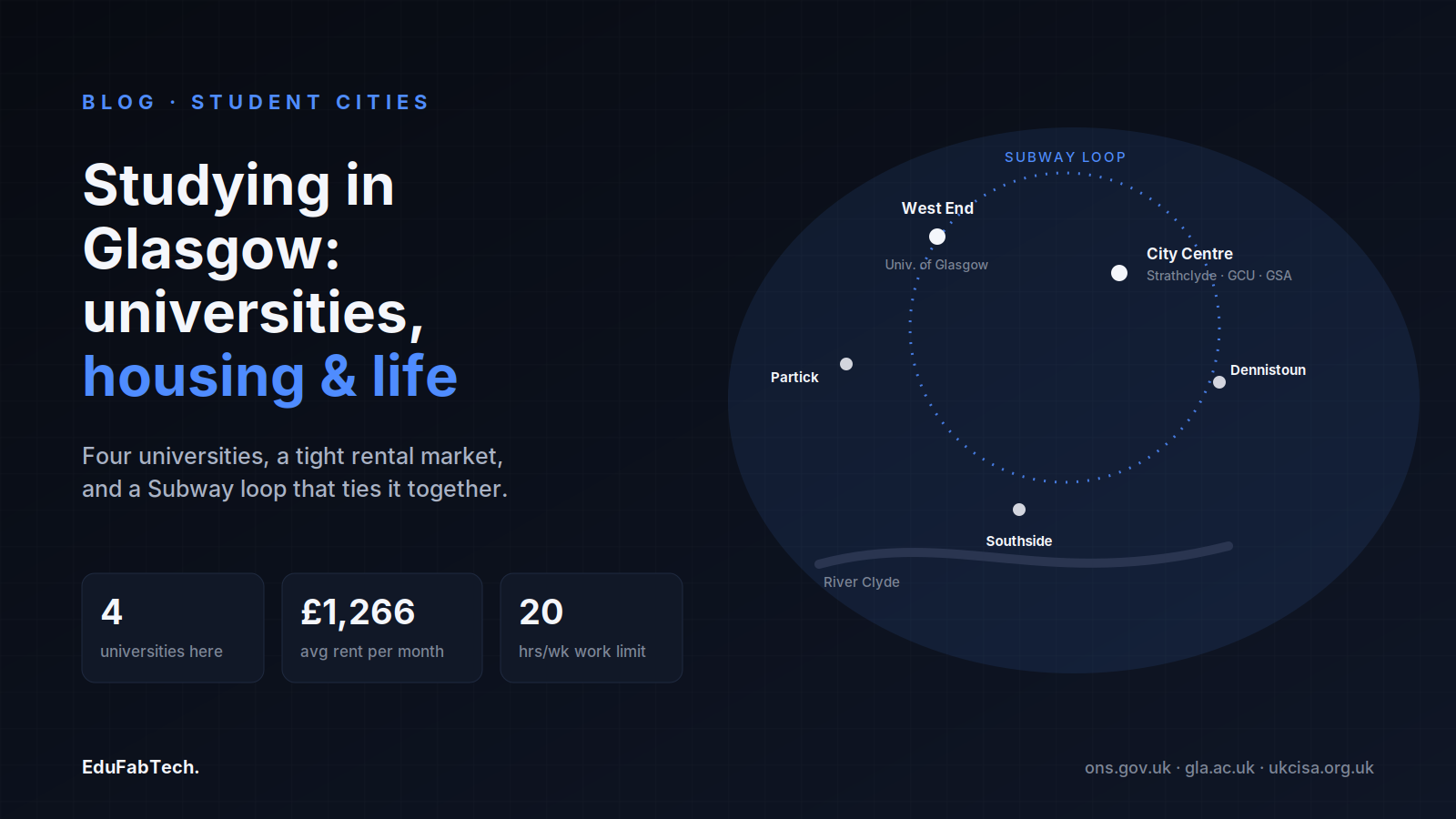
Glasgow holds more university students than any other city in Scotland, and they are not tucked away on a single edge-of-town campus. The institutions sit close together — the oldest on a hill in the West End, the others threaded through the city centre — so it is normal to live in one neighbourhood, study in another, and walk home afterwards. This guide gathers what a new arrival actually needs: who teaches what and where, which districts people rent in, how to furnish a room for very little, the work rules for international students, and what the Subway and the buses cost. The current EduFabTech listings for the city are collected at /in/united-kingdom/glasgow.
The shape of the city matters for where you end up. The River Clyde runs east–west through the centre; the West End climbs away to the north-west around Kelvingrove Park, the Southside spreads across the river, and the East End falls away towards the old market quarter. The Subway runs a single circular loop that links the West End, the city centre and part of the Southside, which is why so much student life clusters along it.
Four universities, an art school, and a college worth knowing
The University of Glasgow was founded by papal bull in 1451, as its own history pages record (gla.ac.uk), and its main campus has stood at Gilmorehill in the West End for over a century. The University describes the site as "based in the West End of the city, within easy reach of the city centre", gathered around the spired Gilbert Scott building and an "enormous library over 12 floors" (gla.ac.uk). It is a broad research university; within it, the Adam Smith Business School carries the name of the economist who studied and later taught in the city.
The University of Strathclyde sits in the opposite setting — the centre of town. It calls itself "a leading technological university right in the heart of Glasgow" whose campus is "only a short walk from two mainline railway stations, the bus station and the subway", and it traces "useful learning" to a founding purpose "over 200 years ago" (strath.ac.uk). Its John Anderson Campus occupies much of the Townhead and Merchant City fringe of the centre, which puts engineering, science and business students within a few streets of Queen Street station.
Glasgow Caledonian University has its City Campus in Cowcaddens, just north of the main shopping streets and beside the Buchanan bus station; its Glasgow School for Business and Society teaches business, law and social sciences there. The Glasgow School of Art, a specialist institution in the Garnethill district above the centre, teaches fine art, design and architecture and is known for the Charles Rennie Mackintosh building that gives the area its character.
Not every campus is inside the city. The University of the West of Scotland is based in Paisley, which it describes as "just 10 minutes by train from Glasgow" (uws.ac.uk); many students treat Glasgow as their social base and commute out. For practical, hands-on courses — and for a cheaper route into higher education — City of Glasgow College runs large campuses near the river and the centre. Together these give the city an unusually dense student map for its size; listings close to the biggest campus are at /near/university-of-glasgow.
The neighbourhoods students choose
The West End is the classic student quarter, wrapped around the University of Glasgow. Hillhead, Kelvinbridge and Woodlands are full of tenement flats, cafés and secondhand bookshops; the Subway stops at Hillhead and Kelvinbridge make the commute trivial, and Kelvingrove Park and Byres Road give the area its reputation. It is also among the pricier places to rent, which pushes some students one stop further out.
Partick, west of the university, is slightly cheaper and exceptionally well connected: it is one of the few points where the Subway, the train and the bus network meet, so students at campuses across the city live here. Just south-east, Finnieston runs along the Clyde towards the exhibition and concert venues — busy with bars and restaurants, convenient for the riverside, and increasingly sought-after.
The city centre and Merchant City suit students at Strathclyde, Glasgow Caledonian and the Glasgow School of Art who want to live on their doorstep. It is the most purpose-built-halls-heavy part of town and can be lively at night rather than quiet. Dennistoun, in the East End, has become a popular lower-cost alternative within walking distance of Strathclyde; it has no Subway but good buses and nearby stations. Across the river, the Southside — Shawlands, Govanhill and Battlefield — is where many postgraduates and sharers settle for more space and lower rents, relying on frequent trains into Glasgow Central and buses rather than the Subway.
Renting here: a tight market and how not to get caught
Most Glasgow students rent a room in a shared tenement flat or a room in purpose-built student accommodation. The private market tightens sharply in late summer, so for a September start it is normal to begin looking from spring onwards; good West End and central rooms go quickly. EduFabTech's room listings for the city are at /in/united-kingdom/glasgow/rooms, and university accommodation offices open applications months ahead.
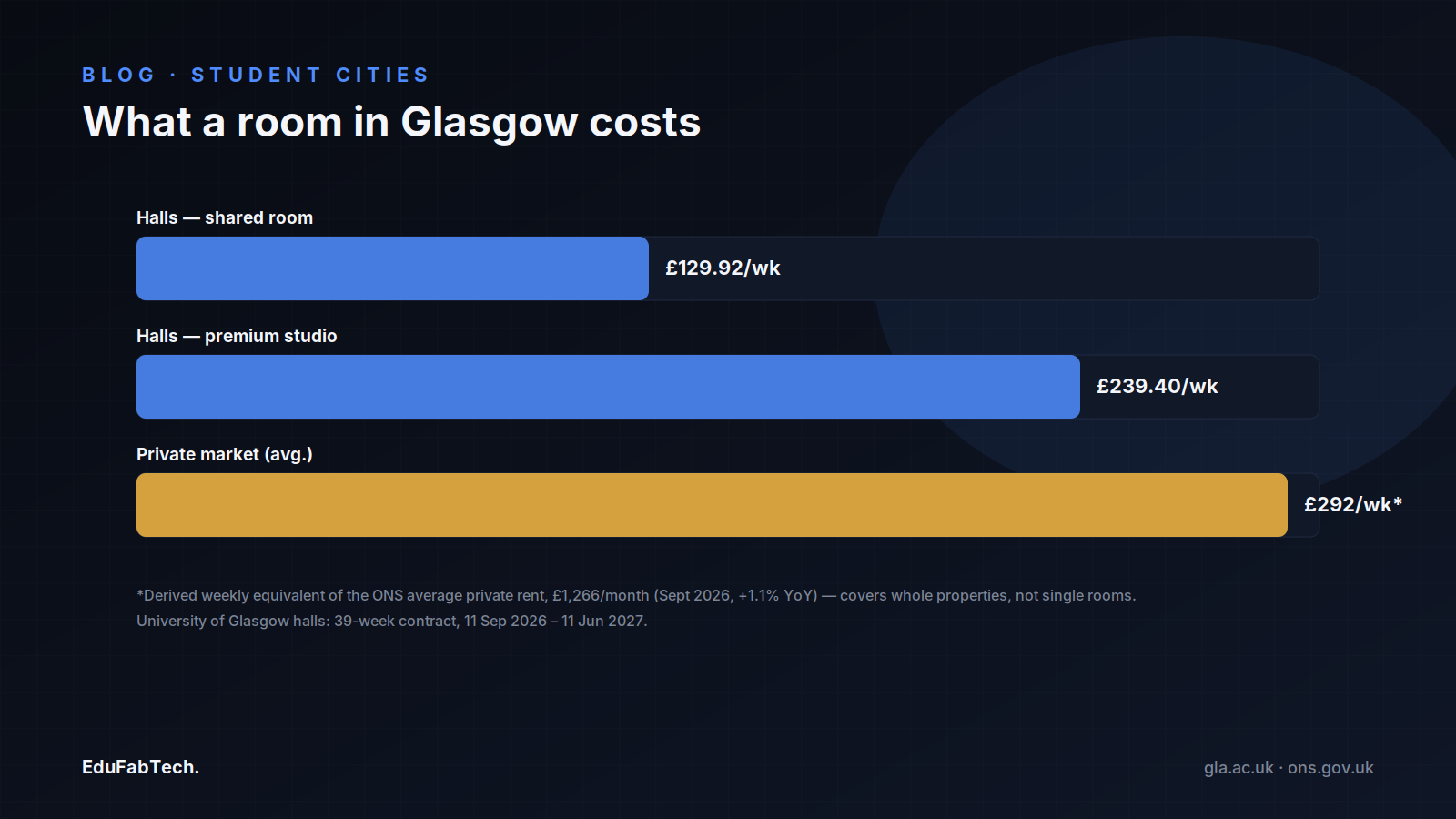
For a dated anchor on price, the University of Glasgow lists its 2026/27 residence fees from £129.92 a week for a shared room to £239.40 a week for a premium studio, with most residences on a 39-week contract running from 11 September 2026 to 11 June 2027 (gla.ac.uk). In the private market, the Office for National Statistics put the average monthly private rent in Glasgow at £1,266 in September 2026, an annual rise of 1.1% from £1,252 a year earlier (ons.gov.uk); that figure covers whole properties across the wider market, so a single room in a shared flat typically costs less.
Scams in Glasgow follow the same pattern as the demand: they cluster around the West End and central flats that students want most, and around the first weeks of term when people are desperate. The warning sign is always the same — a "landlord" who will not let you view the flat in person and asks you to transfer money to "hold" it. See the room, meet whoever is letting it, and never send a deposit by bank transfer, gift card or cryptocurrency to secure a place you have not visited. In Scotland a private deposit must by law be lodged with an approved tenancy deposit scheme, and you should get written confirmation of that; if someone resists giving it, walk away.
Furnishing a room for almost nothing
Glasgow is a good city for second-hand. The famous name is The Barras, the weekend market in the East End off the Gallowgate; its official listing gives the hours as "every Saturday & Sunday: 10am–4pm" and the stalls as "everything from vintage clothing and antiques to fresh produce and one-of-a-kind local goods" (barrowland.co.uk). It is the place for cheap household bits, records and oddments if you enjoy rummaging.
Beyond the market, the West End and Southside are thick with charity shops — Byres Road, Great Western Road and the streets around Shawlands are reliable for crockery, lamps, desks and books. End of term, late June in particular, is when departing students leave usable furniture on the pavement or give it away locally. EduFabTech gathers the city's second-hand goods at /in/united-kingdom/glasgow/second-hand and things offered free at /in/united-kingdom/glasgow/free-stuff; checking both before buying anything new is the frugal move.
Working while you study
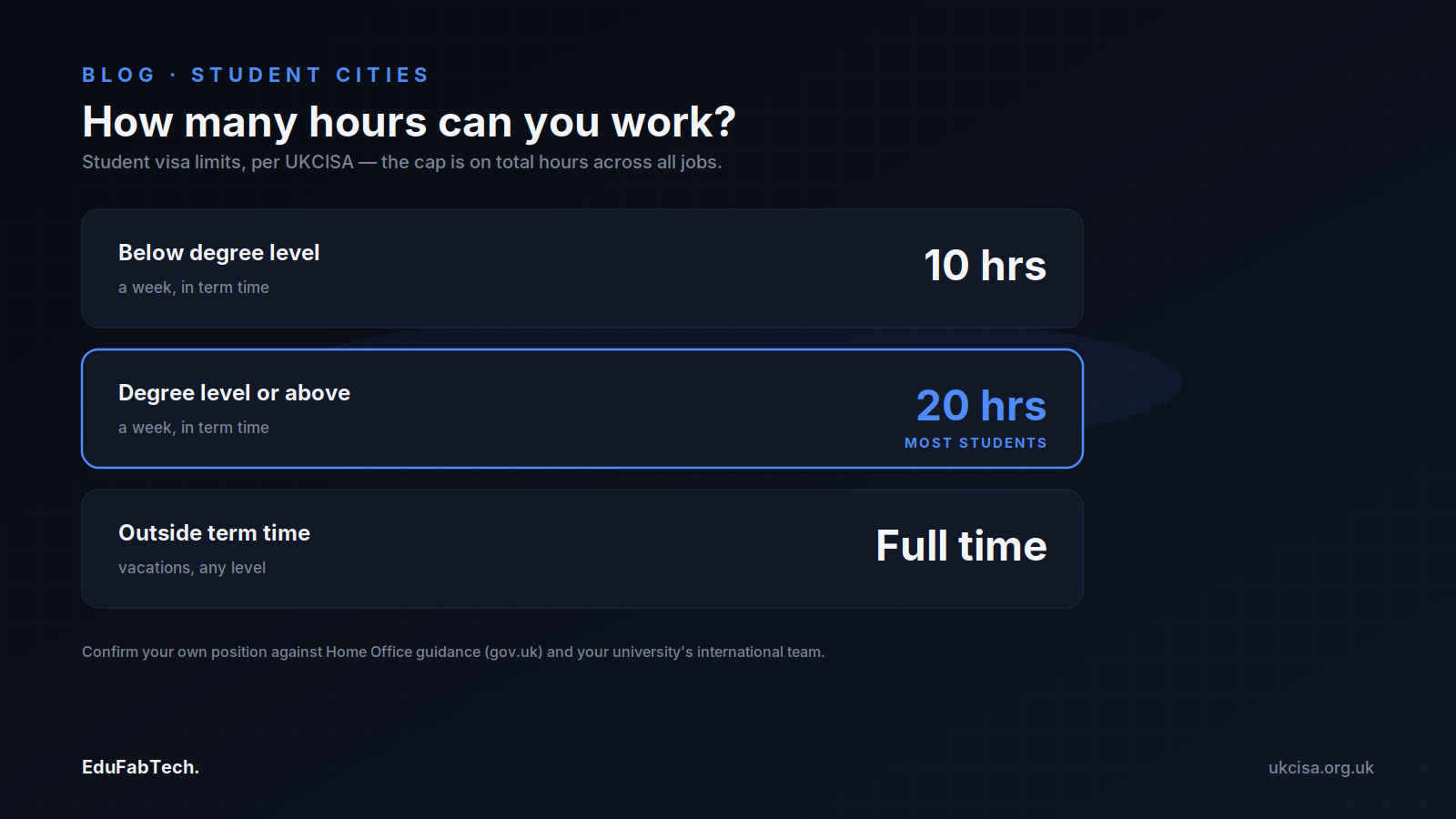
Part-time work is common, and for international students the hours are a visa condition rather than a choice. According to UKCISA, a Student visa generally allows work "up to 20 hours a week in term time if you are studying for a qualification at degree level or above", "up to 10 hours a week in term time" below degree level, and "full time outside term time" including vacations (ukcisa.org.uk). The limit is on your total hours across all jobs, not per employer. These are rules with real consequences, so confirm your own position against the official Home Office guidance on the gov.uk Student visa page and with your university's international team rather than relying on word of mouth; this guide is not legal advice.
For the actual hunt, hospitality, retail and campus jobs dominate, and the city centre and West End carry most of the vacancies. Local part-time openings are listed at /in/united-kingdom/glasgow/jobs.
Libraries and desks across the city
Each university has its own library — the University of Glasgow's twelve-floor library on Hillhead Street, Strathclyde's Andersonian Library in the centre, and Glasgow Caledonian's Saltire Centre — all open to their own students with a card. When you want neutral ground, the city's public reference library is the landmark. Glasgow Life describes The Mitchell Library on North Street as "one of Europe's largest public libraries with more than a million items", free to enter, and lists opening hours of 9am–5pm on Monday, Wednesday, Friday and Saturday and 9am–8pm on Tuesday and Thursday, closed Sunday (glasgowlife.org.uk). Its reading rooms are quiet, grand and open to anyone.
Glasgow Life also runs neighbourhood libraries across the city with free desks and wifi, useful if you live on the Southside or in the East End and want somewhere near home. Cafés in the West End and Finnieston fill up with laptops during exam season; for bookable desks and quieter alternatives, see /in/united-kingdom/glasgow/study-spaces.
Getting around: the Subway, the trains and the bus pass
The Glasgow Subway is small, simple and distinctive — a single circular line of fifteen stations that locals nickname the Clockwork Orange. It is run by SPT (Strathclyde Partnership for Transport), the regional transport body that operates the Subway. As of November 2026, SPT lists a single journey at £1.80 and an all-day ticket at £3.40, with a reusable smartcard costing £5 (spt.co.uk). For students, SPT advertises a 10-week ticket for £132 for "unlimited travel all semester", available online with a registered smartcard (spt.co.uk).
The Subway only reaches part of the city, so most students also use ScotRail trains — Partick, Central and Queen Street tie the suburbs together — and the extensive bus network. The strongest saving is for the young: Transport Scotland's scheme means "everyone aged between 5 and 21" who lives in Scotland can travel free on "nearly all local registered and long-distance scheduled bus services" with a National Entitlement Card or Young Scot NEC (transport.gov.scot). That does not cover the Subway or the train, but for anyone under 22 it makes buses effectively free across the whole country.
The good and the hard
What makes Glasgow work for students is its compactness and its culture. The campuses are close, the Subway is cheap and the rents, at an ONS average of £1,266 a month in September 2026, sit well below London's. The city has a deep music, gallery and sport scene and a long-standing reputation for friendliness. The flipside is real: the private rental market is genuinely tight at the start of term, the best West End rooms are expensive and go fast, and purpose-built halls can cost as much as £239.40 a week at the top end. The weather is famously wet, the Subway closes relatively early and does not run everywhere, and the East End and parts of the Southside are less served by it. None of that is a reason to stay away; it is a reason to start early and choose your neighbourhood with the commute in mind.
A checklist for your first weeks
- Confirm your accommodation in writing before you pay anything, and for a private let make sure the deposit is lodged with an approved tenancy deposit scheme.
- Register with a local GP practice near where you live — do it early, before you are unwell.
- If you are under 22 and living in Scotland, apply for a National Entitlement Card or Young Scot NEC for free bus travel; if you will use the Subway, order and register an SPT smartcard.
- Ask your university or Glasgow City Council about the council tax exemption that full-time students can claim.
- International students: check your exact work-hour limit on the gov.uk Student visa page and with your university's international team before taking a job.
- Get a library card for The Mitchell and your nearest Glasgow Life branch, so you have somewhere to study beyond campus.
- Before buying furniture, look at local second-hand and free listings and visit The Barras on a weekend.
A quick question for readers
Do you work part-time while you study?
Many students work to pay the bills. See how common it is — and how many hours people really do.
Pick an answer, create a free account in a minute, and your vote counts. Already a member? Sign in
Comments 2
Comment-
The £1,266 average rent figure is doing more work than it should here. The piece itself admits that's for whole properties across the market…
-
The rent numbers in here don't actually connect to each other. You get £129.92–£239.40/week for university halls, and £1,266/month for an av…
Join free to read the full comments and reply Comments are between members; an account takes a minute.
Source: University of Glasgow
Sources (5)
- University of Glasgow. Undergraduate accommodation fees 2026/27. University of Glasgow, 2026. gla.ac.uk ↗ · checked 5 Nov 2026
- Office for National Statistics. Housing prices in Glasgow: private rent. Office for National Statistics, 2026. ons.gov.uk ↗ · checked 5 Nov 2026
- Strathclyde Partnership for Transport. Subway tickets. SPT, 2026. spt.co.uk ↗ · checked 5 Nov 2026
- UKCISA. Can you work? Working as a student. UK Council for International Student Affairs, 2026. ukcisa.org.uk ↗ · checked 5 Nov 2026
- Transport Scotland. Under 22s free bus travel. Transport Scotland, 2026. transport.gov.scot ↗ · checked 5 Nov 2026