Studying in Gloucester: universities, housing and student life
A practical guide to Gloucester's two-town university, specialist rural campuses, where students live, what a room costs, and the honest trade-offs of a cathedral city on the Severn.
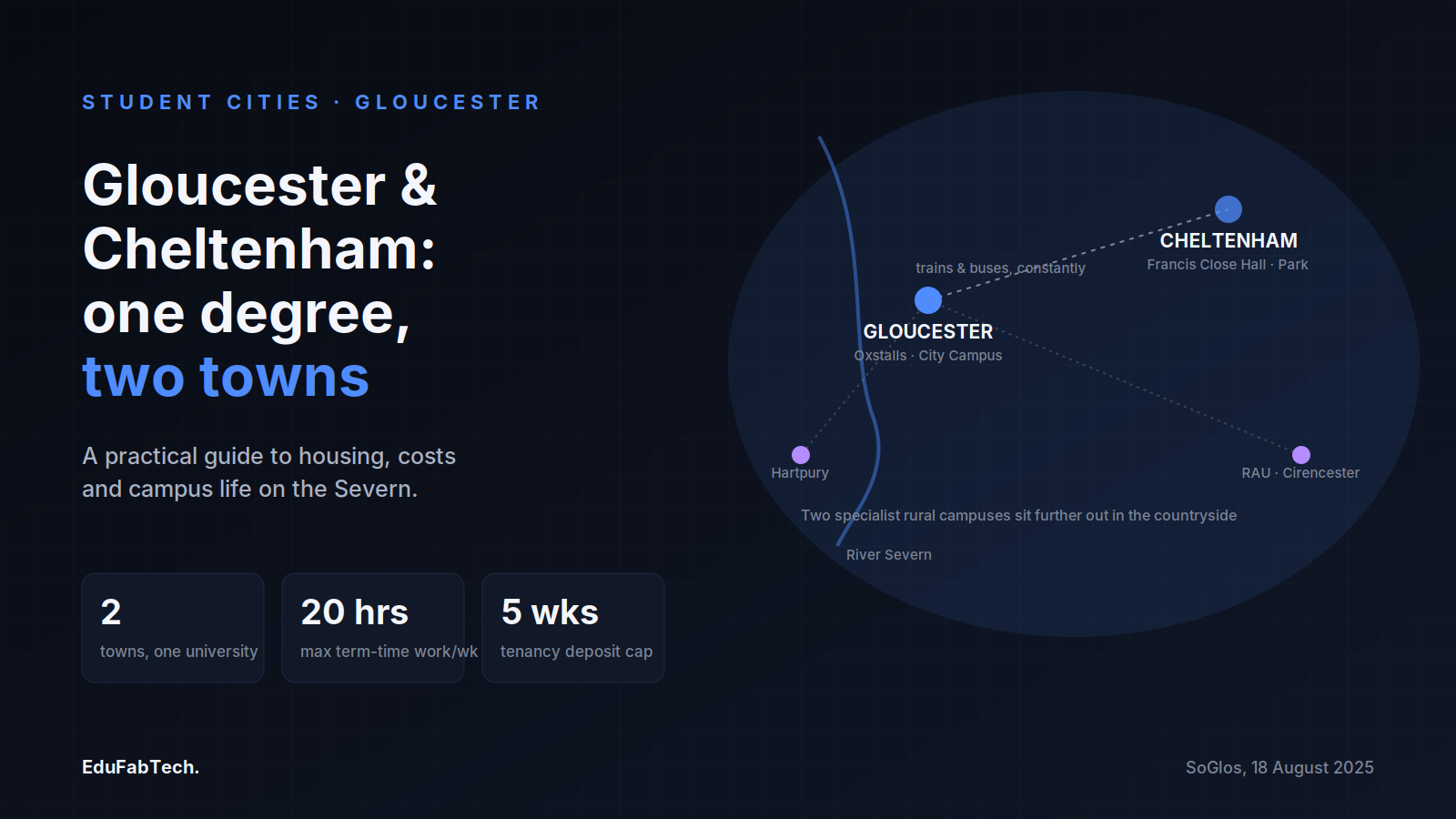
Gloucester is an old river city rather than a classic university town. It sits on the east bank of the River Severn, built around a Norman cathedral and England's most inland docks, and it has always been a working place — quays, warehouses, railways — more than a college quarter. That shapes student life here. The degrees on offer are split between the city itself, the suburb of Longlevens, and specialist campuses out in the Gloucestershire countryside, so where you study decides a lot about where you live and how you travel.
The other thing to understand early is that Gloucester shares its main university with Cheltenham, the spa town four miles to the north-east. Teaching, halls and social life are spread across both towns, and trains and buses between them run constantly. If you picture a single compact campus, adjust that now: studying around Gloucester usually means moving between two towns and, for some courses, a rural estate. This guide walks through the institutions, the neighbourhoods, the real costs, and the parts that are genuinely harder than the prospectus admits. You can browse current local listings on EduFabTech's Gloucester page as you read.
The universities in and around Gloucester
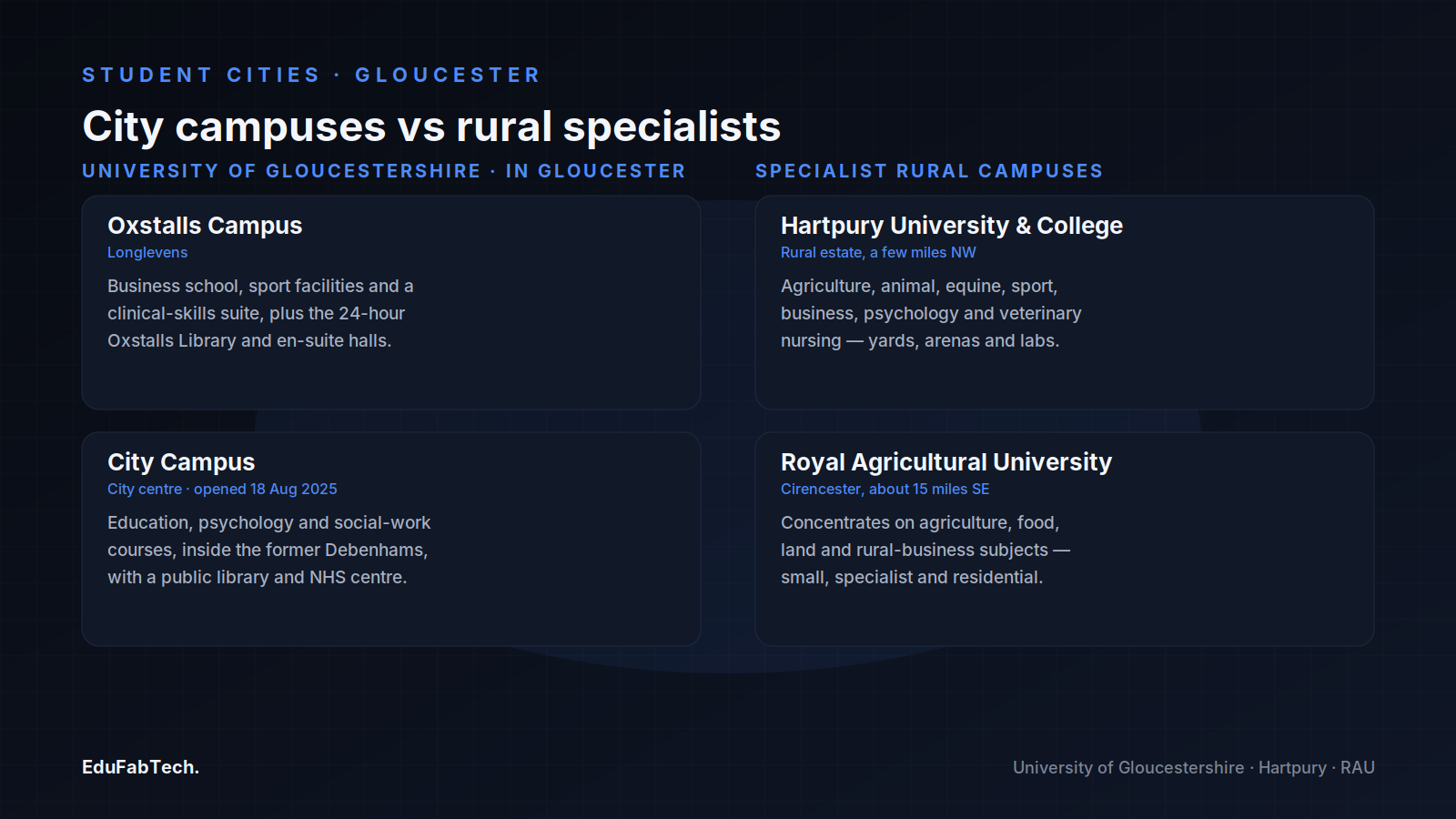
The University of Gloucestershire is the main provider, and it operates across several campuses in two towns. Two of them sit in Gloucester. Oxstalls Campus, on Oxstalls Lane in Longlevens, houses the business school and the university's sport facilities — an indoor arena, sports-science labs and a clinical-skills suite — along with the 24-hour Oxstalls Library and a cluster of en-suite halls. The newest site is City Campus, in the heart of the city centre. As the Gloucestershire news outlet SoGlos reported, it opened to the public on 18 August 2025 inside the former Debenhams store (originally the Bon Marché), and it holds the education, psychology and social-work courses as well as a new public library and an NHS arts, health and wellbeing centre. The university's other two main campuses — Francis Close Hall and Park — are in Cheltenham.
Two specialist universities sit in the surrounding countryside. Hartpury University and Hartpury College — a degree-awarding university alongside a linked further-education college, and the institution EduFabTech also lists as Hartpury University and College — occupies a large rural estate a few miles north-west of Gloucester. Its own site describes strengths in agriculture, animal, equine, sport, business, psychology and veterinary nursing, with the kind of yards, arenas and labs those subjects need. The Royal Agricultural University is in the market town of Cirencester, about fifteen miles south-east, and concentrates on agriculture, food, land and rural-business subjects. Both are small, specialist and heavily residential, so most of their students live on or beside campus rather than in central Gloucester. Listings close to the main provider are grouped at University of Gloucestershire.
The neighbourhoods students actually choose
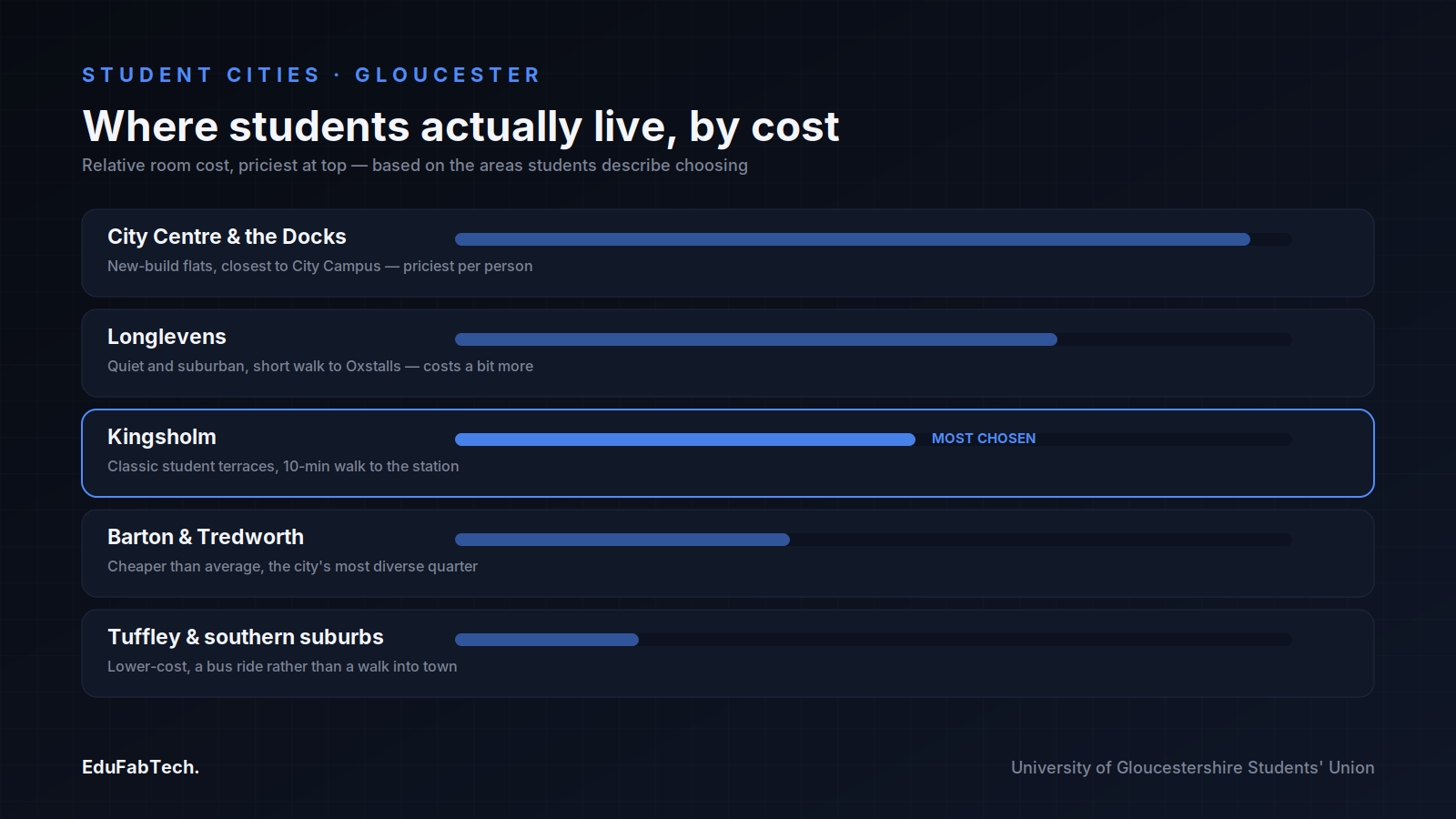
Kingsholm is the classic student address. It sits just north of the centre, around Kingsholm Stadium — the home of Gloucester Rugby since 1891 — and its streets of Victorian terraces have long been carved into shared student houses. It is a ten-minute walk to the railway station and close to both the city centre and Oxstalls, which is its main draw. The trade-off is rugby-day crowds and noise roughly a dozen Saturdays a season.
Longlevens, a little further out to the north-east, is where Oxstalls Campus actually is. It is quieter and more suburban — family houses, a high street of its own — so it suits students who want calm and a short walk to class, and it tends to cost a bit more than the inner terraces. Barton and Tredworth, just outside the old Eastgate, is the city's most diverse quarter: Gloucestershire County Council's Director of Public Health Report 2024 records residents from more than 25 countries, over 70 languages spoken and at least 14 places of worship. It is close to the centre, cheaper than average, and good for everyday international groceries, though some streets are rougher around the edges than Longlevens.
Tuffley and the southern suburbs are residential and lower-cost, with a bus ride rather than a walk into town — reasonable if you want a whole house for less and don't mind commuting. The city centre and the Docks, by contrast, are where the new-build flats are: close to City Campus, the station and the Gloucester Quays shopping and nightlife, convenient but priciest per person. Finally, students at Hartpury and the Royal Agricultural University mostly live on their rural estates or in the villages and small towns nearby; if you study there, factor in that Gloucester's shops and clubs are a bus or car journey away, not a walk.
Finding a room without losing your deposit
Most first-year University of Gloucestershire students take a room in halls; returning students and many international students move into shared houses, concentrated in Kingsholm, Barton and the roads around Oxstalls. If you want a house for the following September, the Gloucester cycle starts early — viewings for the best shared houses often happen between January and March — but do not let that pressure rush you into paying for something unseen. Plenty of rooms also appear over the summer as plans change, so a late search is not a lost one. You can compare what is currently available on EduFabTech's Gloucester rooms page.
The safety rules are specific and worth repeating. See the actual room in person, or have someone you trust see it, before any money changes hands — scams in cities like Gloucester usually involve a "landlord" who is conveniently abroad, a too-cheap room near Oxstalls or the centre, and pressure to send a holding deposit fast. Never send money by bank transfer, gift card or cryptocurrency to "hold" a room; those payments cannot be reversed and are the hallmark of a fraud. In England a holding deposit is capped at one week's rent and a tenancy deposit at five weeks' rent for most lettings, and a genuine deposit should be protected in a government-approved scheme — ask which one, and get a tenancy agreement in writing. The university's own accommodation service and students' union can check a contract before you sign, which is worth doing for a first private let.
Furnishing a room for very little
You rarely need to buy new. Gloucester's city-centre streets — Northgate, Eastgate and Southgate — carry a dense run of charity shops that turn over crockery, lamps, desks and bikes constantly, and term-end is when departing students give away or sell almost everything. Two markets are worth knowing: the Gloucester Farmers' Market runs every Friday at The Cross, the junction of the four gate streets in the centre, according to Visit Gloucester; and the Orchard Street food and craft market sets up at Gloucester Quays on the first weekend of each month. For furniture, bedding and kitchen kit without the shop mark-up, the second-hand and giveaway routes are the cheapest — start with EduFabTech's second-hand furniture page for Gloucester, and set a rule for yourself: never pay a deposit to collect an item you haven't seen, the same as with rooms.
Part-time work and the visa rules
Gloucester's retail parks, the Quays outlet, cafés, warehouses and the two universities themselves are the usual sources of term-time work, and vacancies tend to cluster before Christmas and the summer. If you are an international student, what you are allowed to do is set by your visa, not by the employer. The UK Home Office's Student and Child Student caseworker guidance sets the term-time limit at 20 hours a week for students on a full-time course at degree level or above with a sponsor that has a track record of compliance, and 10 hours a week for full-time study below degree level; the government's Student visa work page adds that you cannot be self-employed or work as a professional sportsperson. Those hours are a legal condition, not a target, and breaching them has serious consequences, so treat them as fixed and keep your own record of hours worked. This is general information rather than advice; check your own visa and ask your university's international team if anything is unclear. Current openings are listed on EduFabTech's Gloucester jobs page.
Libraries and places to study
On campus, the Oxstalls Library is open around the clock in term time, and City Campus added study space and a public library to the centre of town when it opened in 2025. Off campus, the city's main public library reopened in a new location when the Brunswick Road building closed in 2025: Gloucester Library is now where Northgate Street meets The Oxbode (GL1 1SQ), open Monday, Tuesday and Thursday 9am–7pm, Wednesday and Friday 9am–5:30pm and Saturday 9am–4pm, with quiet-study areas, computers and free mobile printing. Between the two university libraries, the public library and the cafés around the Docks and Gate streets, there is enough variety to work somewhere different when your own room goes stale. More desks and bookable spaces are collected on EduFabTech's Gloucester study-spaces page.
Getting around
Gloucester is compact and flat, which makes walking and cycling genuinely practical for anyone living in Kingsholm, Barton or the centre — Oxstalls is about fifteen minutes on foot from the city core. Local buses are run by Stagecoach West, which sells student passes aimed at University of Gloucestershire students, including StudentRider season tickets on a smartcard and UniRider tickets bought with a valid student ID; because fares and the exact pass options change each year, check the current prices on Stagecoach's own page before you buy. Gloucester railway station, a short walk south of the centre, links the city to Cheltenham in roughly ten minutes and on to Bristol, Birmingham and South Wales — useful given how much of university life straddles both Gloucester and Cheltenham. A 16–25 Railcard is worth it if you travel by train often.
What is good, and what is hard
The honest case for Gloucester is cost and character. Rents are lower than in Bristol, Oxford or Bath, the city is small enough to cross on foot, and the Docks, the cathedral and the Cotswolds on the doorstep give it a texture that a purpose-built campus town lacks. The flat geography suits cyclists, and the diversity of areas like Barton and Tredworth means good, cheap food from many kitchens.
The hard parts are real too. Housing costs are rising: the Office for National Statistics put the average private rent in Gloucester at £1,122 a month in September 2026, up 6.8% on the year, with one-bedroom homes at £748 and three-bedroom homes at £1,219. University-managed halls are pricier per person but predictable and come with bills included: the University of Gloucestershire's 2026/27 halls page lists weekly rents from £165 for a non-en-suite room to £265 for a studio, with en-suite rooms at £191. Beyond cost, the split between Gloucester and Cheltenham means some students commute more than they expected; the two specialist universities are rural, so a car or a reliable bus habit matters there; and Gloucester, as a mid-size working city rather than a student capital, has a quieter nightlife than Bristol — a plus or a minus depending on what you came for.
A checklist for your first weeks
- Confirm which campus each of your modules is on — Oxstalls, City Campus, Cheltenham or a Hartpury/Cirencester estate — before you commit to a room, so you are not commuting across two towns unnecessarily.
- If you are house-hunting, view in person, never transfer money to "hold" an unseen room, and ask which deposit-protection scheme will hold your deposit.
- Register with a local GP and bring any medication records.
- Set up bus travel: get your student ID, then check Stagecoach West's current StudentRider or UniRider prices, and consider a 16–25 Railcard for trips to Cheltenham and beyond.
- Join the library — the university libraries plus the new Gloucester Library at The Oxbode — and find two or three study spots you like.
- International students: read the GOV.UK Student visa work conditions and note your weekly hour limit before taking any job.
- Furnish from charity shops, the Friday Farmers' Market at The Cross and second-hand listings rather than buying new.
- Walk the route from your room to campus once in daylight and once after dark so you know it before term fully starts.
A quick question for readers
Do you work part-time while you study?
Many students work to pay the bills. See how common it is — and how many hours people really do.
Pick an answer, create a free account in a minute, and your vote counts. Already a member? Sign in
Comments 3
Comment-
The number that undercuts the "honest case for cost" is sitting in the same paragraph: average rent in Gloucester is up 6.8% in a year to £1…
-
The gap I'd flag is the cost pitch itself. The piece states flat out that rents are lower than Bristol, Oxford or Bath, then backs every oth…
-
The number I'd want pinned down before I trust this piece is the halls range: £165 to £265 a week against £1,122 average private rent (ONS,…
Join free to read the full comments and reply Comments are between members; an account takes a minute.
Source: Office for National Statistics
Sources (5)
- Office for National Statistics. Private rent and house prices, UK: Gloucester. Office for National Statistics, 2026. ons.gov.uk ↗ · checked 10 Nov 2026
- University of Gloucestershire. Halls of Residence Rent 2026/27. University of Gloucestershire, 2026. glos.ac.uk ↗ · checked 10 Nov 2026
- UK Home Office. Student and Child Student: caseworker guidance. GOV.UK, 2026. gov.uk ↗ · checked 10 Nov 2026
- Gloucestershire County Council. Director of Public Health Report 2024: Barton and Tredworth. Gloucestershire County Council, 2024. gloucestershire.gov.uk ↗ · checked 10 Nov 2026
- SoGlos. First look inside Gloucester city centre's new university campus. SoGlos, 2025. soglos.com ↗ · checked 10 Nov 2026