Studying in Göttingen: universities, housing and student life
A practical guide to the universities, rooms, second-hand markets, part-time work, libraries, transport and real costs of being a student in Göttingen, with every figure sourced.
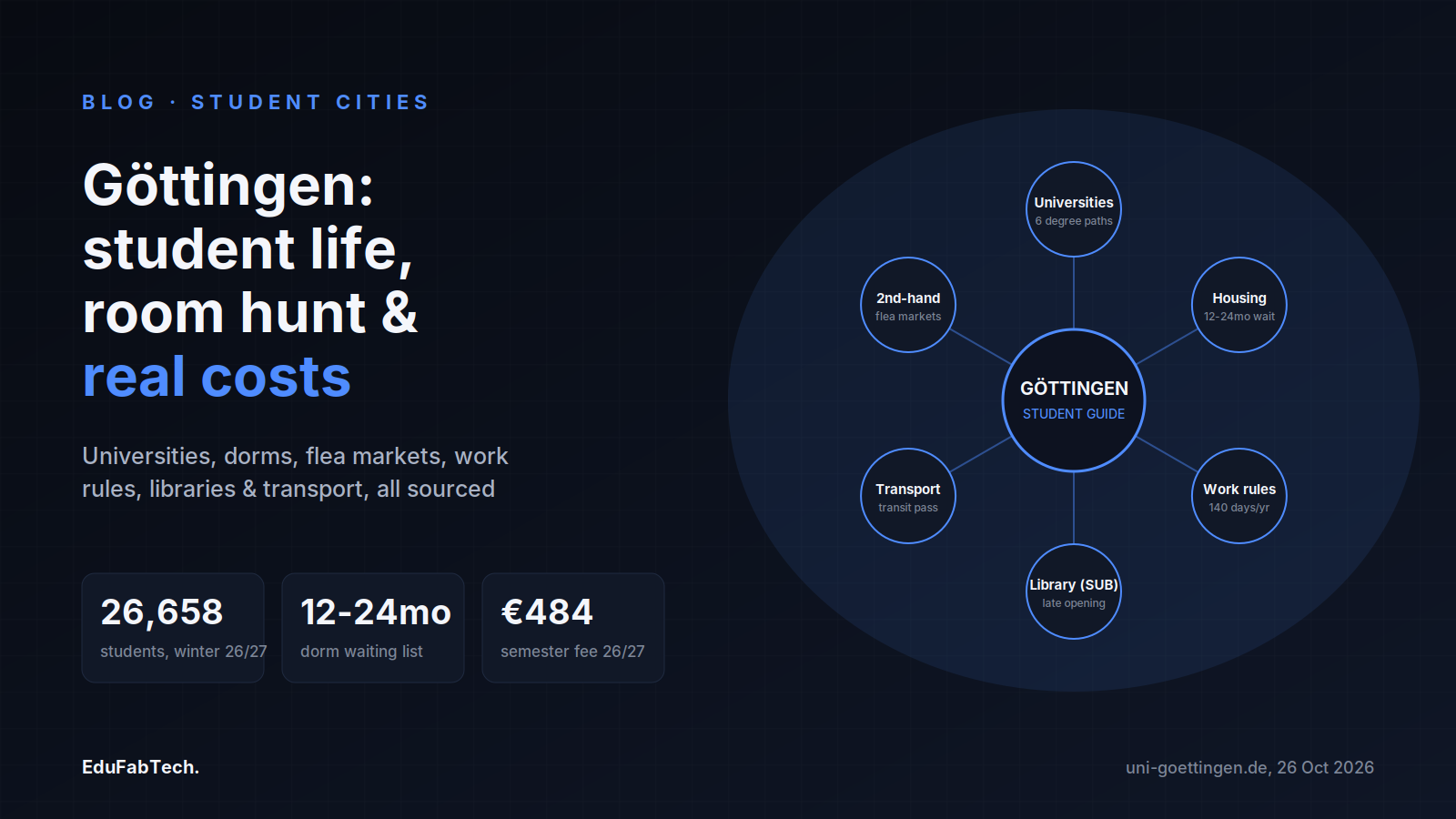
Göttingen is a small city in southern Lower Saxony where the timetable of a single university sets the rhythm of almost everything. The Georg-August-Universität reported a provisional 26,658 students for the 2026/27 winter semester in its enrolment press release of 26 October 2026, a figure large enough that in term time the old town's cafés, bookshops and bike lanes feel built for undergraduates. The city markets itself as the Stadt, die Wissen schafft — the town that creates knowledge — and the Gänseliesel fountain in the market square, which doctoral graduates traditionally climb to kiss the bronze goose-girl, is as close as a university town gets to a civic mascot. The centre is flat and compact: most students walk or cycle, and a great deal of daily life happens within the ring of the medieval wall.
Six places to earn a degree in and near Göttingen
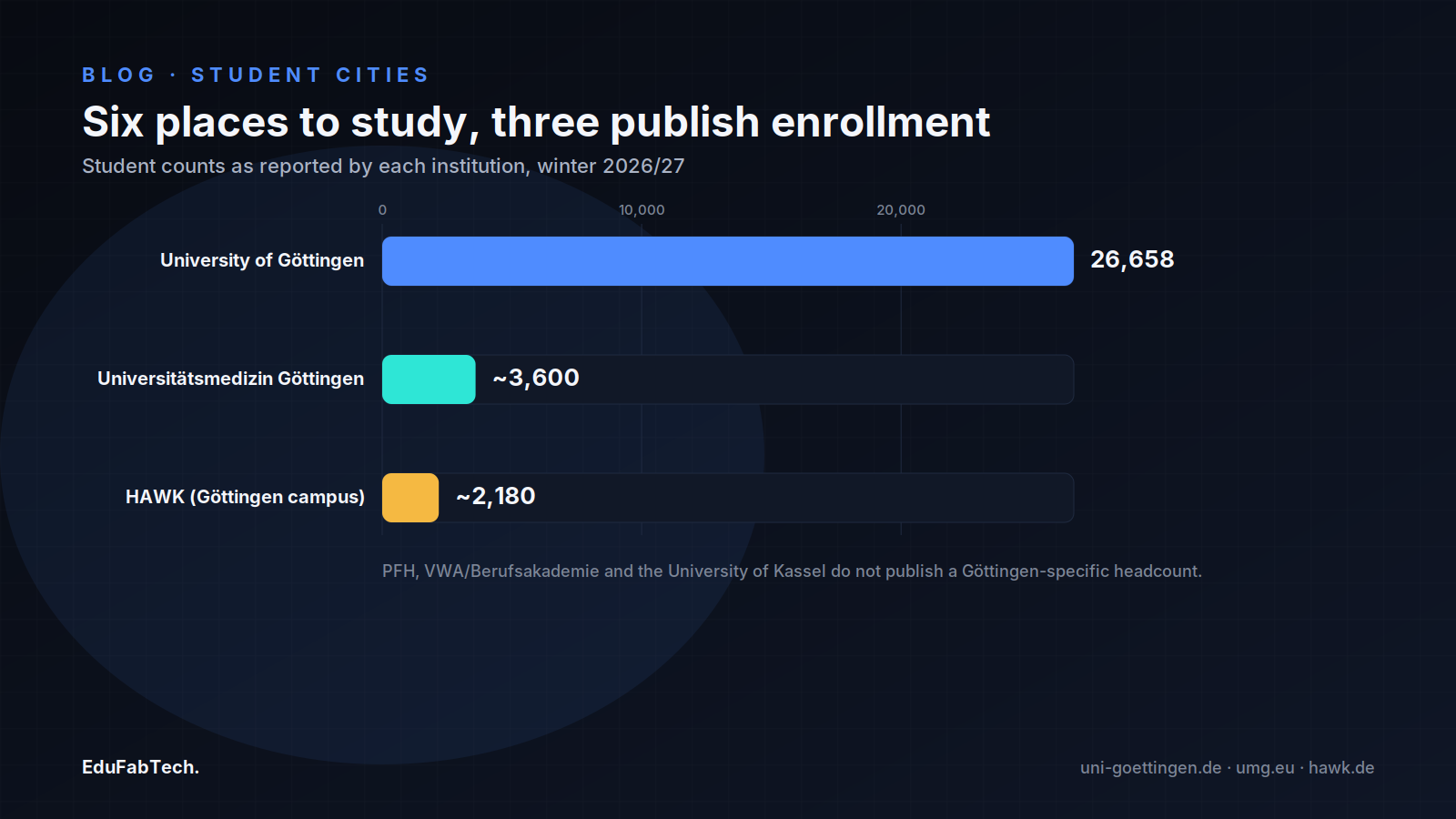
The University of Göttingen (Georg-August-Universität) is the anchor. Its enrolment press release of 26 October 2026 recorded around 4,440 new students, a provisional total of 26,658, and an international share that rose to 19.3 per cent from 18.5 per cent the year before (uni-goettingen.de). Law was the most sought-after first-semester subject with 326 first-year students, ahead of Business Administration, Agricultural Sciences and Forestry — a reminder that alongside its famous mathematics and physics tradition, Göttingen is also a serious agricultural and forestry school. The central campus sits just north of the old town, with the science faculties on the Nordcampus further out.
Medicine is run through Universitätsmedizin Göttingen, the university's medical centre and teaching hospital on the eastern edge of the centre. UMG says around 3,600 students are enrolled across human medicine, dental medicine, molecular medicine and cardiovascular science, and that its faculty of medicine has existed since 1737 (umg.eu); human medicine leads to the national state examination (Staatsexamen) rather than a bachelor's or master's degree. For applied subjects, the HAWK University of Applied Sciences and Arts runs a Göttingen campus that it describes as having about 2,180 students and 24 study programmes in its faculties of Engineering and Health and of Resource Management (hawk.de) — the hands-on, lab-and-workshop counterpart to the research university.
Three smaller institutions round out the list. The Private University of Applied Sciences (PFH) is a private, fee-charging school in Göttingen with campus and distance programmes in management, engineering, psychology and health technology. VWA und Berufsakademie Göttingen teaches business part-time; its state-recognised Berufsakademie awards a Bachelor of Arts through dual study programmes in Business Administration and Social Work. And if you are willing to commute, the University of Kassel, founded in 1971, sits in the neighbouring city of Kassel to the south, reachable by regional train. Listings near the main campus are collected on EduFabTech at /near/university-of-gottingen.
Finding a room in a tight market
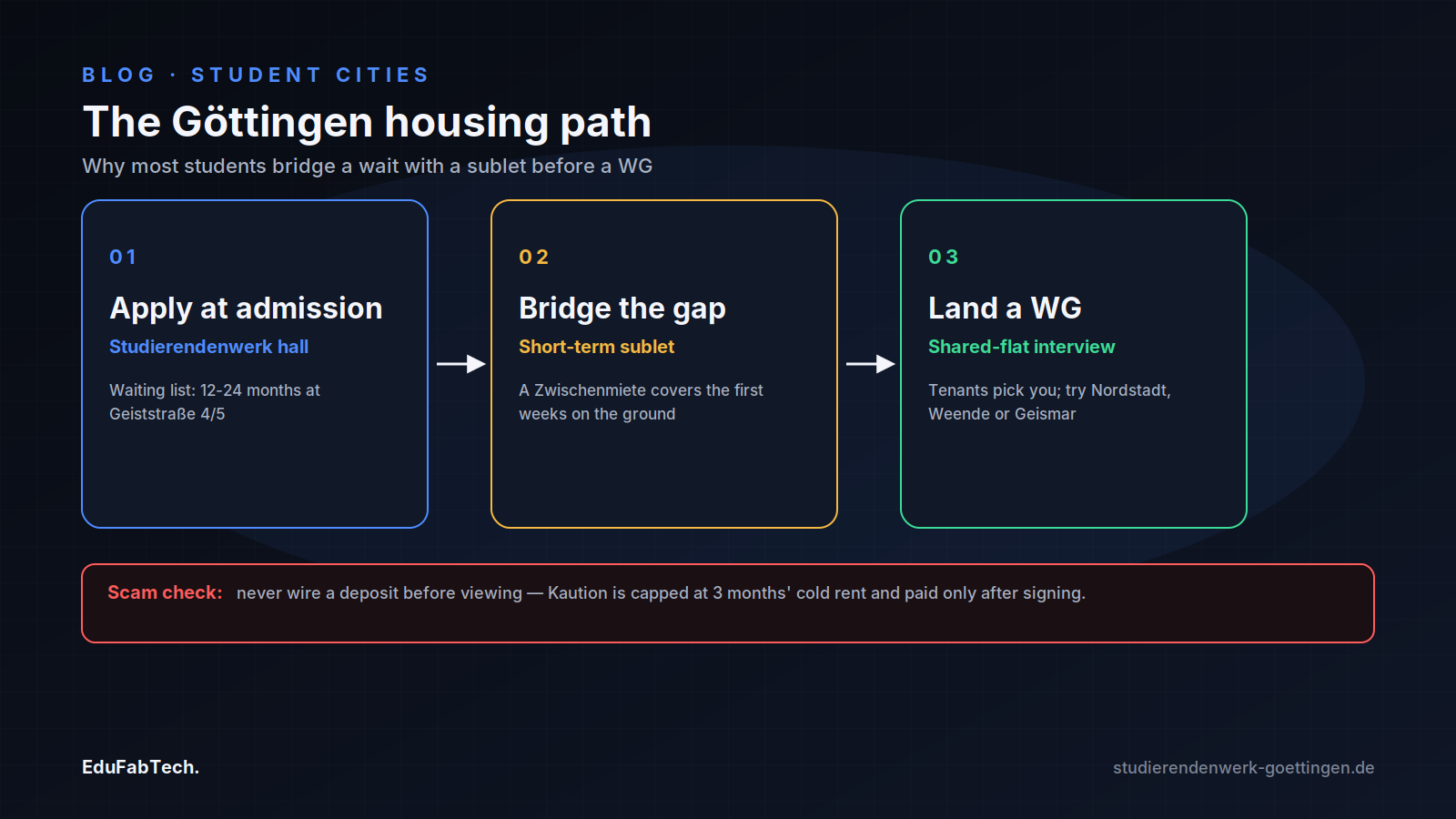
Housing is the hardest part of arriving in Göttingen, because the city is small and demand is seasonal — it peaks sharply every October. The cheapest reliable option is a hall of residence run by the Studierendenwerk Göttingen, the public student-services body. Its stock ranges from single rooms in shared flats to small apartments spread across dormitories in and around the centre. These are not available on demand: the Studierendenwerk's own page for its Geiststraße 4/5 residence lists a waiting period of 12 to 24 months for both room types (studierendenwerk-goettingen.de), so you apply the moment you have an admission offer, not when you arrive.
Most students who miss out on a hall end up in a Wohngemeinschaft (a shared flat, or "WG"), where current tenants interview candidates and pick one. Popular areas are the old town itself, Weende and the Nordstadt near the science campus, and Geismar and Grone further out. Rooms turn over fastest in late summer; starting in a short-term sublet (Zwischenmiete) for the first weeks and searching on the ground is often more realistic than securing a permanent room from abroad.
On scams: in Göttingen, as in every German university town, the fake listings appear on the same WG and housing portals students genuinely use. The pattern is consistent — an unusually cheap, well-photographed room, a "landlord" who is conveniently abroad, and a request to wire a deposit or send the keys' cost before you can view. Do not. A deposit (Kaution) is normal and is capped by German law at three months' cold (base) rent, but it is paid only after you have seen the place and signed a contract. View in person, or by live video with the actual person letting the room, and never send money by bank transfer, gift card or cryptocurrency to "reserve" a room you have not seen. The Studierendenwerk never asks for a holding fee to keep a dormitory place. EduFabTech's room listings for the city are at /in/germany/goettingen/rooms.
Kitting out a room: the Wochenmarkt, flea markets and second-hand
Dormitory rooms in Göttingen are typically let unfurnished — the Geiststraße page states plainly that both its room types come unfurnished — so budget for a bed, a desk and a lamp. The cheapest route is second-hand. The city's official listing of flea markets (Flohmärkte) names several recurring venues, including a market on the Wochenmarktplatz (Am Wochenmarkt 1) with eleven dates spread across 2026, and regular markets at the Kaufpark and other sites from spring through autumn (goettingen.de). For food and everyday supplies, the Wochenmarkt (weekly market) brings regional traders into the centre on market days through the week.
Online, student WhatsApp and Facebook groups, departmental noticeboards and the end-of-semester move-out season are when desks, bikes and crockery change hands cheaply or are given away. EduFabTech gathers local second-hand items, furniture and free giveaways at /in/germany/goettingen/second-hand. One practical habit: in Germany, items left on the pavement marked zu verschenken ("to give away") are genuinely free to take.
Working while you study
Many students in Göttingen take a part-time job, and the rules differ sharply by nationality. For students from non-EU and non-EEA countries, the German federal government's official portal Make it in Germany states that you may work up to 140 full days or 280 half days per year alongside your studies without further permission (make-it-in-germany.com); a half day is counted as up to four hours. Working beyond that limit, or in self-employment, needs the approval of the local immigration office — in Göttingen, the Ausländerbehörde within the city administration. This is general information, not legal advice: confirm your own conditions with that office and with the exact entry on your residence permit, because the terms attached to individual permits vary. EU and EEA students are treated essentially like German students. Student assistant jobs at the university are a common first job, and local openings are listed at /in/germany/goettingen/jobs.
Where to read: the SUB and other study spaces
The main study space is the Niedersächsische Staats- und Universitätsbibliothek Göttingen (SUB), one of Germany's large research libraries, whose central library sits on the Platz der Göttinger Sieben beside the central campus. Its own site lists long opening hours at the central library — into the late evening on weekdays and open at weekends (sub.uni-goettingen.de) — and the system runs numerous branch and departmental libraries across the faculties, so there is usually a reading room close to wherever you have lectures. During exam periods seats fill early; departmental libraries and the learning spaces listed at /in/germany/goettingen/study-spaces are useful fallbacks when the central library is full.
Getting around: buses, bikes and the semester ticket
Göttingen is small enough that a bicycle is the default means of transport, and the centre is largely walkable. City buses are run by the Göttinger Verkehrsbetriebe (GöVB). The important point for students is that the semester fee includes a Germany-wide semester ticket based on the Deutschlandticket, and GöVB confirms on its own fares page that Deutschlandticket holders can use it on its city buses within Göttingen (goevb.de). In practice that one ticket covers both the local GöVB buses and regional and local public transport across Germany, which makes weekend travel from Göttingen's station — on the fast north–south rail line through Hannover, Kassel and Frankfurt — straightforward and already paid for.
What a semester actually costs
There is no tuition fee at the public universities, but every student at the University of Göttingen pays a semester contribution (Semesterbeitrag). The university's own fees page sets it at €484.18 for the 2026/27 winter semester, a sum that bundles the administrative fee, the student-body and student-services contributions and the Germany-wide semester ticket (uni-goettingen.de); long-term students pay an extra €500 on top. For housing, the Studierendenwerk's Geiststraße 4/5 residence currently lists single rooms of 10–31 m² at an inclusive (warm) rent of €290.50–350.50 per month and shared double rooms at €375.50–390.50 (studierendenwerk-goettingen.de) — among the cheaper options in the city, which is part of why the waiting list is long. Incoming non-EU students should also plan for the blocked-account requirement: Make it in Germany's figures for 2026 put the standard proof of funds at €11,904 for the first year, released at €992 a month (make-it-in-germany.com).
The good and the hard
What Göttingen does well is scale. It is compact, cheap to get around, safe to cycle in, and so dominated by students that the libraries, bars and societies are built for them; the university's research depth and the breadth of subjects — from forestry to molecular medicine — are real draws. The rail links mean you are rarely stuck. What is hard is mostly housing: the market is small and tight, dormitory waiting lists run to one or two years on the Studierendenwerk's own figures, and arriving in October without a room already arranged is stressful. The town is quiet by the standards of a Hamburg or a Cologne, winters are grey and damp, and if you want the energy of a big city you will be taking the train to find it. For most students the trade is worth it, but go in with the room sorted and the costs understood.
A checklist for your first weeks
- Apply to the Studierendenwerk for a hall as soon as you are admitted — the waiting list is measured in months, not weeks.
- Never pay a deposit before you have seen a room in person or by live video; a Kaution is capped at three months' cold rent and is paid only after signing.
- Register your address at the Bürgeramt (residents' office) and, if you are a non-EU student, keep the Ausländerbehörde's conditions on your permit in front of you before taking any job.
- Confirm your semester fee payment so your Deutschlandticket-based semester ticket activates; it covers both GöVB city buses and nationwide regional transport.
- Get a bike early and a library card for the SUB; both do more for daily life here than almost anything else.
- Furnish from flea markets, move-out giveaways and zu verschenken piles rather than buying new. Start at /in/germany/goettingen.
A quick question for readers
Do you work part-time while you study?
Many students work to pay the bills. See how common it is — and how many hours people really do.
Pick an answer, create a free account in a minute, and your vote counts. Already a member? Sign in
Comments 3
Comment-
The 12 to 24 month wait for a Geiststraße room is the headline stat, but it's sourced from one dormitory's own page and never set against to…
-
The housing section buries its own contradiction. A 10-31 m² single room at €290.50-350.50 is called 'among the cheaper options,' but the wa…
-
The bit that actually bites is the maths on the dormitory waiting list. Twelve to twenty-four months for a Geiststraße room, against a check…
Join free to read the full comments and reply Comments are between members; an account takes a minute.
Source: Georg-August-Universität Göttingen
Sources (5)
- Georg-August-Universität Göttingen. Winter semester begins: around 4,440 new students. Georg-August-Universität Göttingen, 2026. uni-goettingen.de ↗ · checked 13 Nov 2026
- Studierendenwerk Göttingen. Dormitory Geiststraße 4/5. Studierendenwerk Göttingen, 2026. studierendenwerk-goettingen.de ↗ · checked 13 Nov 2026
- Georg-August-Universität Göttingen. Semesterbeiträge. Georg-August-Universität Göttingen, 2026. uni-goettingen.de ↗ · checked 13 Nov 2026
- Göttinger Verkehrsbetriebe. Tickets. Göttinger Verkehrsbetriebe (GöVB), 2026. goevb.de ↗ · checked 13 Nov 2026
- Universitätsmedizin Göttingen. Study and teaching. Universitätsmedizin Göttingen (UMG), 2026. umg.eu ↗ · checked 13 Nov 2026