Studying in Goslar: the Energie-Campus, the Harz universities, housing and student life
Goslar is a World Heritage mining town that now hosts a TU Clausthal campus and new digital degrees — here is how studying and living there actually works, with sourced costs and the honest trade-offs.
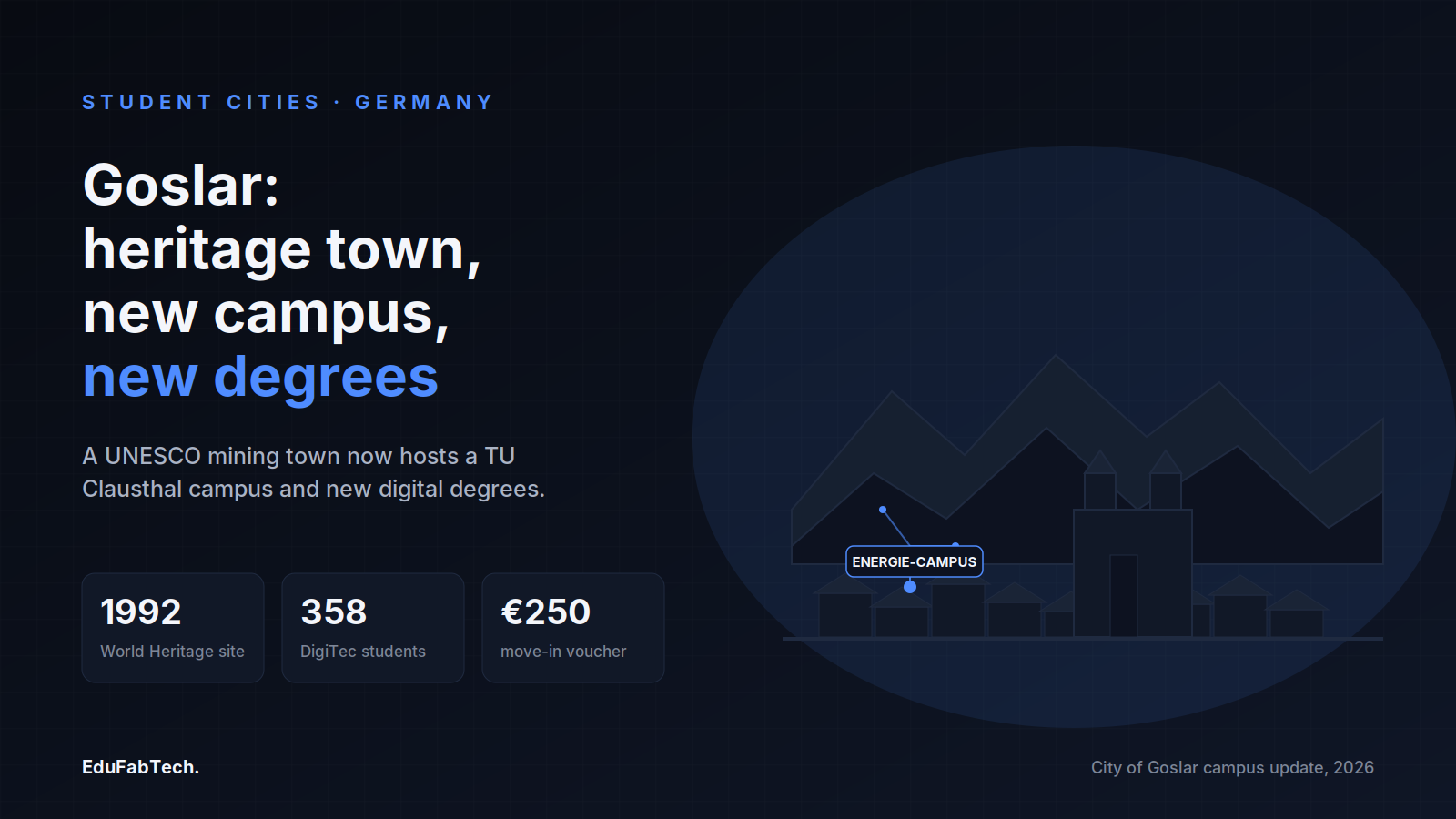
A thousand-year mining town learning to be a student town
Goslar sits at the northern foot of the Harz, the low mountain range that divides Lower Saxony from Saxony-Anhalt. Its old town, together with the Rammelsberg ore mine, was inscribed on the UNESCO World Heritage list in 1992; the Welterbe im Harz description counts more than 1,500 half-timbered houses from the 15th to the 19th centuries packed into the lanes below the Kaiserpfalz, the imperial palace that gives the town its silhouette. Rammelsberg was worked for roughly a thousand years until the last shift in 1988. For most of its history Goslar was a town of miners, merchants and emperors, not of students.
That is changing, slowly and deliberately. The town has become what its administration calls a Zukunftsstandort — a future location — by hosting a campus of a technical university and a set of new digital degrees, rather than by founding a university of its own. The result is unusual for Germany: the degrees that carry Goslar's name are taught in the town, but the two universities behind the region are up in the hills, in Clausthal-Zellerfeld and in Wernigerode across the state line.
So read this guide with that geography in mind. If you enrol on one of the new programmes you will actually live and study in Goslar. If you want the full range of a technical university — mining, materials, energy, chemistry — you will study in Clausthal-Zellerfeld, and you can choose whether to live up there or commute from Goslar in the valley. Either way, EduFabTech's local listings for the city are gathered at /in/germany/goslar.
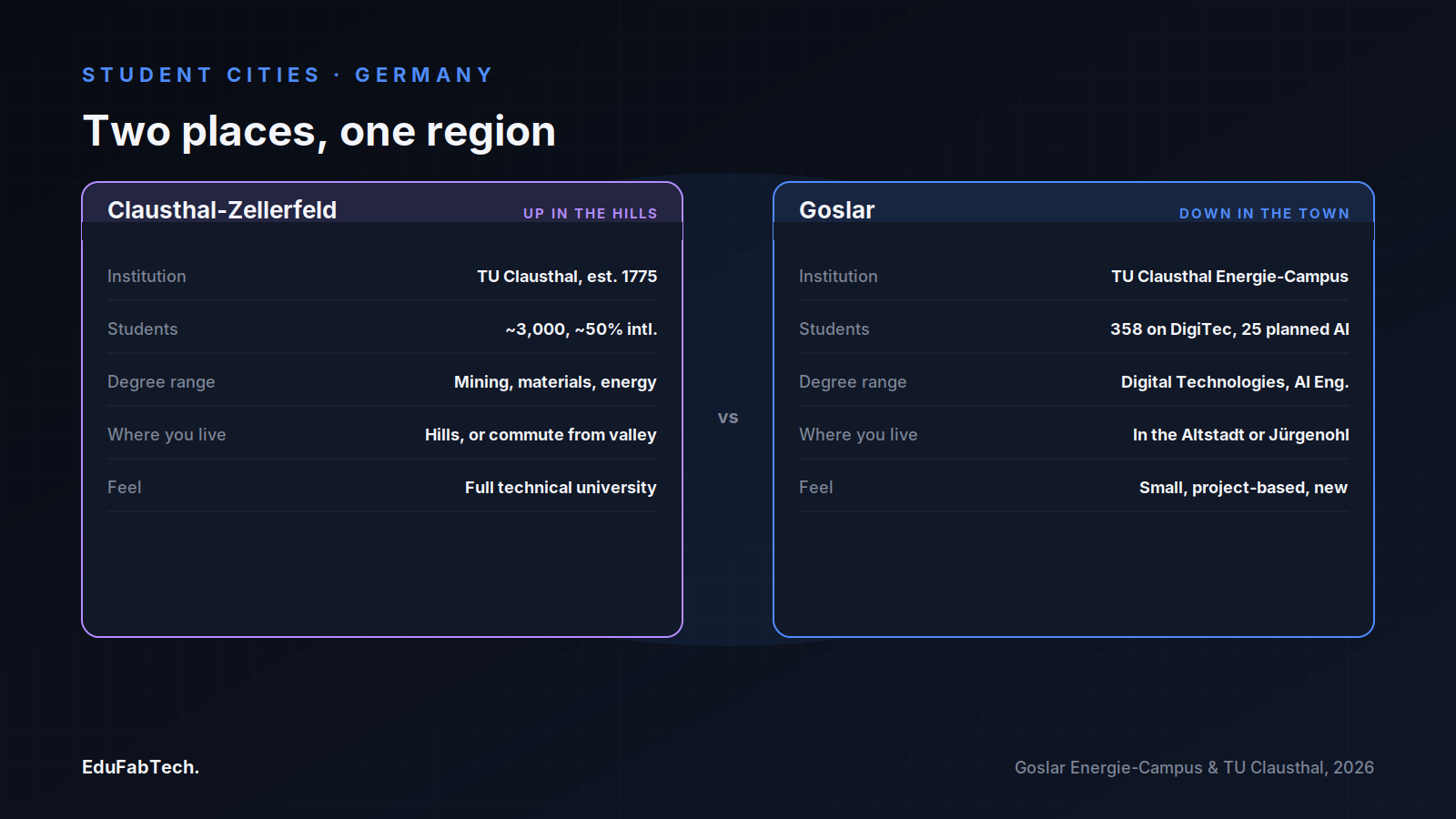
Two universities in the hills, and a campus in the town
The anchor institution is Clausthal University of Technology (Technische Universität Clausthal), in the Oberharz town of Clausthal-Zellerfeld about twenty kilometres south of Goslar. Its own figures page gives a founding year of 1775, around 3,000 students, around 50 percent of them from abroad, and around 85 professors — one of Germany's smallest and most international universities, grown out of a historic mining academy and now organised around what it calls the lead topic of circular economy, with research centres for materials, energy storage, digital technologies, drilling simulation and simulation science.
In Goslar itself, TU Clausthal runs the Energie-Campus on Am Stollen, on the slope below Rammelsberg, where its Research Center for Energy Storage Technologies (EST) and the Center for Digital Technologies (DIGIT) are based. This is the part of the university that sits in the town, and it is where the undergraduate teaching described below happens.
The second institution the region points students towards is Harz University of Applied Sciences (Hochschule Harz). It is worth being precise about where it is: its Wernigerode campus page places the main site in Wernigerode, in Saxony-Anhalt, with a second campus in Halberstadt, and the departments of Automation and Computer Science and of Business Studies in Wernigerode. Wernigerode is a Harz town in its own right, on the far side of the range from Goslar and in a different federal state, so treat Harz University as a nearby regional option rather than a Goslar institution.
What you can actually study in Goslar
The degree that has put students on Goslar's streets is Digital Technologies (DigiTec), a Bachelor of Science offered jointly by TU Clausthal and Ostfalia University of Applied Sciences in Wolfenbüttel. Its programme profile describes a project-based course run by the two institutions together; the first year is taught in Goslar, in the GoTEC building on the Energie-Campus, before study spreads to the partner locations in Wolfenbüttel and Clausthal-Zellerfeld. The town's administration reported in its 2026 campus update that 358 students were enrolled on Digital Technologies, above the original target of 296, with a medium-term aim of 400 to 450.
A second programme is new. TU Clausthal announced in a press release dated 21 April 2026 a bachelor's degree in AI Engineering, based at DIGIT in Goslar, starting in the winter semester 2026/27 and running over six semesters, with eight specialisations. The same city update put the planned first cohort at 25 and described the programme as, so far, unique in Lower Saxony. Both degrees lean heavily on project work with regional companies, which is the main reason the town, not just the university, is involved in running them.
The practical consequence for a prospective student: the choice in Goslar itself is narrow and engineering-flavoured. If you want breadth — humanities, medicine, law, a large social scene — Goslar is not that place, and you would look to the full universities in the region or elsewhere.
Finding a room in a small market, and the deposit traps
Goslar is a small housing market, which cuts both ways. Rents are lower than in a big university city, but there are few purpose-built student blocks in the town, so most students rent an ordinary flat or a room in a shared flat (a WG). For the DigiTec and AI Engineering intake the programme has set up a shortcut: its housing page says a dedicated room quota is reserved for students on the programme and mediated through the municipal housing company, with partly furnished rooms and shared or single flats, and a seven-step process that ends with a €250 furnishing voucher once you register your address in the city. There is no guarantee of a place, but it is the safest first channel, so start there before you look on the open market.
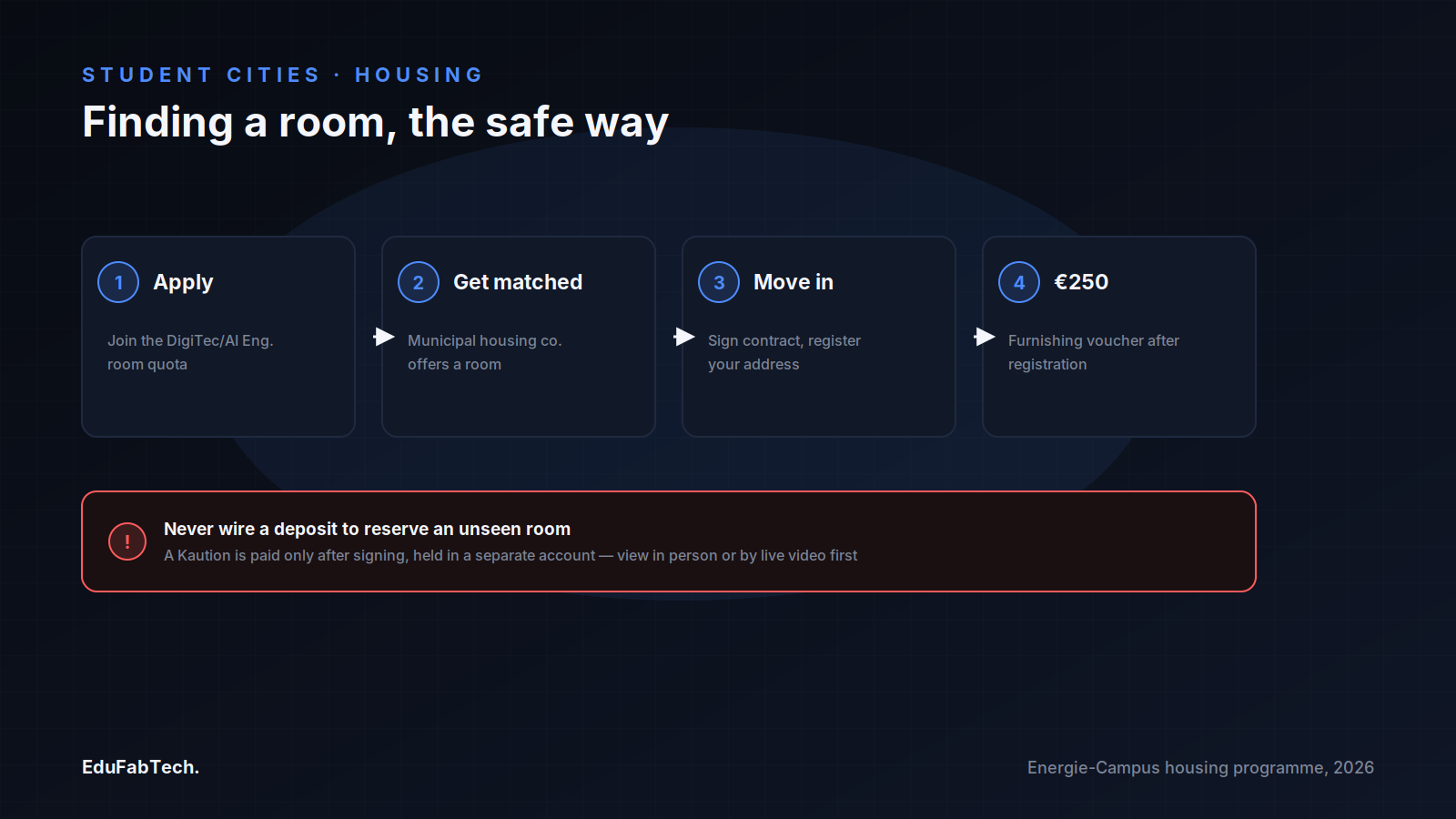
Because the market is thin and the intake is international, the scam pattern to expect in Goslar is the familiar one aimed at newcomers who cannot view in person: an attractive, cheap flat in the Altstadt advertised in a student group or portal, a landlord who is conveniently abroad, and a request to wire a deposit to "reserve" the room before any viewing. Do not do it. Never send a deposit by bank transfer, gift card or cryptocurrency to hold a room you have not seen. In Germany a deposit (Kaution) of up to two or three months' cold rent is normal, it is paid only after you sign a contract and is held in a separate account, and a genuine landlord will let you view the place in person or by live video first. If you are coming from abroad, lean on the programme's housing contact or, for Clausthal, the Studierendenwerk, rather than paying a stranger up front. EduFabTech's own room listings for the city are at /in/germany/goslar/rooms.
Students based up in Clausthal-Zellerfeld have a more conventional option: the Studierendenwerk OstNiedersachsen runs halls there, including Haus VI on Leibnizstraße with 175 places, where mostly furnished single rooms and apartments are let, as of 2026, for between €368.50 and €504.50 a month including operating costs. That is a rare dependable, dated housing figure for this area; Goslar itself has no comparable published student-rent table, so for private flats in the town you should compare current listings rather than trust a single number.
Furnishing a room: weekly markets and second-hand
Once you have a room, Goslar's markets are genuinely useful and genuinely local, not a tourist add-on. The city's weekly markets run on the Jakobikirchhof in the old town on Tuesdays and Fridays from 8:00 to 13:00, and in the Jürgenohl district on Danziger Straße on Wednesdays and Saturdays from 8:00 to 12:00, with local traders selling fruit, vegetables, fish, cheese, bread and flowers — the cheapest way to eat well while you find your feet.
For furnishing a room cheaply, the Stadtbibliothek Goslar holds a recurring book flea market where withdrawn titles sell for small change, which is a painless way to build a shelf. Beyond that, the honest advice in a town this size is to buy second-hand through local give-away and resale channels rather than furnishing new: EduFabTech gathers Goslar's second-hand goods at /in/germany/goslar/second-hand and second-hand furniture, including items people are giving away free, at /in/germany/goslar/furniture.
Working while you study
Part-time work is common and the rules depend on your passport, not on the town. According to the DAAD, students from the EU, the EEA and Switzerland have essentially unrestricted access to the German labour market (with insurance contributions once they work more than 20 hours a week), while students from other countries may work 140 full days or 280 half days per year, and working as an academic or student assistant at the university does not count against that limit. These are the current rules as DAAD states them; your residence permit is issued by the local Ausländerbehörde, which is the authority to confirm your own case with, and nothing here is legal advice. In a small town the realistic jobs are in hospitality, retail and the regional companies attached to the DigiTec projects; current local postings on EduFabTech are at /in/germany/goslar/jobs.
Libraries, desks and long opening hours up the hill
In Goslar, the main public study space is the Stadtbibliothek Goslar at Am Museumsufer 2, in the Kulturmarktplatz. Its library page gives opening hours of Tuesday to Friday 10:00–17:00 and the first Saturday of the month 10:00–13:00, with self-service "Open Library" access on Wednesday and Friday mornings from 10:00 to 14:00 — a reasonable base for coursework, though it is a town library rather than an academic one.
For a proper academic workplace you go up to Clausthal-Zellerfeld. The University Library Clausthal lists opening hours on its hours page of 09:00 to 24:00 on weekdays and 10:00 to 24:00 at weekends, which for a university this small is generous; the library's learning-space pages describe PC pools and bookable group rooms. If you are based in Goslar, EduFabTech also indexes desks and study spots in the town at /in/germany/goslar/study-spaces.
Getting around — and the ticket Goslar doesn't have
Goslar has no tram and no metro; getting around means regional buses and Deutsche Bahn trains, with the station on the line that links Goslar to Hannover, Braunschweig and Hildesheim, and regional buses climbing to Clausthal-Zellerfeld. The one thing to plan for is that, unlike most German universities, TU Clausthal has no semester ticket. Its student union, the AStA, states plainly on its semester-ticket page that there is no such ticket; instead students buy a VRB monthly student pass for €30, or the nationwide Deutschland-Ticket month by month. In budget terms that means transport is a real line item here rather than something bundled into your semester fee — worth weighing if you plan to live in one place and study in another.
Costs, trade-offs and a first-weeks checklist
The case for Goslar is concrete. Rents are modest by German standards, the Studierendenwerk halls up the hill are affordable at €368.50–€504.50 a month including operating costs (2026), the town actively courts students with a reserved room quota and a €250 furnishing voucher for students on its degree programmes, the degrees are small and project-based with direct company contact, and you live inside a genuinely beautiful World Heritage town at the edge of the Harz. The weekly markets, the library and the mountains are all within walking or short-bus distance.
The case against is just as concrete, and you should hear it before you commit. The student body in Goslar itself is still small and the choice of subjects is narrow; the full universities are elsewhere, which can mean a daily commute to Clausthal-Zellerfeld or Wernigerode; there is no semester ticket to soften that commute; the social and nightlife scene is that of a mid-sized historic town, not a student city; and the Harz uplands, where Clausthal-Zellerfeld sits, are among the colder, snowier parts of Germany, which shapes winters more than newcomers expect. For some students the quiet and the landscape are the appeal; for others they are the drawback.
A short checklist for the first weeks:
- Line up a room before you arrive — for DigiTec and AI Engineering through the programme's housing quota, for Clausthal through the Studierendenwerk — and never pay a deposit before you have seen the place.
- Register your address (Anmeldung) at the Bürgerbüro; if you are on the DigiTec or AI Engineering housing track, this is also what unlocks the €250 furnishing voucher.
- Complete your enrolment and, if you are an international student, sort out health insurance and any blocked-account requirement.
- Decide your transport early: a VRB monthly pass or the Deutschland-Ticket, since there is no semester ticket.
- Get a Stadtbibliothek card, and if you study up the hill, learn the University Library's late opening hours.
- If you hold a non-EU passport, confirm your work-day limit with the Ausländerbehörde before you take a job.
- Furnish from the markets, the library book sale and second-hand channels rather than buying new.
Used with clear eyes, Goslar is a workable and unusually scenic place to study — as long as you choose it for what it is: a small, practical, engineering-focused campus inside a medieval town, not a conventional university city.
A quick question for readers
Do you work part-time while you study?
Many students work to pay the bills. See how common it is — and how many hours people really do.
Pick an answer, create a free account in a minute, and your vote counts. Already a member? Sign in
Comments 3
Comment-
The number that'd make me pause is 358 enrolled on DigiTec against the Studierendenwerk halls' 175 places up in Clausthal - and that's a hal…
-
The honest asymmetry in this piece is the housing data: Clausthal's Haus VI gets a precise, dated figure, €368.50–€504.50 a month, sourced s…
-
The number that actually tells you something is the AI Engineering cohort size against DigiTec's: 25 students starting versus 358 already en…
Join free to read the full comments and reply Comments are between members; an account takes a minute.
Source: Technische Universität Clausthal
Sources (5)
- Technische Universität Clausthal. Mit neuem Bachelor „AI Engineering" setzt die TU Clausthal Maßstäbe. TU Clausthal, 2026. tu-clausthal.de ↗ · checked 25 Nov 2026
- Technische Universität Clausthal. TU Clausthal in figures. TU Clausthal Presse, Kommunikation & Marketing, 2026. presse.tu-clausthal.de ↗ · checked 25 Nov 2026
- Studierendenwerk OstNiedersachsen. Haus VI, Clausthal-Zellerfeld. Studierendenwerk OstNiedersachsen, 2026. stw-on.de ↗ · checked 25 Nov 2026
- DAAD. Side jobs. Deutscher Akademischer Austauschdienst, 2026. daad.de ↗ · checked 25 Nov 2026
- Stadt Goslar. Goslar wird zum Zukunftsstandort: Digitale Studiengänge auf Wachstumskurs. Stadt Goslar, 2026. goslar.de ↗ · checked 25 Nov 2026