Studying in Green Bay: universities, housing and student life
A practical, sourced guide to UW-Green Bay and NWTC — where students live, what a room costs, how the free bus pass works, and the honest trade-offs of a city built around a bay and a football stadium.
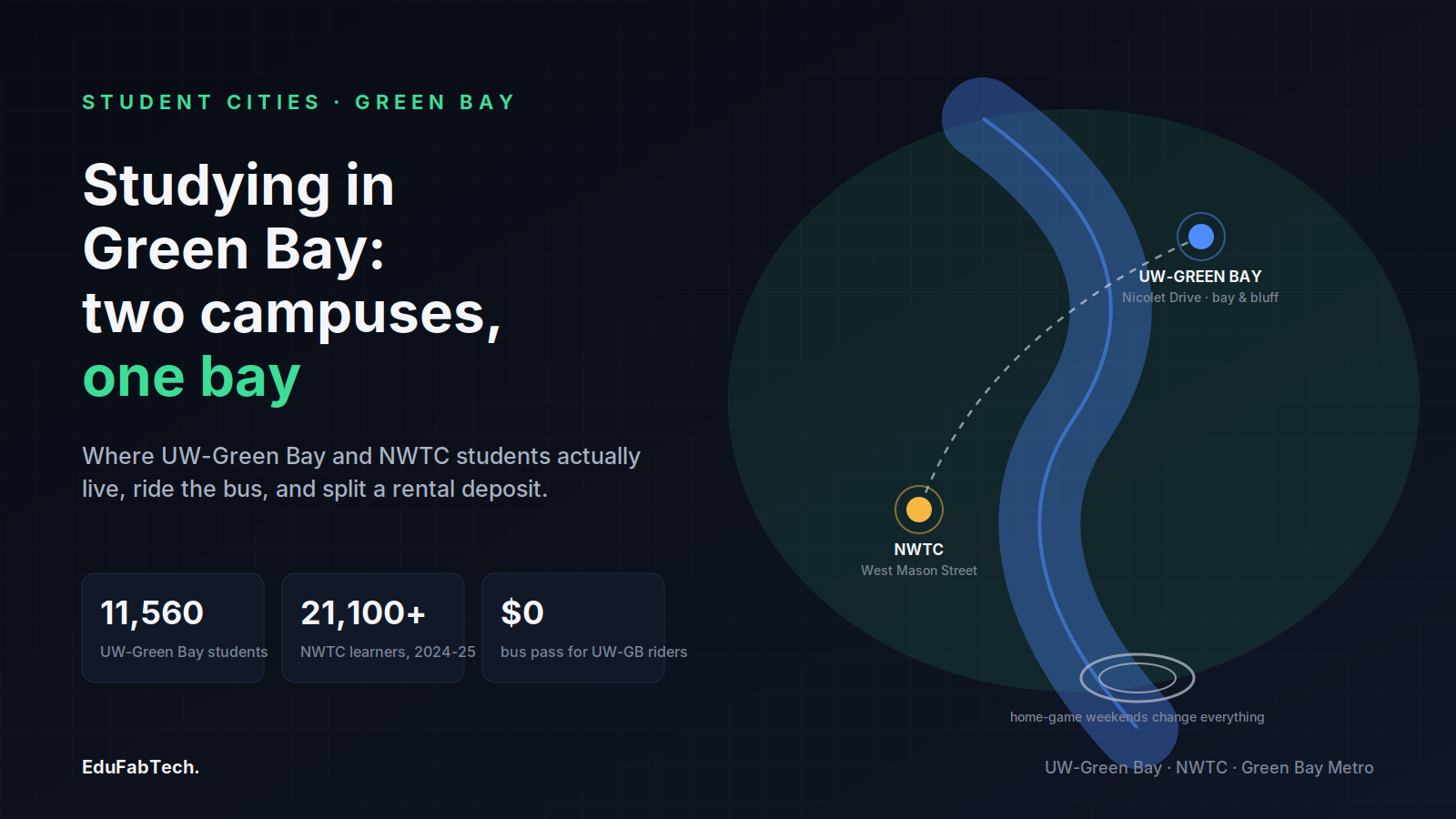
Green Bay sits where the Fox River empties into the long, shallow bay that gives the city its name, at the far southern tip of the water that opens into Lake Michigan. It is a working port and paper town, the smallest city in the United States to hold a major professional sports franchise, and a place where the rhythm of autumn is set as much by the Green Bay Packers' home schedule at Lambeau Field as by the academic calendar. For students, the useful thing to understand first is that the city has two campuses with almost nothing in common, on opposite sides of the river, serving very different people.
One is a public university on a wooded ridge above the bay; the other is one of the largest technical colleges in the state, a few minutes from downtown. Between them they shape where rooms are cheap, where the buses run, and which parts of a cold, car-shaped city a student actually uses. This guide pulls together what each institution publishes about itself, what the City of Green Bay charges to ride its buses, and the rules an international student has to live by — with every figure linked to the page it came from.
If you are starting from scratch, the local EduFabTech listings for Green Bay are a reasonable first stop for rooms, second-hand furniture and part-time work before term begins.
Two campuses, two kinds of student life
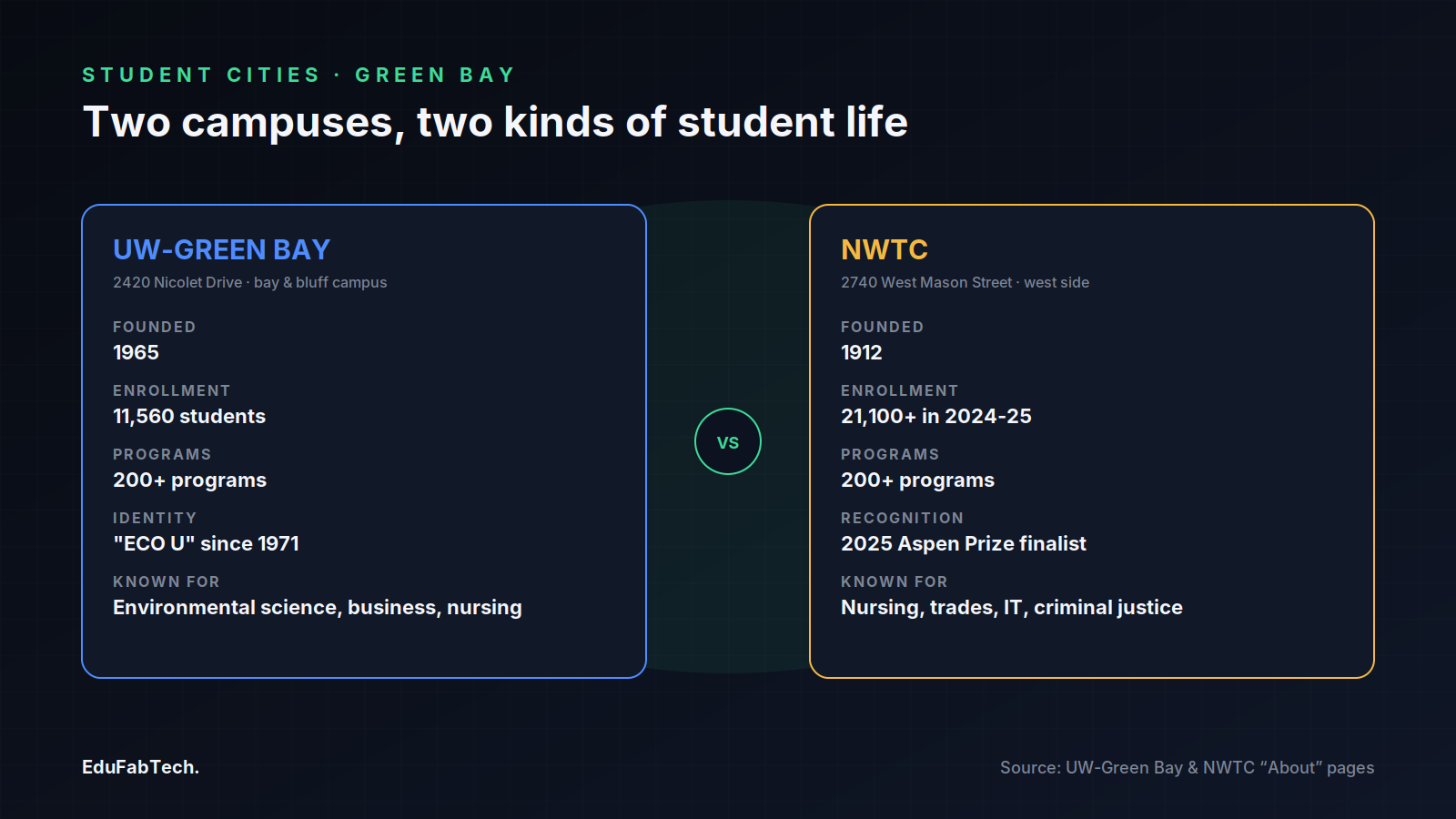
University of Wisconsin–Green Bay is the four-year public option, at 2420 Nicolet Drive on the city's north-east edge, where the campus meets the bay on one side and the limestone of the Niagara Escarpment on the other. The university's own about page says it was founded in 1965, reports total enrolment of 11,560, calls itself "ECO U" — an environmental identity it traces to 1971 — and describes itself as the fastest-growing University of Wisconsin school, with more than 200 programs. Much of the site is left as natural land, including the Cofrin Memorial Arboretum that rings the campus, so a walk between buildings can feel more like a nature trail than a quad. Environmental science, business and nursing are among its better-known fields.
Northeast Wisconsin Technical College (NWTC) is a different animal. Its about page dates the college to 1912, says more than 21,100 individuals took classes in the 2024–25 academic year, and lists 200-plus degree, diploma, certificate and apprenticeship programs, from registered nursing to construction trades, criminal justice and information technology. The main campus is at 2740 West Mason Street on the city's west side, a short drive from downtown. NWTC also notes it was a top-ten finalist for the 2025 Aspen Prize for Community College Excellence. For students who want a trade, a two-year associate degree, or a cheaper first two years before transferring, this is the practical route.
The neighbourhoods around each campus are genuinely different places to look for a room, which is worth settling before you fix on one side of the river.
Where rooms turn up, from campus to across the river
UW-Green Bay runs its own on-campus housing, and because the campus is somewhat removed from the city, a large share of undergraduates live there rather than commute. The housing is a mix of traditional residence-hall rooms and apartment-style units clustered on the Nicolet Drive side. Off campus, students who want to be near UW-Green Bay look at the east side and the Bay Settlement area along the bay, while anyone studying at NWTC or wanting cheaper rent tends toward the west side, the older housing stock near Broadway, and the neighbourhoods between the college and downtown.
Downtown itself, the East River and Astor districts, and the Broadway District across the river all have the kind of older single-family houses that get split into student rentals. For an NWTC student without a car, proximity to a bus route matters more than the neighbourhood's name. You can browse what is currently listed through the EduFabTech rooms pages, which is a safer starting point than chasing posts on social media.
Start looking early. For on-campus housing, apply as soon as your admission is confirmed; for off-campus leases, the useful window is late spring for a September start, because the better-located houses near both campuses turn over quickly once one academic year ends.
Signing a lease without losing a deposit
Rental scams in a city like Green Bay almost always follow the same script: a listing with a too-good price, a "landlord" who is conveniently out of town, and pressure to send money to hold the room before you have seen it. The single most protective rule is simple — never wire a deposit, buy gift cards, or send cryptocurrency to secure a place you have not walked through. Those payment methods are chosen precisely because they cannot be reversed.
See the unit in person, or have someone you trust see it, before paying anything. In Wisconsin, a landlord who takes a security deposit has specific obligations about returning it and itemising deductions, so insist on a written lease that names the parties and the amount, and get a dated receipt for any deposit. Be especially wary of a listing whose photos appear elsewhere, an address that does not match what you see on the ground, or anyone unwilling to let you view the property. A deposit of one month's rent is ordinary here; a demand for several months up front, paid instantly and irreversibly, is a warning sign, not a deal.
Furnishing a room for almost nothing
Green Bay's second-hand economy runs on two things: a strong farmers-market culture and the twice-yearly churn of students moving in and out. The Downtown Green Bay Saturday Farmers Market, at 130 E. Walnut Street, runs Saturdays from 7 a.m. to noon across a season listed as 23 May to 31 October 2026, with more than a hundred vendors, according to its listing; it is more food than furniture, but it is the easiest way to eat cheaply and learn the city. The Farmers' Market on Broadway, west of the river in the Broadway District, is the Wednesday counterpart during the warm months.
For the actual furnishing of a room, the move-out weeks at the end of each semester are when desks, chairs and mini-fridges appear on the kerb and in local listings. The EduFabTech page for second-hand furniture is built for exactly this, and it saves you from buying new what another student is trying to get rid of. Bring a friend with a car, or arrange a pickup, because Green Bay is not a city where you can carry a bookshelf home on foot.
Working while you study
Both institutions have on-campus jobs, and for domestic students a part-time job in dining, the library, a lab or a local shop is the normal way to cover costs. The honest caveat is that Green Bay's job market is spread out, so a job off campus usually means a bus ride or a car.
For international students, the rules are not advice to take lightly, and they come from the federal government rather than the university. The U.S. Citizenship and Immigration Services policy manual states that an F-1 student with approval from their Designated School Official may work an on-campus job for up to 20 hours per week when school is in session, and full-time during vacation periods. Anything beyond on-campus work — practical training, off-campus employment — has its own authorisation process. Treat your DSO, the international student office on your campus, as the first and last word on what you are allowed to do, and read USCIS directly rather than relying on second-hand summaries. Current local openings are collected on the EduFabTech jobs page.
Libraries and places to read
The Cofrin Library is the tall building at the centre of UW-Green Bay, and according to the library's hours page its second-floor Library Commons and Learning Center are open for study during campus building hours of 6 a.m. to 11 p.m. It is the quietest reliable indoor study space on the north-east side of the city once the weather turns.
At NWTC, the Green Bay campus library is open Monday to Thursday from 7:30 a.m. to 6 p.m. and Friday until 4 p.m., per the college's library FAQ, with a computer-equipped CyberZone and reservable study rooms available during the longer building hours. Beyond the campuses, the Brown County Library's downtown central branch gives any student a quiet, free place to work. The EduFabTech study spaces page lists additional desks and quiet rooms around the city.
Getting around a city built for cars
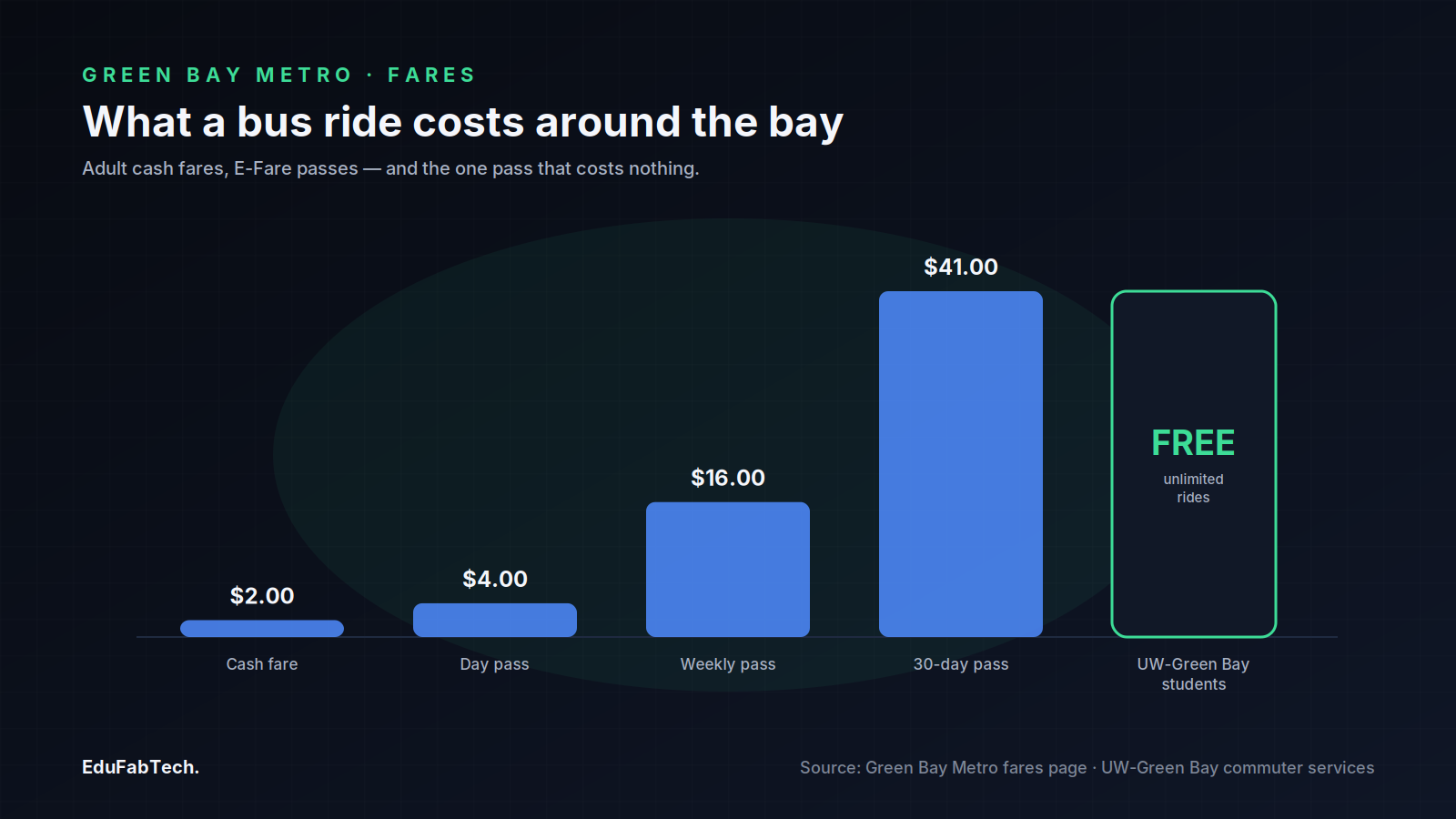
Green Bay is a driving city, but it has a real bus network, Green Bay Metro, run by the city. Its fares page lists an adult cash fare of $2.00, a day pass at $4.00, a weekly pass at $16.00 and a 30-day pass at $41.00, with a reduced 30-day pass at $31.00 for eligible riders. Rather than paper tickets, the system uses E-Fare, where each rider holds their own account on a reloadable smartcard or the E-Fare app.
The best deal in the city belongs to UW-Green Bay students. The university's commuter services page states that Green Bay Metro bus passes are free for currently enrolled UW-Green Bay students with the Green Bay campus segregated-fee designation, picked up at the University Ticketing and Information Center. NWTC students do not get a free pass; the college's transportation support page lists a $41.00 adult 30-day pass and a $31.00 reduced pass, and points students toward the city's LIFT low-income fare programme if they qualify. Winter is the real argument for sorting out transport early: snow and short daylight make the walk-and-wait experience harder than the map suggests.
What it costs, and what is good and hard
The clearest dated housing figure comes from UW-Green Bay itself. The university's 2026–27 housing rates put a residence-hall double at $4,854 for the academic year, shared-bedroom apartments from $5,123, and private-bedroom apartments at $5,988 to $6,131 per student — with all utilities, wireless internet and furnishings included, which removes the hidden costs that catch out first-year renters off campus. Dining plans and any off-campus rent are on top of that, and off-campus prices vary by neighbourhood and how far you are from a bus line.
What is genuinely good about Green Bay for a student: it is affordable by national standards, the two campuses cover both academic and vocational paths, the natural setting around UW-Green Bay is unusual, and a student body folded into a mid-sized city means less of the inflated, student-only pricing of bigger college towns. The free Metro pass for UW-Green Bay students is a real saving.
What is hard: this is a cold place. The Wisconsin State Climatology Office puts Green Bay's average snowfall at 55.6 inches a year, based on the 1991–2020 climate normals, and winters are long and dark. The city is spread out and built around cars, so without one — or without a route on a bus line — errands and off-campus jobs take planning. UW-Green Bay's distance from downtown is a double edge: quiet and green, but far from the bars, shops and part-time jobs that cluster elsewhere.
A checklist for the first few weeks
- Confirm housing first — apply for on-campus housing as soon as you are admitted, or view any off-campus room in person before paying a cent.
- Never send a deposit by wire transfer, gift card or cryptocurrency, and get a written lease and a dated receipt.
- If you are at UW-Green Bay, collect your free Green Bay Metro pass from the University Ticketing and Information Center; if you are at NWTC, price a 30-day pass or an E-Fare smartcard and check whether you qualify for the LIFT programme.
- International students: meet your Designated School Official in week one and confirm what work you are permitted before accepting any job.
- Furnish from the end-of-semester move-out churn and local second-hand listings rather than buying new.
- Find your study spot early — Cofrin Library, the NWTC library, or the Brown County downtown branch — and learn one warm indoor route for January.
- Check what is happening around town on the EduFabTech events page to meet people beyond your programme.
Green Bay rewards students who plan for the practical things — a room seen in person, a bus pass in hand, a warm coat bought before the first snow. Do that, and a small city on a cold bay turns out to be a manageable, affordable place to get a degree or a trade.
A quick question for readers
Do you work part-time while you study?
Many students work to pay the bills. See how common it is — and how many hours people really do.
Pick an answer, create a free account in a minute, and your vote counts. Already a member? Sign in
Comments 1
Comment-
The 20-hour on-campus cap for F-1 students is the detail I'd want pinned above the fold, not buried after the furniture section. It's a hard…
Join free to read the full comments and reply Comments are between members; an account takes a minute.
Source: University of Wisconsin–Green Bay
Sources (5)
- University of Wisconsin–Green Bay. 2026–27 Housing Rates. University of Wisconsin–Green Bay, 2026. uwgb.edu ↗ · checked 31 Oct 2026
- University of Wisconsin–Green Bay. About UW-Green Bay. University of Wisconsin–Green Bay, 2026. uwgb.edu ↗ · checked 31 Oct 2026
- Northeast Wisconsin Technical College. About NWTC. Northeast Wisconsin Technical College, 2026. nwtc.edu ↗ · checked 31 Oct 2026
- City of Green Bay. Green Bay Metro — Fares. City of Green Bay, 2026. greenbaywi.gov ↗ · checked 31 Oct 2026
- U.S. Citizenship and Immigration Services. Policy Manual, Volume 2, Part F, Chapter 6: Employment. U.S. Citizenship and Immigration Services, 2026. uscis.gov ↗ · checked 31 Oct 2026