Studying in Greensboro: universities, housing and student life
A practical, sourced guide to studying in Greensboro, North Carolina — its universities, where students live, what a room costs, work rules, study spaces and getting around.
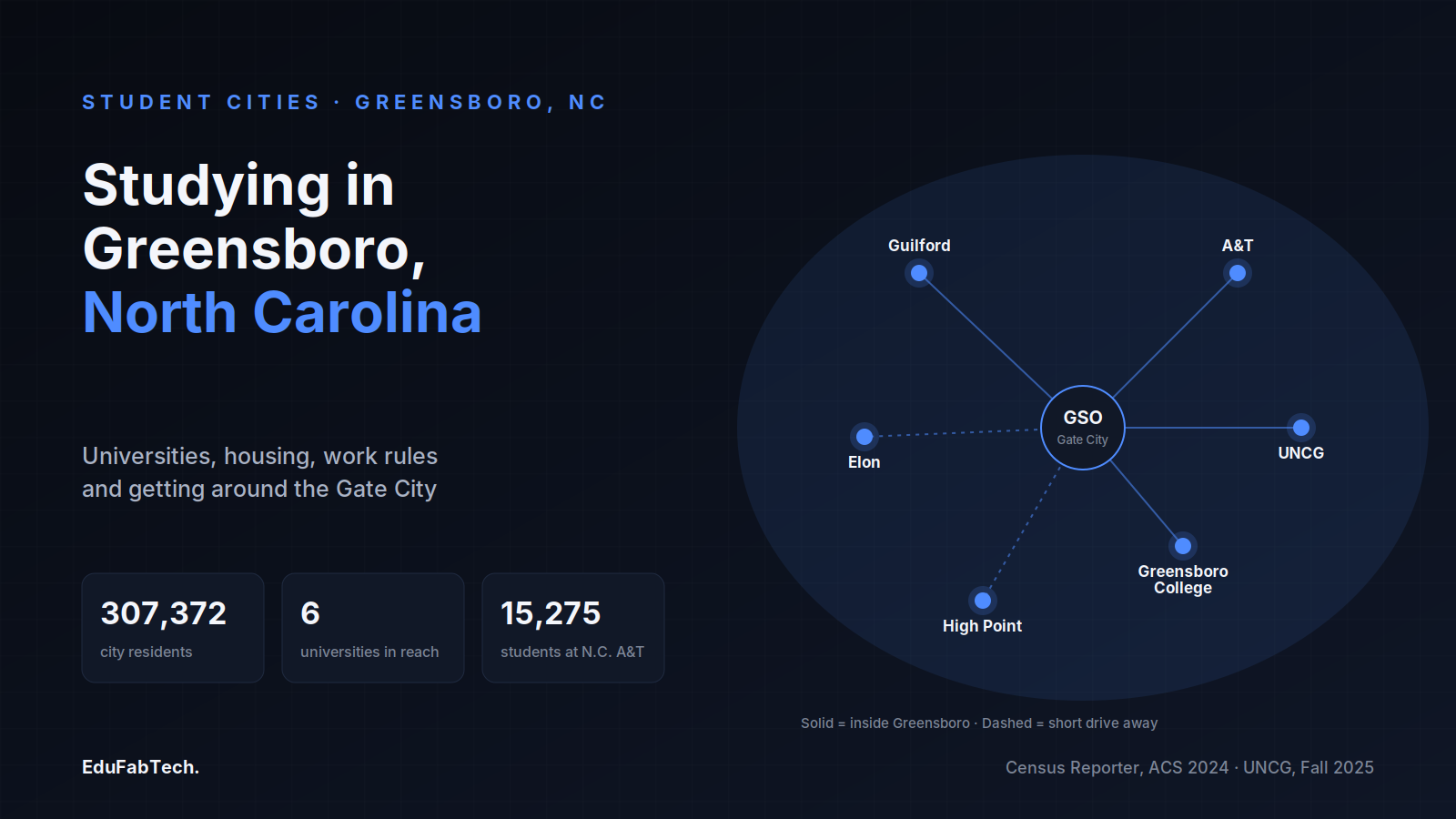
Greensboro sits in the middle of North Carolina's Piedmont Triad, roughly equidistant from the Blue Ridge and the coastal plain, and the nickname locals use — the Gate City — comes from its nineteenth-century role as a railway junction. According to Census Reporter's compilation of U.S. Census Bureau data (ACS 2024 one-year estimates), the city had about 307,372 residents and a median household income of $63,516. It is a mid-sized, spread-out Southern city with a strong student presence relative to its size, three distinct campuses inside the city limits and three more within a short drive.
For many students the city's identity is bound up with the sit-in of 1 February 1960, when four first-year students from North Carolina A&T refused to leave a segregated Woolworth lunch counter downtown; the building now houses the International Civil Rights Center & Museum, a short walk from Greensboro College. That history is not a museum piece here — A&T remains a working land-grant university and the anchor of East Greensboro.
The campuses, from East Market Street to Elon
North Carolina Agricultural and Technical State University occupies East Greensboro, with its library and historic core along East Market Street. It is the largest HBCU in the United States: the university reported Fall 2025 enrollment of 15,275, the first time any historically Black college or university has passed 15,000 students, and its twelfth consecutive year as the nation's largest public HBCU. A land-grant institution, it is best known for its College of Engineering and its agricultural and environmental sciences.
The University of North Carolina at Greensboro (UNCG) is a mile and a half southwest, its main campus centred on 1400 Spring Garden Street. Founded in 1891 as the State Normal and Industrial School — the first public women's college in North Carolina, per the university's history of UNCG — it is today a minority-serving institution with nearly 19,000 students, according to its About UNCG page; its campus includes the Weatherspoon Art Museum, which is free and open to the public. Between the two large public universities sit two small private colleges: Greensboro College, founded downtown in 1838 by the Methodist church and a small liberal-arts and master's college today (Greensboro College), and Guilford College, a Quaker-founded liberal-arts college in the northwest of the city whose roots as the New Garden Boarding School go back to 1837 (Guilford College).
Two more degree-granting universities are close enough to matter when you are choosing where to study and live. Elon University, in the town of Elon about twenty minutes west, is a private university founded in 1889 whose campus is designated as a botanical garden and sits between Greensboro and the Raleigh area. High Point University, roughly ten miles south in High Point, was founded in 1924 as High Point College and renamed in 1991; its campus is known for the lavish grounds it has built out since the 2000s, including a former shopping mall it bought and absorbed. If you are weighing these schools, read the course catalogue and the campus map on each university's own site rather than a ranking — and treat any ranking you do cite with its year attached.
Where students settle
Housing choices track the campuses closely. Around A&T, students live in East Greensboro near Market Street and in the university's own residence areas; around UNCG the student neighbourhoods are College Hill (the historic district immediately north of campus), the blocks off Tate Street — the city's long-standing student strip of cafés and small venues — and the nearby Lindley Park and Glenwood areas. Downtown apartments draw older students and those at Greensboro College. Elon students cluster in Elon and neighbouring Burlington; High Point students stay close to that campus, which is a genuine commute from central Greensboro rather than a bus ride.
On-campus, UNCG runs a large residence system (its Spartan Village and Spring Garden apartments, plus traditional halls) and A&T houses a substantial share of first-years. If you want to live off-campus, start looking in the spring for an August move-in; the College Hill and Tate Street blocks turn over quickly as leases run on the academic year. You can browse current student listings for the city on EduFabTech at /in/united-states/greensboro, rooms specifically at /in/united-states/greensboro/rooms, and the listings nearest campus at /near/university-of-north-carolina-at-greensboro.
Renting without being caught out
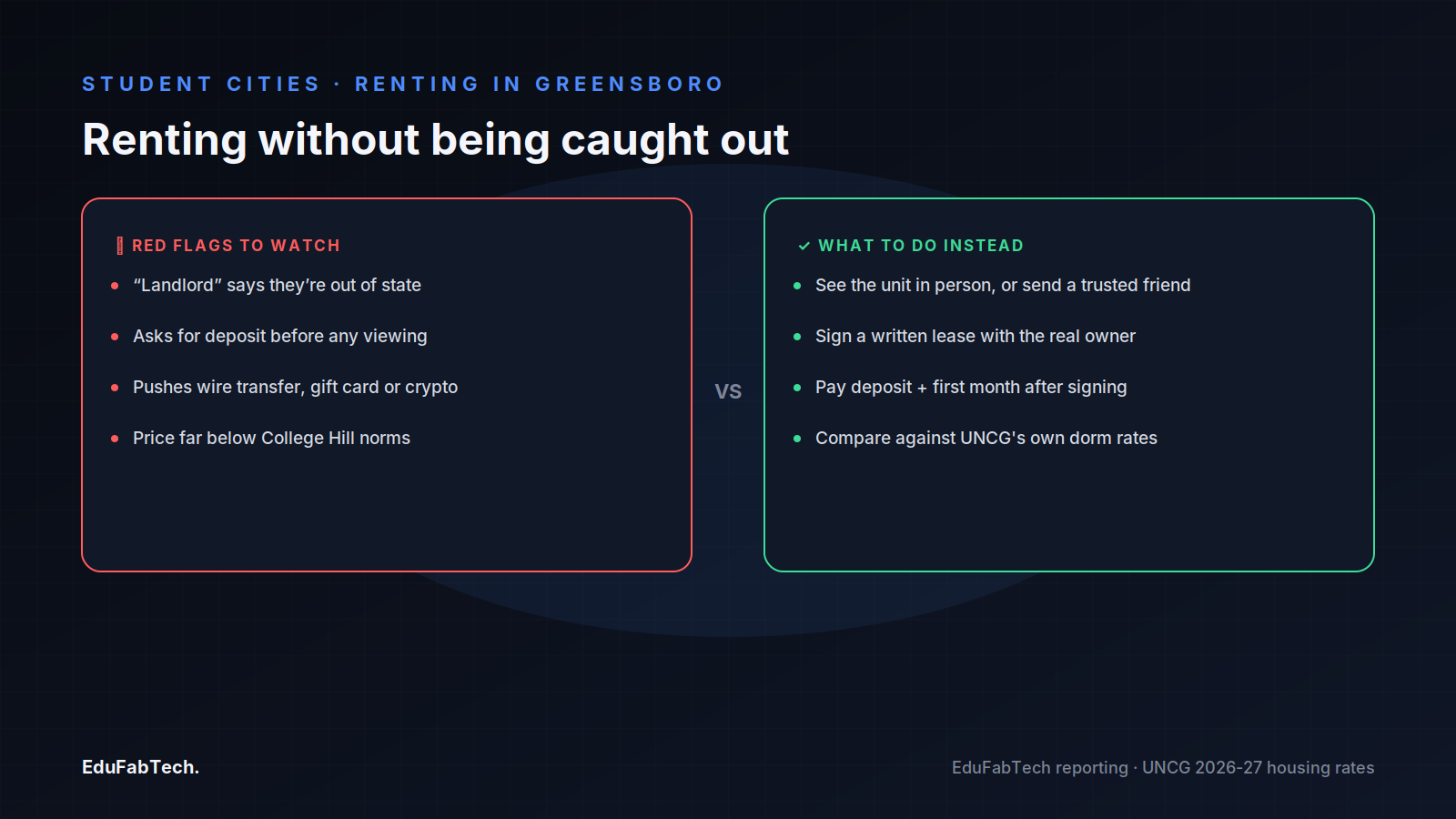
The scams that show up in Greensboro are the ones that target the student market: a too-cheap room advertised in College Hill or just off Tate Street, a "landlord" who says they are out of state and asks you to send a deposit before you can view it. Treat that as the warning sign it is. See the actual unit in person, or have someone you trust see it, before any money changes hands, and sign a written lease with the real owner. A normal local arrangement is a security deposit plus first month's rent paid after you view the place and sign; no legitimate landlord in Greensboro needs a deposit wired to "hold" a room. Never send money by bank wire, gift card or cryptocurrency — those payments cannot be reversed, which is exactly why fraudsters ask for them.
For a sense of the wider market: DataUSA's compilation of Census figures put the median property value in Greensboro at $244,800 in 2024 (DataUSA, ACS 2024), which feeds into rents. The clearest dated figure a student can anchor to is a dormitory rate: UNCG's 2026-27 housing rates list a traditional premium double room at $3,216.50 per semester, with two-bedroom campus apartments at $4,657.00 per semester. Those numbers are per student and exclude a meal plan, but they give you a floor to compare any private offer against.
Furnishing a room for next to nothing
Greensboro is a good city for second-hand furnishing because it has both a large indoor flea market and an old farmers' market. The Flea, on North O. Henry Boulevard, is an indoor-outdoor market that has operated for decades and is where students find cheap furniture, kitchenware and bikes (The Flea). The Greensboro Farmers Curb Market at 501 Yanceyville Street runs Saturday mornings from 8am to noon year-round, with a seasonal Tuesday afternoon market, and is the place for produce, bread and local goods rather than furniture. For moving-day essentials and giveaways, EduFabTech lists free and second-hand things for the city.
Working while you study
If you are an international student on an F-1 visa, the baseline rule the U.S. Department of Homeland Security sets out is that on-campus employment may not exceed 20 hours per week while school is in session; off-campus work and training options such as curricular or optional practical training carry their own, stricter conditions. The authoritative source is DHS's Study in the States guidance, and the person who actually authorises your work is your university's Designated School Official (DSO) in the international student office. Check with them before you accept any job — this guide points you to the rules but is not legal advice, and the details change with your status. Local and campus openings are listed at /in/united-states/greensboro/jobs.
Libraries and places to study
Each campus has its own library, and the city library system adds more. At A&T, the F.D. Bluford Library sits at 1601 East Market Street and offers several levels of individual and group study space, collaboration rooms and public computers (N.C. A&T Bluford Library). UNCG's University Libraries anchor the Spring Garden campus and include a Digital Media Commons for multimedia work (UNCG University Libraries). Off campus, the Greensboro Public Library's Central Library at 219 North Church Street, downtown in the cultural district, has study rooms and generous weekday hours and is open to anyone (Greensboro Public Library). More desks, cafés and bookable rooms around the city are collected at /in/united-states/greensboro/study-spaces.
Getting around
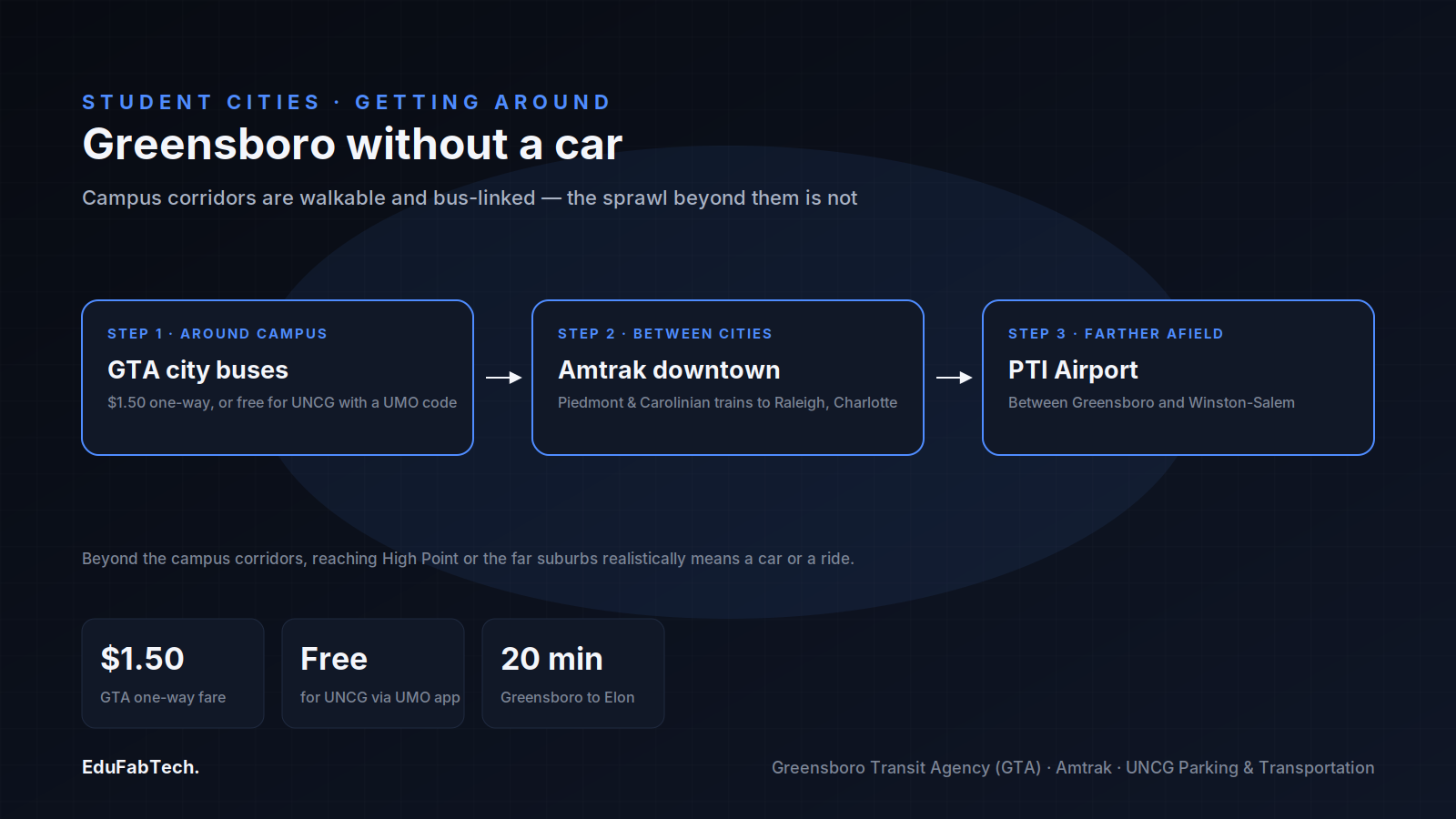
Greensboro is a car-oriented city, but students have a real transit option. The Greensboro Transit Agency (GTA) runs the city buses, and UNCG tells students they can ride the green GTA buses fare-free by presenting a UNCG UMO code in the UMO mobile-pay app; without a valid code the one-way fare is $1.50 (UNCG Parking & Transportation). GTA also operates campus-area routes serving the universities, so day-to-day travel between the major campuses and downtown is workable without a car. For longer trips, the Amtrak station downtown carries the Piedmont and Carolinian trains toward Raleigh and Charlotte, and Piedmont Triad International Airport lies between Greensboro and Winston-Salem. Beyond the campus corridors, though, the city sprawls, and reaching High Point or the far suburbs realistically means a car or a ride.
What is good, and what is hard
The good: Greensboro is affordable by U.S. standards, with a median household income around $63,516 (Census Reporter, ACS 2024) and housing to match, and it concentrates an unusual number of universities in one metro — which means a large, varied student population and a free bus for those who qualify. The Tate Street scene, the downtown arts district and the farmers' market give the city a texture that a commuter town lacks, and the Piedmont climate is mild, with long warm autumns and short winters.
The hard: it is a spread-out city, and life off the main campus corridors assumes a car; transit is useful but not comprehensive. Summers are hot and humid. The two big universities sit in very different parts of town with their own housing markets, so advice that fits a UNCG student near Tate Street may not fit an A&T student in East Greensboro or someone commuting from High Point. And as elsewhere, the cheapest advertised rooms are where rental fraud concentrates, so the saving on paper is sometimes a trap.
A checklist for the first few weeks
- Confirm your housing in writing with the actual owner, and view the unit — in person or through someone you trust — before paying a deposit or first month's rent.
- If you are on an F-1 visa, meet your DSO in the international office before taking any job, and read the DHS on-campus work rules.
- Set up the UMO app and get your campus UMO code so you can ride GTA buses fare-free if your university participates.
- Get a library card for the Central Library downtown in addition to your campus library account.
- Budget against a real benchmark — compare any private rent to UNCG's published dorm rates for the same year.
- Furnish from The Flea and the Curb Market, and check the city's free and second-hand listings before buying new.
- If you are commuting from Elon or High Point, plan around the distance — this metro is more spread out than it looks on a map, so factor the trip into any lease.
A quick question for readers
Do you work part-time while you study?
Many students work to pay the bills. See how common it is — and how many hours people really do.
Pick an answer, create a free account in a minute, and your vote counts. Already a member? Sign in
Comments 0
CommentNo comments yet. Members start the conversation.
Source: North Carolina A&T State University
Sources (5)
- North Carolina A&T State University. N.C. A&T is First HBCU Ever to Enroll More Than 15,000 Students. North Carolina A&T State University, 2025. ncat.edu ↗ · checked 9 Oct 2026
- UNC Greensboro Housing and Residence Life. Housing Rates (2026-27). University of North Carolina at Greensboro, 2026. hrl.uncg.edu ↗ · checked 9 Oct 2026
- UNC Greensboro. About UNCG. University of North Carolina at Greensboro, 2026. uncg.edu ↗ · checked 9 Oct 2026
- U.S. Department of Homeland Security. Working in the United States (F-1 students). Study in the States, 2025. studyinthestates.dhs.gov ↗ · checked 9 Oct 2026
- Census Reporter (U.S. Census Bureau, ACS 2024). Greensboro, NC profile. Census Reporter, 2024. censusreporter.org ↗ · checked 9 Oct 2026