Studying in Hamburg: universities, housing and student life
A practical, honest guide to studying in Germany's port city-state — its named universities, the districts students live in, how to find a room safely, what it costs, and the trade-offs.
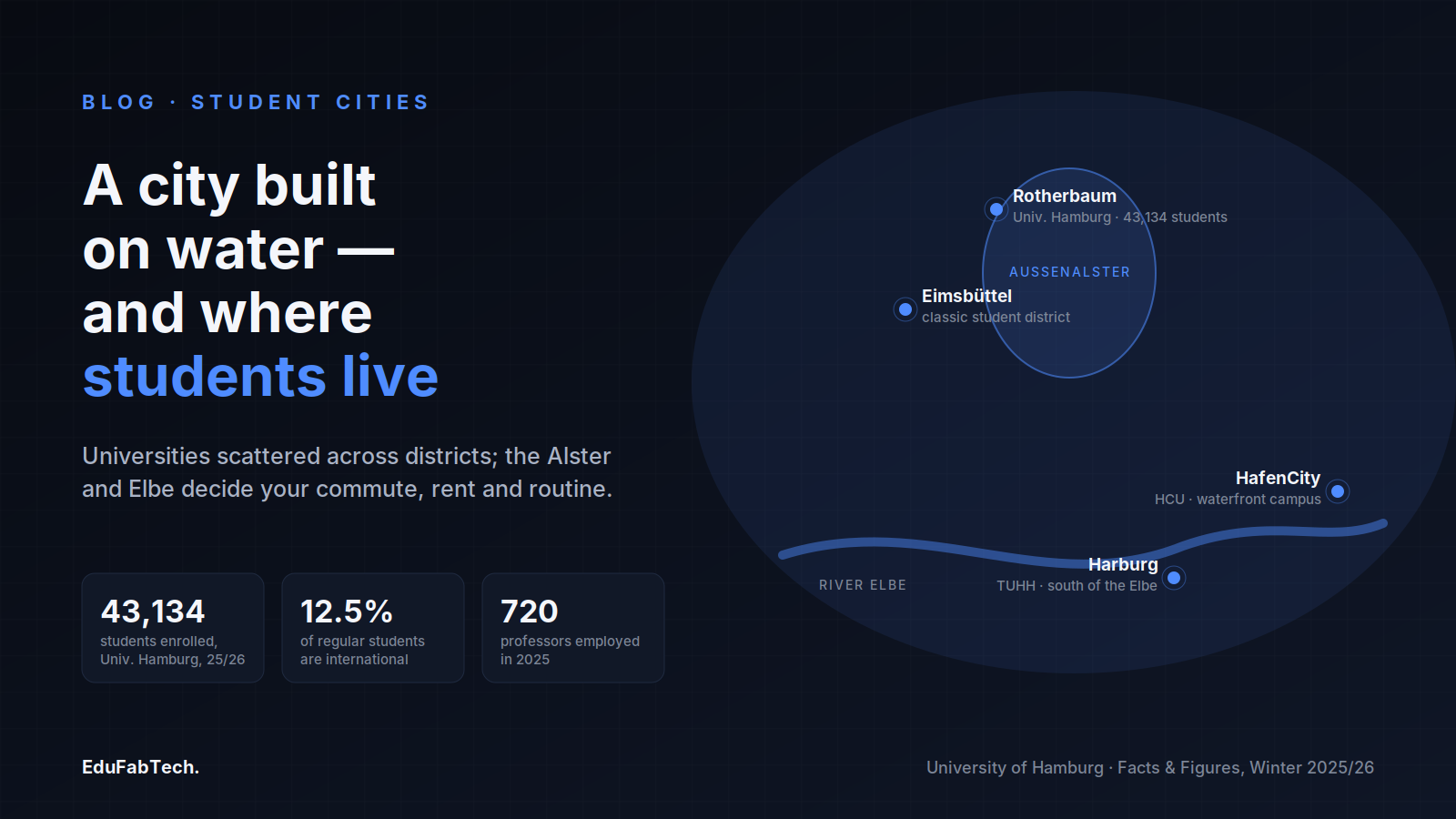
Hamburg is a city-state — the Freie und Hansestadt Hamburg is a federal state as well as a city — and it is laid out around water: the two Alster lakes in the middle, the River Elbe and the working port to the south, and canals that cross more bridges than the tourist brochures can count. For students this geography is not decoration. It decides where campuses sit, which S-Bahn or U-Bahn line you will come to live by, and why a room in Harburg, south of the Elbe, is a genuinely different commute from a room in Eimsbüttel. The universities are scattered across the districts rather than gathered on one hill, so choosing where to study and where to live are really the same decision.
The anchor is the University of Hamburg, whose main campus clusters around Von-Melle-Park and the Rotherbaum district near the Außenalster. It opened in 1919 and is now the largest institution in northern Germany: its own Facts and Figures page reports 43,134 enrolled students in Winter Semester 2025/26 (including doctoral researchers and those on leave of absence) across eight faculties, with 12.5 percent of regular students coming from abroad and 720 professors employed in 2025. It is a full-spectrum university — law, medicine, humanities, the sciences — and the departments spread out from Rotherbaum into neighbouring streets. Alongside it, Hamburg University of Technology sits well to the south in Hamburg-Harburg, a compact engineering campus with a maritime and logistics bent; Hamburg University of Applied Sciences (HAW Hamburg), the city's large applied-sciences institution, runs campuses across several districts.
The rest of Hamburg's higher education is specialised and worth knowing by name. HafenCity University Hamburg stands on the waterfront in the new HafenCity quarter and concentrates on architecture, civil engineering, geomatics and urban planning. Kuehne Logistics University, a private, English-taught institution, is also in HafenCity and focuses on logistics, supply-chain and management. Helmut Schmidt University in the east of the city is run by the Bundeswehr, and most of its students are serving officers. The arts have two homes: the Hamburg University of Music and Drama (Hochschule für Musik und Theater Hamburg) near the Alster, and the Hochschule für bildende Künste Hamburg, the fine-arts school on Lerchenfeld. Two more are small and vocational: the Berufliche Hochschule Hamburg, a public institution that pairs a bachelor's degree with recognised vocational training, and the Evangelical School of Social Work & Diakonie (Evangelische Hochschule für Soziale Arbeit & Diakonie), a church-run college for social work and diaconal studies.
A ring of institutions in the surrounding states counts as Hamburg for many commuters. Nordakademie Hochschule der Wirtschaft in Elmshorn and the University of Applied Sciences Wedel in Wedel both lie just over the border in Schleswig-Holstein, reachable by regional train; hochschule 21, rendered in English as college 21, is in Buxtehude to the south-west. All three build their bachelor's programmes around a dual model, alternating study with paid phases at partner companies, so a place there usually comes attached to an employer. If you are weighing one of these, the commute by regional train is the thing to test before you sign a lease anywhere.
The districts students actually end up in
Rotherbaum and Harvestehude are the campus core: handsome nineteenth-century streets between the university and the Außenalster, walkable to lectures, and priced accordingly. Rooms here are scarce and expensive, and most students who live in them do so in a shared flat (a Wohngemeinschaft, universally shortened to WG). Just west, Eimsbüttel is the classic student district — leafy, dense with WGs, cafés and small shops, and close enough to cycle to campus. It is popular enough that rooms move fast.
West again, Altona and its quarter Ottensen sit near the Elbe and have their own rhythm: markets, independent cinemas, a diverse crowd, and a direct S-Bahn spine running back through the centre. Sternschanze (the Schanze) and St. Pauli are the loud heart of young Hamburg — nightlife, street art, the Reeperbahn — and renting there means accepting noise and rents that have climbed as the areas gentrified. South of the river, Harburg is the practical choice for Hamburg University of Technology students: cheaper than the inner west, with its own town centre, though a commute to the main university means crossing the Elbe. To the east and the port islands, districts like Barmbek, Wilhelmsburg and Wandsbek tend to be more affordable and are well connected by U-Bahn and S-Bahn, which is often the sensible trade when central rooms are out of reach.
Getting a room, and not getting cheated in the process
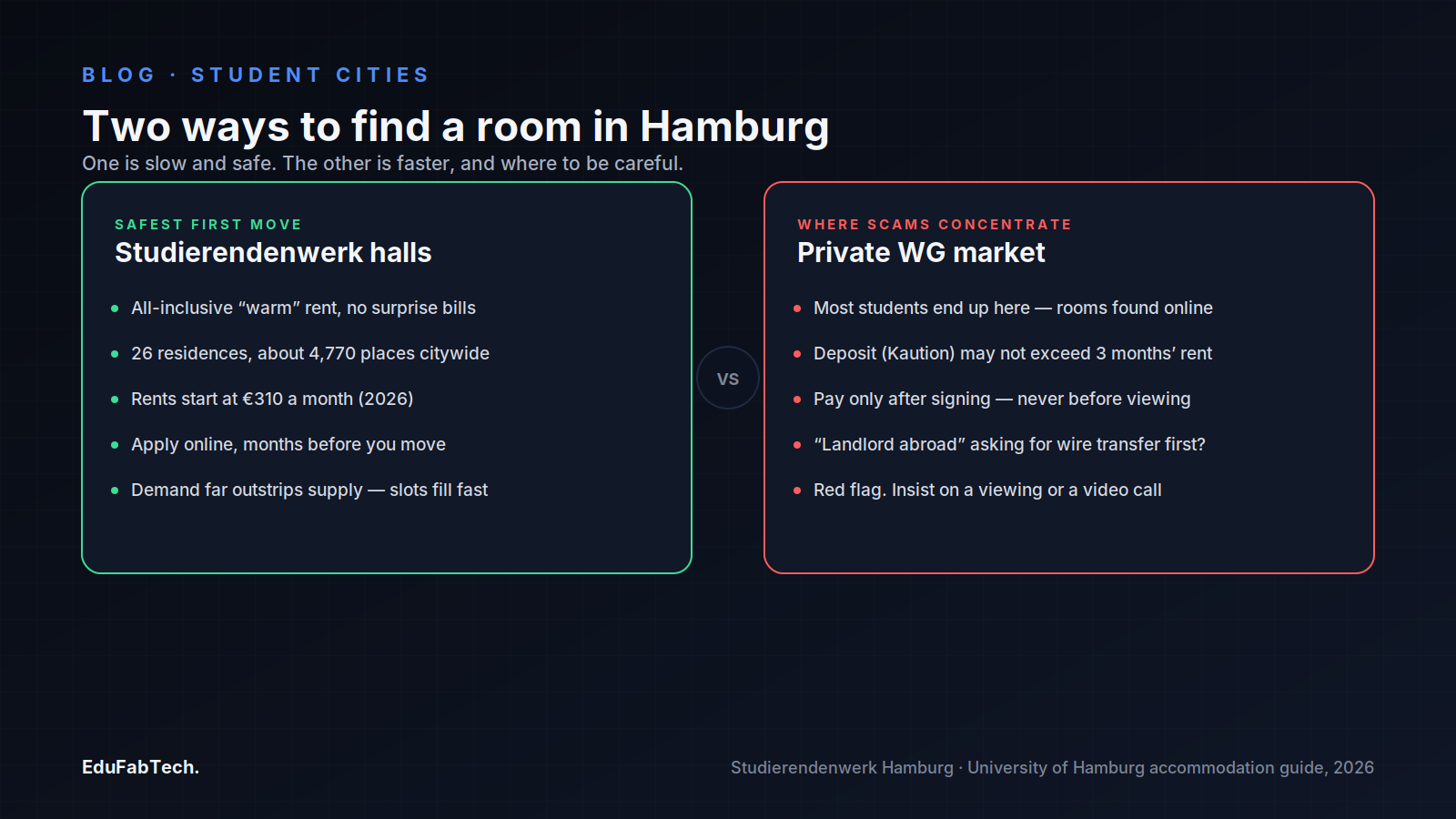
Hamburg's housing market is tight, and the University of Hamburg says so plainly on its own accommodation page: it advises you to start looking as early as possible and notes that affordable housing in the city is rare. The safest first move for any new arrival is a place in a hall of residence. Studierendenwerk Hamburg, the public student-services body, runs its residences on an all-inclusive ("warm") rent and lists 26 residential complexes with around 4,770 places, with rents starting at 310 euros a month in 2026. Demand far outstrips supply, so apply online through the Studierendenwerk months before you move, and do not count on a place being ready for day one.
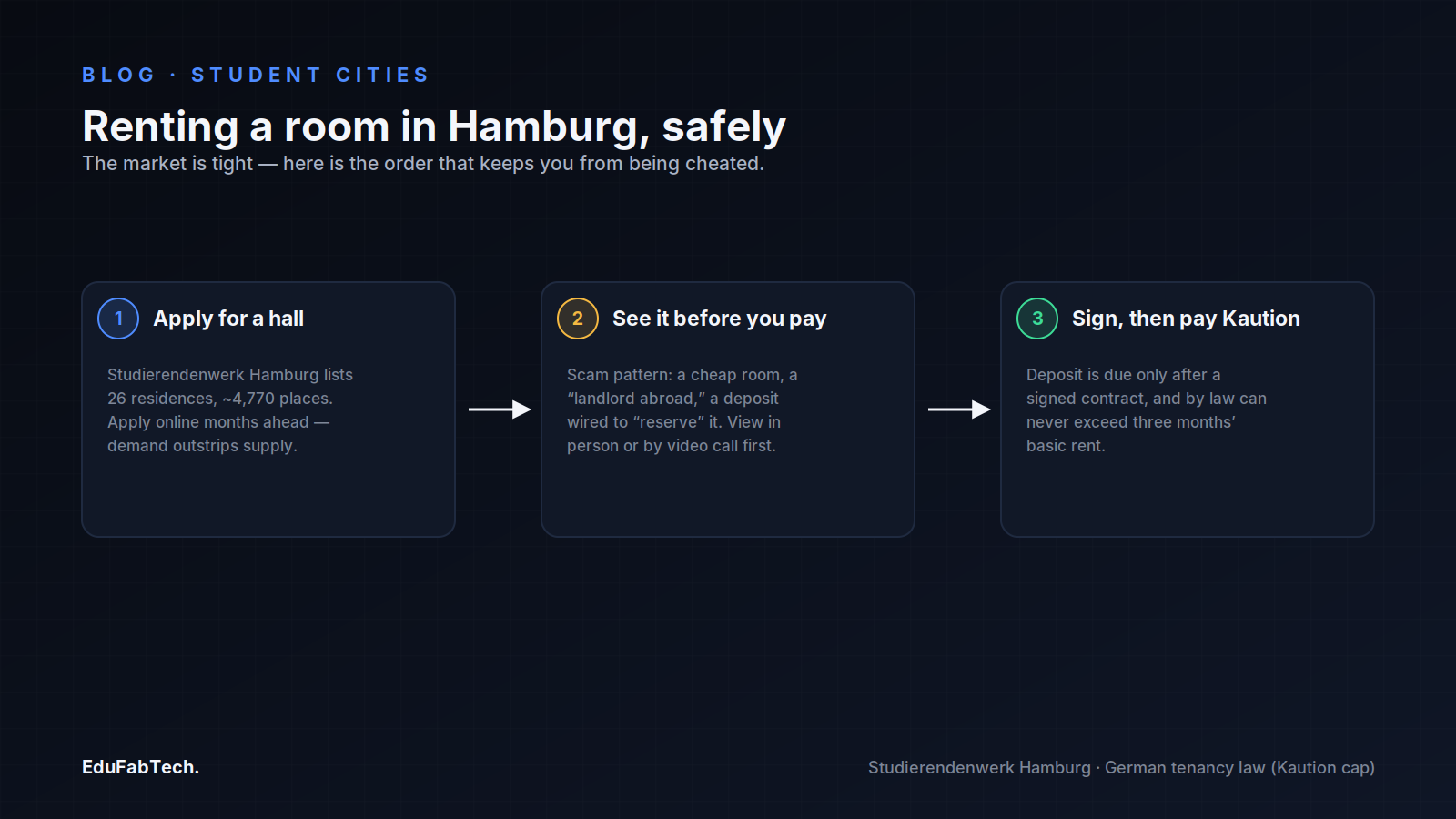
Most students end up in a private WG instead, usually found online, and this is where scams concentrate. The pattern in Hamburg is predictable: a room that looks too cheap for a sought-after district — the Schanze, Eimsbüttel, Ottensen — advertised by a "landlord" who is conveniently abroad and asks you to wire a deposit to "reserve" it before any viewing. Treat that as a red flag every time. See the room in person before you pay anything, or send someone you trust to view it for you; a real landlord or flatmate will let you. A normal deposit (Kaution) is paid only once you have a signed contract, and under German tenancy law it may not exceed three months' basic rent. Never send money by bank transfer, gift card or cryptocurrency to hold a room you have not seen, and be wary of anyone who refuses a video call or a proper contract. For listings and rooms across the city you can also browse rooms on EduFabTech or the wider Hamburg listings.
Furnishing from Hamburg's markets and flea halls
An unfurnished Hamburg room can be filled cheaply if you know the city's markets. The best known for second-hand goods is the Flohschanze, a flea market held every Saturday in two former cattle-slaughter halls at Neuer Kamp in the Schanze; it runs on a no-new-goods rule, so what you find is genuine used furniture, crockery, bikes and clothes. The city's signature institution, though, is the Fischmarkt in Altona, on the banks of the Elbe at Große Elbstraße: hamburg.de lists it as open every Sunday from 5:00 to 9:30 in summer (15 March–14 November) and 7:00 to 9:30 in winter (15 November–14 March), and beyond the fish the stalls sell plants, household goods and cheap produce to a crowd that includes students on their way home from a night out. The weekly Isemarkt, strung out under the U-Bahn viaduct in Eppendorf, is the place for fresh food rather than furniture. Opening days do change, so check a market's current listing before making the trip.
For anything the markets don't cover, Hamburg has an active give-away-and-resell culture: students leaving at the end of a semester shed furniture fast, and whole flats get emptied cheaply in summer. On EduFabTech you can look through second-hand things and second-hand furniture in the city, including items people give away free. Timing helps: the turnover is highest around the start and end of each semester.
Working on the side as an international student
Many students work part-time, and the rules depend on where you are from. For students from outside the EU, the DAAD (the German Academic Exchange Service) states that you may work 140 full days or 280 half days per year; to work beyond that you need permission from the Agentur für Arbeit (the Federal Employment Agency) and the Ausländerbehörde (the foreigners' office). Students from the EU and EEA are broadly treated like German students. These limits and the paperwork around residence permits change, and this is not legal advice — confirm your own position with the official source and, in Hamburg, with the immigration authority (the Hamburg Welcome Center / Einwohner-Zentralamt). When you are ready to look, EduFabTech lists jobs and part-time work in the city.
Where to read: the Stabi and the Bücherhallen
The central academic library is the Staats- und Universitätsbibliothek Hamburg Carl von Ossietzky — everyone calls it the Stabi — at Von-Melle-Park 3 in Rotherbaum, next to the main university campus; it is the largest academic library in the city-state and the hub of Hamburg's university library system. Faculty and departmental libraries add reading rooms closer to specific subjects. Away from the university, the public network, the Bücherhallen, is useful for quieter study and for anyone not enrolled: its Zentralbibliothek sits at Hühnerposten near the Hauptbahnhof and has individual desks, group rooms and long opening hours. During exam season good seats go early everywhere, so it pays to arrive before midday. EduFabTech also collects study spaces and desks around Hamburg.
Moving around on the hvv
Public transport is run by the Hamburger Verkehrsverbund (hvv), whose network covers U-Bahn, S-Bahn, buses and — a Hamburg particularity — the public harbour ferries on the Elbe, which run on the same tariff as the trains. Enrolled students are issued the hvv Deutschland-Semesterticket, paid for as part of the semester fee: hvv's student page puts it at 226.80 euros for the whole of Winter Semester 2026/27 (37.80 euros a month), a figure based on students paying 60 percent of the standard Deutschlandticket price. That ticket is valid nationwide in second-class regional and local transport, so it covers not just your commute but weekend trips well beyond Hamburg. Many students also cycle: the flat terrain and dense network make a bike the fastest way across the inner districts.
What it costs, and what wears you down
Two of the larger costs are easy to pin down. A Studierendenwerk room starts at 310 euros a month all-in (2026), and the semester transport ticket is 226.80 euros for Winter Semester 2026/27 — modest, and a real advantage of studying in a German city-state.
| Item | Figure | Source (year) |
|---|---|---|
| Studierendenwerk residence, all-inclusive rent | from €310 / month | Studierendenwerk Hamburg (2026) |
| hvv Deutschland-Semesterticket | €226.80 / Winter Semester 2026/27 | hvv (2026) |
The honest picture: Hamburg is expensive and crowded in the places students most want to be, and residence places are too few — the university itself flags that affordable housing is rare and tells you to start early. The private market rewards people who can view in person and move quickly, which is hard to do from abroad. The weather is a genuine factor: grey, wet and windy for much of the year, with short winter days. Against that, the compensations are large. Rent in the halls is low by big-city standards; the semester ticket is cheap and goes everywhere; the universities are strong and varied; and the city itself — the Alster for running and swimming, the Elbe and the port, the Schanze and St. Pauli for going out, lakes and parks threaded through the districts — is genuinely good to live in. If you can solve housing, the rest of Hamburg tends to look after itself.
A checklist for your first weeks
- Apply for a Studierendenwerk residence months ahead; keep a private WG search going in parallel, and never pay a deposit before viewing.
- Register your address (Anmeldung) at a district office (Kundenzentrum) soon after moving in — you will need it for almost everything else.
- Collect your enrolment documents and make sure your hvv Deutschland-Semesterticket is activated through the semester fee.
- Open a German bank account and sort out statutory health insurance, which you need to enrol.
- If you are a non-EU student, confirm your work allowance and any residence-permit steps with the official source and the Hamburg immigration authority before taking a job.
- Get a library card for the Stabi or the Bücherhallen, and a bike if you can — it is the quickest way to learn the districts.
- Furnish from the Flohschanze, the Fischmarkt and end-of-semester give-aways rather than buying new.
A quick question for readers
Do you work part-time while you study?
Many students work to pay the bills. See how common it is — and how many hours people really do.
Pick an answer, create a free account in a minute, and your vote counts. Already a member? Sign in
Comments 3
Comment-
The number worth sitting with is 4,770 residence places against 43,134 enrolled at University of Hamburg alone - and that's before counting…
-
The stat that bugs me is the Studierendenwerk number: 26 residences, ~4,770 places, against a university of 43,134 students. That's coverage…
-
What jumps out is the Studierendenwerk ratio: 26 residences, about 4,770 places, against a university of 43,134 students. Even if you ignore…
Join free to read the full comments and reply Comments are between members; an account takes a minute.
Source: University of Hamburg
Sources (5)
- University of Hamburg. Facts and Figures: Details. University of Hamburg, 2025. uni-hamburg.de ↗ · checked 12 Nov 2026
- Studierendenwerk Hamburg. Student residences. Studierendenwerk Hamburg, 2026. stwhh.de ↗ · checked 12 Nov 2026
- hvv. Studierende – Deutschland-Semesterticket. Hamburger Verkehrsverbund (hvv), 2026. hvv.de ↗ · checked 12 Nov 2026
- DAAD. Side jobs. Deutscher Akademischer Austauschdienst (DAAD), 2026. daad.de ↗ · checked 12 Nov 2026
- Freie und Hansestadt Hamburg. Fischmarkt. hamburg.de, 2026. hamburg.de ↗ · checked 12 Nov 2026