Studying in Hannover: universities, housing and student life
A practical, honest guide to Lower Saxony's capital for students — its universities, where rooms turn up, the Saturday flea market, part-time work rules, libraries, transport and what it costs.
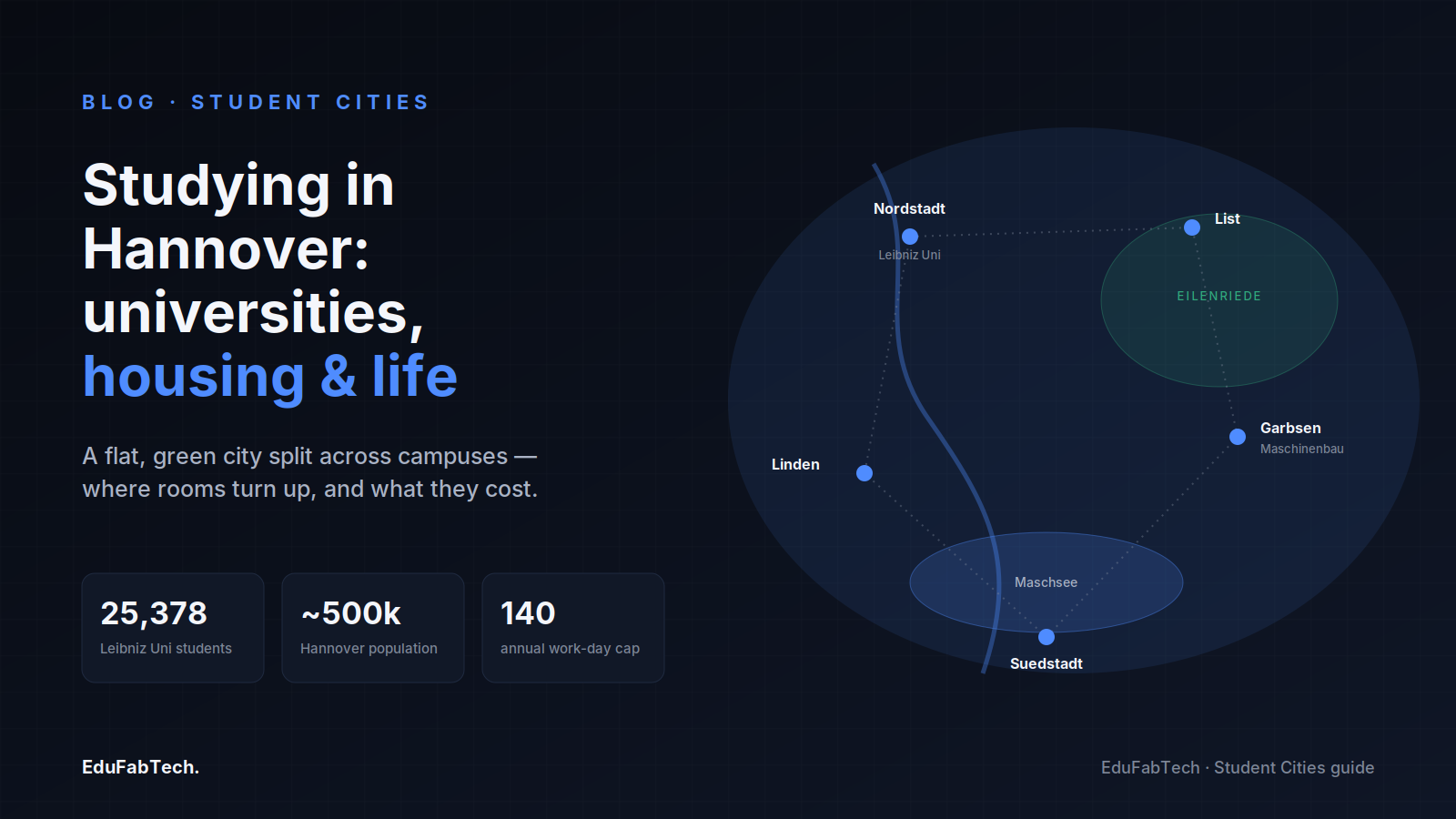
Hannover (Hanover in English) is the capital of the German state of Lower Saxony, a city of about half a million people built along the river Leine and the Mittelland Canal. It is best known inside Germany as a trade-fair city — the vast Messe grounds on the southern edge host events that fill the city's hotels — and as a transport junction, with a main station on the north–south high-speed line. For a student it has a particular rhythm: a large, green, mostly flat city you can cross by bike, with the Eilenriede urban forest running through the middle of it and the artificial Maschsee lake just south of the centre.
It is a university town without being a one-campus town. Students are spread across several institutions and several neighbourhoods rather than concentrated in a single quarter, which shapes almost everything below — where rooms come up, how long the tram ride is, and where you end up studying on a wet November afternoon. Most of the city was rebuilt after heavy wartime bombing, so the look is more practical than postcard; the compensation is space, greenery and rents that are lower than in Munich, Hamburg or Frankfurt.
The universities, from the Welfenschloss to Garbsen
The largest institution is Leibniz University Hannover, whose main building is the Welfenschloss, a former royal palace at the Welfengarten in the Nordstadt district, as the university's own history pages describe (uni-hannover.de). On its facts page the university reports 25,378 students enrolled in the winter semester 2025/26, of whom 14 per cent — 3,564 people — were international, across nine faculties and three schools (uni-hannover.de, 2026). It is a broad research university strong in engineering and the natural sciences; its entire Faculty of Mechanical Engineering moved out to a purpose-built Campus Maschinenbau in neighbouring Garbsen, which opened in 2019 (uni-hannover.de), so engineering students should expect a longer commute to the north-west than the central campus suggests.
The city's other institutions are more specialised. Hannover Medical School (Medizinische Hochschule Hannover, MHH), on a single large campus in the east, admitted its first students in 1965 (mhh.de) and is one of the largest transplant centres in Germany for all solid organs and a world leader in lung transplants (mhh.de). The Hanover University of Music, Drama and Media (HMTMH), the city's state conservatoire for music, theatre and media, teaches around 1,400 students across its music, theatre and media programmes (hmtm-hannover.de). Hochschule Hannover, the applied-sciences university, reports more than 10,000 students and teaches across several sites including its main campus in Linden and the media and design faculty at the EXPO-Plaza in Mittelfeld (hs-hannover.de). Smaller private and dual-study providers round out the picture: the Fachhochschule für die Wirtschaft (FHDW Hannover) and the Leibniz University of Applied Sciences (Leibniz-Fachhochschule) both focus on business and IT, with the latter offering dual degrees that combine study with paid work in a company (leibniz-fh.de), while the University of Cooperative Education for Banking (Berufsakademie für Bankwirtschaft) runs a dual Banking and Finance programme leading to a state-recognised Bachelor of Arts, with its later semesters taught in Hannover (ba-bankwirtschaft.de). If you are weighing up the region rather than just the city, the University of Hildesheim — about 8,000 students in four faculties, founded in 1978 and strong in teacher education and cultural studies (uni-hildesheim.de) — and HAWK Hildesheim, its applied-sciences neighbour for design, health and social work (hawk.de), sit about 30 kilometres south in Hildesheim, a separate city reachable by regional train. You can see EduFabTech's current listings near Leibniz University Hannover and near the music, drama and media school.
Nordstadt, Linden and the dorm question
Students cluster in a few districts. The Nordstadt sits directly against the Leibniz University main campus, and its spine, the Engelbosteler Damm — universally shortened to "Eddo" — is the closest thing to a student high street, lined with kebab shops, bars and the kind of cheap lunch places that fill up at one o'clock. West across the Ihme, Linden (especially Linden-Nord around the Limmerstraße) is the lively, left-leaning quarter where many older students and graduates end up; the List to the north-east and the Südstadt below the centre are quieter and a little pricier. Which of these suits you depends mostly on which campus you are tied to.
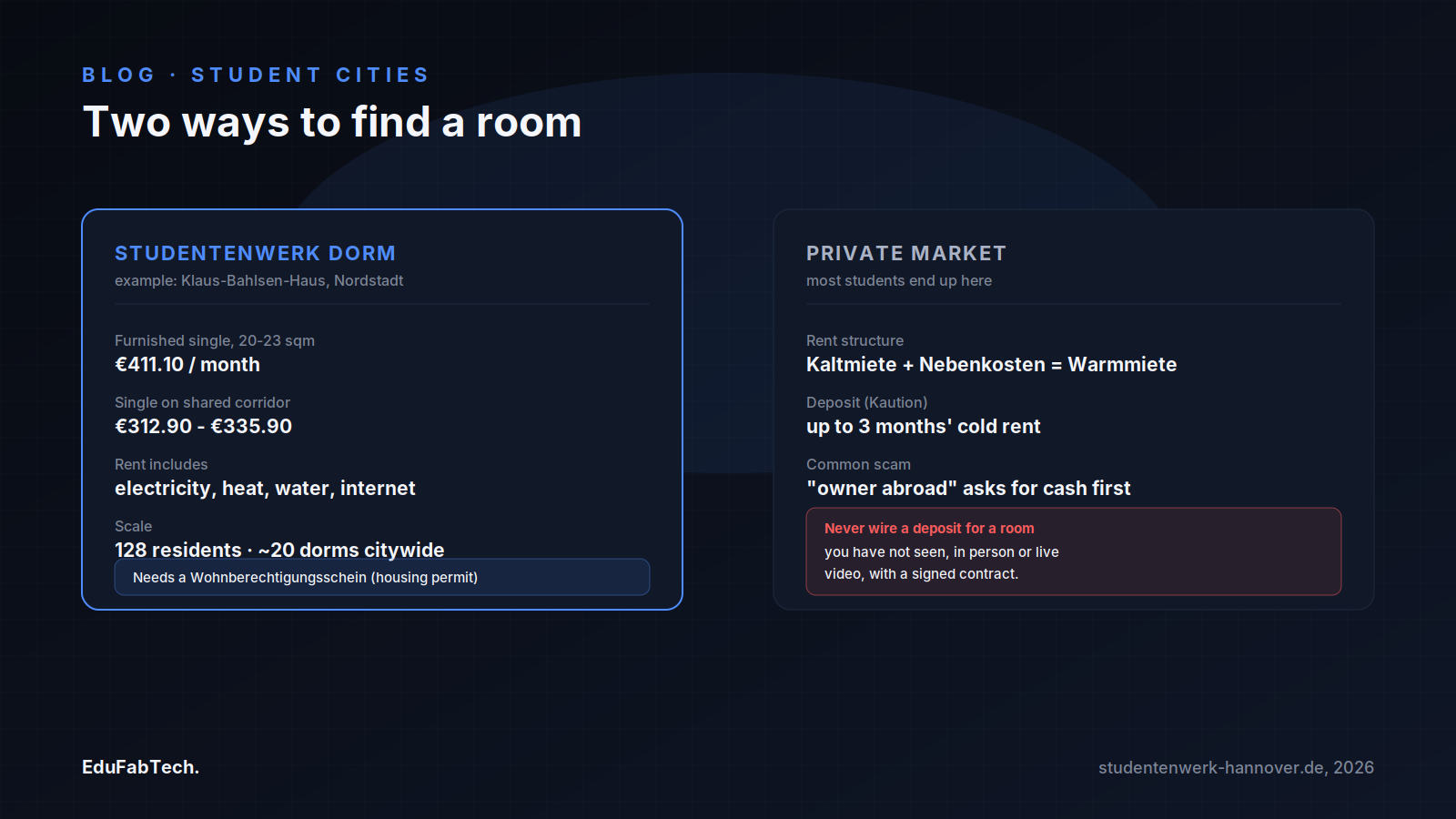
The cheapest reliable option is a room with Studentenwerk Hannover, the public student-services body, which runs around twenty dormitories across the city (studentenwerk-hannover.de). As a concrete example, its 2026 listing for the Klaus Bahlsen dormitory on Wilhelm-Busch-Straße — right beside the university's main building — gives a furnished single room of 20–23 m² at €411.10 a month and a single room on a shared corridor at €312.90–€335.90, with the rent including electricity, heating, water and internet; the house holds 128 residents and, as with several dormitories, a housing-eligibility certificate (Wohnberechtigungsschein, or "B-Schein") is required (studentenwerk-hannover.de, 2026). Places are limited and waiting times are real, so apply through the Studentenwerk as early as you can — ideally before you have even confirmed your study place, since an offer can be declined but a late application cannot be undone.
Most students, though, rent on the private market, and that is where care is needed. German lettings separate the "Kaltmiete" (bare rent) from "Nebenkosten" (service charges) to give the "Warmmiete" you actually pay, and a cash deposit (Kaution) of up to three months' cold rent is normal. In Hannover the scams concentrate exactly where demand is highest — cheap rooms advertised near the Nordstadt campus or in Linden, often with a story that the "owner" has moved abroad and will post the keys once you transfer a deposit or the first month's rent to "reserve" the flat. Treat that as a red flag every time. See the room in person, or at least by live video with someone you can speak to; ask for the full contract before any money moves; and never send a deposit by bank transfer, gift card or cryptocurrency to hold a place you have not seen. Browse what is currently available through EduFabTech's rooms in Hannover and the wider city listings, and verify anything that looks too cheap.
Furnishing a room: the Saturday flea market and the Markthalle
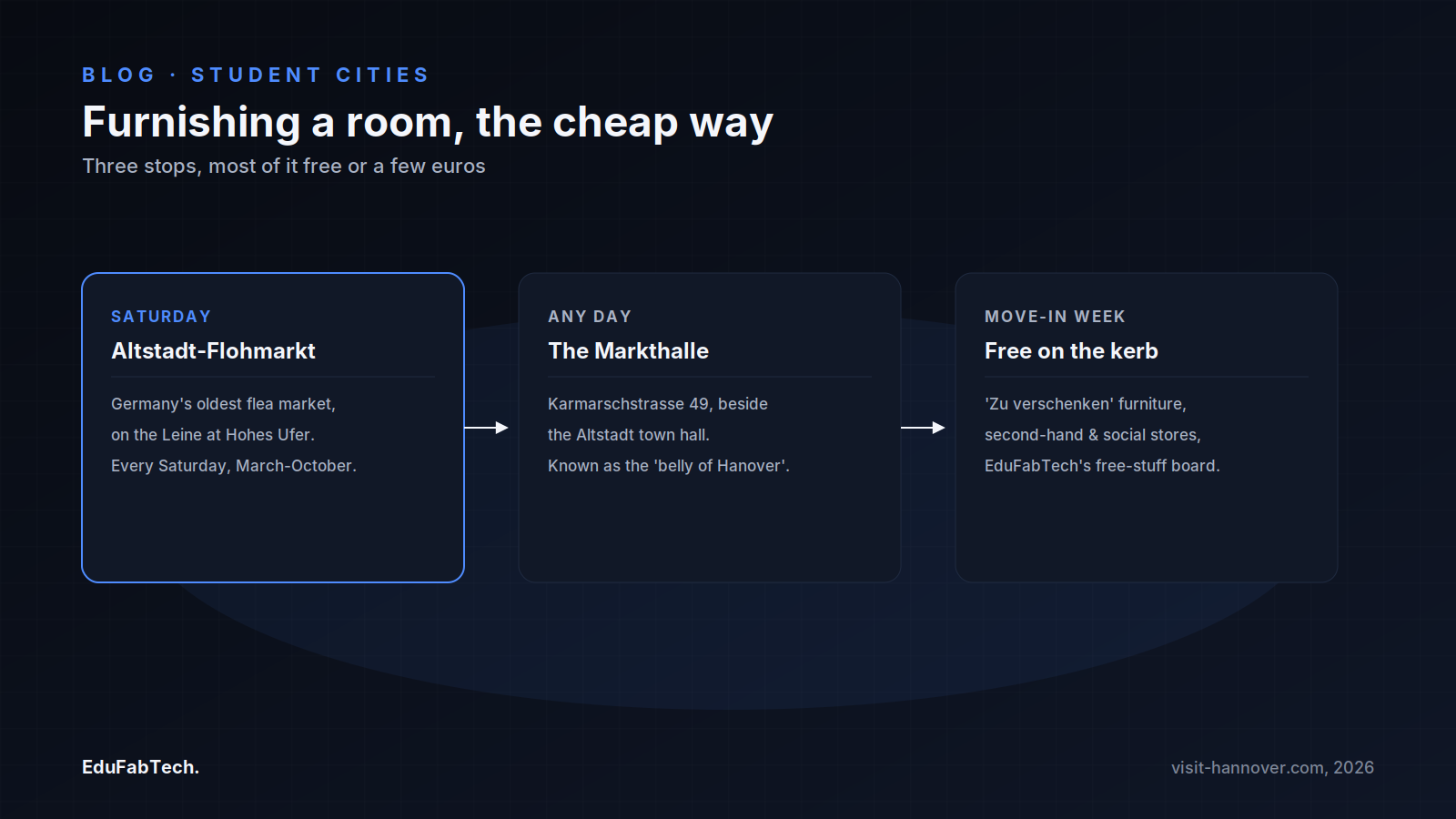
Once you have the room, you have to fill it, and Hannover makes that cheap. The Altstadt-Flohmarkt am Hohen Ufer, on the raised bank of the Leine beside the old town, is described by the city's tourism service as Germany's oldest flea market; it runs every Saturday from March to October and trades in antiques, records, jewellery and odd finds (visit-hannover.com, 2026). It is as much a weekend ritual as a shop, and a good place to pick up a lamp, crockery or a bike for a few euros. For food, the covered Markthalle at Karmarschstraße 49, at the edge of the Altstadt opposite the old town hall and known locally as the "belly of Hanover", gathers fresh produce and food stalls under one roof (visit-hannover.com).
Beyond the flea market, the German habit of putting usable furniture on the pavement to be taken ("zu verschenken") and the city's second-hand and social department stores mean you rarely need to buy a desk or a wardrobe new. EduFabTech keeps separate local boards for second-hand things, used furniture and items given away free in Hannover, which are worth checking in the first week when everyone else is also moving in.
Part-time work and the rules that apply
Many students work alongside their studies, and the rules depend on your nationality. According to DAAD, the German academic exchange service, international students from outside the EU, Iceland, Liechtenstein, Norway and Switzerland are allowed to work 140 full days or 280 half days per year; jobs as an academic assistant (a "HiWi" at your own university) face no day limit, though you must still inform the foreigners' office (daad.de). Students from EU and equivalent countries are treated essentially like German students. These limits are tied to your residence permit, so the authoritative word for your own case is the Ausländerbehörde (foreigners' office) of the Region Hannover, which issues and annotates the permit — check your conditions with them rather than relying on second-hand advice, and treat the DAAD page above as the starting point, not a substitute. Local student jobs are posted on EduFabTech's Hannover jobs board.
Libraries and places to study
The main academic library is the TIB — the Leibniz Information Centre for Science and Technology, which also serves as the university library for Leibniz University Hannover (tib.eu). It runs several sites across the city, including the science and technology building, the Conti-Campus for law and economics, and smaller social-sciences and history locations, with reading desks, bookable study cubicles and lockers; live occupancy displays for the main sites are useful in exam season, when seats fill early. Independent of the university, the Gottfried Wilhelm Leibniz Bibliothek — the Lower Saxony state library on Waterloostraße — is open to the public and offers air-conditioned reading rooms and reservable study cabins, with a dedicated set of services for students (gwlb.de). Between the two, plus the city's public libraries, finding a desk is rarely the problem; finding one at nine in the morning during exams is. EduFabTech also lists quieter study spaces and desks around the city.
Getting around: the ÜSTRA network and the semester ticket
Day-to-day transport means the ÜSTRA, Hannover's municipal operator, which runs the Stadtbahn light-rail lines (partly underground in the centre) and the city buses as part of the regional GVH/ÜSTRA network. The headline benefit for students is the ticket that comes bundled with enrolment: since the winter semester 2024/25 every student in the Hannover region receives the Deutschland-Semesterticket, provided through Niedersachsentarif GmbH, which the operator states gives full freedom of movement not only in the ÜSTRA area but on local and regional public transport throughout Germany (uestra.de). That single ticket covers trams and buses in the city and regional trains well beyond it, which is unusually generous and makes weekend travel across Germany essentially free once you have paid the semester fee. In the city itself, holders of the D-Semesterticket can also use the sprintRad hire bikes for 30 free minutes per trip (uestra.de). Hannover is flat and well-provided with cycle routes, so for many students the bike does most of the daily work and the ticket covers the rest.
What it costs
Public universities in Germany charge no tuition fees; what you pay each term is the semester contribution. At Leibniz University Hannover the Semesterbeitrag for the winter semester 2026/27 is €453.16, and its official breakdown shows that €226.80 of that is the Deutschland-Semesterticket, with the rest going to student services (€130.00), the administration fee (€75.00), the student body and a handful of small levies (uni-hannover.de, 2026). In other words, roughly half of the fee is the nationwide travel pass. Rent is the other big number, and here the Studentenwerk figures above — €312.90–€411.10 a month for a room in the Klaus Bahlsen dormitory in 2026, all utilities and internet included (studentenwerk-hannover.de, 2026) — are a reasonable floor; private rooms in Nordstadt or Linden typically run higher once you add service charges. Private universities of applied sciences, unlike the public institutions, do charge their own fees, so check each provider directly.
The honest trade-offs
What is good about Hannover for a student is concrete. There are no tuition fees at the public universities; the semester ticket reaches the whole country; the city is green, flat and bike-friendly, with the Eilenriede forest and the Maschsee on your doorstep; and it is a genuine rail hub, so visiting the rest of Germany is easy and cheap. Rents, while rising, are below those of the larger German cities.
What is hard is also concrete. Affordable rooms are scarce at the start of each winter semester, dormitory waiting lists are long, and newcomers often take a temporary room while they search. The engineering move to Garbsen means a real commute for mechanical-engineering students. The weather is the Lower Saxon default — grey, wet and windy from late autumn into spring — and the rebuilt city centre leaves some people cold at first. And while many master's programmes are taught in English, most bachelor's teaching and most of daily life still run in German, so arriving with some of the language makes the first months far less lonely.
A checklist for the first weeks
- Apply for a Studentenwerk Hannover dormitory as early as possible — do not wait for your final admission letter if the system lets you apply sooner.
- Complete enrolment and pay the semester contribution (€453.16 at Leibniz University Hannover for winter 2026/27); this is what activates your Deutschland-Semesterticket.
- Register your address (Anmeldung) at a Bürgeramt soon after you move in, taking your landlord's confirmation (Wohnungsgeberbestätigung) with you.
- If you are not an EU citizen, book an appointment with the Ausländerbehörde of the Region Hannover for your residence permit, and confirm your exact work-day limits with them.
- Open a German bank account and set up the basics (health insurance proof, phone contract).
- Get a reader card for the TIB and the Gottfried Wilhelm Leibniz Bibliothek so you have somewhere to work from day one.
- When viewing rooms, see the place first and never transfer a deposit to hold one you have not seen.
A quick question for readers
Do you work part-time while you study?
Many students work to pay the bills. See how common it is — and how many hours people really do.
Pick an answer, create a free account in a minute, and your vote counts. Already a member? Sign in
Comments 0
CommentNo comments yet. Members start the conversation.
Source: Leibniz University Hannover
Sources (5)
- Leibniz University Hannover. Facts and Figures. Leibniz University Hannover, 2026. uni-hannover.de ↗ · checked 13 Nov 2026
- Studentenwerk Hannover. Studentenwohnheim Klaus Bahlsen (dormitory details). Studentenwerk Hannover, 2026. studentenwerk-hannover.de ↗ · checked 13 Nov 2026
- üstra Hannoversche Verkehrsbetriebe AG. Semesterticket. üstra, 2026. uestra.de ↗ · checked 13 Nov 2026
- DAAD. Side jobs. Deutscher Akademischer Austauschdienst, 2026. daad.de ↗ · checked 13 Nov 2026
- Hannover Marketing und Tourismus. Hanover Old Town Flea Market. visit-hannover.com, 2026. visit-hannover.com ↗ · checked 13 Nov 2026