Studying in Hartford: universities, housing and student life
A practical, sourced guide to Connecticut's capital for students — its universities, where to live, what things cost, how to get around, and the honest trade-offs.
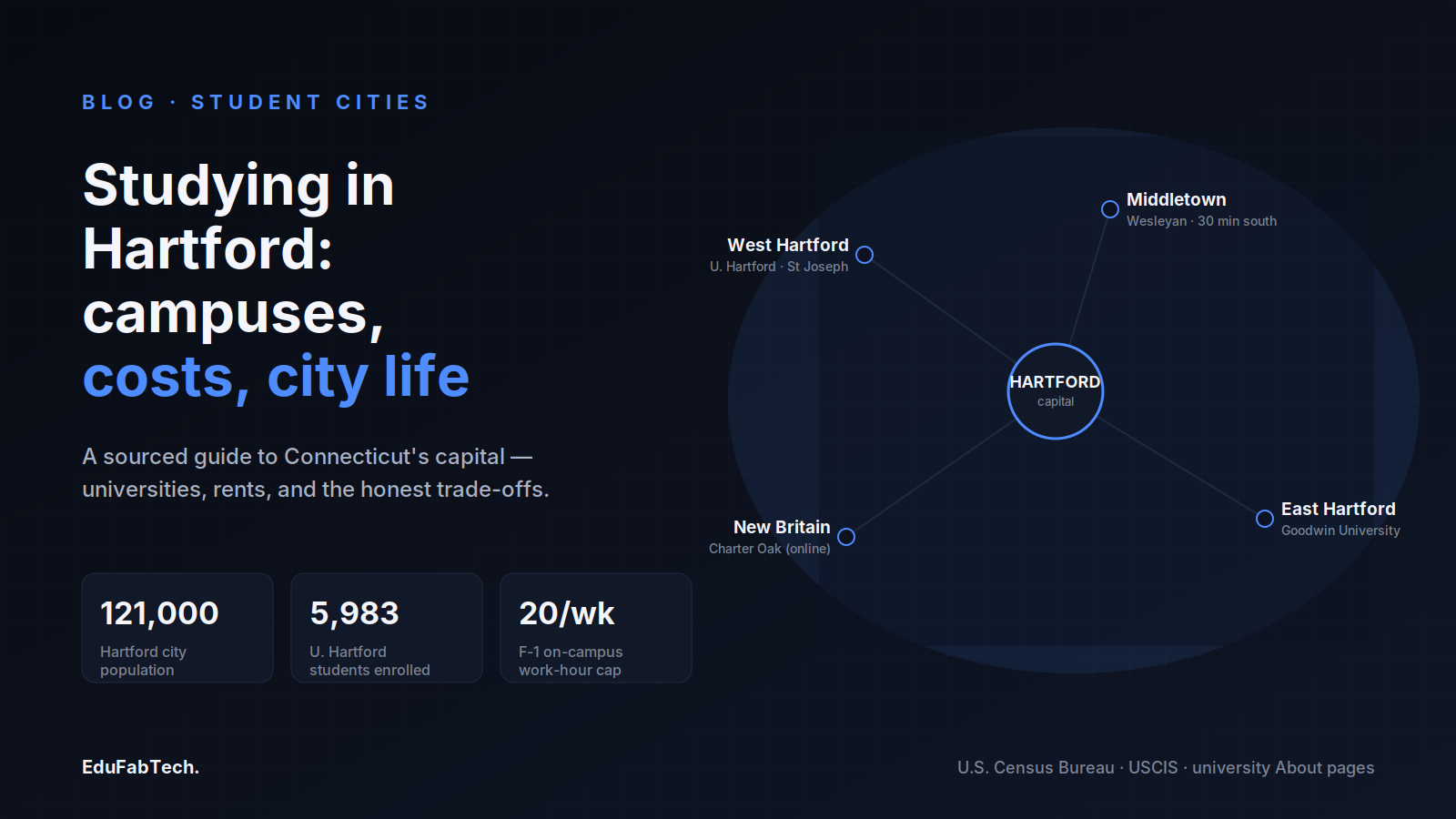
Hartford is Connecticut's capital and the historic centre of the United States insurance industry, a low-slung city on the west bank of the Connecticut River roughly halfway between Boston and New York. According to U.S. Census Bureau QuickFacts, it is a city of about 121,000 people — small enough to cross in a short bus ride, large enough to have distinct neighbourhoods with their own character, from the downtown office towers to the Victorian streets of the West End and Asylum Hill.
For students, the first thing to understand is that "Hartford" as a place to study is really a cluster of towns. The degree-granting institutions a student might choose are spread across the capital itself and the suburbs and smaller cities that ring it: West Hartford, New Britain, Middletown and East Hartford. Where you study will shape where you live and how much you lean on the bus, far more than in a single-campus college town.
This guide names the universities, explains where students actually find rooms and how to avoid the rental traps that appear here, sets out the costs that can be sourced to a dated figure, and is honest about what is good and what is hard about the city.
The universities in and around the capital
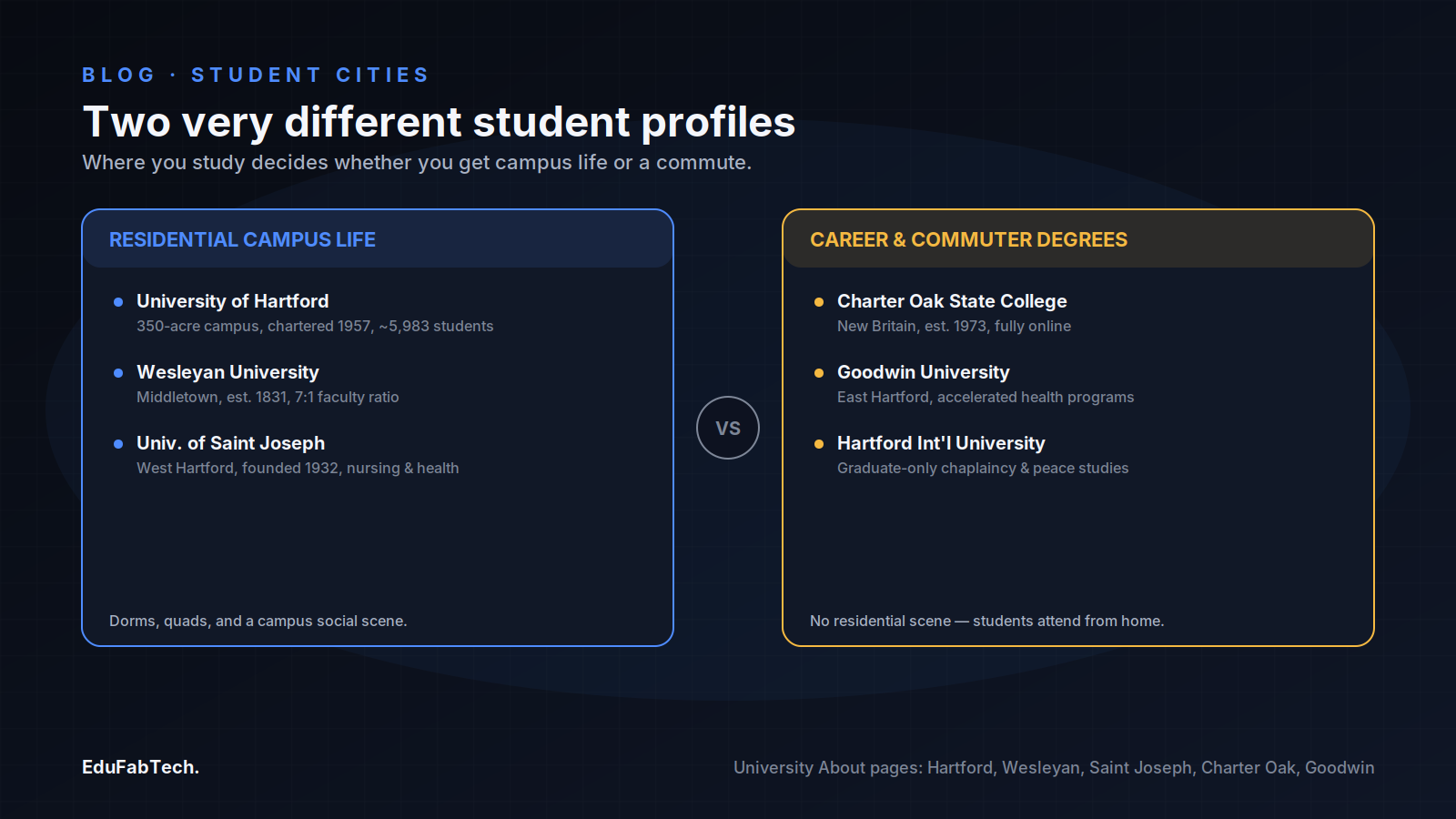
The University of Hartford is the largest private university with a Hartford name and the one most undergraduates mean when they say they are "studying in Hartford." Its own About page describes a 350-acre campus chartered in 1957 and spanning the capital city together with the neighbouring towns of West Hartford and Bloomfield, with a branch of the Park River running through it and roughly 5,983 students across seven schools and colleges. Those schools include The Hartt School, one of the better-known performing-arts conservatories in the region, the Hartford Art School, and the Barney School of Business — so the student body mixes musicians and artists with business and engineering students on the same quad.
Wesleyan University sits about half an hour south in Middletown, on the same river. Wesleyan's About page says it has called Middletown home since 1831, enrols roughly 3,000 full-time undergraduates, keeps a 7:1 student-to-faculty ratio and runs an "open curriculum" with no distribution requirements. It is one of the "Little Three" liberal-arts colleges alongside Amherst and Williams, and it is a residential, selective institution quite different in feel from the commuter-friendly schools closer to downtown — worth weighing if you are choosing between a room in Middletown and one in the capital.
In West Hartford, the University of Saint Joseph is a Catholic university whose history page records that the Sisters of Mercy of Connecticut founded it in 1932 as the first college for women in the Hartford area; it has strengths in nursing, pharmacy and the health sciences and sits on a leafy quadrangle campus a short distance from West Hartford's town centre. Charter Oak State College, based in New Britain, is a different model again: its About Us page describes Connecticut's public online college, established by the state legislature in 1973 to help adults finish degrees through fully online and credit-transfer routes — so it has no residential campus or student-life scene, and students "attend" from wherever they live. Its intake matters mostly to adults already settled in or around New Britain rather than to anyone relocating for campus life.
Rounding out the city's own institutions, Hartford International University for Religion and Peace is a small graduate school in Hartford — the renamed Hartford Seminary — whose mission page describes preparing chaplains and peacebuilders through interreligious and peace studies in an interfaith setting. It grants graduate degrees only, so it is relevant to a narrow group of students rather than undergraduates. One more career-focused option on the east bank is Goodwin University in East Hartford, a private non-profit whose About page emphasises accelerated, career-oriented degrees in fields such as nursing and health sciences.
Where students end up living
Because the campuses are scattered, there is no single "student quarter." University of Hartford undergraduates who do not live in residence halls tend to look at West Hartford and the capital's West End, both within reach of the campus on the Hartford–Bloomfield line. Students tied to downtown — at the public university campuses, or anyone who wants to be near Union Station and the bus hub — look at apartments in and around the city centre, Asylum Hill and Frog Hollow. University of Saint Joseph students gravitate to West Hartford itself, where the walkable centre (locally "West Hartford Center" and the adjacent Blue Back Square) has the cafés and shops but also the higher rents. Wesleyan students mostly live in or immediately around Middletown, a separate rental market from the capital.
If you are coming from abroad or from out of state, the safest plan is to take a university residence hall or a verified room for the first term and search for a private flat only once you are on the ground and can view places in person. Campus housing applications open months ahead — for a September start, expect to apply in the spring — so read your university's housing deadlines early rather than assuming a room will be there in August. You can scan what is currently offered across the city on EduFabTech's Hartford rooms listings and the wider Hartford student listings, and filter for places near the University of Hartford.
Renting safely in Hartford
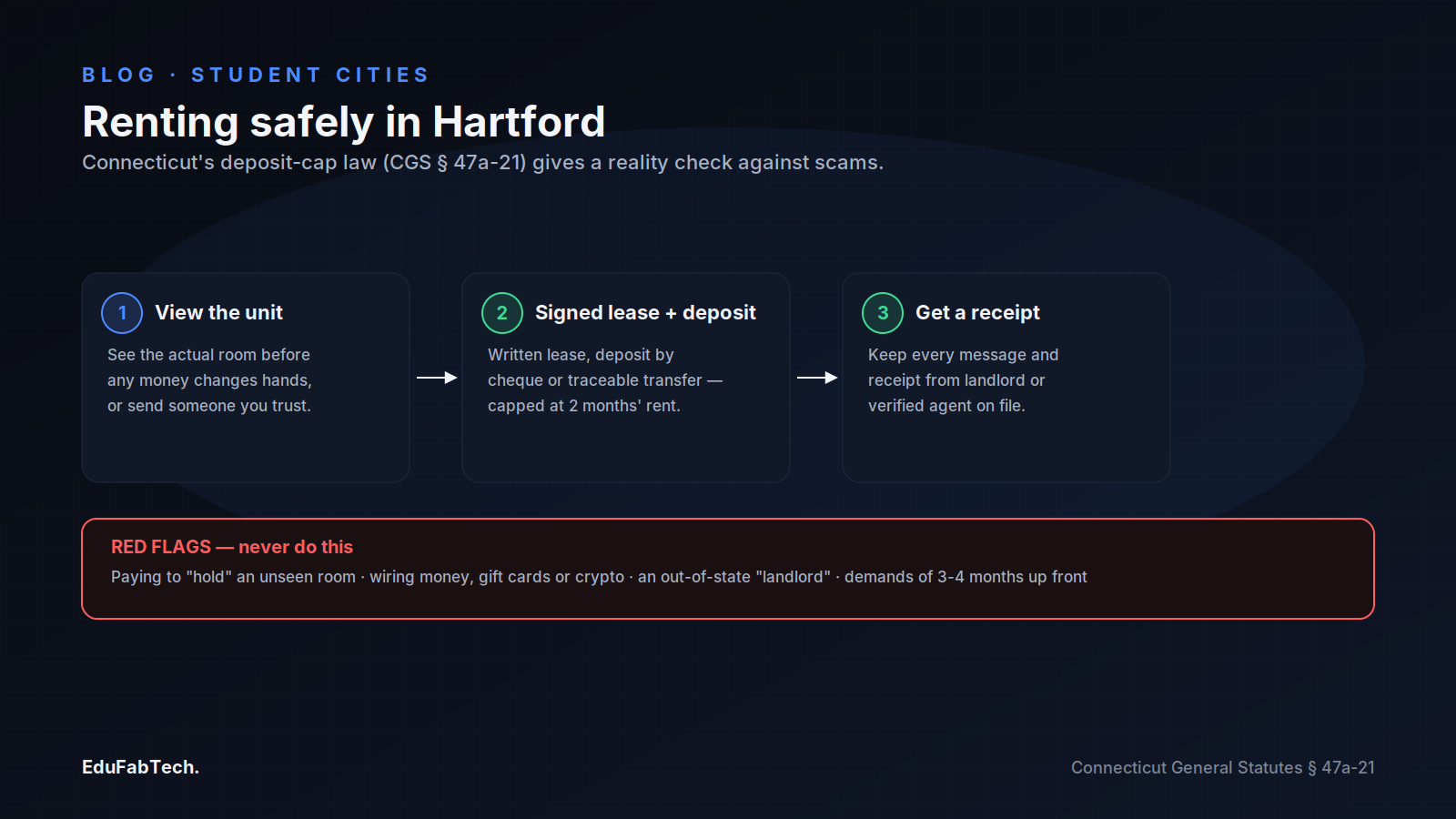
The rental traps here follow a familiar shape. Listings that look unusually cheap for West Hartford Center or the West End, a "landlord" who is conveniently out of state, and pressure to send a deposit before you can see the unit are the warning signs that recur in this market. Never pay to "hold" a room you have not entered, and never send money by bank wire, gift card or cryptocurrency — none of those are normal or recoverable, and a genuine Hartford landlord will not ask for them. A normal arrangement is a signed written lease, a security deposit paid by cheque or traceable transfer after you have viewed the place, and a receipt.
Under Connecticut's security-deposit statute (General Statutes § 47a-21) the deposit for a tenant under 62 is capped at two months' rent, which is a useful reality check: if someone demands three or four months up front to secure a room sight-unseen, treat it as a red flag. View the actual unit (or have someone you trust view it) before any money changes hands, meet the landlord or a verified agent, and keep every message and receipt. If you cannot travel to Hartford before term, lean on your university's housing office or a first-term residence hall rather than wiring a stranger a deposit.
Furnishing a room, and the Regional Market
Furnishing a first room cheaply in Hartford mostly means buying second-hand and timing your search to the student calendar — the days around move-out in May and move-in in late August are when usable desks, chairs and mini-fridges change hands or are left on the kerb. EduFabTech keeps running local pages for second-hand things in Hartford, and the same traps that apply to rooms apply to furniture bought online: see the item, meet in a public place, pay on collection.
For food and fresh produce, the landmark worth knowing is the Connecticut Regional Market on Reserve Road. The Connecticut Department of Agriculture describes it as a wholesale and farmers' market whose outdoor stalls run on Saturday mornings from late spring through October, and the Department's Regional Market page calls it the largest perishable-food distribution facility between New York and Boston — the retail stalls open early, so go in the morning for the best pick. It is a far cheaper way to eat well than the downtown lunch spots, especially if you share a weekly shop with flatmates.
Working while you study
Part-time work is realistic in a state-capital economy built on insurance, healthcare and government, but international students should be clear on the rules before taking any job. For students on an F-1 visa, the U.S. Citizenship and Immigration Services policy manual states that on-campus employment is limited to 20 hours per week while school is in session, with full-time work permitted during official breaks, and that off-campus work generally requires separate authorisation. The authoritative, up-to-date source for your own situation is USCIS together with the Student and Exchange Visitor Program (SEVP); the person who can actually sign off on employment is your university's Designated School Official (DSO) in the international-student office. This guide is not legal advice — check with your DSO before you accept anything. Current openings around the city are collected on EduFabTech's Hartford jobs listings.
Libraries and places to study
Each university runs its own library, but the civic anchor is the Hartford Public Library, whose downtown branch at 500 Main Street is open seven days a week during term, including Sunday afternoons, and is free to use for anyone in the city, with public desks and Wi-Fi — useful when you need a neutral place to read that is not your campus. For quieter or later sessions, students rely on their own campus libraries and the study spaces listed on EduFabTech's Hartford study-spaces page. West Hartford's public library and the cafés around West Hartford Center give University of Saint Joseph and University of Hartford students closer options on that side of town.
Getting around: CTtransit, CTfastrak and the Hartford Line
Hartford is the hub of the state's bus network, run by CTtransit. Its fare page lists a 2-hour local pass at $1.75, an all-day pass at $3.50 and a 31-day local pass at $63.00 (as of 2026), with the same tickets usable on local buses and on CTfastrak, the dedicated bus-rapid-transit busway that links New Britain to downtown Hartford through Newington and West Hartford. For trips beyond the city, the CTrail Hartford Line connects Hartford's Union Station south to New Haven and north to Springfield, Massachusetts.
On discounts, be precise about who qualifies. The state's U-Pass CT programme lets students at participating Connecticut public colleges and universities ride CTtransit, CTfastrak and CTrail services on a single pass; the UConn transportation office lists the local and express buses, CTfastrak and CTrail Hartford Line among the services it covers. It is not free, though: participating public colleges fund it through a mandatory per-semester student fee — Eastern Connecticut State University, for example, charges $40 a semester for it. Because it is tied to participating public institutions, a University of Hartford or University of Saint Joseph student should not assume they are covered — check with your own university before budgeting around it. A central, walkable downtown plus a flat-fare bus network means a car is genuinely optional in Hartford, which is not true of every US city this size.
What it costs
Costs depend heavily on whether you live on campus and in which town. For an on-campus benchmark, the University of Hartford's 2026–2027 housing fee schedule lists a standard double room in its A-F Complex and Hawk Hall at $4,507 per term and an A-F Complex single at $5,292 per term — roughly $9,000 and $10,600 respectively over the two-term academic year — with apartment-style rooms in the Village and Park River buildings priced higher, a single there reaching $6,207 per term. Those figures exclude the required meal plan, which the same page prices separately.
For the private market, the U.S. Census Bureau QuickFacts puts the median gross rent in Hartford city at $1,269 a month for 2020–2024 — a citywide figure covering all households, not a student-room price, so a shared flat split several ways can come in well below it while a studio in West Hartford Center will run above it. Add the $63 monthly bus pass from the CTtransit figures above, and a student who shares a flat and skips a car can keep monthly costs modest by north-eastern US standards.
The honest trade-offs
What works in Hartford's favour: it is affordable for the north-east, with a citywide median rent below the national figure in the Census data; it is compact and transit-served, so you can live without a car; and the spread of universities means a genuine mix of students, from Wesleyan's residential undergraduates to adult learners finishing degrees online through Charter Oak. The Connecticut River, Bushnell Park and the arts scene around The Hartt School give the small city more cultural weight than its size suggests.
What is hard: because the campuses are scattered across several towns, there is no dense single student district, and students who pick the wrong neighbourhood for their campus can end up commuting more than they expected. Hartford's winters are cold and grey, and the city's wealth is unevenly spread — downtown empties after office hours, and the gap between prosperous West Hartford and poorer city neighbourhoods is real and visible. Private-market rooms near the nicest areas are not cheap, and you should budget for a deposit of up to two months' rent plus first-month rent up front.
A checklist for your first weeks
- Confirm your university's residence-hall or first-term housing option before arrival, rather than committing to a private flat you have not seen.
- If renting privately, view the unit in person, sign a written lease, and pay the deposit (capped at two months' rent for most tenants) only after viewing — never by wire, gift card or crypto.
- Buy a CTtransit 31-day pass ($63 as of 2026) if you will ride daily, and confirm whether your institution takes part in the U-Pass CT programme before assuming it covers your fares.
- Register with your DSO in the international-student office and confirm your work limits with them before taking any job.
- Get a Hartford Public Library card for free downtown study space and Wi-Fi.
- Plan a first furniture run around the May/August move cycles and the Saturday Regional Market, and check EduFabTech's Hartford second-hand and city listings.
A quick question for readers
Do you work part-time while you study?
Many students work to pay the bills. See how common it is — and how many hours people really do.
Pick an answer, create a free account in a minute, and your vote counts. Already a member? Sign in
Comments 0
CommentNo comments yet. Members start the conversation.
Source: University of Hartford
Sources (5)
- University of Hartford. Student Housing, Dining, and Parking Fees (2026–2027). University of Hartford, 2026. hartford.edu ↗ · checked 9 Oct 2026
- University of Hartford. About the University of Hartford. University of Hartford, 2026. hartford.edu ↗ · checked 9 Oct 2026
- U.S. Census Bureau. QuickFacts: Hartford city, Connecticut. U.S. Census Bureau, 2024. census.gov ↗ · checked 9 Oct 2026
- CTtransit. Fare Options. Connecticut Department of Transportation / CTtransit, 2026. cttransit.com ↗ · checked 9 Oct 2026
- Connecticut Department of Agriculture. Farmers Market at the Hartford Regional Market. State of Connecticut, 2026. portal.ct.gov ↗ · checked 9 Oct 2026