Studying in Hilo: universities, housing and student life
A practical, honest guide to studying in Hilo on Hawaiʻi Island — the University of Hawaiʻi at Hilo, where students live, what it costs, the fare-free Hele-On bus, and the wet climate you plan your week around.
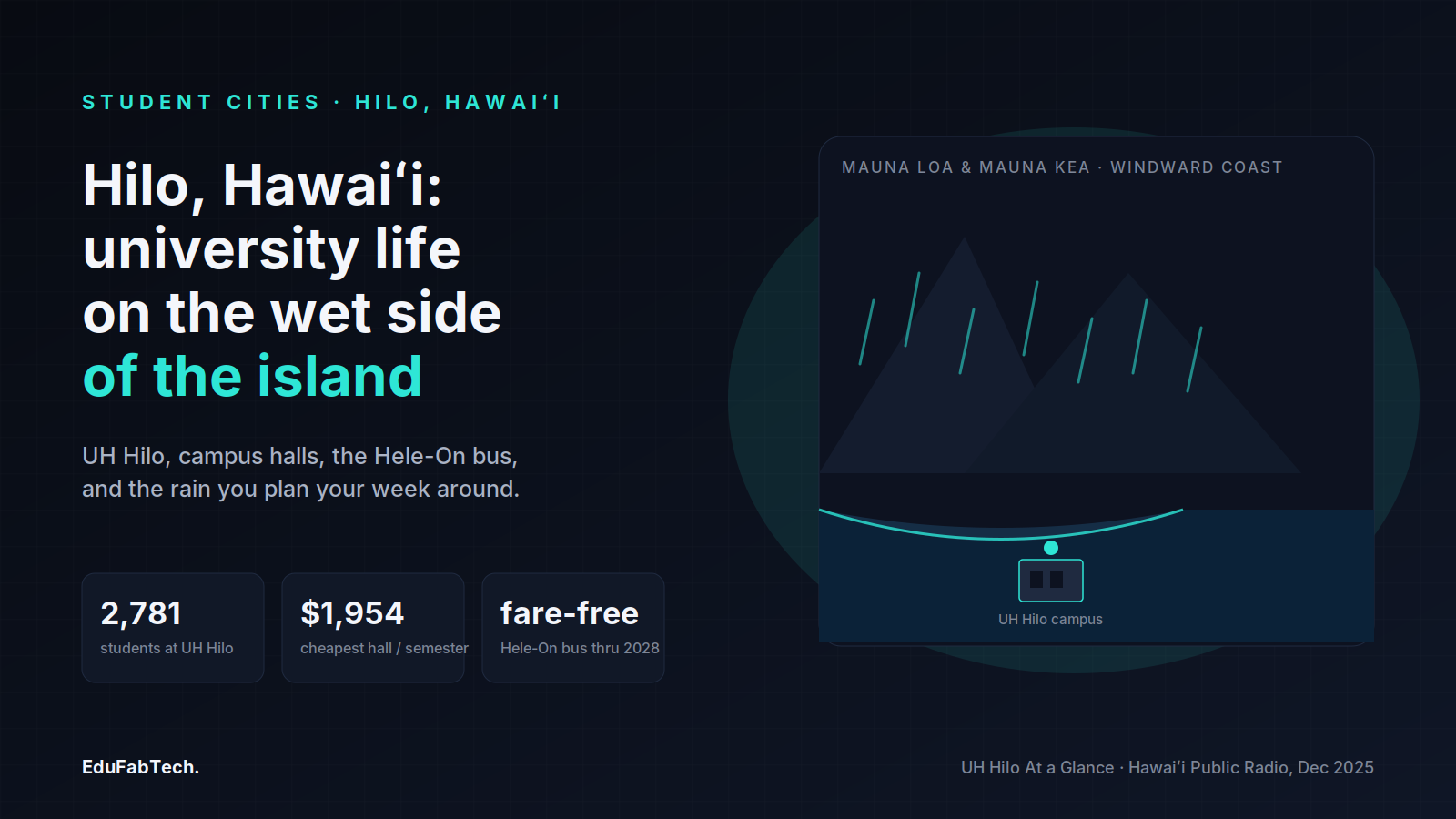
Hilo sits on the rainy, windward side of Hawaiʻi Island, wrapped around a crescent bay and backed by the slopes of Mauna Loa and Mauna Kea. It is the largest town on the island and the seat of Hawaiʻi County, but it is not a resort strip: the economy runs on government, health care, agriculture and the university rather than on tourism, and the waterfront is lined with early-20th-century storefronts rather than hotels. Rain defines daily life here. Hilo is one of the wettest cities in the United States, and students quickly learn to carry a rain jacket year-round and to treat a dry afternoon as a reason to get outside.
For a student that character cuts both ways. The town is small, green and unhurried, and the natural laboratory around it — rainforest, black-sand coast, active volcano, high-altitude observatories — is genuinely part of why people come to study here. But Hilo is also remote: it is an island town several hours by plane from the mainland, with a thin rental market and prices shaped by everything having to arrive by sea or air. This guide walks through the university, where students live, what things cost, and the honest trade-offs of basing yourself here.
The University of Hawaiʻi at Hilo
The University of Hawaiʻi at Hilo is the town's main degree-granting institution, on a campus at 200 W. Kāwili Street on the south side of town. According to the university's At a Glance page, it began in 1947 as a UH Mānoa program and was officially named the University of Hawaiʻi at Hilo in 1970, and today enrols 2,781 students — 2,424 undergraduates and 357 graduate students. That makes it a small university by mainland standards, and the close student-to-faculty scale is part of what it offers.
The same page lists 50 degree programs and some unusual ones for a campus this size: it names a Doctor of Pharmacy (Pharm.D.) and a Doctor of Nursing Practice (DNP) with a rural focus among its doctorates. Its distinctive strengths grow out of where it sits: UH Hilo describes the island as a place where "Ten of the 14 world climate zones exist on the Island of Hawaiʻi, making it a living laboratory for the study of volcanoes, astronomy, agriculture, marine science, and other natural sciences." Astronomy students are within reach of the Maunakea observatories, and Hawaiian language and Pacific studies have a real home here rather than being an afterthought. Hilo also hosts Hawaiʻi Community College, whose programs serve many local students alongside UH Hilo. You can see EduFabTech's full set of local listings for the town at /in/united-states/hilo, and listings clustered around campus at /near/university-of-hawai-i-at-hilo.
Living in the residence halls
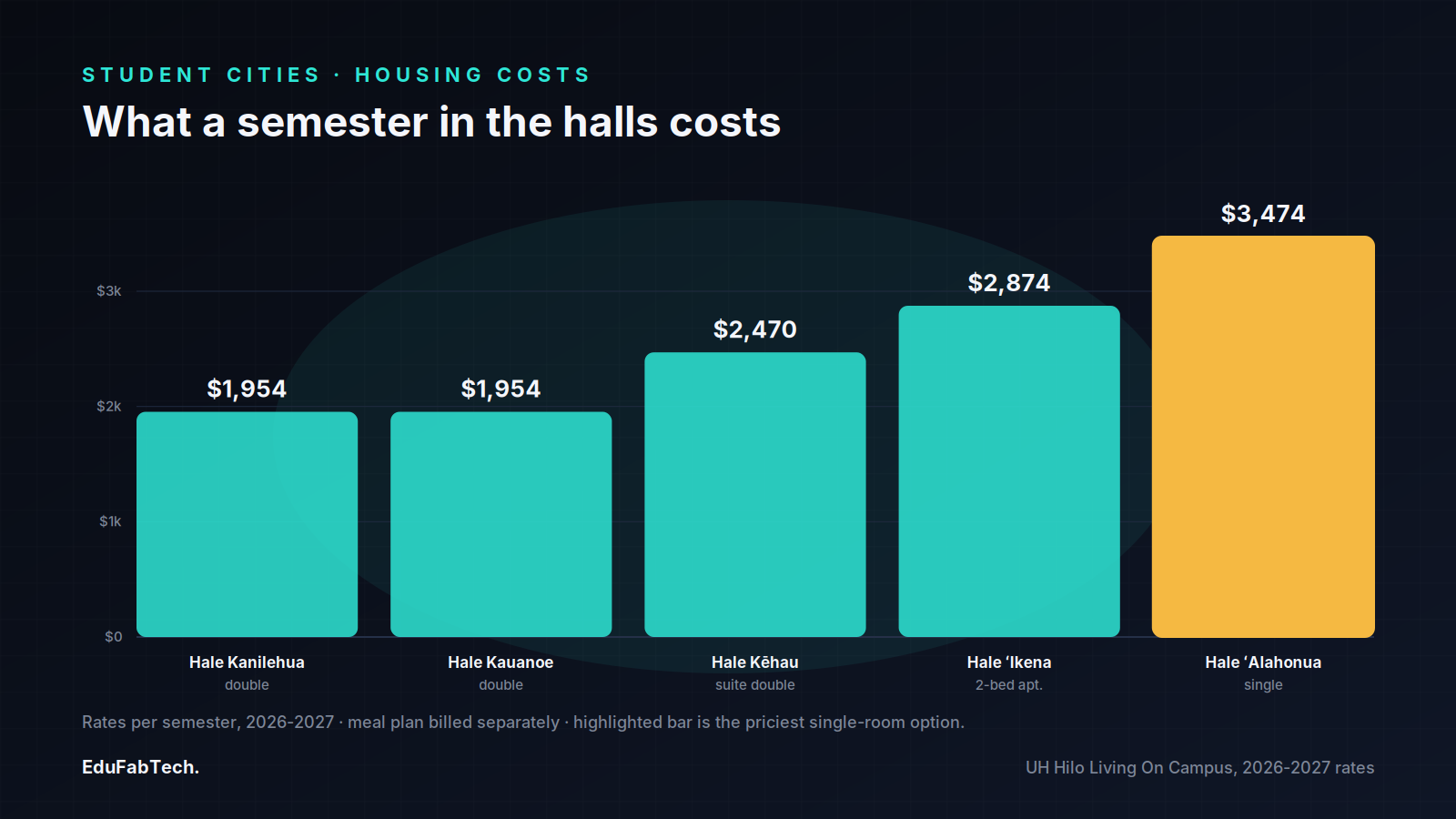
On-campus housing is the simplest first move, especially if you are arriving from off-island and cannot view a flat in person. UH Hilo's Living On Campus page lists five residence halls with per-semester rates for 2026-2027: Hale Kanilehua and Hale Kauanoe, both traditional double rooms, at $1,954 each; Hale Kēhau, a double in a four-person suite, at $2,470; Hale ʻIkena, a shared two-bedroom apartment, at $2,874; and Hale ʻAlahonua, a single bedroom in a two-person unit, at $3,474. The same page states you must be enrolled in at least 12 credit hours — usually four courses — to be eligible to live on campus.
Those figures are per semester and do not include a meal plan, which is billed separately. Living in a hall removes the two hardest parts of the Hilo rental search — finding a place from a distance and furnishing it — and puts you a short walk from classes, the library and the dining hall. The trade-off is the credit-hour requirement and the fixed room types; if you want a kitchen or a pet, or you are a graduate student, you will likely be looking off campus.
Renting off campus without losing your deposit
Hilo's private rental market is small and tilts toward houses, cottages and "ʻohana" units (a secondary dwelling on a family's lot) rather than purpose-built student blocks. Rooms open up through word of mouth, campus noticeboards and community listings, and the supply is thin enough that good rooms go quickly around the start of each semester. Start looking early, and if you are coming from abroad or the mainland, consider booking a hall or a short-term room first and doing the house search once you are on the ground.
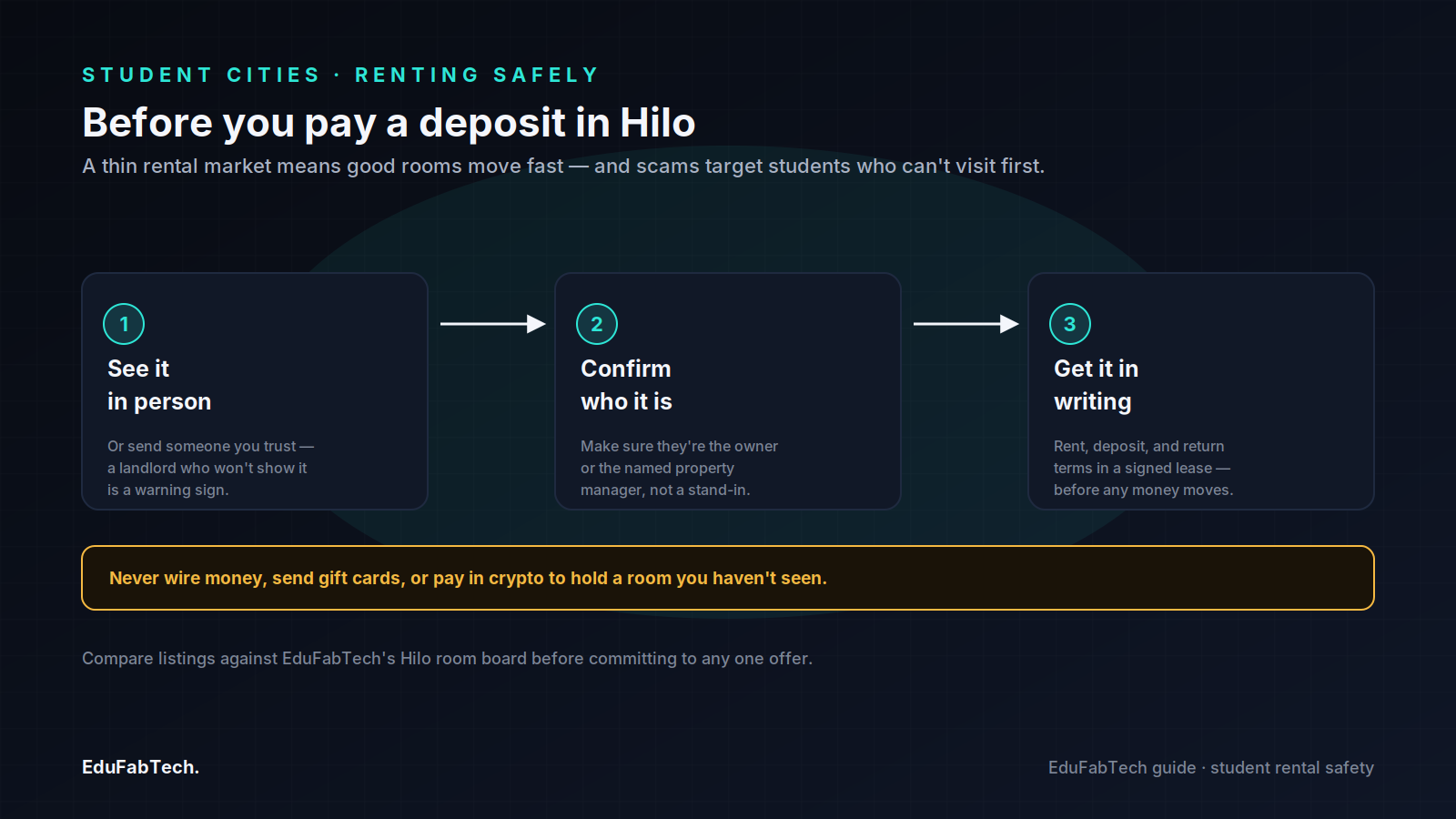
The scams to watch for in Hilo are the familiar remote-rental ones, sharpened by the fact that so many incoming students cannot visit first. A listing far below the going rate, a "landlord" who is conveniently off-island and cannot show the unit, and pressure to pay a deposit immediately to "hold" it are the warning signs. Never send money by bank wire, gift card or cryptocurrency to reserve a room you have not seen — those payments cannot be reversed, and a genuine local landlord will not insist on them. See the place yourself or send someone you trust; confirm the person showing it is the owner or the named property manager; and get the rent, deposit and rules in a written lease before any money changes hands. Ask what the deposit is and when it is returned, and keep a record of every payment. EduFabTech's room listings for the town are at /in/united-states/hilo/rooms; use them to compare what is genuinely on offer before committing.
Furnishing a room, and the markets Hilo is known for
Because shipping furniture to the island is expensive, buying second-hand locally is almost always the sensible choice, and students leaving at the end of a semester are a steady source of cheap desks, bikes and kitchen kit. Watch campus and neighbourhood boards around move-out in May and December, when whole flats are cleared at once. EduFabTech gathers local second-hand items and furniture at /in/united-states/hilo/second-hand.
Hilo's markets are part of daily life, not just a weekend outing. The Hilo Farmers Market, at 20 Mamo Street on the corner of Kamehameha Avenue in historic downtown, runs daily from 7:00 a.m. to 3:00 p.m. according to the market's own site, with produce, tropical fruit, flowers, prepared food and craft stalls; it is a cheap way to eat well and a good place to find household odds and ends. Out in the Puna district toward Pāhoa, the Makuʻu Farmers Market sets up on Sunday mornings on the Keaʻau–Pāhoa bypass and mixes a produce market with a sprawling flea-market section where used goods, tools and plants change hands. Between the two, and the farmers' stalls that pop up around town, you can furnish a kitchen and a shelf without ordering anything online.
Working while you study
Many students take a few hours of paid work, and the campus itself is the most straightforward employer for international students. The U.S. Department of Homeland Security's Study in the States guidance explains that an F-1 student with active status may work on campus but not more than 20 hours per week while school is in session, and that on-campus employment does not require a separate Form I-765 application to USCIS — though you must talk to your school's Designated School Official (DSO) first. Off-campus employment is tightly restricted and requires specific authorisation arranged through your DSO; the rules change, so treat the DHS page and your DSO as the authority rather than anything here, and do not rely on second-hand advice. This is general information, not legal advice. Local openings posted through EduFabTech are at /in/united-states/hilo/jobs.
Libraries and places to study
The Edwin H. Mookini Library is the academic anchor on campus and holds a notable Hawaiian collection. Its hours are modest and worth planning around: the library's hours page shows a Fall 2026 weekday pattern of opening at 9:00 a.m. and closing at 9:00 p.m. Monday to Thursday and 4:00 p.m. on Friday, with the main-floor lobby and coffee area opening earlier at 8:00 a.m. on weekdays; weekend coverage is limited, with some Sundays opening only in the early afternoon. The exact days and times shift through the semester, so check the page before a late session. If you are used to a 24-hour library, that thin weekend coverage matters: plan heavy study for weekday evenings. Beyond the library, the small scale of campus means cafés, the student centre and quiet corners of academic buildings fill the gaps, and the rain makes an indoor desk more appealing than it might be elsewhere. EduFabTech lists study spaces around town at /in/united-states/hilo/study-spaces.
Getting around on the Hele-On bus
Public transport on Hawaiʻi Island is the county-run Hele-On system, and its headline feature for students is the price. As Hawaiʻi Public Radio reported in December 2025, Hawaiʻi County officials voted on 3 December 2025 to extend the fare-free program for another three years, keeping Hele-On fare-free through December 2028, funded through federal formula funds. There is no fare to pay and no card to buy while that program runs. The catch is coverage: Hele-On is a rural network built around a handful of routes, with limited frequency and little or no evening and Sunday service on many lines, so it works best for a predictable campus-and-town commute rather than spontaneous trips. Many students end up walking or cycling for short hops in compact Hilo, and keep a bike dry against the rain. Check current timetables before you rely on a route, because schedules change.
The costs, and the honest trade-offs
UH Hilo's Estimated Cost of Attendance for 2026-2027 gives the clearest sourced picture. Annual tuition is listed at $7,632 for Hawaiʻi residents and $20,592 for non-residents. For a student living in the dorms the university budgets $3,908 for housing and $8,298 for food over the year; for a student living off campus it estimates $17,046 for housing and $6,542 for food. Those off-campus housing and food lines are the honest signal of island prices: nearly everything is dearer here than on the mainland because it is shipped in, and rent is the figure most likely to strain a budget.
Weigh that against what Hilo gives you. It is a genuine small university town in an extraordinary landscape, with a strong local culture, cheap fresh food at the markets, a free bus and a campus you can cross on foot. Against it: the rain is constant and some people find it wearing; the rental market is thin and not cheap; the bus will not take you everywhere; and the island's remoteness means flights home are long and not casual. For students who want quiet, nature and a close community it is a rare fit. For those who need a dense city, abundant part-time jobs and dry weather, it will feel limiting.
A checklist for your first weeks
- Lock down housing first. If arriving from off-island, book a residence hall or short-term room before you commit to a lease you cannot view — see the room listings.
- Meet your DSO early if you are on an F-1 visa, before taking any job, and read the DHS Study in the States work rules.
- Buy second-hand. Furnish from departing students and the markets rather than shipping anything in.
- Learn the Hele-On route you need and its timetable, since service is limited and free.
- Plan study time around the library's hours, which thin out at weekends and shift through the semester.
- Buy good rain gear on day one — it is the single most-used piece of kit in Hilo.
- Never wire a deposit for an unseen room. See the place, confirm the landlord, get it in writing.
A quick question for readers
Do you work part-time while you study?
Many students work to pay the bills. See how common it is — and how many hours people really do.
Pick an answer, create a free account in a minute, and your vote counts. Already a member? Sign in
Comments 0
CommentNo comments yet. Members start the conversation.
Source: University of Hawaiʻi at Hilo
Sources (5)
- University of Hawaiʻi at Hilo. UH Hilo at a Glance. University of Hawaiʻi at Hilo, 2026. hilo.hawaii.edu ↗ · checked 26 Oct 2026
- University of Hawaiʻi at Hilo. Living On Campus — residence hall rates 2026-2027. University of Hawaiʻi at Hilo, 2026. hilo.hawaii.edu ↗ · checked 26 Oct 2026
- University of Hawaiʻi at Hilo. Estimated Cost of Attendance for 2026-2027. University of Hawaiʻi at Hilo, 2026. hilo.hawaii.edu ↗ · checked 26 Oct 2026
- Hawaiʻi Public Radio. Hawaiʻi Island residents can keep riding Hele-On buses for free. Hawaiʻi Public Radio, 2025. hawaiipublicradio.org ↗ · checked 26 Oct 2026
- U.S. Department of Homeland Security. Working in the United States. Study in the States, DHS, 2026. studyinthestates.dhs.gov ↗ · checked 26 Oct 2026