Studying in Honolulu: universities, housing and student life
A practical, sourced guide to the four degree-granting universities in and around Honolulu, where students live, what a room costs, and getting around an island city with little housing to spare.
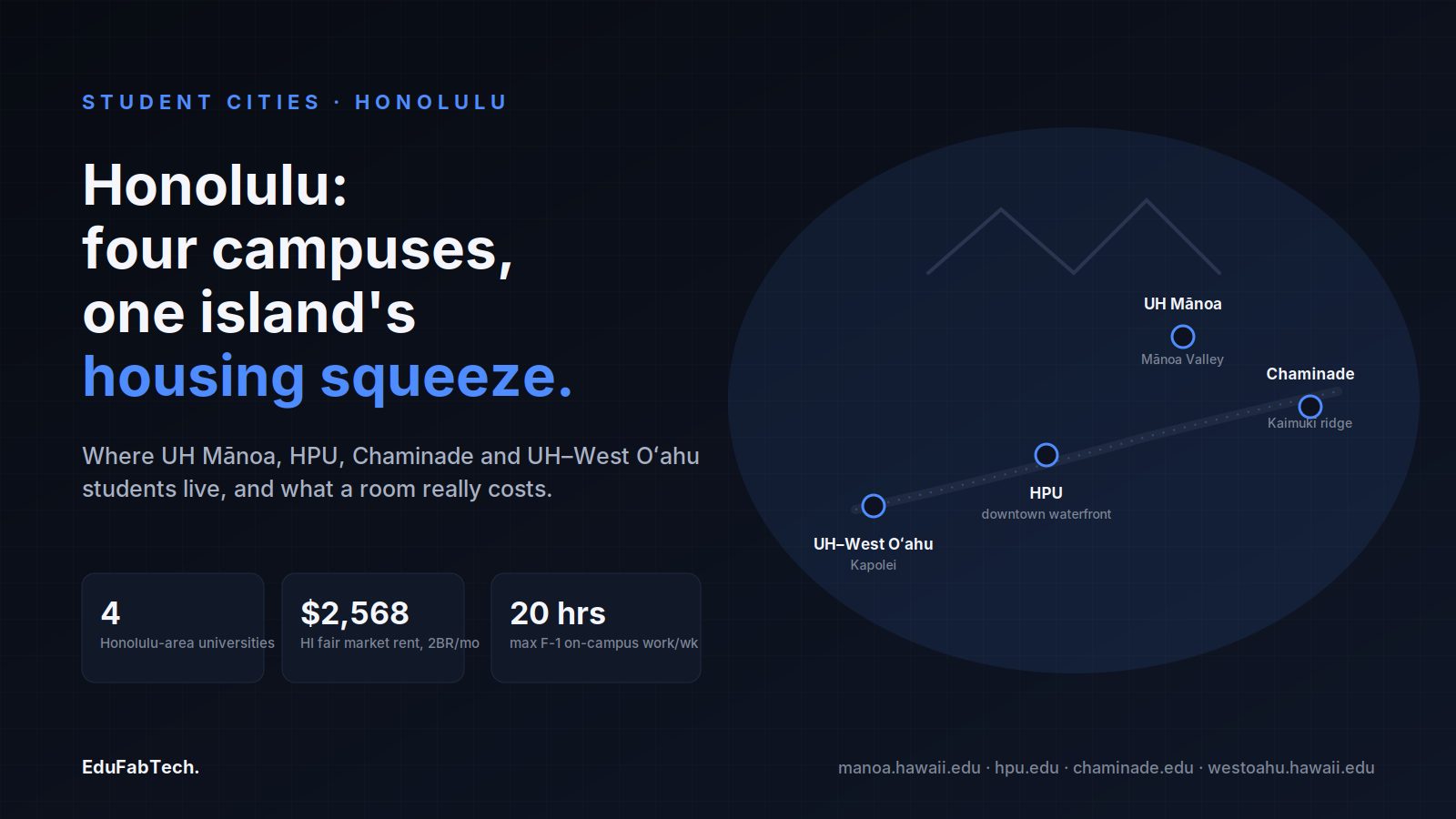
Honolulu is a university town wrapped inside a tropical port city, strung along the south shore of Oʻahu between the Koʻolau mountains and the Pacific. Its campuses are not clustered in one quarter the way they are in many college towns: one sits in a green valley above the city, another on the downtown waterfront among cargo piers and office towers, a third on a ridge in a residential neighbourhood, and a fourth out on the dry Leeward plain half an hour west. Studying here means choosing not just a university but a side of the island, because the commute between them can swallow an hour each way.
What ties the experience together is that Honolulu is an island economy with very little housing to spare, so rent, groceries and furniture all cost more than a mainland student might expect, and finding a room is harder than finding a course. This guide walks through the universities, where students actually end up living, what the numbers look like with their sources attached, and the parts of island life that the brochures leave out.
Throughout, figures are given in US dollars with the institution and year that published them, because on an island where almost everything is shipped in, a number from the wrong year can be badly misleading.
Four universities, four very different settings
The anchor is the University of Hawaiʻi at Mānoa, the flagship of the ten-campus UH system. Its own figures state it was established in 1907, occupies a 320-acre campus in Mānoa Valley just outside downtown Honolulu, and is one of 146 institutions classed R1 for research, as well as a rare land-, sea-, space- and sun-grant university (manoa.hawaii.edu/about). The same page records 15,375 undergraduate and 4,653 graduate students as of autumn 2024. Mānoa's recognised strengths lean into where it is — tropical agriculture and medicine, oceanography, astronomy, volcanology, Hawaiian studies, and Pacific and Asian studies.
Hawaiʻi Pacific University is the private counterpoint, founded in 1965, with its campus built into the Aloha Tower Marketplace on the downtown waterfront — a converted retail and harbour complex at Piers 8 and 9 that houses classrooms, a learning commons and the university's residence alongside restaurants and shops. HPU is known for nursing, marine science and business, and its downtown location puts students within walking distance of hospitals, government offices and the Chinatown arts district.
Chaminade University of Honolulu is the smallest of the three city campuses, a Catholic university founded in 1955 by the Marianists and located at 3140 Waiʻalae Avenue in the Kaimukī neighbourhood, at the foot of St. Louis Heights (chaminade.edu/about). It describes itself as the only Catholic university in Hawaiʻi, with more than 25 undergraduate and graduate programmes across the sciences, behavioural sciences, business, education and nursing.
The fourth, University of Hawaiʻi–West Oʻahu, is not in Honolulu proper but in the planned city of Kapolei, about half an hour west. Its own site dates it to 1976, notes it moved to the current Kapolei campus in 2012, and lists roughly 2,863 undergraduates with distinctive programmes in creative media, cybersecurity, health sciences and sustainable food systems (westoahu.hawaii.edu/about). It is the natural choice for students already living on the Leeward Coast, and the only one of the four reachable by Honolulu's new rail line.
Living near your campus: valley, downtown, ridge or Leeward plain
Housing decisions in Honolulu follow the campus. UH Mānoa students who do not live in halls cluster in the flat, dense neighbourhoods just downhill — Mōʻiliʻili, McCully and lower Makiki — and along University Avenue and King Street, where older walk-up apartments and converted houses sit within a bus ride or a long walk of campus. Rents fall as you move further from the valley, but so does convenience, and parking near Mānoa is scarce enough that a bus pass often beats a car.
HPU students, by contrast, are downtown: Chinatown, Nuʻuanu and the edges of Kakaʻako put them close to the waterfront campus but into a busier, pricier rental market. Chaminade sits in residential Kaimukī and Palolo, quieter and more suburban, while UH–West Oʻahu students generally live out in Kapolei, ʻEwa Beach or Waipahu rather than commuting from town. On an island this compact it is tempting to think any neighbourhood is close to any campus; in practice traffic on the H-1 freeway makes a cross-town commute genuinely slow, and where you live should be dictated by where you study.
Renting safely when rooms are scarce
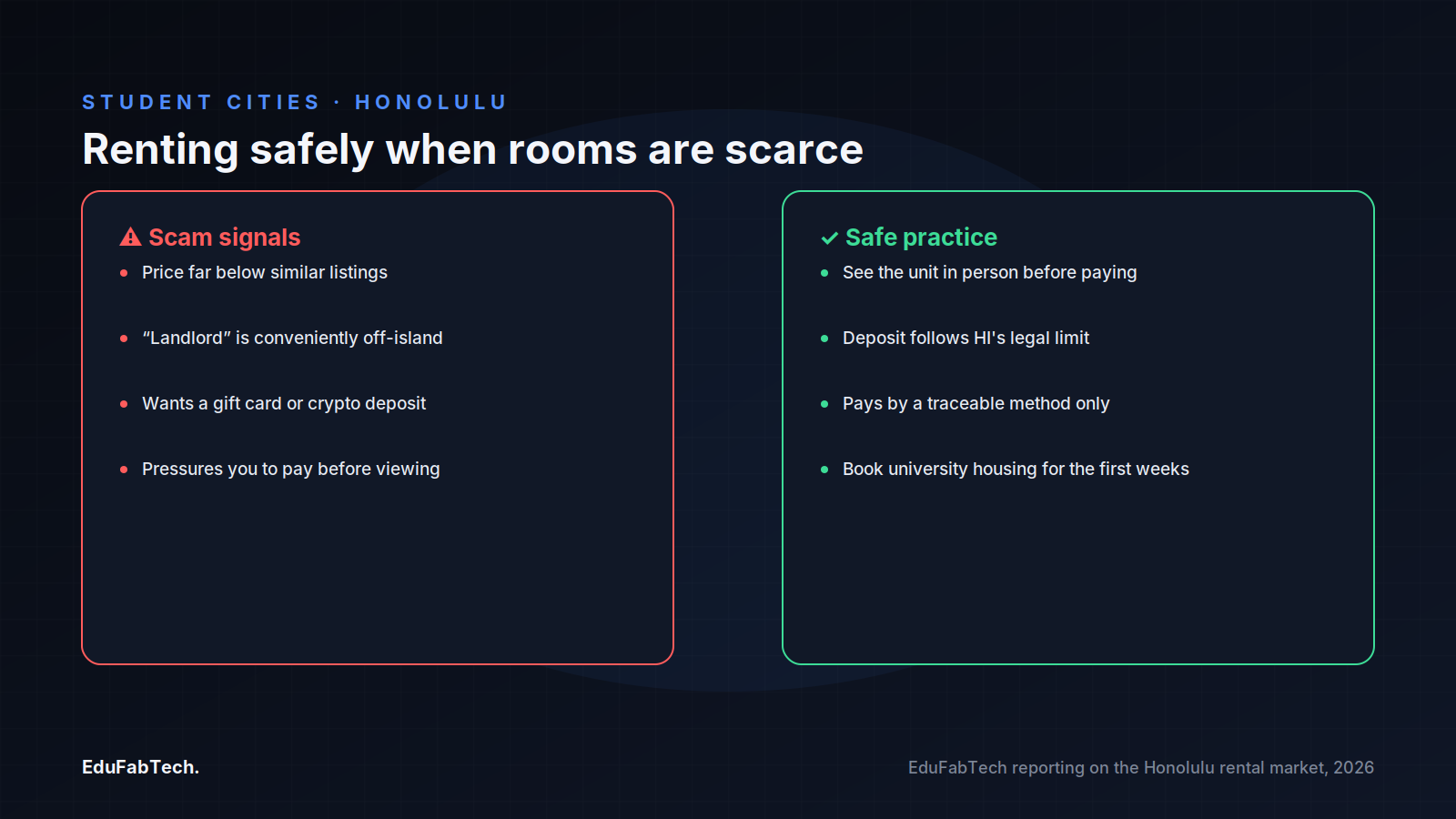
Honolulu's rental market is tight, and that tightness is exactly what rental scams exploit. The pattern here is familiar: a listing for a studio or shared room near Mānoa or Waikīkī priced noticeably below everything else, a "landlord" who is conveniently off-island — often described as working or deployed elsewhere — and a request to wire a deposit or pay with a gift card or cryptocurrency to "hold" the unit before you can see it. Treat every one of those signals as a reason to walk away.
The safe version is slow and local. See the place in person, or have someone you trust see it, before any money changes hands; on an island where listings move fast there is pressure to skip this, but a real landlord will let you view the unit. In Hawaiʻi it is normal to be asked for first month's rent plus a security deposit, and state law limits that deposit, so a demand for several months up front is a warning sign. Pay by a method that leaves a record and never by irreversible transfer. If you are arriving from abroad, consider booking a university residence or short-term stay for your first weeks and searching for a longer-term room only once you are on the ground and can view places yourself. EduFabTech's own Honolulu rooms listings and the wider city page are a starting point, but the same rule applies there: see it first.
What a room costs on Oʻahu
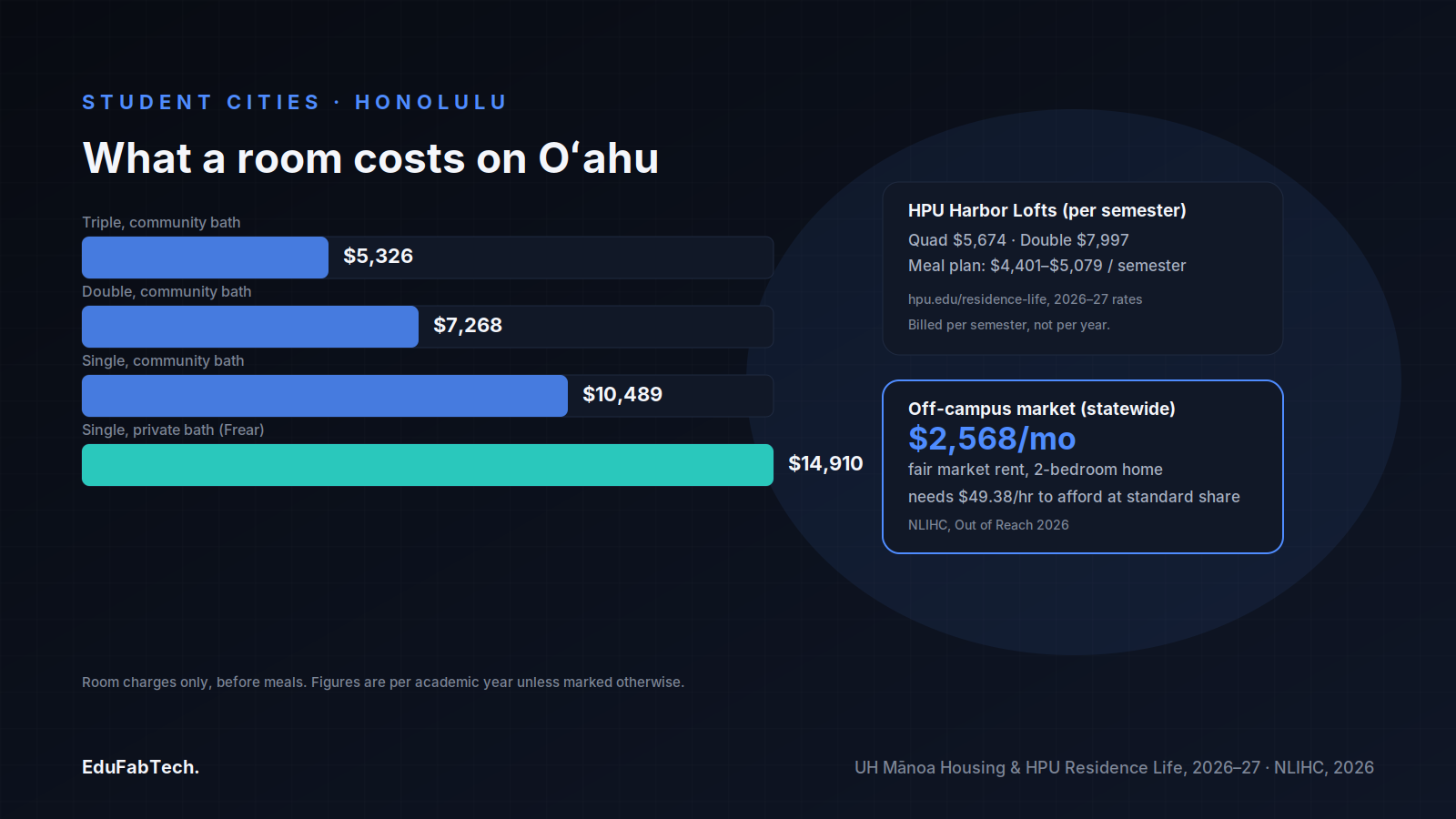
The most reliable published housing numbers come from the universities themselves. For the 2026-2027 academic year (August 2026 to May 2027), UH Mānoa's housing office lists a triple room with a community bath at $5,326 per person, a double at $7,268, and a single with community bath at $10,489, rising to $14,910 for a single-occupant room with a private bath in Frear Hall; a non-refundable $25 application fee applies (manoa.hawaii.edu/housing). Those are room charges only, before meals.
HPU's residence rates for the same 2026-2027 year, charged per semester for its downtown Harbor Lofts, run from $5,674 for a quad-occupancy loft to $7,997 for a double, with a mandatory meal plan on top costing between $4,401 and $5,079 per semester (hpu.edu/residence-life). For the private market, the National Low Income Housing Coalition's Out of Reach 2026 report put the fair market rent for a two-bedroom home in Hawaiʻi at $2,568 a month, among the highest of any US state, and calculated that affording it at the recommended share of income would take a wage of $49.38 an hour (nlihc.org/oor/state/hi). Split between flatmates, that is the figure most off-campus students are really planning around.
Furnishing a room for less
Because everything ships in, buying furniture new in Honolulu is expensive, and the second-hand economy is correspondingly lively — move-out season near Mānoa in May leaves usable furniture on kerbsides across Mōʻiliʻili. For thrift shopping, Goodwill Hawaiʻi and Savers both run stores in town, including a Goodwill on Waiʻalae Avenue in Kaimukī. The KCC Farmers Market on the grounds of Kapiʻolani Community College, held Saturday mornings on the Diamond Head side of town, is the city's best-known market for produce and prepared food, and the Aloha Stadium Swap Meet in nearby ʻAiea is the island's largest flea market for household goods and cheap basics. For the rest, EduFabTech's second-hand listings are worth watching, especially around semester turnover.
Working while you study
Rules on part-time work depend entirely on your status, and this is one area where it pays to read the official source rather than secondhand advice. International students on an F-1 visa are generally limited to on-campus employment of up to 20 hours per week while classes are in session, with full-time work allowed during official breaks; standard on-campus work does not require a separate employment authorisation document. The authoritative statement of these rules is the US Citizenship and Immigration Services policy manual (uscis.gov, Volume 2, Part F, Chapter 6), and your university's international-student office is the body that actually certifies your eligibility. This is not legal advice — confirm your own situation with that office before you accept any job.
For everyone, on-campus roles — library desks, dining, research assistantships, tutoring — are the simplest to start with because they sit inside the university system. Tourism, food service and retail dominate Honolulu's off-campus job market, concentrated in Waikīkī and Ala Moana, though those are only open to students whose status permits off-campus work. Current openings aggregated for the city sit on EduFabTech's Honolulu jobs page.
Libraries and places to study
UH Mānoa anchors campus study life with Hamilton Library, its main research library, and Sinclair Library, which is geared toward undergraduate study space. Off campus, the Hawaiʻi State Public Library System is an underused resource for students: a library card is free for Hawaiʻi residents and renews free every five years (librarieshawaii.org). The flagship Hawaiʻi State Library, built in 1911 next to ʻIolani Palace and the State Capitol downtown, is within walking distance of HPU and gives downtown students a quiet, air-conditioned alternative to a cramped flat. Branch libraries in Mōʻiliʻili, Kaimukī and across the island extend that for free. EduFabTech also keeps a running list of study spaces in Honolulu for when the libraries fill up during exams.
Getting around: TheBus, Skyline and the HOLO card
Honolulu's public transport is run by the City and County of Honolulu as TheBus, complemented since 2023 by the elevated Skyline rail on the Leeward side. Both are paid with the contactless HOLO card. From 1 July 2026, the adult HOLO fare is $3.00 for a two-hour pass with unlimited transfers, capped at $7.50 a day, with a monthly pass at $90 and an annual pass at $990 (thebus.org fares). A youth HOLO card for riders aged 6 to 17 — extended to high-school students up to 19 with proof of enrolment — is cheaper at $1.50 a ride, $3.75 a day and $40 a month (thebus.org youth fares).
The best deal, though, is institutional. Full-time UH Mānoa undergraduate and graduate students who have paid the mandatory Student U-Pass transportation fee ride TheBus at no extra cost, and newly issued Mānoa One Card student IDs are now encoded with a HOLO number so students simply tap their ID to board (manoa.hawaii.edu/commuter). For UH–West Oʻahu students in Kapolei, Skyline's western segment is the fast way into the growing rail network, and the same HOLO card covers both modes. A car is genuinely optional in town; in the Leeward suburbs it is harder to do without.
The honest trade-offs
What is good about studying in Honolulu is hard to overstate and easy to take for granted: a mild climate year-round, the ocean minutes from every campus, and a genuinely multicultural student body in a place where no single group is the majority. The universities are small enough to feel personal, and the setting — tropical valley, working harbour, volcanic ridge — is unlike anywhere else in the US system.
What is hard is mostly the cost and the isolation. Rent and groceries are among the highest in the country, as the NLIHC figures above make plain, and shipping makes everything from textbooks to furniture pricier than on the mainland. The island is small, so cross-town traffic is real and housing is genuinely scarce. For students from abroad or from the mainland, the distance home is long and flights are expensive, and some find the enclosed feel of an island — "rock fever," locals call it — wears on them by the second year. None of this is a reason to stay away; it is a reason to budget honestly and arrive with housing and transport sorted.
A checklist for the first weeks
- Confirm your university housing or a short-term booking before you fly; do not sign for an unseen flat from off-island.
- Get a HOLO card — or activate the HOLO number on your Mānoa One Card — and check whether your student fees already cover a bus pass.
- Get a free Hawaiʻi State Public Library card once you have a local address.
- If you are on a visa, visit your international-student office in week one to confirm what work, if any, you may do.
- Furnish from Goodwill, Savers, the Aloha Stadium Swap Meet and end-of-semester give-aways rather than buying new.
- Budget for island prices from the first week, and keep a record of every rental payment you make.
Used carefully, the city rewards the effort. Listings, rooms and study spaces gathered for the city — along with what is near each campus — live on EduFabTech's Honolulu page and the listings near UH Mānoa.
A quick question for readers
Do you work part-time while you study?
Many students work to pay the bills. See how common it is — and how many hours people really do.
Pick an answer, create a free account in a minute, and your vote counts. Already a member? Sign in
Source: University of Hawaiʻi at Mānoa
Sources (5)
- University of Hawaiʻi at Mānoa. About UH Mānoa. University of Hawaiʻi at Mānoa, 2025. manoa.hawaii.edu ↗ · checked 8 Oct 2026
- University of Hawaiʻi at Mānoa. 2026-2027 Academic Year Housing Rates. University of Hawaiʻi at Mānoa, 2026. manoa.hawaii.edu ↗ · checked 8 Oct 2026
- City and County of Honolulu Department of Transportation Services. TheBus and Skyline Fares (effective July 1, 2026). TheBus, 2026. thebus.org ↗ · checked 8 Oct 2026
- Hawaiʻi Pacific University. Residence Life: Housing and Meal Rates 2026-2027. Hawaiʻi Pacific University, 2026. hpu.edu ↗ · checked 8 Oct 2026
- National Low Income Housing Coalition. Out of Reach 2026: Hawaii. NLIHC, 2026. nlihc.org ↗ · checked 8 Oct 2026