Studying in Houston: universities, housing and student life
A practical, sourced guide to studying and living in Houston — its universities, where students rent, part-time work rules, study spaces, transport, costs and the honest trade-offs.
Houston is the fourth-largest city in the United States and one of the hardest to picture from the outside. There is no single downtown that everything orbits, no zoning code in the ordinary sense, and no tidy campus belt. Instead there is a vast, flat, humid plain threaded by freeways and slow green bayous, where the universities sit several miles apart and students scatter across dozens of neighbourhoods. The city is enormously diverse — a place where you can hear a dozen languages in a single afternoon — and it runs on cars far more than on foot. Understanding Houston as a student means accepting from the start that your campus is one point on a very large map, and that where you choose to live shapes your day more than almost anything else.
That size is also the opportunity. Houston holds one of the densest concentrations of research universities, teaching hospitals and medical institutes in the world, clustered around the Texas Medical Center just south of downtown. Rent is lower than in comparable coastal cities, food is extraordinary and cheap, and the student population is genuinely international. The trade-offs are real too — long commutes, summer heat and humidity that take weeks to adjust to, and a housing market where the good rooms move quickly. This guide walks through the institutions, the neighbourhoods, and the practical mechanics of landing safely.
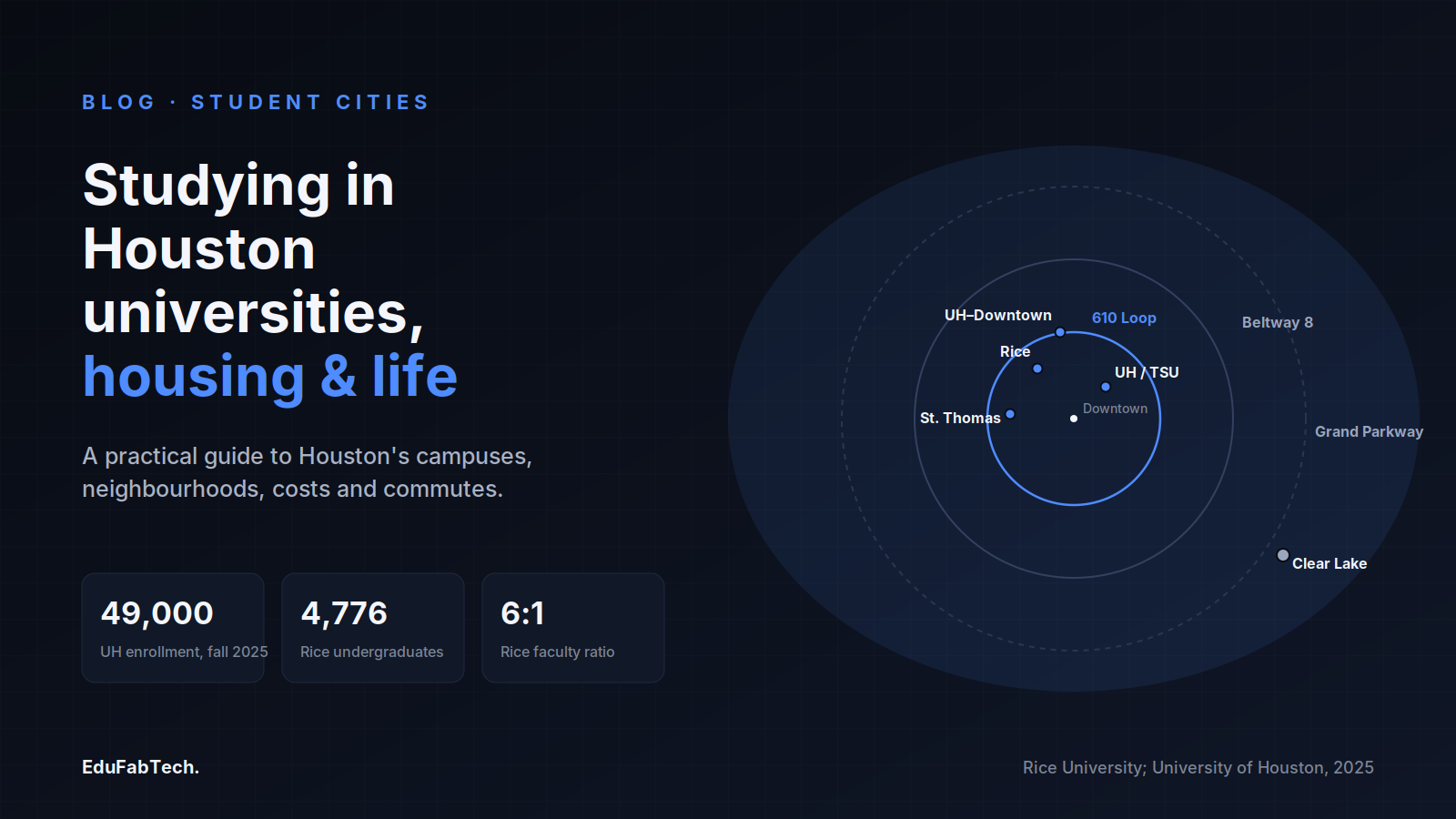
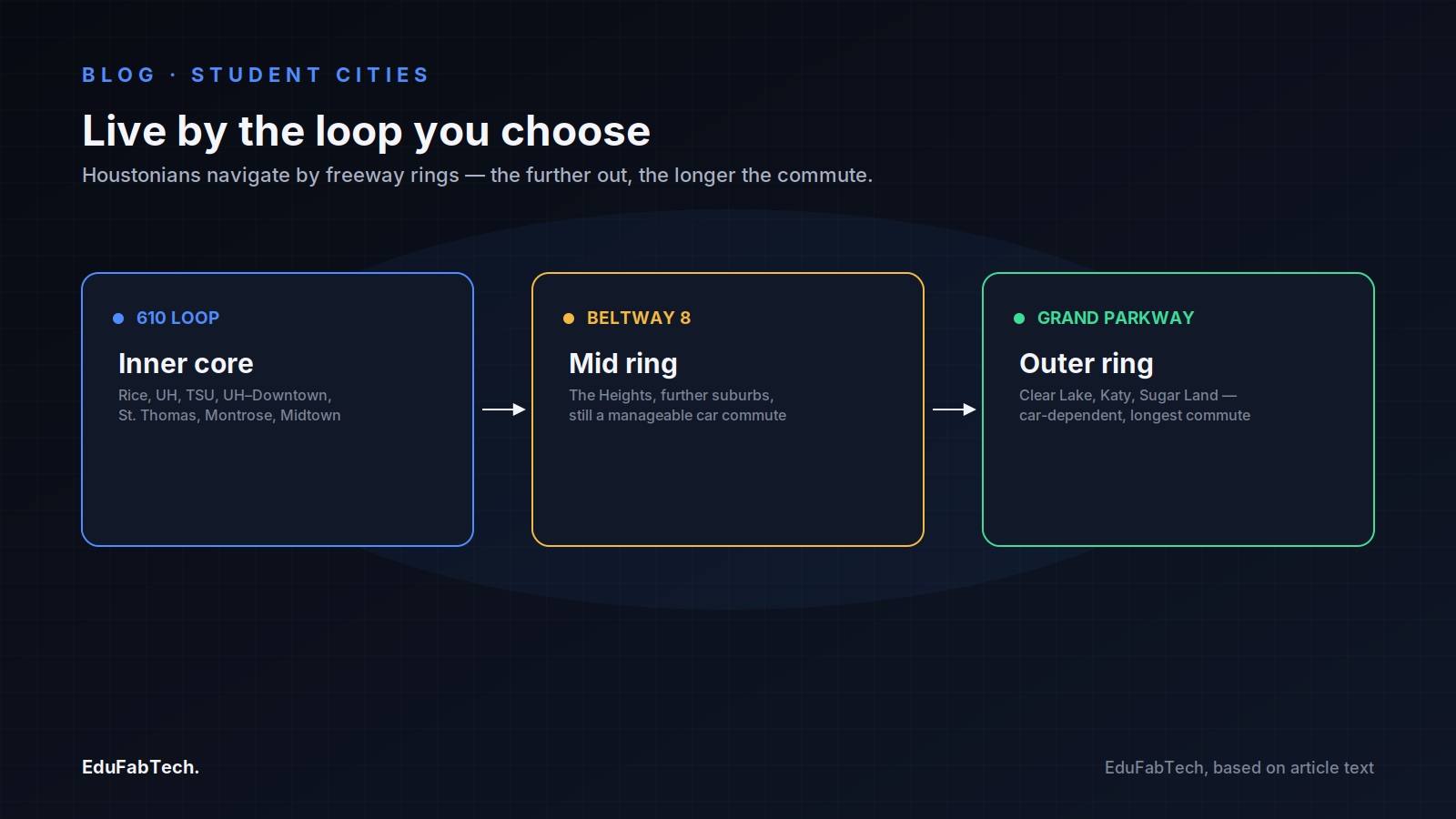
A note on orientation: Houstonians navigate by freeway loops. The 610 Loop circles the core; Beltway 8 is the next ring out; the Grand Parkway is the outer ring. Most student life happens inside the 610 Loop, and the further out you live, the longer and more car-dependent your commute becomes.
The universities, and what studying here is like
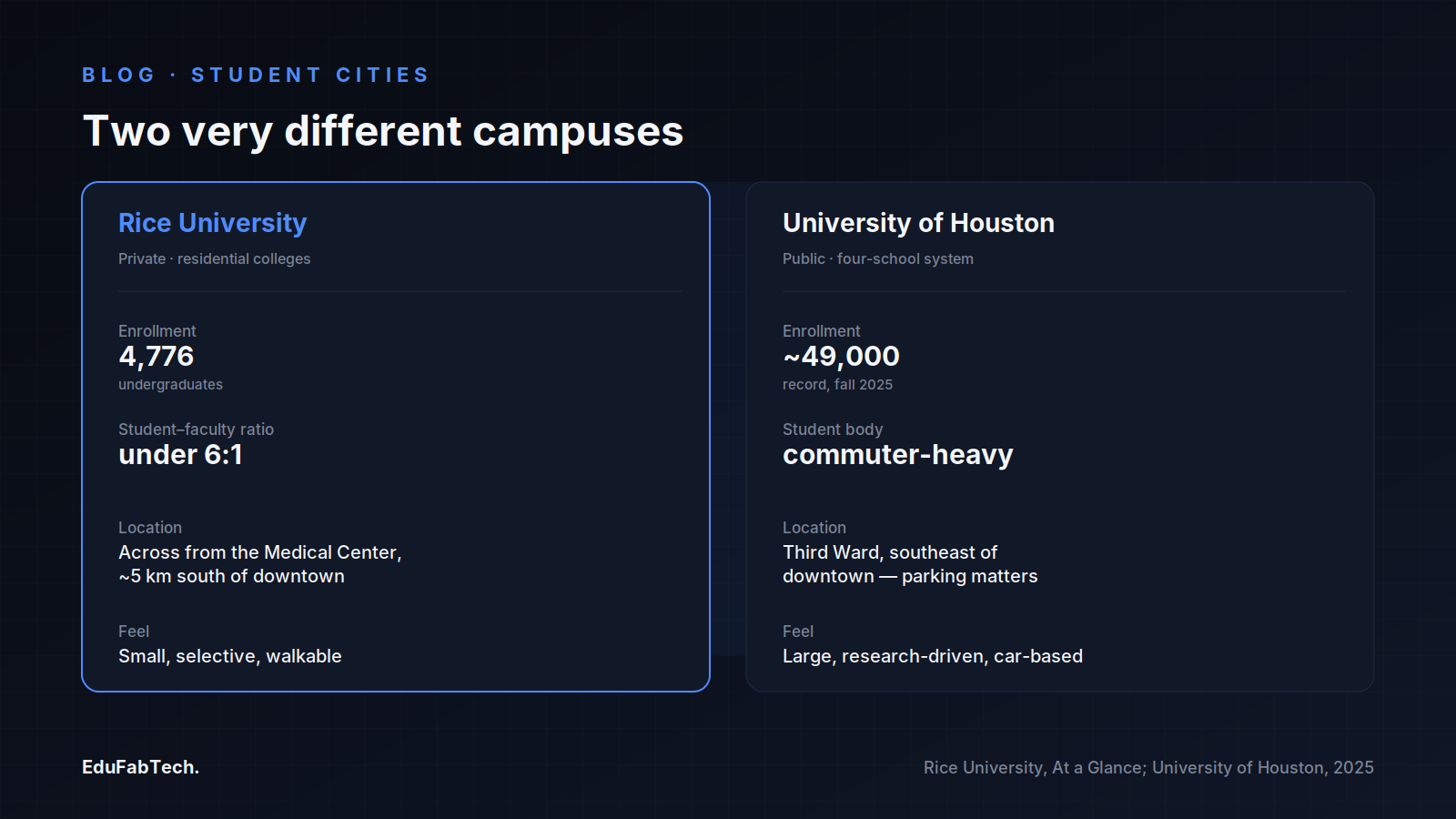
Rice University is the city's best-known private research university, sitting on a wooded campus of roughly 300 acres just across from the Texas Medical Center and the Museum District, about five kilometres south of downtown. Rice's own profile describes a campus of about 4,776 undergraduates drawn from more than 60 countries, with an undergraduate student-to-faculty ratio just under 6-to-1 (Rice University, At a Glance, accessed 2026). It is small, selective and residential, organised around a system of residential colleges, and strong in engineering, the natural sciences, music and architecture.
The University of Houston is the opposite kind of place: a large public research university in the historic Third Ward, a few kilometres southeast of downtown, and the anchor of a four-institution public system. The university reported a record enrollment of nearly 49,000 students for the autumn 2025 term, the largest in its history (University of Houston, 2025). It is a federally designated research university with a full range of undergraduate and graduate programmes, a serious engineering and energy focus, and a commuter-heavy student body — many students drive in, which makes parking and transit real daily questions.
Sharing the Third Ward is Texas Southern University, one of the largest historically Black universities in the country, established in 1927 and serving as a cultural anchor of the neighbourhood with a wide span of academic and professional programmes. A short distance north, on the edge of the central business district where Buffalo and White Oak bayous meet, is the University of Houston–Downtown, founded in 1974 and the city's only downtown university; its main building is the converted Merchants and Manufacturers Building, and it is a largely non-residential campus serving commuters from across the region.
The medical cluster is its own world. The University of Texas Health Science Center at Houston sits inside the Texas Medical Center and trains health professionals across schools of medicine, dentistry, nursing, public health and biomedical informatics. Alongside it, The University of Texas MD Anderson Cancer Center — a major cancer treatment and research centre — jointly runs a graduate school of biomedical sciences with UTHealth Houston, offering PhD and MS programmes in fields from cancer biology to medical physics. These are graduate and professional institutions rather than places you arrive at straight from secondary school, but they draw researchers from everywhere.
Two smaller private universities round out the inner city. University of St. Thomas is a Catholic liberal-arts university on a compact campus in the walkable Montrose neighbourhood, next to the Menil Collection and the Rothko Chapel. Houston Christian University — known as Houston Baptist University until it renamed in 2022 — is a residential Christian university on the city's southwest side, near Meadows Place.
Studying in Houston, wherever you land, means reconciling a strong academic core with a city built for driving. The campuses are good; the distances between them and your room are the thing to plan around.
Other universities and campuses around Houston
The region spreads well beyond the 610 Loop, and several institutions sit in its satellite towns.
- University of Houston–Clear Lake sits on a wooded nature preserve on the city's southeast edge near Nassau Bay, founded in 1974 in response to the nearby space centre and strong in sciences, engineering and education.
- Lee College is a public community college in Baytown, about 50 kilometres east of downtown, offering associate degrees and technical programmes with a well-known petrochemical process-technology focus.
- The Sasakawa International Center for Space Architecture, part of the University of Houston, runs the world's only graduate programme in space architecture — habitats and structures for extreme environments.
- The Susanne M. Glasscock School of Continuing Studies is Rice University's continuing-education school, offering courses and certificates to adult and community learners rather than a traditional degree track.
- The University of Houston System at Cinco Ranch is a teaching centre in the fast-growing Katy area west of the city, delivering upper-level and graduate courses from across the university system; the system also runs a teaching centre at University of Houston Sugar Land to the southwest.
- Bay Ridge Christian College is a small, unaccredited two-year Bible college associated with the Church of God; published records place it south of the city around Brookside Village, and it is a niche institution rather than a general-admission university.
- For the first two years or technical credentials, the large regional community-college districts are everywhere; Lone Star College–Kingwood in Humble, northeast of the city, is one example students use as an affordable on-ramp.
Where students actually live
Because campuses are scattered, there is no one "student quarter." These are the areas students most often choose, roughly from the inner core outward.
Montrose and the Museum District
Montrose is the walkable, artsy, long-established heart of inner Houston — tree-lined, LGBTQ-friendly, full of cafés, bookshops and old bungalows cut into apartments. It is ideal for University of St. Thomas students, who are right in it, and reachable from Rice and the Medical Center. The neighbouring Museum District, wrapped around Hermann Park, is leafier and quieter, with easy rail access to the Medical Center and downtown. Both are among the more expensive inner areas, but splitting a flat brings them within reach.
Midtown and the Third Ward
Midtown is the social, nightlife-heavy strip between downtown and the Museum District, popular with students who want to be central and on the rail line. The Third Ward, immediately around the University of Houston and Texas Southern University, is the obvious choice for those campuses — historically Black, culturally significant, and a mix of student housing and long-time residents; blocks vary a lot, so look at the specific street, not the label.
EaDo (East Downtown)
EaDo, just east of the central business district, has become one of the more popular and relatively affordable inner options — converted warehouses, breweries, the soccer stadium and a growing residential scene, with light rail into downtown and a reasonable run to the University of Houston.
The Heights
Northwest of downtown, The Heights is a historic, leafy, increasingly sought-after district of early-20th-century houses, good coffee and the restored Houston Farmers Market. It is more residential and a touch pricier, better for graduate students and those who value calm over nightlife, with a car commute to most campuses.
Clear Lake
Far to the southeast, Clear Lake is effectively its own suburban world near the water and the space centre, built up in the 1960s. It is the natural base for University of Houston–Clear Lake students, car-dependent, calmer and cheaper than the core, but a long haul from inner-city campuses.
Rooms and sublets across these areas are worth comparing on the general city listings, in the dedicated rooms section, and on campus-specific pages such as listings near the University of Houston and listings near The University of Texas MD Anderson Cancer Center.
Finding a room — and not losing money to a scam
Most students who are not in university halls rent a room in a shared flat or house, or a studio, usually on a twelve-month lease. Start looking four to eight weeks before term: Houston's market moves quickly in late summer, and the best-priced rooms near campus go first. Expect to show identification and proof that you can pay; many landlords ask for the first month plus a deposit, and some want a guarantor or a larger deposit from students without a local credit history.
Before you pay anything, check a short list of things in person: that the person showing the place actually controls it, that the lease names the real owner or management, what is included in rent (in Houston, air-conditioning in summer is not optional, so ask whether electricity is included and roughly what a summer bill runs), whether there is assigned parking, and how the building has handled flooding — this is a flood-prone city, and it is fair to ask whether a unit has ever taken on water.
On scams, the guidance from the national consumer-protection agency is blunt and worth following exactly: scammers copy real listings or invent places that do not exist, then rush you to pay a deposit or first month before you have seen anything. Its published advice is to never pay a deposit or rent to "hold" a place you have not seen in person or on a live video call, and that anyone who insists on a wire transfer, gift cards or cryptocurrency is running a scam — those payments are like cash and cannot be recovered (consumer-protection agency guidance, 2024). Pay by a method with a paper trail, meet the landlord, and search the address online to check it is not posted elsewhere under a different name.
Furnishing a room: markets and second-hand Houston
Furnishing cheaply is easy here if you are willing to hunt. The city's signature destination is Traders Village in the northwest, a large open-air weekend flea market with more than 1,500 vendors — good for furniture, kitchen kit, bikes and oddities if you bring cash and patience. North of downtown, the restored Houston Farmers Market on Airline Drive is a long-running produce market and a good place for cheap fruit and vegetables and a sense of old Houston.
Beyond the markets, thrift and resale stores are plentiful across the city, student move-out weekends in late spring and August produce a flood of giveaways, and campus and neighbourhood groups constantly pass on furniture. Local classifieds make this easier: it is worth scanning second-hand listings in the city. A practical tip: furniture is bulky and Houston is spread out, so sort out how you will transport a find before you commit to it.
Working, libraries and getting around
If you are an international student, work rules are strict and you should read the official source rather than rely on word of mouth. Under the guidance published by the national immigration authority, a student in F-1 status may generally work on campus up to 20 hours per week while classes are in session, and full-time during official breaks, with their designated school official's approval and without separate work-permit paperwork; off-campus work is tightly restricted and needs specific authorisation. The authoritative statement of these rules is the national immigration authority's policy manual on student employment (immigration authority policy manual, 2024). This is not legal advice — confirm your own situation with your university's international student office before you take any job.
For study space, every campus has its own research library — Rice's Fondren Library and the University of Houston's M. D. Anderson Library among them — and the city layers a strong public system on top. The Houston Public Library, whose Central Library is downtown at 500 McKinney Street, lets permanent Texas residents join free with photo identification and proof of address, while non-residents can buy a temporary card; branches across the city offer quiet desks, Wi-Fi and, at some locations, maker equipment. There are also desks and study spots shared by other students on the study-spaces listings.
Getting around is Houston's genuine weak spot. The city is built for driving, and while there is a bus network and three light-rail lines connecting downtown, Midtown, the Museum District and the Medical Center, coverage thins quickly outside the core. The regional transit authority, METRO, offers a discounted fare for students: with a registered discounted fare card, riders pay a reduced fare — half the standard price — on local buses and rail (METRO, All About Fares, 2026). If you live near a rail line and study at an inner campus you can manage without a car; further out, most students end up driving.
Costs, climate and the honest trade-offs
Houston is cheaper to live in than most large US cities of its size, and housing is the main reason. The national statistical agency's QuickFacts put the city's median gross rent at about US$1,361 a month for the 2020–2024 period, a figure that covers all housing, not student rooms specifically — QuickFacts, 2020–2024 American Community Survey. In practice, sharing a two- or three-bedroom with roommates in the Third Ward, EaDo or the edges of the Museum District pushes the per-person cost well below that, while a solo studio in Montrose or the Heights sits above it. Treat any single rent number as a starting point and budget separately for summer electricity, which is substantial.
The climate deserves its own line in the budget and the calendar. Using the 1991–2020 climate normals, the national weather service records an average July high of about 94.5°F (around 35°C) and roughly 51.8 inches (about 1,315 mm) of rain a year at the city's main airport station (1991–2020 normals, Houston/Galveston). Summers are long, hot and intensely humid; air-conditioning is a necessity, not a comfort, and the rain arrives in heavy bursts. Houston is also genuinely flood-prone, which is why checking a unit's flooding history matters.
What is good about studying here: strong universities and an unmatched medical-research cluster, a low cost of living for a major city, remarkable food and cultural diversity, a warm winter, and a job market in energy, health and technology. What is hard: the heat and humidity, the car dependence and long commutes, the lack of a walkable centre that ties everything together, and a housing market where you must move early and inspect carefully. None of this is a reason to stay away — it is a reason to plan around the map.
A checklist for the first two weeks
- Confirm your room in person or on a live video call, read the lease, and never send money by wire, gift card or crypto to hold a place.
- If you are an international student, visit your university's international student office to confirm your work and status rules before doing anything else.
- Get a discounted transit fare card if you will use buses or rail, and work out your campus commute by transit and by car.
- Join the Houston Public Library (free for Texas residents with ID and proof of address) and find your nearest branch and campus library.
- Set up electricity in your name early and budget for summer air-conditioning bills.
- Plan one weekend trip to Traders Village or a thrift run for furniture, and arrange transport before you buy anything bulky.
- Learn the freeway loops — 610, Beltway 8, the Grand Parkway — so directions and rent ads make sense.
- Check local rooms and city listings for anything you still need to settle in.
A quick question for readers
Do you work part-time while you study?
Many students work to pay the bills. See how common it is — and how many hours people really do.
Pick an answer, create a free account in a minute, and your vote counts. Already a member? Sign in
Sources (5)
- Rice University. At a Glance (About). Rice University, 2026. rice.edu ↗
- University of Houston. University of Houston Welcomes Record Enrollment of Nearly 49,000 Students. University of Houston, 2025. uh.edu ↗
- U.S. Census Bureau. QuickFacts: Houston city, Texas. U.S. Census Bureau, 2025. census.gov ↗
- NOAA National Weather Service. Houston IAH Extremes, Normals, and Annual Summaries (1991–2020 Normals). NOAA National Weather Service, Houston/Galveston, 2022. weather.gov ↗
- Federal Trade Commission. Rental Listing Scams. FTC Consumer Advice, 2024. consumer.ftc.gov ↗