Studying in Indianapolis: universities, housing and student life
A practical, sourced guide to Indianapolis for students — its campuses after the IUPUI split, where to live, what a semester costs, and how to get around a flat, spread-out city.
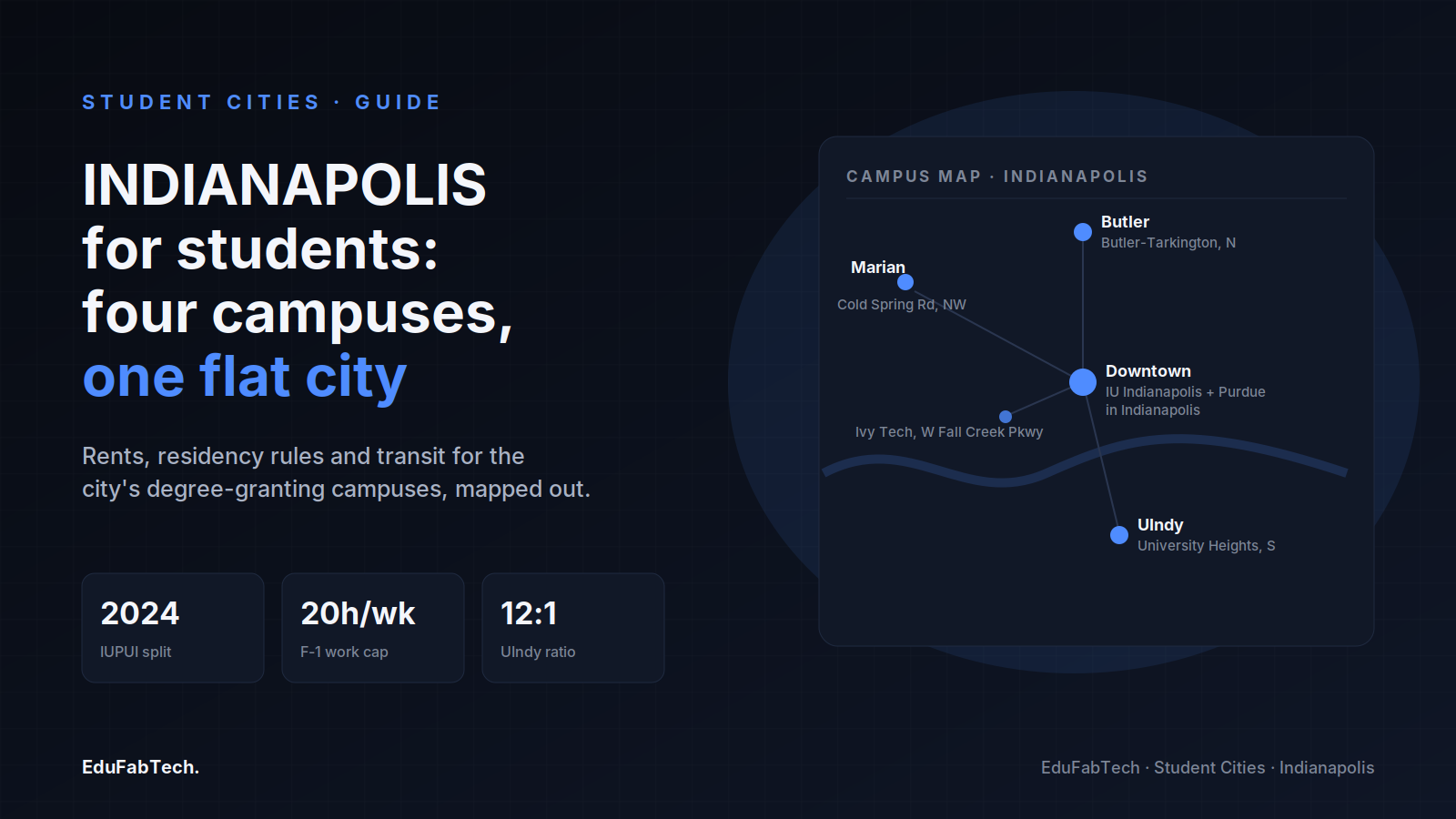
Indianapolis sits almost exactly in the middle of Indiana, on flat ground where the White River bends through the centre of the state. The city was laid out around a single point — Monument Circle — and its oldest core is still called the Mile Square. Unlike a classic college town built around one quadrangle, the capital spreads its students across several campuses separated by a few miles of grid streets, interstates and neighbourhoods, so where you study shapes your daily life here more than it would in a smaller place.
That matters because Indianapolis is a driving city with a growing but still limited transit spine. A student near Butler University in the leafy north, one in a downtown tower by the canal, and one on the south side will each experience very different versions of the same city. The good news is that rents are modest by the standard of large US cities, the terrain is flat enough to cycle, and the campuses are close enough to visit one another in an afternoon.
This guide names the institutions that currently grant degrees in the city, explains where students actually end up living and how to rent without being cheated, and gives costs you can check against their original sources. Where a figure appears, the institution and the year it published it are in the sentence.
The campuses, from Butler-Tarkington to the south side
The city's best-known private university is Butler University, whose campus occupies the north-side neighbourhood of Butler-Tarkington — a district named jointly for the university and the novelist Booth Tarkington. Butler moved onto the former Fairview Park grounds in 1928, and the campus today is residential and compact, strong in pharmacy and health sciences, dance and the arts, with its own professional-grade concert hall and planetarium. First-year students not living at home must live in a university residence hall, and sophomores and juniors not living at home must live in university housing or approved Greek housing, per Butler's published residency requirement — so most undergraduates spend three years in campus housing.
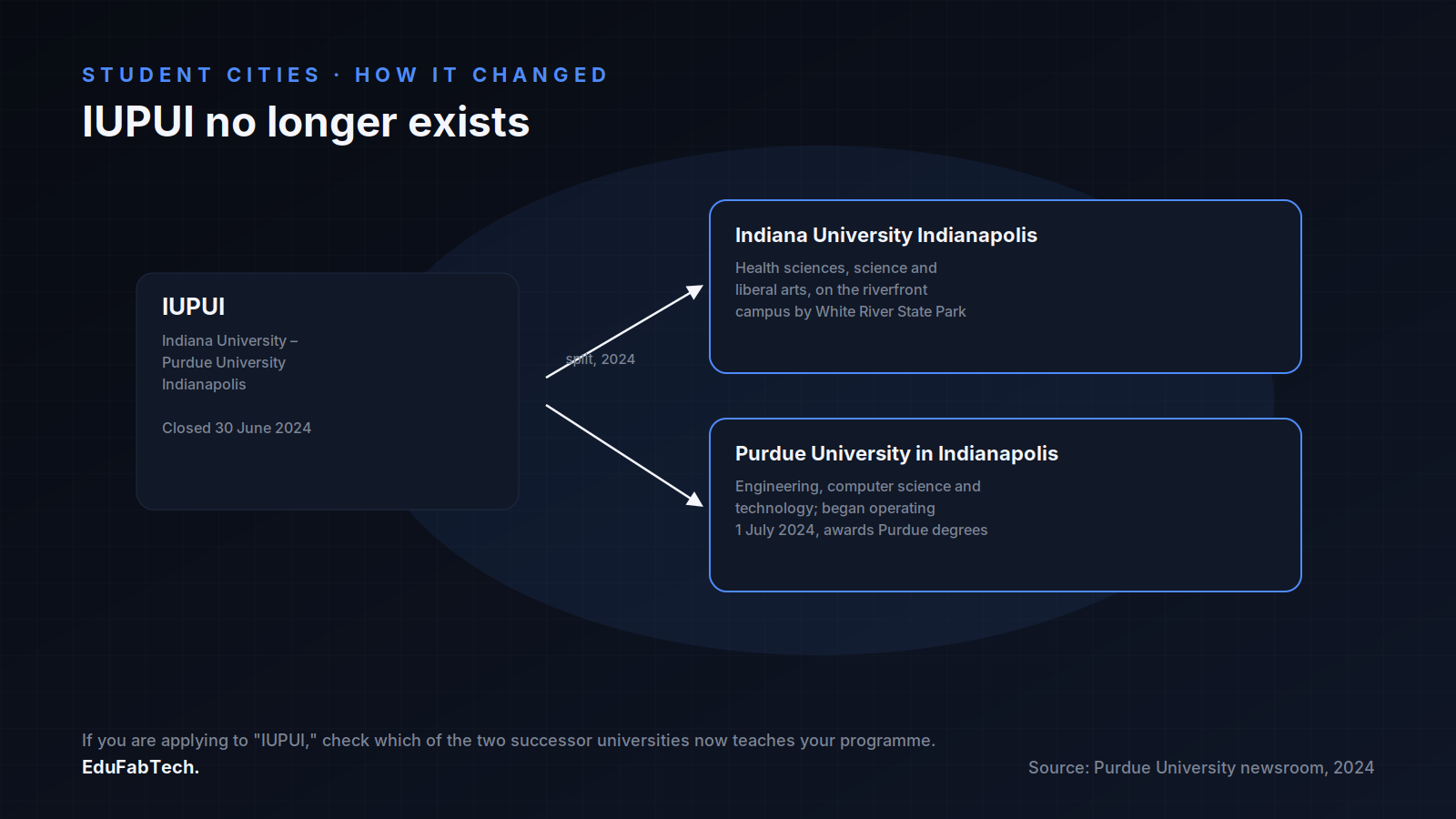
The largest cluster of students is downtown, on the campus that until recently was Indiana University – Purdue University Indianapolis. As Purdue's newsroom announced, IUPUI dissolved on 30 June 2024 and Purdue University in Indianapolis began operation on 1 July 2024, taking over the former engineering, computer science and technology programmes and awarding Purdue degrees, while Indiana University Indianapolis kept the health, science and liberal-arts side on the large riverfront campus beside White River State Park. If you are applying to "IUPUI", that name no longer exists — check whether the programme you want now sits under Indiana University Indianapolis or Purdue University in Indianapolis, because they are separate universities on overlapping ground.
Five miles or so south of downtown is the University of Indianapolis, a private university affiliated with the United Methodist Church in the quiet University Heights neighbourhood at 1400 East Hanna Avenue. Its Fast Facts page reports more than 4,000 students on the main campus, with students from 40-plus US states and 60-plus countries, a student-to-faculty ratio of 12:1 and an average class size of 16, and it says it produces more clinical psychologists than any other university in the state. UIndy's engineering school, the RB Annis School of Engineering, sits within the university and awards bachelor's degrees in engineering and computer science.
North-west of downtown, on Cold Spring Road, is Marian University, a Catholic Franciscan university. Its Fast Facts note it was founded in 1851 by the Sisters of St Francis, Oldenburg, that its cycling programme has won more than 50 USA Cycling national titles, and that its Wood College of Osteopathic Medicine is Indiana's first and only college of osteopathic medicine. It is smaller and more residential than the downtown campuses.
Rounding out the list is Ivy Tech Community College, Central Indiana Region, which runs part of Indiana's statewide community-college system from its Indianapolis campus on West Fall Creek Parkway, offering associate degrees, certificates and low-cost transfer pathways into the four-year universities — a common and cheap first step for local students.
Neighbourhoods students choose, and renting without getting burned
Because the campuses are scattered, so is student housing. Around Butler, students spill north into Broad Ripple, a walkable district of bars, restaurants and older rental houses linked to downtown by the Monon Trail and IndyGo's Red Line. Downtown students cluster in the apartment blocks of the Mile Square and along the Central Canal, or just east in historic Fountain Square and Irvington. UIndy students stay close to University Heights and Garfield Park on the south side. Rents generally rise the closer you get to Broad Ripple and the canal, and fall as you move toward the older east- and south-side streets.
If you are coming from abroad or from out of state, start looking later than you might think — serious leasing for a US autumn term happens from roughly February to May, and the best-priced rooms near Butler and in Broad Ripple go first. For a first term, a university-run residence hall or a sublet arranged through your institution's off-campus housing office is the safest landing; it buys you time to learn the neighbourhoods before signing a twelve-month lease.
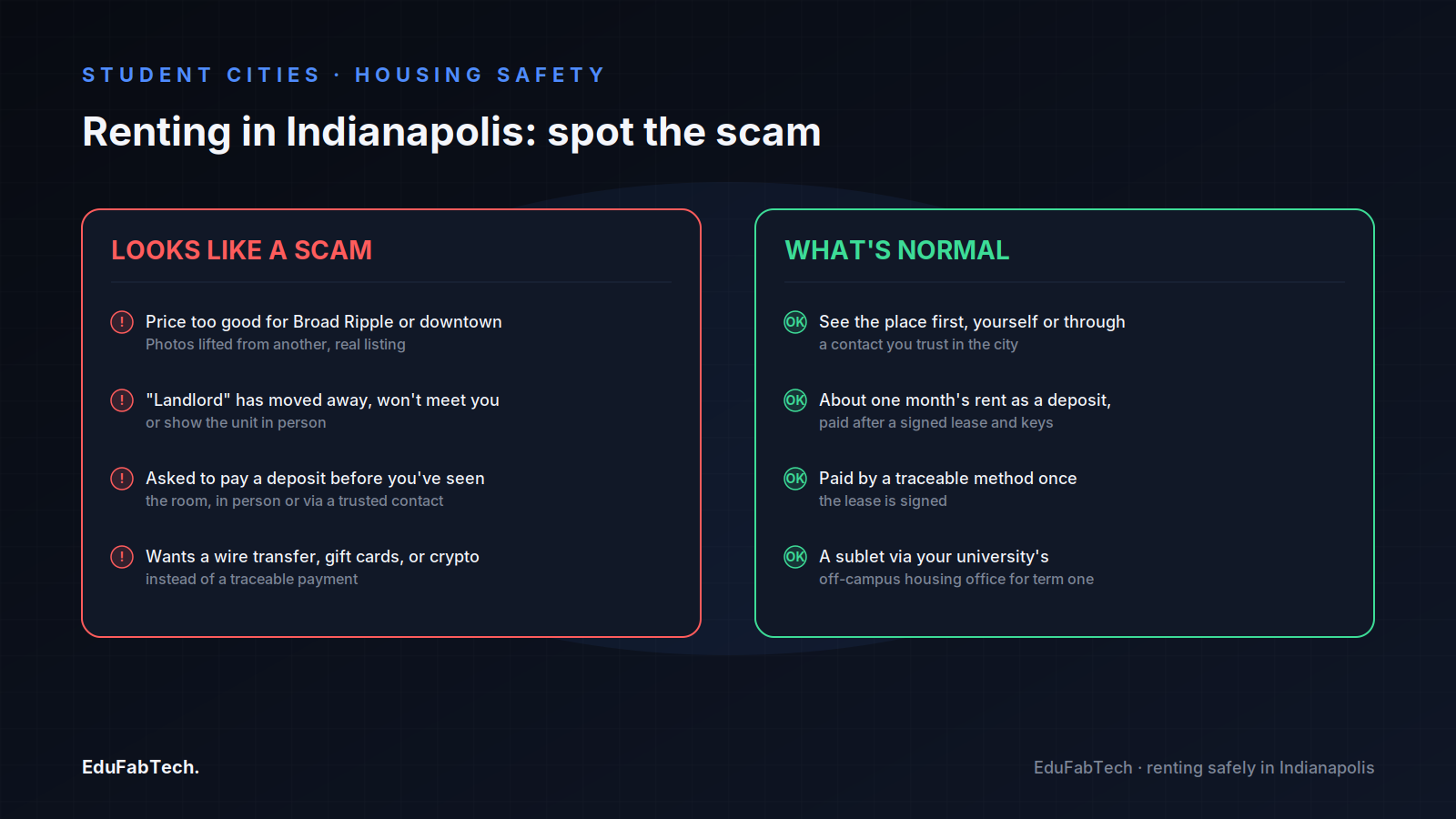
Rental scams in Indianapolis follow a familiar local pattern: a too-cheap house in Broad Ripple or an apartment near the downtown campuses is advertised with photographs lifted from a real listing, and whoever you are talking to cannot meet you because they have "moved away", then asks for a deposit to hold it. Never send money to hold a room you have not seen. See the place in person, or have a trusted contact in the city view it for you, before you pay anything. A security deposit of about one month's rent, paid by a traceable method once you have a signed lease and a set of keys, is normal; a request to wire money, buy gift cards, or pay in cryptocurrency is not, and no legitimate Indianapolis landlord needs any of those. You can browse what students are offering on EduFabTech's rooms listings for the city, and the broader Indianapolis page gathers everything in one place.
Kitting out a room: thrift stores, ReStores and a Saturday market
Furnishing a room cheaply is easy here because the metro has a dense network of charity resale shops. Goodwill of Central and Southern Indiana runs thrift stores across the city selling clothing, furniture, books and household goods, and Habitat for Humanity ReStores in the metro sell donated furniture and appliances at low prices. For the first month, when you need a desk, a lamp and a set of pans fast, these are usually cheaper than anything new.
Markets are worth knowing too, with one caveat: the historic Indianapolis City Market downtown — a covered hall that had traded since 1886 — closed to the public on 1 March 2024 for a multi-year redevelopment, as its own site confirms, so do not count on it during your studies. What does run year-round is the Broad Ripple Farmers Market on the north side, a Saturday fixture since 1994 that its organisers describe as one of the few year-round farmers markets in the state and the only one in central Indiana — held outdoors near Glendale in summer and indoors over winter. For second-hand furniture and giveaways from other students, EduFabTech lists local second-hand items for the city.
Working while you study
Local students work in campus jobs, cafés, hospitals and the city's large convention and sports-events economy. International students face rules that are tighter and that you should confirm with your own university before acting. The US Department of Homeland Security's Study in the States site states that an F-1 student in on-campus employment "may not work more than 20 hours per week when school is in session", and that off-campus work generally requires prior authorisation through a Designated School Official and, in most cases, approval from U.S. Citizenship and Immigration Services (working in the United States). This is a summary, not legal advice: the authority on your situation is your campus international-student office and the official DHS guidance, and you should never begin working before your status allows it. EduFabTech's Indianapolis jobs listings can show what part-time work students are posting locally.
Libraries and places to study
Each university has its own library — Butler's Irwin Library, the Indiana University Indianapolis University Library downtown, and UIndy's Krannert Memorial Library — but the public system is a serious resource students underuse. The Indianapolis Public Library's Central Library, at 40 East Saint Clair Street just north of downtown, combines a 1917 limestone building with a six-storey glass addition that opened in 2007, and its page confirms that study rooms are available for public reservation. Branch libraries across Marion County offer the same, free, with longer and more varied hours than a single campus library, which helps when term-time demand peaks. EduFabTech also collects quiet desks and bookable rooms on its study spaces page.
Getting around a flat, spread-out city
Public transport is run by IndyGo, whose network centres on three electric bus-rapid-transit lines — the Red, Purple and Blue — running in dedicated lanes through the busiest corridors, plus local routes. The Red Line is the one students use most, linking Broad Ripple, Butler, downtown and the south side along College and Meridian. Fares rose on 1 January 2026 for the first time in 16 years: IndyGo's new-fares page lists a full one-way fare of $2.75, a half fare of $1.35, a daily fare cap of $6.00 and a weekly cap of $24.75 through the MyKey system, with half-price fares for persons 18 or younger, persons 65 and older, and riders with disabilities — note that university students are not among the listed half-fare categories unless they qualify another way. Away from the BRT corridors, service thins out, and many students rely on bicycles — the flat terrain and the Monon Trail make cycling genuinely practical here — or on a car. Budget realistically: much of the metro is built for driving.
What a semester costs
Tuition depends entirely on where you study, and the public, private and community options differ sharply. For a sense of the private-university figure, Butler University lists full-time undergraduate tuition of $25,430 per semester for most of its colleges in 2026-2027 on its official tuition page. On-campus housing on the same page is charged per semester by room type — for 2026-2027, an Irvington House double is $4,445 per semester and a Fairview House single is $5,555 per semester — which gives a dated, verifiable housing figure to anchor your planning. Community-college tuition at Ivy Tech is a fraction of that, which is why many Indianapolis students begin there. Private-market rents vary too much month to month to quote a single reliable city figure here, so treat the university dormitory rates above as your firm anchor and compare any private room against them. On top of rent and tuition come transport (see the IndyGo fares above), food and the usual fees each university lists separately.
The honest trade-offs
What is genuinely good about studying in Indianapolis: it is affordable by big-US-city standards, the ground is flat and cyclable, the Monon Trail and the BRT lines make the north–south spine easy without a car, and the downtown campus puts you inside a real capital city with professional sport, museums and a large events economy that generates part-time work. The split of IUPUI has also brought fresh investment downtown through Purdue University in Indianapolis and Indiana University Indianapolis.
What is hard: the city is spread out and built around driving, so if you live or study off the BRT corridors, getting around without a car takes planning, and transit thins in the evenings. Winters are cold and grey and summers humid. Housing near Butler and Broad Ripple is competitive and the best rooms go early. And the reshaping of the downtown campuses is a reminder that an institution's name and structure can change under you — worth checking before you commit years to one.
A checklist for your first weeks
- Confirm which university now runs your programme — Indiana University Indianapolis or Purdue University in Indianapolis — if you were looking at anything once labelled IUPUI.
- If you are an international student, meet your campus international-student office early and confirm work rules against the official DHS guidance before taking any job.
- For a first term, take university housing or a vetted sublet; do not sign a twelve-month private lease before you know the neighbourhoods.
- Never pay a deposit for a room you have not seen in person, and never by wire transfer, gift card or cryptocurrency.
- Get a MyKey and learn the Red Line timetable; price a bicycle against a term of fares and the Monon Trail.
- Furnish from Goodwill, a Habitat ReStore and student give-aways rather than buying new.
- Register for a free Indianapolis Public Library card for study rooms and branch hours beyond your campus library.
- Browse the listings near Butler University on EduFabTech to settle in.
A quick question for readers
Do you work part-time while you study?
Many students work to pay the bills. See how common it is — and how many hours people really do.
Pick an answer, create a free account in a minute, and your vote counts. Already a member? Sign in
Comments 0
CommentNo comments yet. Members start the conversation.
Source: Butler University
Sources (5)
- Butler University. Tuition & Fees 2026-2027. Butler University, 2026. butler.edu ↗ · checked 8 Oct 2026
- IndyGo. New Fares (effective 1 January 2026). IndyGo, 2026. indygo.net ↗ · checked 8 Oct 2026
- University of Indianapolis. Fast Facts About the University of Indianapolis. University of Indianapolis, 2026. uindy.edu ↗ · checked 8 Oct 2026
- Marian University. Fast Facts. Marian University, 2026. marian.edu ↗ · checked 8 Oct 2026
- Purdue University. Purdue University in Indianapolis launching Purdue's first comprehensive urban campus. Purdue University, 2023. purdue.edu ↗ · checked 8 Oct 2026