Studying in Inverness: universities, housing and student life
A practical, sourced guide to UHI Inverness, finding a room on and off the Beechwood campus, part-time work rules, study spaces and the real costs of a student year in the Highland capital.
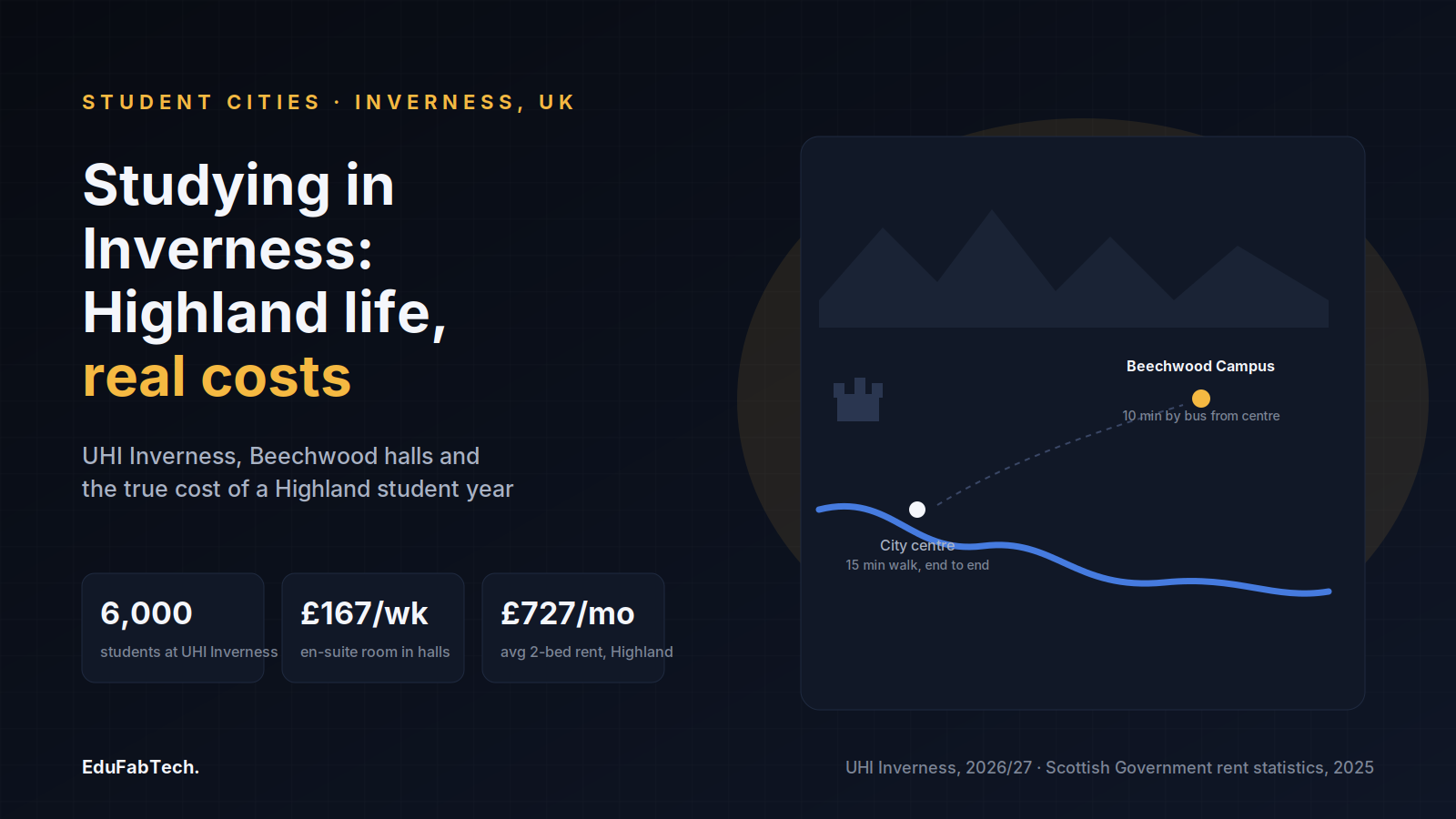
Inverness sits where the River Ness empties into the Moray Firth, the main town of the Scottish Highlands and the administrative centre of a council area that stretches from the Cairngorms to Cape Wrath. The centre is small enough to cross on foot in fifteen minutes: the castle on its mound, the river with its chain of islands joined by footbridges, Academy Street and the High Street, the bus and railway stations side by side. Around that core the city thins quickly into housing estates and, to the east, into the open country at Beechwood where the university campus stands. It is a city that doubles as a Highland service hub and a tourist gateway, and that mix shapes student life more than any single thing about the university does.
For a student, the consequences are concrete. The student body is small and spread across further-education and degree courses, so you will not find the dense, self-contained student quarters of a Leeds or a Cardiff. The landscape — Loch Ness, Glen Affric, the hills of the Great Glen — is genuinely on the doorstep. And the weather is cool, wet and, by December, very dark, with daylight short enough that your timetable and your mood both notice.
This guide covers the university and what studying there involves, where students live and how to avoid rental scams in a tight local market, furnishing a room cheaply, the work rules for international students, libraries and study space, transport, costs with dated figures, and an honest account of what is good and what is hard.
UHI Inverness and the university it belongs to
The degree-awarding institution here is the University of the Highlands and Islands, usually written UHI. It is not a single campus in the conventional sense but a partnership: the university's own site describes 48 locations across the Highlands and Islands, Moray and Perthshire, bringing together colleges and research institutions that each keep their own name and campus. In Inverness, that partner is UHI Inverness — until recently called Inverness College UHI — which delivers courses from access level through to degrees and postgraduate study, and which says on its own pages that it has around 6,000 students, making it the region's main provider of further and higher education.
That structure is worth understanding before you apply. Many students at UHI Inverness are studying college-level qualifications — National Certificates, Highers, HNCs and HNDs — alongside those on full bachelor's and master's degrees validated by the university. Subjects reflect the region: alongside business, computing, care and the creative industries, UHI Inverness runs construction and engineering, science, and the Scottish School of Forestry. Across the wider UHI, degree choices lean towards the environment, marine science, archaeology, health and the Highlands themselves, often taught partly online so that students in remote communities can take part. If you want a large, traditional campus with twenty thousand undergraduates, this is not that; if you want small classes and courses rooted in the north of Scotland, it is unusual in the UK.
Teaching in Inverness is concentrated at Inverness Campus at Beechwood, on the eastern edge of the city just off the A9. The campus guide describes a roughly 200-acre (80-hectare) site developed by Highlands and Islands Enterprise as a shared home for the college, university research and life-sciences businesses, about ten minutes from the city centre. The site also houses research and commercial tenants, so the campus feels less like a student island and more like a working science and education park. You can browse current student listings for the city on EduFabTech at /in/united-kingdom/inverness, and places near the campus at /near/inverness-campus.
Where students live: campus residences and the city
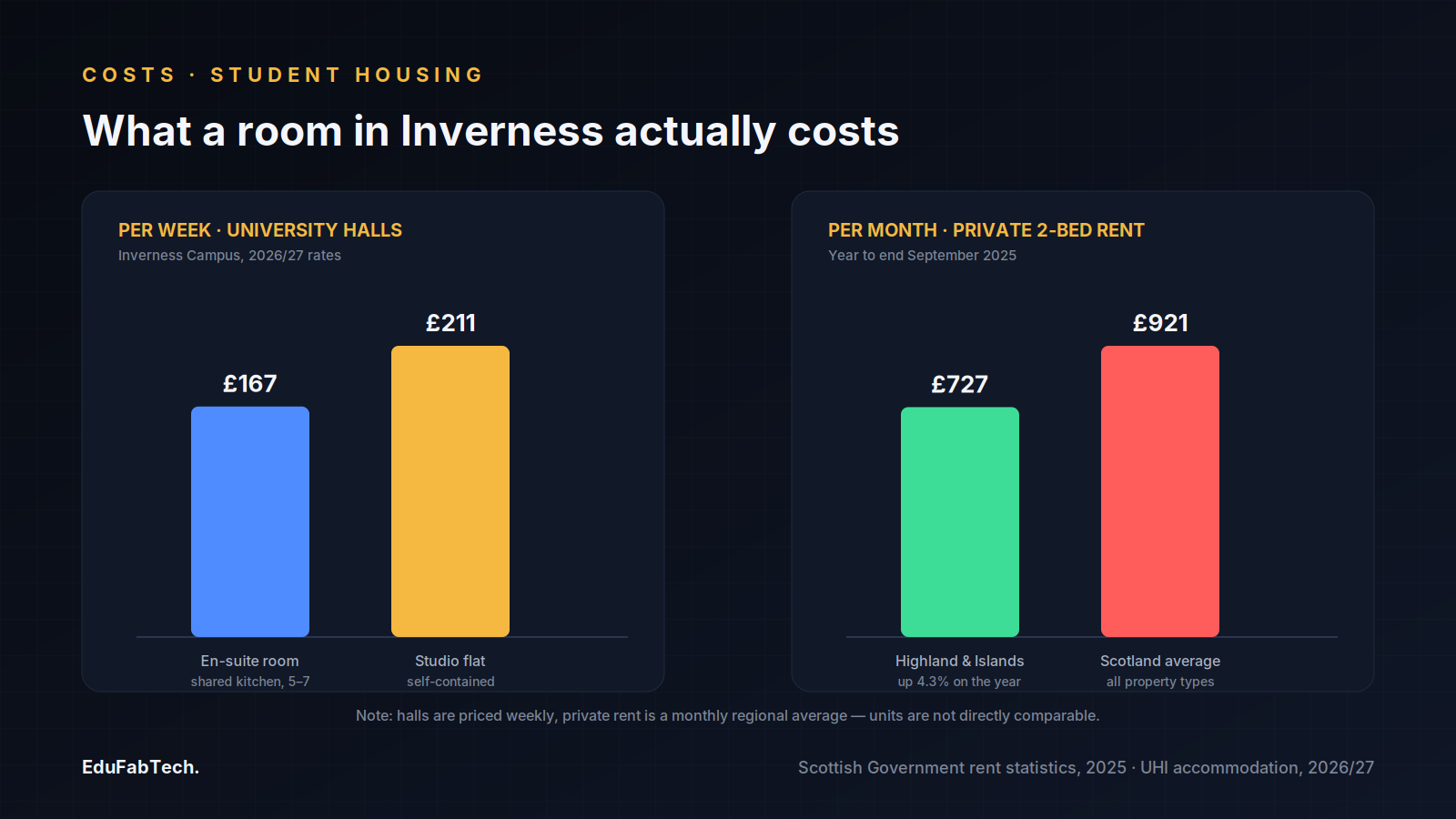
The most predictable option is the university's own halls. UHI owns and manages student residences on Inverness Campus — the accommodation page describes 300 en-suite bedrooms with shared kitchens and living areas, plus self-contained studios, with a staffed team on site. For 2026/27 the university lists a single en-suite room at £167 per week, with utilities and Wi-Fi included and kitchens shared between five and seven students; a studio apartment is £211 per week for the same year, again with utilities included. Laundry on site is payable, and there is covered cycle storage and CCTV. Because the halls sit on the campus itself, residents are a short walk from classes but a bus ride from the city centre and the nightlife along the river.
Beyond halls, most students rent privately in the city, and that is where you need to plan. Inverness has a small private rental market and competes with tourism and short-term lets for the same flats, so good rooms go quickly. Popular areas for students include the streets around the city centre and the river, Crown and the Haugh on the hill above the centre, and the suburbs out towards the campus such as Culloden and Smithton if you want to be closer to Beechwood. Browse rooms listed for the city on EduFabTech at /in/united-kingdom/inverness/rooms.
On price, the broadest dated benchmark is the Scottish Government's rent statistics. Its 2025 release put the average monthly rent for a two-bedroom property in the Highland and Islands Broad Rental Market Area at £727 in the year to end September 2025, up 4.3% on the previous year, against a Scotland-wide average of £921. That is below the national figure, but it covers a huge rural area and masks real pressure in Inverness itself, where supply is tight. Treat the halls figures above as your firm numbers and the rent statistic as a regional guide rather than a quote for a city-centre flat.
Renting in Inverness without being cheated
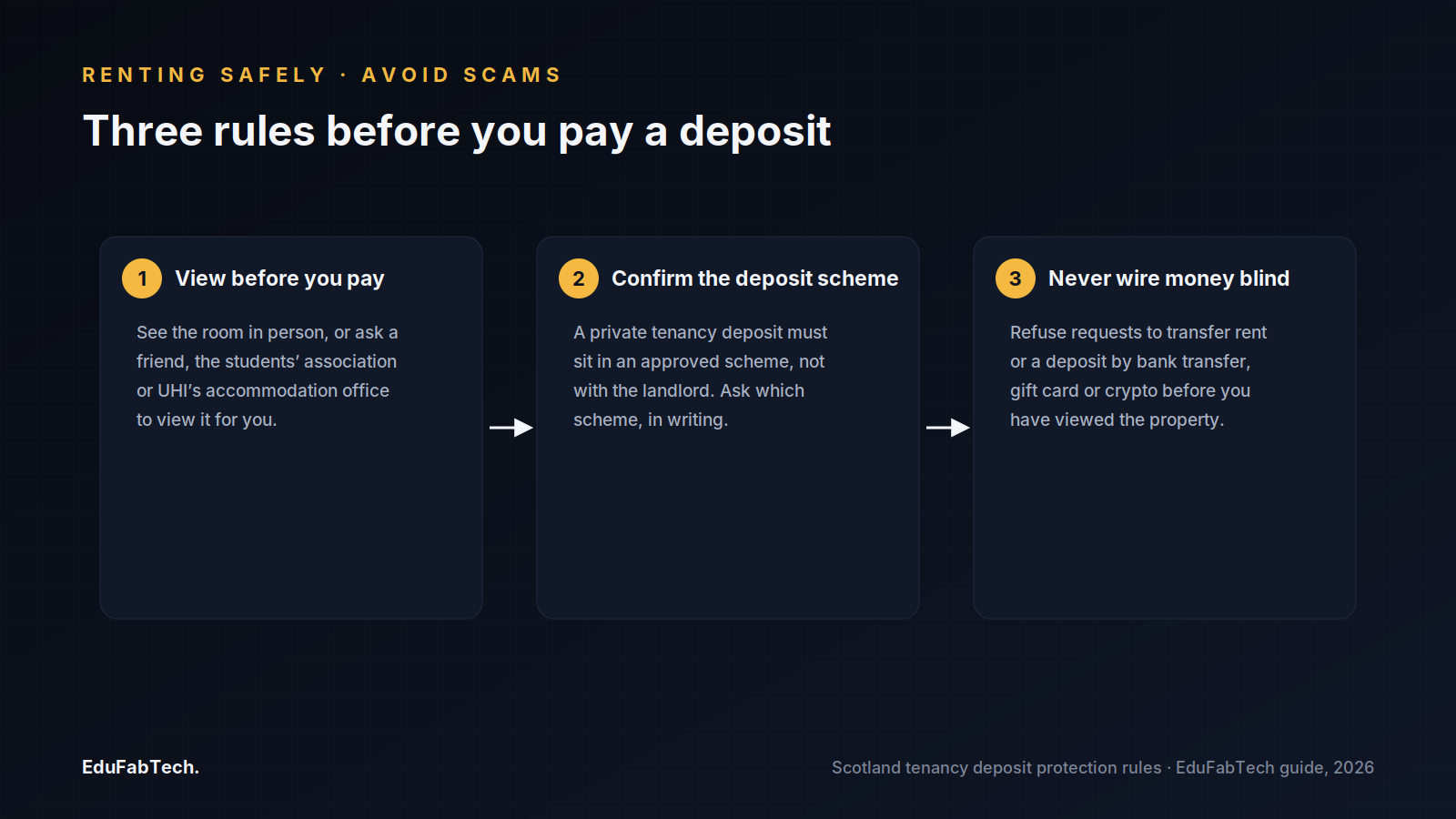
The scams that hit Inverness students follow the market's weak point: demand far outstrips supply, so people accept a listing quickly and pay to "secure" it. A typical fraud is a room advertised below the going rate — often pitched at students arriving from abroad or from the islands who cannot view in person — where the supposed landlord asks for a deposit or a month's rent up front, by bank transfer, to hold it. Once you pay, the listing and the contact vanish. The defence is simple and non-negotiable: never send money to hold a room you have not seen, and never pay a deposit or rent by bank transfer, gift card or cryptocurrency to someone you have not met and whose property you have not viewed.
In Scotland the law is on your side if you use it. A private residential tenancy deposit must be lodged in an approved tenancy deposit scheme, not kept by the landlord, and letting agents must be registered. Ask which scheme your deposit will be protected in and get the confirmation in writing; a genuine landlord will answer without fuss. View the actual room before paying anything — in person if you can, or ask a friend, the students' association or the university's accommodation office to view on your behalf if you are still abroad. Be wary of anyone who refuses a viewing, pressures you to decide within hours, or communicates only by message and wants cash fast. If you are arriving from overseas with nowhere lined up, book a few nights in temporary accommodation and view properties once you are in the city rather than committing money from afar.
Furnishing a room: the Victorian Market and second-hand Inverness
Furnishing a room cheaply in Inverness means charity shops, the city's markets and the usual give-and-take between departing and arriving students. The landmark is the Victorian Market, the covered arcade off Academy Street between the station and the High Street. Visit Inverness Loch Ness describes its arcades of independent shops and services and a food hall of local independent traders that opened in September 2022. It is more useful for a cheap lunch, a haircut or a gift than for a wardrobe, but it is the heart of independent retail in the city and worth knowing from your first week.
For actual furniture and kit, the better routes are the charity shops clustered around the city centre, second-hand and reuse outlets on the edge of town, and student hand-me-downs at the start and end of each term. On EduFabTech you can look through second-hand goods for the city at /in/united-kingdom/inverness/second-hand, furniture specifically at /in/united-kingdom/inverness/furniture, and items being given away free at /in/united-kingdom/inverness/free-stuff. A practical tip for Inverness in particular: because the city is the retail centre for a wide, thinly populated region, people drive in for big purchases and often advertise bulky items for collection — if you have no car, factor in how you will actually move a sofa or a desk before you agree to take one.
Working while you study
Part-time work is realistic in Inverness because the city's tourism, hospitality and retail sectors hire students, especially over the long, busy summer. If you are an international student, the hours you may work are set by your visa, and you must get this right. The UK's Student visa guidance on GOV.UK states that whether and how much you can work depends on your course and whether it is term-time, and that you cannot be self-employed or work as a professional sportsperson. For the specific hour limits, the independent UK Council for International Student Affairs (UKCISA) explains that students on a bachelor's degree course or higher can usually work up to 20 hours a week during term time, that this is a hard weekly cap running Monday to Sunday rather than an average, and that students on some courses are limited to 10 hours or prohibited from working. Your own visa conditions — shown on your eVisa or biometric residence permit — are what count, so check them and do not rely on what a friend's visa allows. This is general information, not legal advice; confirm your position with the university's international team before you take a job. EduFabTech lists local part-time work for the city at /in/united-kingdom/inverness/jobs.
Libraries and places to study
On campus, UHI Inverness has its own library and study spaces, and the residences include dedicated desks in each room. Off campus, the main public option is Inverness Library at Farraline Park, a short walk from the bus station, run by the charity High Life Highland. Its published opening times are 09:00 to 18:30 Monday to Wednesday, 09:00 to 19:00 on Thursday, 09:00 to 18:30 on Friday and 09:00 to 17:00 on Saturday, with the library closed on Sunday. It offers a reference room and a co-working hub alongside the lending collection, which makes it a sensible quiet alternative when campus is far from where you live or the dark winter evenings make the commute out to Beechwood unappealing. The city's cafés fill the gaps for casual study, and you can see study spaces and desks listed for Inverness on EduFabTech at /in/united-kingdom/inverness/study-spaces.
Getting around the Highland capital
Inverness is compact enough that many students walk or cycle in the centre, but the campus at Beechwood sits on the eastern edge, so buses matter if you live centrally and study there, or vice versa. The main operator is Stagecoach, which runs the city and regional network and sells a student season ticket, the UniRider, for travel within set zones around Inverness.
The single most valuable thing to know, though, is Scotland's concessionary travel scheme. Transport Scotland's Under 22s free bus travel gives everyone who lives in Scotland and is aged 5 to 21 free travel on local and most long-distance buses, using a National Entitlement Card or Young Scot NEC, which you apply for at getyournec.scot. If you are a student living in Inverness and under 22 — including many international students resident here — that can make your bus travel free, which changes the economics of commuting from a cheaper suburb or exploring the Highlands at weekends. Check your own eligibility, apply early because cards take days to weeks to arrive, and carry the card. Inverness also has a railway station in the centre with direct trains south to Perth, Glasgow and Edinburgh and north and west on the scenic Highland lines, useful for getting home at the holidays rather than for daily study.
Costs, and the honest trade-offs
The clearest costs to plan around are the ones with dated sources. A single en-suite room in the UHI campus residences is £167 per week for 2026/27 with utilities and Wi-Fi included, and a studio is £211 per week; the regional two-bedroom private rent averaged £727 a month in the Highland and Islands area in the year to end September 2025, per the Scottish Government. If you are under 22 and resident in Scotland, bus travel can be free under the Transport Scotland scheme above, which is a real saving over a city where transport otherwise adds up.
What is genuinely good about studying in Inverness: it is small, safe-feeling and walkable; the natural setting is extraordinary and cheap to enjoy; classes are small and the university's regional courses are distinctive; and the campus halls give new arrivals a soft landing with a known price. What is hard: the rental market is tight and competes with tourism, so off-campus rooms are scarce and can be dear for what you get; the student scene is smaller and more dispersed than in a big university city, which suits some people and isolates others; the campus is on the edge of town rather than in the middle of student life; and the winters are long, wet and short on daylight, which is worth taking seriously if you have not lived this far north before. Getting anywhere else in the UK takes time — Inverness is a long way from everything, which is part of its appeal and part of its cost.
A checklist for your first weeks
- Apply for campus residences early if you want the certainty of a fixed weekly price, and do not pay any off-campus deposit for a room you have not seen.
- If you rent privately, confirm in writing which approved deposit scheme protects your money, and never pay by bank transfer, gift card or crypto to "hold" a place.
- Register with a local GP and bring any documents you need for your course and, if relevant, your visa.
- If you are an international student, check your exact work conditions on your visa and with the university's international team before taking a job; read the UKCISA guidance first.
- If you are under 22 and living in Scotland, apply for a National Entitlement Card or Young Scot NEC for free bus travel straight away.
- Find your quiet-study backstop early — the campus library and Inverness Library at Farraline Park — so you have somewhere to work when the evenings get dark.
- Kit out your room second-hand: start with charity shops, the markets and EduFabTech's free-stuff and furniture listings, and sort out how you will transport anything bulky before you agree to collect it.
A quick question for readers
Do you work part-time while you study?
Many students work to pay the bills. See how common it is — and how many hours people really do.
Pick an answer, create a free account in a minute, and your vote counts. Already a member? Sign in
Comments 3
Comment-
300 en-suite beds against roughly 6,000 students is the number that undercuts 'apply early for halls' as mere advice — it's rationing. Only…
-
The £727 figure is doing a lot of work it isn't built for. It's a two-bedroom property average across the whole Highland and Islands rental…
-
The number that'd actually sway my choice is £167 versus £727. Halls look pricier at first glance until you remember that £727 is a two-bedr…
Join free to read the full comments and reply Comments are between members; an account takes a minute.
Source: University of the Highlands and Islands
Sources (5)
- University of the Highlands and Islands. University accommodation – single room. University of the Highlands and Islands, 2026. uhi.ac.uk ↗ · checked 11 Nov 2026
- Scottish Government. Private Sector Rent Statistics, Scotland, 2010 to 2025: 2-bedroom properties. Scottish Government, 2025. gov.scot ↗ · checked 11 Nov 2026
- Transport Scotland. Under 22s free bus travel. Transport Scotland, 2026. transport.gov.scot ↗ · checked 11 Nov 2026
- UKCISA. Working during your studies. UK Council for International Student Affairs, 2026. ukcisa.org.uk ↗ · checked 11 Nov 2026
- High Life Highland. Inverness Library opening times. High Life Highland, 2026. highlifehighland.com ↗ · checked 11 Nov 2026