Studying in Ipswich: universities, housing and student life
A practical, sourced guide to the University of Suffolk, where students live on and around the waterfront, what a room costs, and how to get by in a small English port town.
Ipswich sits where the River Gipping widens into the Orwell estuary, on the east coast of England in the county of Suffolk. It is one of the country's oldest continuously settled towns — the Anglo-Saxon trading port of Gippeswic — and that long history shows in a compact centre of medieval churches, Tudor timber and Victorian brick wrapped around a working waterfront. For a student, the useful fact is that almost everything is close together: the university, the station, the market and most rooms sit within a flat twenty-minute walk of each other.
This is a small student town rather than a student city. There is one university, the campus is young, and the social life revolves around the regenerated Wet Dock rather than a sprawling campus quarter. That shapes the trade-offs in every section below — the cost, the search for a room, the work, the quiet. If you want a place where you can live without a car and recognise faces within a term, Ipswich delivers; if you want a large, anonymous, around-the-clock student scene, it does not.
What follows is a sourced walk through the practical side of studying here: the institution, where people live, what a room costs, how to furnish it cheaply, the rules on part-time work, where to study, how to move around, and the honest advantages and frustrations.
The university on the quay
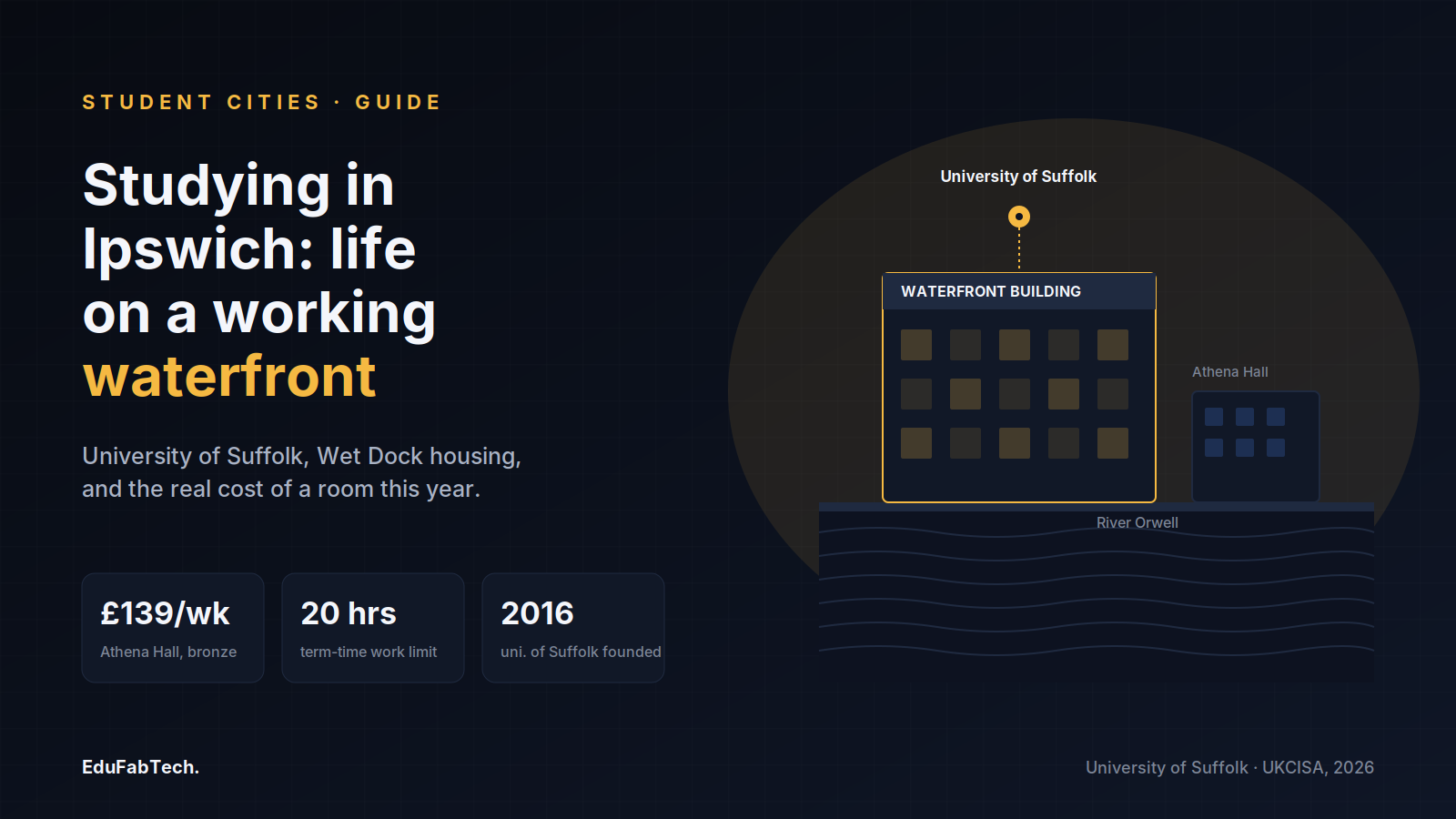
The University of Suffolk is the town's degree-awarding institution, and its main buildings line Neptune Quay on the Ipswich Waterfront, a short walk from the town centre. The university's own pages state that it gained independent university status in 2016, having previously operated as University Campus Suffolk, and that it was awarded University of the Year in the Whatuni Student Choice Awards 2025 (University of Suffolk, About). It is one of the UK's newer and smaller universities, which is worth knowing: cohorts are modest, staff tend to be reachable, and you will not disappear into a lecture hall of six hundred.
The teaching model is distinctive. The university says most undergraduate courses use a "block and blend" method, in which students concentrate on one module at a time rather than juggling several in parallel (University of Suffolk, About). The campus is dominated by the Waterfront Building on Neptune Quay, which houses teaching space and the university library. Its academic schools span business, arts, social sciences and technology on one side and health sciences on the other, so courses lean toward health and social care, business, and the social and creative subjects (University of Suffolk, About).
Two other names students encounter locally are not full universities. Suffolk New College is a further-education college in central Ipswich that also delivers some higher-level qualifications; it runs the former agricultural college at Otley, a few miles outside town, now branded Suffolk Rural, where land-based courses are taught on a working farm. If your plan is a degree, the University of Suffolk is the place; the colleges matter mainly for access routes, technical courses and foundation study.
Where students actually end up living
Because the campus hugs the Waterfront, the gravity of student housing pulls toward the east and south-east of the centre. The purpose-built halls sit on and around the Wet Dock. Beyond that, students cluster in the terraced streets off Spring Road and Foxhall Road, around the California area to the east, and in the grid of Victorian houses near the railway station on the west side of the river, which trades a slightly longer walk for cheaper rent and quick trains. The town is small enough that "far" means twenty-five minutes on foot rather than a cross-city commute.
Two broad options exist: managed halls aimed at students, and ordinary private rented rooms in shared houses. First-year and international students usually start in halls for the simplicity of an all-inclusive contract; second years and postgraduates more often move into a shared house with a joint tenancy. The University of Suffolk's accommodation office lists its on-campus hall, Athena Hall, alongside accredited off-campus options such as properties on Grimwade Street and Ormonde House (University of Suffolk, Accommodation). The office advises applying before the end of June if you want a place in halls for a September start.
What a room costs, with the figures
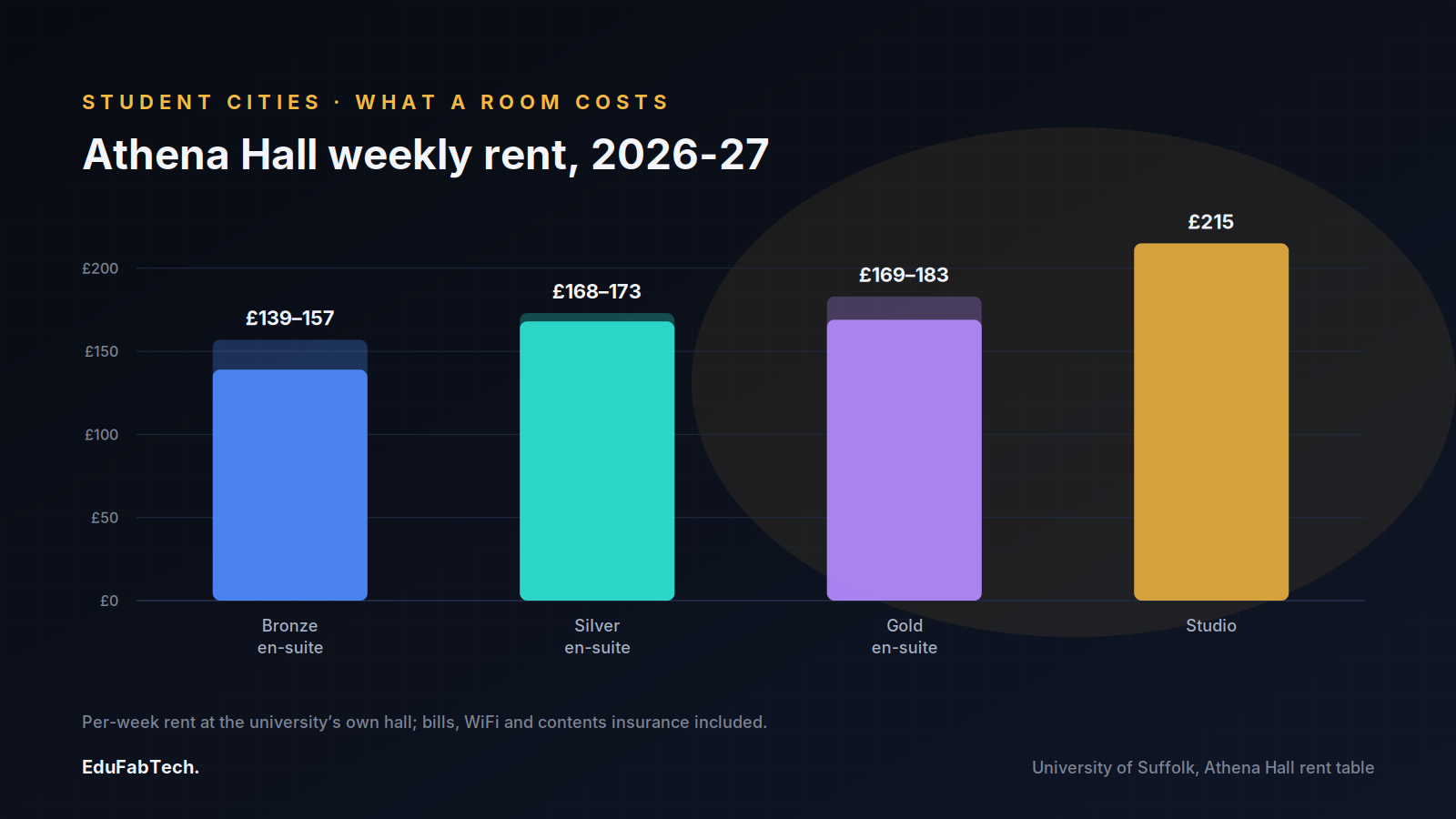
Here is a dated, primary figure to anchor your budget. For the 2026-27 academic year, the University of Suffolk lists weekly rents at Athena Hall of £139 for a Bronze en-suite room on a 51-week contract (or £157 on a shorter 44-week contract), £168–£173 for a Silver en-suite, £169–£183 for a Gold en-suite, and £215 for a studio, with utility bills, WiFi and contents insurance included and a £100 reservation fee deducted from the first instalment (University of Suffolk, Athena Hall). The university also warns on that page that the first rent instalment falls due before your first student finance payment arrives — a cash-flow trap worth planning around.
Private shared houses in the terraces off Spring Road or near the station are usually cheaper per week than a studio but add bills, deposits and the effort of a joint tenancy. Treat the hall figures above as the reliable upper reference point; for private rooms, get the specific weekly rent and a clear statement of what bills are included in writing before you commit.
Finding a room without losing a deposit
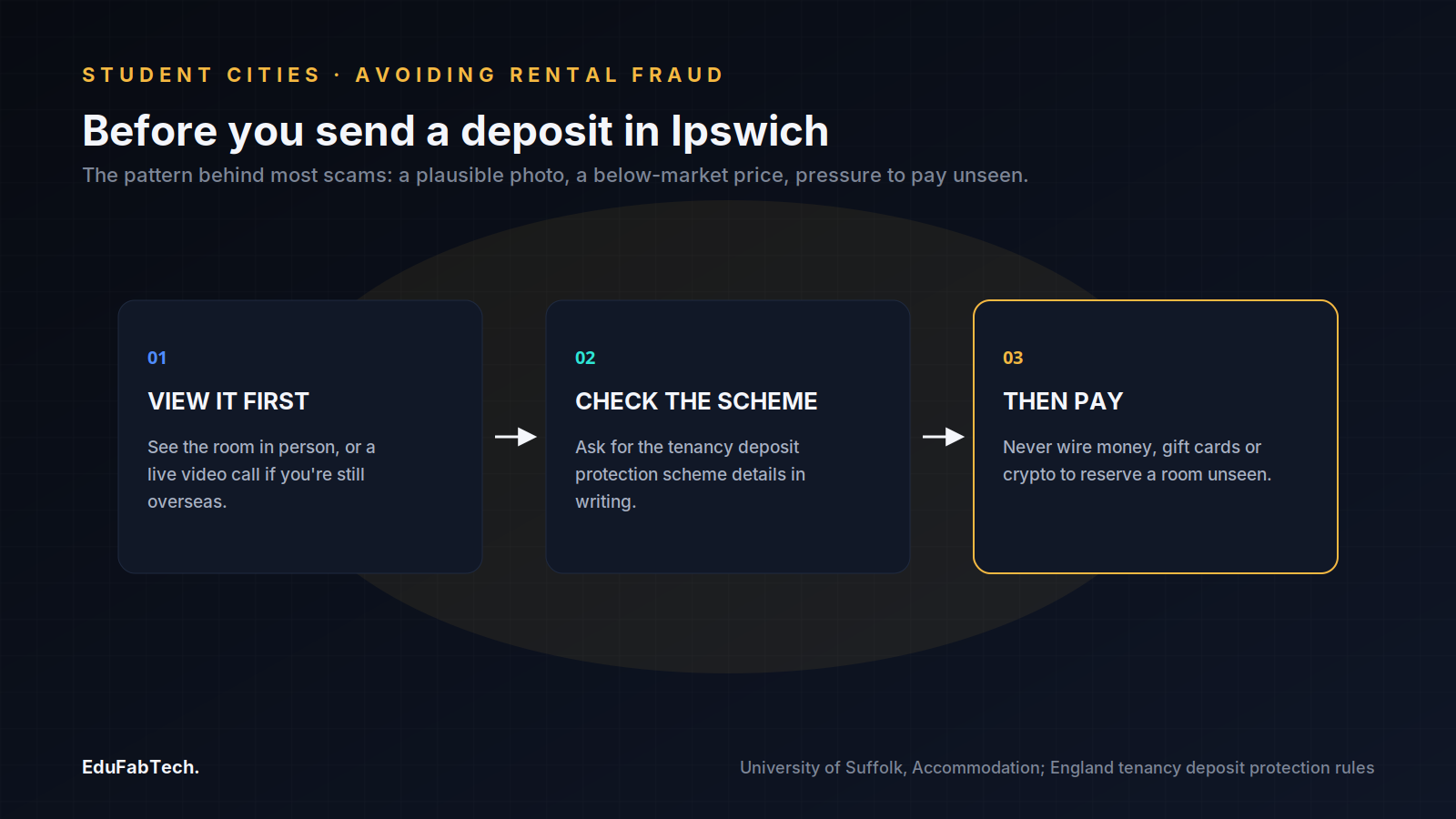
Rental fraud in a town this size tends to appear in the same places: rooms advertised on social-media marketplaces and housing groups by someone who cannot show you the property, often because they claim to be "away" or abroad. The pattern is a plausible photo, a below-market price near the Waterfront or the station, and pressure to pay a "holding deposit" before a viewing. The single rule that defeats almost all of it: never send money by bank transfer, gift card or cryptocurrency to reserve a room you have not seen, and never to a person you have not met.
See the place in person, or on a live video call if you are still overseas, and check that the person showing it can actually let it. In England a landlord or agent must protect your deposit in a government-approved tenancy deposit scheme and give you the scheme details — if they cannot, walk away. A university-accredited listing or the institution's own accommodation service is the safer starting point precisely because the property and the landlord have been checked. When in doubt, ask the University of Suffolk accommodation office before you pay anything; losing a few days to caution is cheaper than losing a deposit. Our local pages at rooms in Ipswich and the wider Ipswich student listings are a place to start, and listings near the University of Suffolk keep you inside the walkable core.
Furnishing a room for very little
Ipswich is unusually well served by second-hand and reuse shops, which matters when you arrive to an unfurnished room or want a desk and a kettle without paying full retail. Emmaus Suffolk runs a second-hand shop and community space at 44 Carr Street in the centre, selling pre-loved furniture, homeware and clothing. The British Heart Foundation runs a furniture and electrical store in Ipswich selling second-hand sofas, beds, wardrobes and appliances, and the Ipswich Furniture Project, a local re-use charity with a shop on St Matthew's Street, sells donated sofas, dining furniture, beds and wardrobes and offers a low-cost delivery service (Ipswich Furniture Project).
For smaller things and food, the Ipswich Market is the centrepiece. Managed by Ipswich Borough Council, it runs on the Cornhill and Giles Circus on Tuesday, Thursday, Friday and Saturday from 8.30am till 4pm, selling fresh fish, local fruit and vegetables, bread, clothing and jewellery, with street food at Giles Circus (Ipswich Borough Council). The council notes the market received its first Royal Charter in 1317 from Edward II, so it is a genuinely old institution rather than a recent addition. Our second-hand pages collect more of what is going locally.
Part-time work and the rules that apply
Many students take a term-time job in the Waterfront's cafés and bars, in town-centre retail, or in the warehousing and logistics work that the nearby Port of Felixstowe generates. If you are an international student, your right to work is set by your visa, not by your employer. For a Student visa holder studying a course at degree level or above, UKCISA states that you may work up to 20 hours a week in term time, and full time outside term time, which includes vacations and after your course has ended (UKCISA, Working during your studies). UKCISA also makes clear that a "week" runs for any seven-day period starting on a Monday, so the limit applies week by week rather than being averaged, and that unpaid "voluntary work" still counts toward it even though genuine volunteering does not.
This is a summary, not legal advice, and the conditions on your own visa take priority — always confirm against the official UK government guidance and the exact wording printed on your visa before accepting shifts. Breaching the limit has serious consequences for your immigration status, so when a rota is unclear, ask. Local openings aimed at students appear on our Ipswich jobs page.
Libraries and places to study
The main study hub is the University of Suffolk library in the Waterfront Building. Its helpdesk and collections are open 8.30am to 7.00pm Monday to Friday and 9.00am to 5.00pm on Saturdays, and — importantly during exam season — the first-floor study spaces are available 24 hours a day, seven days a week to staff and students, with out-of-hours entry via the rear entrance on Coprolite Street using your ID card (University of Suffolk, Library opening hours). Informal study areas with networked computers and printers are spread across the building's upper floors.
Beyond campus, the town's central public library, run by Suffolk Libraries, gives a free, quiet alternative with desks and Wi-Fi, and the many independent cafés around the Waterfront and Cornhill double as working spaces outside peak hours. For a change of scene, our study spaces page lists desks and quiet rooms around the town.
Getting around Ipswich and beyond
Ipswich is walkable, which is its own transport policy: from the station to the Waterfront is roughly a fifteen-minute walk across the river. For longer hops, Ipswich Buses runs the town network. Its fares page lists an adult town single at £2.40, a day ticket at £4.60, a 7-day town pass at £21.50 and a 28-day pass at £72.00, with cheaper under-20s rates (a 7-day pass at £14.00) and payment by contactless, the Ipswich Buses Smartcard or the mobile app (Ipswich Buses, Tickets & Fares). Note that most undergraduates are over 20 and pay the adult rate, so budget accordingly rather than assuming the youth fare.
For travel out of town, Ipswich station is a main-line stop: Greater Anglia runs direct trains south to London Liverpool Street and out to Felixstowe and along the Suffolk coast, as well as services toward Colchester, Norwich and Cambridge. A 16-25 Railcard, bought through railcard.co.uk, cuts the cost of off-peak fares and pays for itself quickly if you travel home at weekends. For anything within the town itself, though, you will mostly be on foot.
The honest trade-offs
The case for Ipswich is scale and calm. Rents and everyday costs are lower than in Cambridge, Norwich or London; the campus is compact and friendly; the Waterfront is a genuinely pleasant place to study and walk; and the town is flat, walkable and well connected by rail to London and the coast. A small university means small classes and approachable staff.
The case against is the flip side of the same coin. Nightlife and the specialist-shop scene are limited next to a big student city, and some students find the town quiet, especially at weekends and outside term. The choice of courses is narrower than at a large multi-faculty university. Housing stock aimed at students is finite, so leaving the search late genuinely costs you options. And the east-coast climate is grey and damp for much of the year — pack for wind off the North Sea rather than for sun. None of this is a dealbreaker; it is simply the texture of studying in a small English port rather than a metropolis.
A checklist for the first weeks
- Apply for a hall place early — the University of Suffolk advises applying before the end of June for a September start — or line up a viewing for a shared house before you travel.
- Never pay a holding deposit by bank transfer, gift card or crypto for a room you have not seen; confirm any deposit is in a government-approved tenancy deposit scheme.
- If you are on a Student visa, read UKCISA's work guidance and check the hours printed on your visa before taking a job.
- Get an Ipswich Buses Smartcard or the app, and buy a 16-25 Railcard if you will use the train.
- Register with a local GP and a dentist in your first weeks, before you need one.
- Walk the route from your room to the Waterfront library once, and find the Coprolite Street entrance for out-of-hours study.
- Furnish from Emmaus on Carr Street, the British Heart Foundation furniture store, the Ipswich Furniture Project and the Cornhill market before buying anything new.
- Browse our Ipswich student listings for rooms, jobs and second-hand goods as you settle in.
A quick question for readers
Do you work part-time while you study?
Many students work to pay the bills. See how common it is — and how many hours people really do.
Pick an answer, create a free account in a minute, and your vote counts. Already a member? Sign in
Comments 3
Comment-
The Athena Hall figures are solid but the piece quietly drops the one number that would make them useful: it never gives private shared-hous…
-
The transport section quietly admits its own discount is mostly decorative: the under-20 7-day pass at £14.00 looks great next to the adult…
-
The detail that'd land hardest with a first-year is the cash-flow trap buried in the small print: rent at Athena Hall is due before your fir…
Join free to read the full comments and reply Comments are between members; an account takes a minute.
Source: University of Suffolk
Sources (5)
- University of Suffolk. Athena Hall accommodation fees 2026-27. University of Suffolk, 2026. uos.ac.uk ↗ · checked 9 Nov 2026
- UKCISA. Working during your studies: student work. UK Council for International Student Affairs, 2026. ukcisa.org.uk ↗ · checked 9 Nov 2026
- Ipswich Borough Council. Ipswich Market. Ipswich Borough Council, 2026. ipswich.gov.uk ↗ · checked 9 Nov 2026
- Ipswich Buses. Tickets & Fares (Details). Ipswich Buses, 2026. ipswichbuses.co.uk ↗ · checked 9 Nov 2026
- University of Suffolk. About the University of Suffolk. University of Suffolk, 2026. uos.ac.uk ↗ · checked 9 Nov 2026