Studying in Ithaca: universities, housing and student life
A practical guide to living and studying in Ithaca, New York — Cornell and Ithaca College, where students find rooms, what housing costs, how to get around, and the honest trade-offs of a small city built on two steep hills.
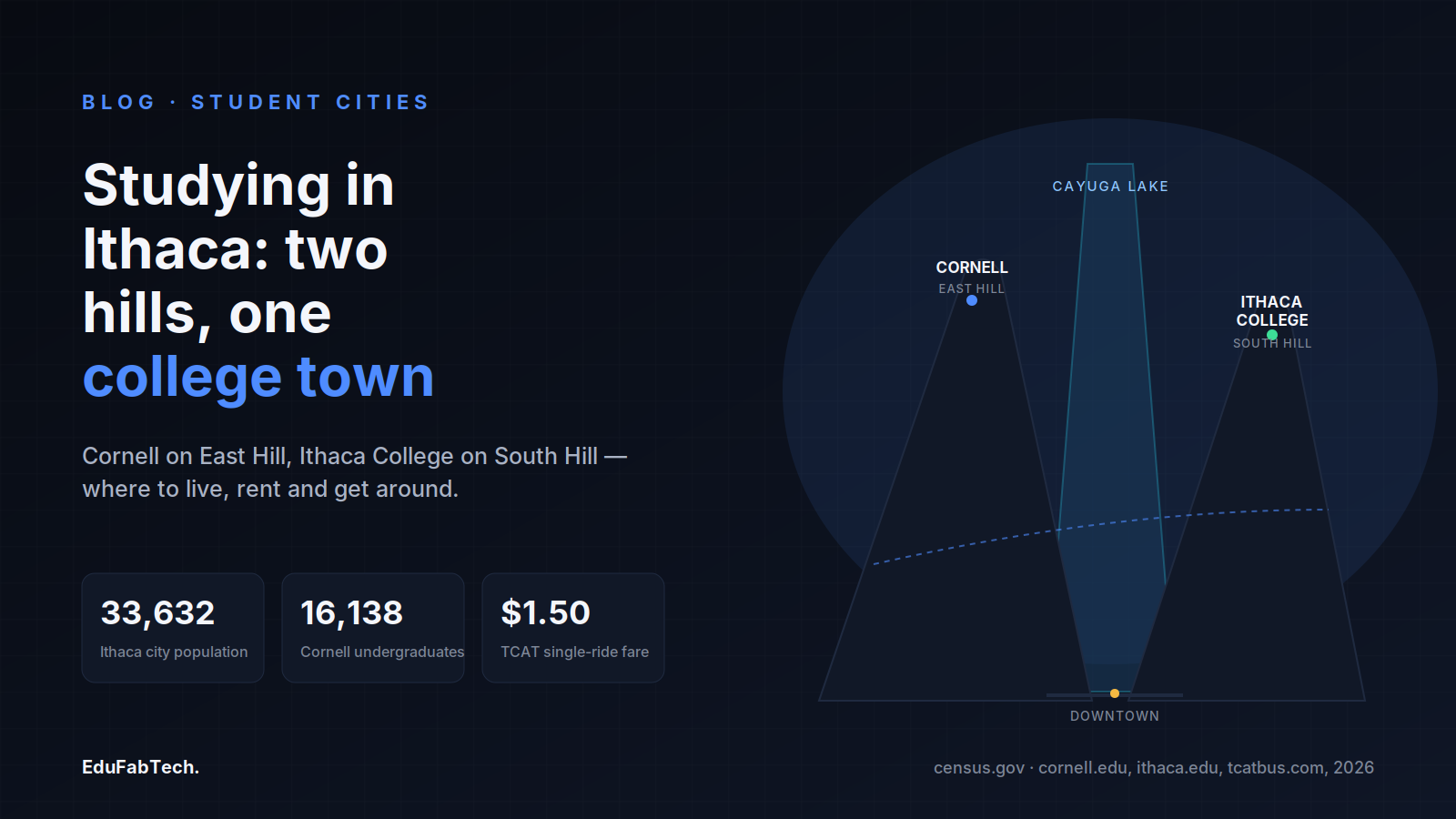
Ithaca sits at the southern tip of Cayuga Lake, the longest of New York State's Finger Lakes, and almost nothing about the city is flat. Downtown occupies the valley floor; the two large campuses look down on it from opposite ridges. Cornell University is on East Hill, overlooking the lake and the gorges that cut through the city; Ithaca College is on South Hill, across the valley. That geography shapes everything a student does here — which bus you catch, how long the walk home feels in February, and how much you pay for a room within sight of class.
For a place of its size — the U.S. Census Bureau's QuickFacts page estimates Ithaca city's population at 33,632 as of 1 July 2025 (census.gov) — the student presence is unusually large. Students make up a big share of the people here, and the rhythm of the academic calendar runs the local economy, the rental market and the buses. This guide covers the universities, where students live, how to rent without being cheated, furnishing a room cheaply, work rules, study spaces, getting around and what it all costs.
The universities on the two hills
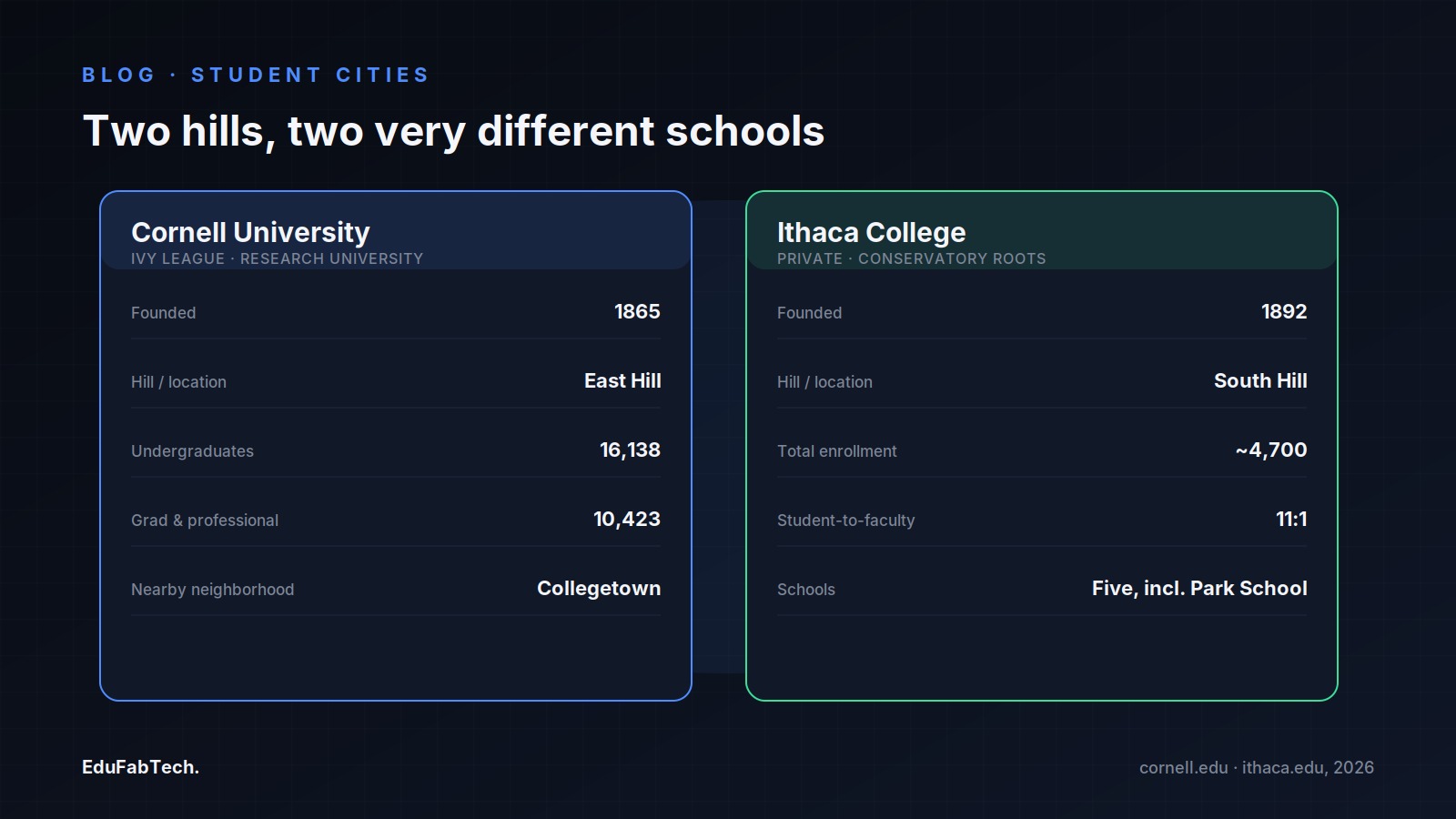
Cornell University is the giant. Its About page states that the university was established in 1865 and now enrols 16,138 undergraduate and 10,423 graduate and professional students on the Ithaca campus (cornell.edu, 2026). It is an Ivy League research university with an unusual structure — a mix of privately endowed and New York State contract colleges — spread across East Hill above Cayuga Lake. The Cornell University College of Veterinary Medicine, also on the Ithaca campus, grants the Doctor of Veterinary Medicine along with graduate degrees in biomedical and biological sciences and public health, and is one of the reasons the city draws students in animal and life sciences from well beyond New York.
Ithaca College, founded in 1892 as a conservatory of music and on its South Hill campus since the 1960s, is a private institution of about 4,700 undergraduate and graduate students organised into five schools, with an 11:1 student-to-faculty ratio, according to its own figures (ithaca.edu, 2026). It is known for performance, media and health-sciences programmes. Its Roy H. Park School of Communications houses the college's degree programmes in film, television, documentary, strategic communications and sports media — a well-regarded destination for students headed into media production rather than a separate institution.
A short drive north-east, in the neighbouring city of Cortland, the State University of New York at Cortland (SUNY Cortland) is a public college founded in 1868, strong in teacher education and in kinesiology and sport studies; it sits in a separate town from Ithaca, so factor in the commute if you are considering it.
Where students live, and renting without losing a deposit
The neighbourhood most associated with student life is Collegetown, the dense cluster of apartments, cafés and takeaways immediately south of the Cornell campus, built up along College Avenue and the streets around it. It is walkable to East Hill lecture halls and priced accordingly — the closer to campus and the newer the building, the steeper the rent. Fall Creek and the Northside, down in the flat part of town near the pedestrianised Ithaca Commons, offer older houses split into shared flats and a quieter, more residential feel, at the cost of a climb or a bus ride back up the hill.
Ithaca College students tend to look on and around South Hill, where the college houses most undergraduates in its own residence halls and apartments. Both universities guarantee or strongly encourage on-campus housing for new students, so arriving first-years rarely need to sign a private lease in their first year — a real advantage in a tight market. Graduate students, transfers and upper-years are the ones who face the open rental market, and that market is small and competitive.
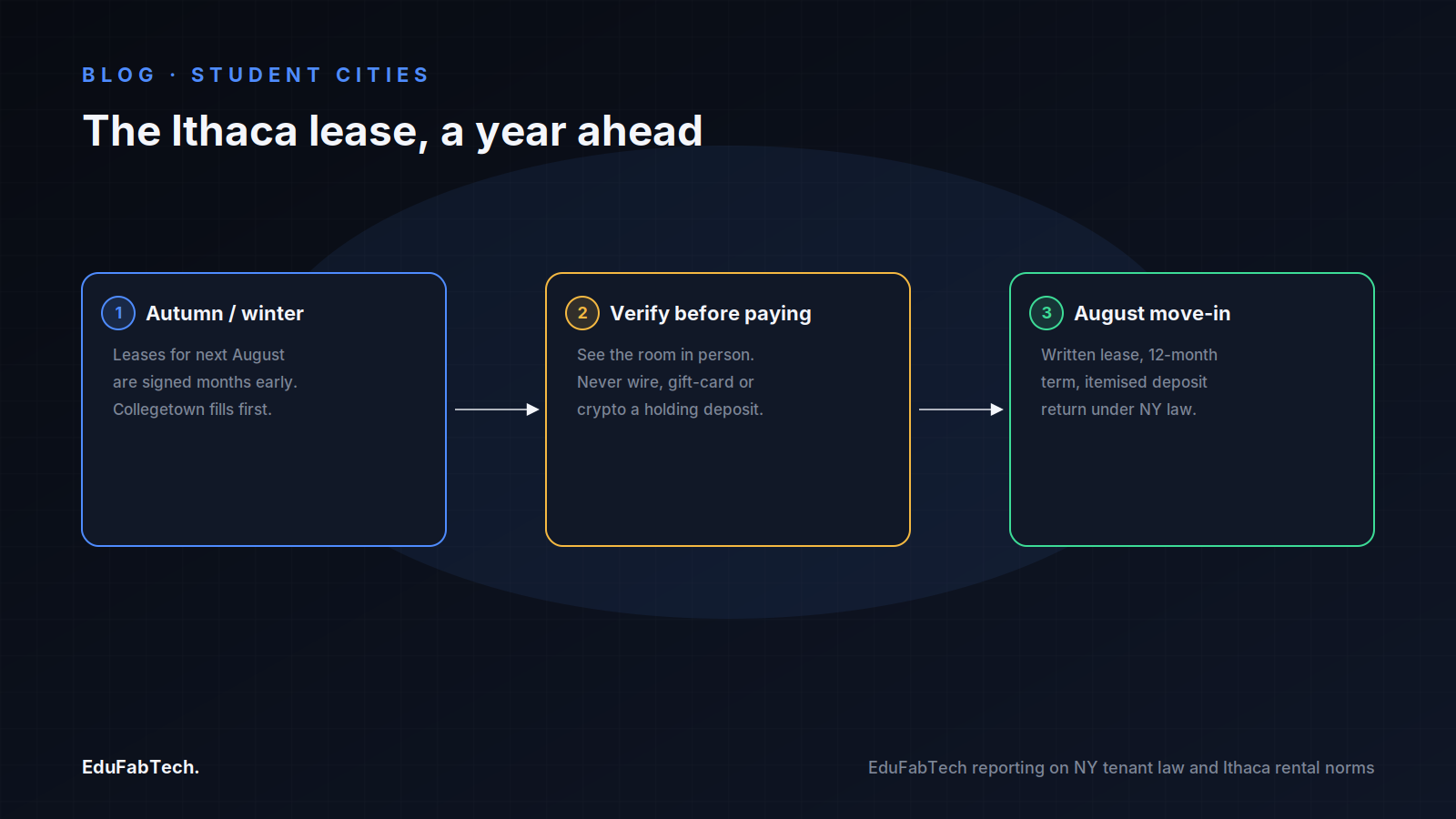
The single most important thing to understand about Ithaca renting is timing. Because the housing stock near both campuses is limited, leases for the following August are often signed the preceding autumn or winter — many returning students commit to a Collegetown flat months in advance. That early cycle creates pressure to sign quickly, which is exactly the condition in which mistakes and scams happen. You can browse current rooms on EduFabTech's Ithaca rooms listings and near each campus via listings near Cornell University and listings near Ithaca College.
Renting without losing a deposit
Rental scams in a university town like Ithaca usually follow a pattern: a listing with a price that looks noticeably below the Collegetown norm, a "landlord" who says they are out of town — often claiming to be away for work or study — and a request to send a holding deposit before you can see the place. Treat that combination as a warning. See the actual room in person, or have someone you trust see it, before any money changes hands, and confirm the person you are paying genuinely controls the property.
Never send money to "hold" a room by bank wire transfer, gift card or cryptocurrency — those methods are chosen by fraudsters precisely because they cannot be reversed. A legitimate Ithaca landlord will give you a written lease and a receipt, and New York State law limits how large a security deposit can be and requires its return with an itemised statement for any deductions. Read the lease for the full twelve-month term before you sign, because many Ithaca student leases run August to August whether or not you are in town over the summer, and check what utilities, snow removal and internet are included given the long winters.
Furnishing a room for very little
Ithaca is an unusually good place to furnish a room second-hand, partly because thousands of students cycle through it each year and leave usable furniture behind every May. Finger Lakes ReUse, a local non-profit, runs retail stores that sell donated furniture, housewares, electronics and building materials and divert reusable goods from landfill; in 2026 its ReUse MegaCenter relocated to a larger space in the Cayuga Shopping Center on North Triphammer Road (Ithaca Voice, 2026). For produce, prepared food and crafts, the Ithaca Farmers Market operates seasonally at the Steamboat Landing pavilion on the waterfront, with vendors drawn from within about 30 miles of the city (visitithaca.com).
The end-of-year move-out, around May, is also when the free-furniture economy peaks: departing students give away or kerb-set perfectly good desks, lamps and kitchenware. It is worth timing a furniture hunt to those weeks. EduFabTech's second-hand furniture listings for Ithaca collect what students are selling or giving away locally, which can save you both money and the awkwardness of hauling a sofa up a hill.
Working while you study
Both universities employ large numbers of students in libraries, dining halls, labs and administrative offices, and on-campus work is the simplest option for international students. Under U.S. federal rules, F-1 visa students may take on-campus employment but, in the Department of Homeland Security's own words, "may not work more than 20 hours per week when school is in session" (Study in the States, DHS). Off-campus work generally requires specific authorisation tied to your programme, and the rules around it are detailed; this is not legal advice, so confirm your own situation with your university's international student office and the official DHS guidance before accepting any job. Current openings students are posting about appear on EduFabTech's Ithaca jobs listings.
Libraries and places to study
Cornell runs one of the largest academic library systems in the country, and its reading rooms — Olin and Uris on the Arts Quad among them — are the default study spaces for East Hill students. Ithaca College's library anchors studying on South Hill. For a space that belongs to the whole city rather than a campus, the Tompkins County Public Library sits downtown at 101 East Green Street, open Monday to Thursday until 8pm with Friday and Saturday hours as well (tcpl.org); library cards are free to Tompkins County residents. Downtown cafés around the Commons fill the gap when you want to study off-campus without the hill climb. If you are hunting for a quiet desk, EduFabTech's Ithaca study-spaces listings gather options around the city.
Getting around a vertical city
Public transport in Ithaca and Tompkins County is run by TCAT (Tompkins Consolidated Area Transit), whose buses connect downtown, both campuses and the surrounding towns. TCAT's adult single-ride fare is US$1.50, with reduced fares for seniors and people with disabilities and free rides for riders 17 and under (tcatbus.com, 2026). Cornell integrates heavily with TCAT through its OmniRide programme: first-year Cornell students automatically receive OmniRide privileges for unlimited TCAT rides, registered PhD students and graduate assistants receive free OmniRide passes, and other students can buy an annual OmniRide pass for US$200 a year (Cornell Transportation, 2026).
Buses matter here more than in a flat city, because the walk between the valley and either campus is a real climb. Many students live car-free and rely on TCAT plus walking; the compact core means downtown, the Commons and Collegetown are all reachable on foot once you accept the gradients. Winters are long, grey and snowy, so a transport plan that does not depend on walking up an icy hill at night is worth having before term starts.
What it costs
University housing gives you the clearest dated figures. For 2026–2027, Ithaca College lists a standard double residence-hall room at US$9,346 for the academic year and a single at US$10,692, with its College Circle apartments ranging from US$11,666 to US$13,548 (ithaca.edu, 2026). Cornell's Office of Financial Aid estimates housing at US$13,744 for the 2025–26 academic year, within a total estimated cost of attendance of US$99,734 (finaid.cornell.edu, 2025). For the private market across the city as a whole, the U.S. Census Bureau's QuickFacts reports a median gross rent of US$1,447 for 2020–2024 (census.gov) — a city-wide figure that includes non-student households, so Collegetown rooms close to Cornell typically run higher.
What is good, and what is hard
What students tend to love about Ithaca is its setting and its scale: gorges and waterfalls inside the city limits, a lake at the bottom of the hill, a walkable downtown with an active arts and food scene, and a culture that genuinely revolves around its students. The two institutions give the city intellectual density far beyond its population.
What is hard is mostly structural. Housing near either campus is limited and competitive, and the early leasing cycle forces decisions before you may feel ready. The terrain is steep, so your daily commute involves real hills in all weather. Winters are cold, grey and snowy for months. And Ithaca is geographically isolated — it is several hours from the nearest large cities and has no major airport nearby — which can feel confining if you are used to a big metropolis. None of this is a reason to stay away, but all of it is easier to handle if you plan for it.
A checklist for your first weeks
- Confirm your on-campus housing assignment early if you are a new student, and do not sign a private lease sight-unseen.
- If renting privately, see the room in person first and never wire, gift-card or crypto a deposit to "hold" a place.
- Sort out your bus situation: activate your Cornell OmniRide privileges, or plan your TCAT routes and fares if you are at Ithaca College or renting off-campus.
- Get a Tompkins County Public Library card for a free, quiet study space downtown.
- Furnish from Finger Lakes ReUse, the Ithaca Farmers Market and the May move-out giveaways rather than buying new.
- International students: register with your university's international office and read the official DHS rules before taking any job.
- Buy proper winter clothing and boots before the first snow — the hills are unforgiving in ice.
A quick question for readers
Do you work part-time while you study?
Many students work to pay the bills. See how common it is — and how many hours people really do.
Pick an answer, create a free account in a minute, and your vote counts. Already a member? Sign in
Source: Cornell University Office of Financial Aid
Sources (5)
- Cornell University. About Cornell. Cornell University, 2026. cornell.edu ↗ · checked 3 Oct 2026
- Ithaca College. Housing and Meal Costs (2026–2027). Ithaca College, 2026. ithaca.edu ↗ · checked 3 Oct 2026
- Cornell University Office of Financial Aid. Costs & Affordability: 2025–26 Cost of Attendance. Cornell University, 2025. finaid.cornell.edu ↗ · checked 3 Oct 2026
- Cornell Transportation. Bus Services — Privileges & Passes. Cornell University, 2026. fcs.cornell.edu ↗ · checked 3 Oct 2026
- U.S. Department of Homeland Security. Working in the United States. Study in the States, 2026. studyinthestates.dhs.gov ↗ · checked 3 Oct 2026