Studying in İzmir: universities, housing and student life
A practical, honest guide to studying and living in İzmir — its universities, neighbourhoods, housing, second-hand markets, part-time work rules, study spaces, transport and the real trade-offs.
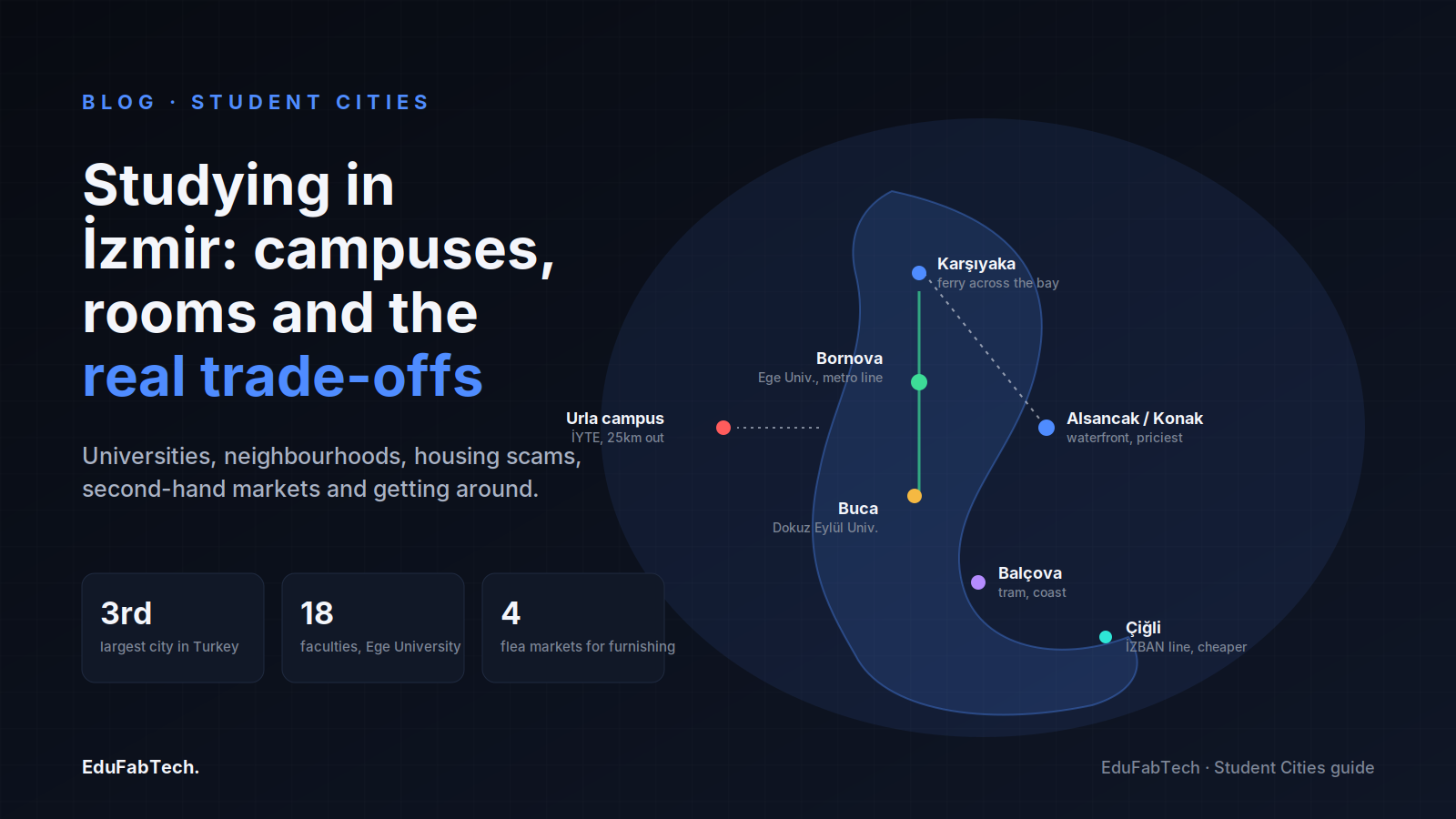
İzmir sits at the head of a long, sheltered gulf on Turkey's Aegean coast, a working port that curls around the water and climbs into the hills behind it. It is the country's third-largest city, and it has been a place of study for a long time: Ege University, in the district of Bornova, is the oldest university in the city, founded in the 1950s. When its academic body was split in two in 1982, the city gained its second major state institution, Dokuz Eylül University. Today students are spread from the seaside campuses west of the gulf to the flat industrial north, and the bay itself — crossed by ferries, a commuter railway and two metro lines — is the thing that shapes how they live.
The climate is a real part of the decision. The İzmir Metropolitan Municipality describes the city as having hot, dry summers and mild, rainy winters, with an afternoon sea breeze — the imbat — that keeps the coast a degree or two cooler than the interior. In practice that means term-time weather that is pleasant for most of the academic year and a short, sharp heat in early autumn and late spring, when lecture halls without air conditioning are no fun. Winters are wet rather than cold.
What follows is a grounded look at studying here: the universities and where their campuses actually are, the neighbourhoods students choose, how to find a room without being cheated, how to furnish it cheaply, what the rules say about working, where to study, how to move around, and — honestly — what the city does well and badly for a student budget.
The universities, and what studying here is like
The big state institution is Ege University, whose single large campus in Bornova holds most of its faculties, its central library and a students' village of dormitories; its own site lists eighteen faculties across a broad research university. Dokuz Eylül University, the city's other major state university, is deliberately the opposite: it is scattered across the city, with its central settlement and the Dokuzçeşmeler faculties in Buca, health faculties and a university hospital in the İnciraltı–Balçova belt, and a fine-arts and health campus — the 15 July Health and Art Campus — out in Narlıdere. If you study at Dokuz Eylül, which campus you are attached to matters more than the university name, because they are kilometres apart.
The İzmir Institute of Technology is a different animal again. It is a state technical university that, by its own account, was established in 1992 and teaches entirely in English, and since 1999 it has sat on a large seaside campus in the Özbek–Gülbahçe area of Urla, west of the city. That location is a genuine trade-off: quiet, green and self-contained, but a long way from the nightlife and cheap rooms of the centre, so many students live on or beside the campus.
İzmir also has a cluster of foundation (private) universities. İzmir University of Economics, founded in 2001, has its main campus in Balçova on the western shore and teaches in English, with a second campus at Güzelbahçe further along the coast. Yaşar University, also founded in 2001, runs its Selçuk Yaşar Campus on the Bornova–Bayraklı boundary, close to the metro. İzmir Tınaztepe University, a newer foundation university in Buca, concentrates on the health sciences. Studying at a foundation university generally means smaller classes, more English-medium programmes and tuition fees; the state universities are cheaper but larger and more crowded.
Among the newer state universities, İzmir Kâtip Çelebi University has its central campus in Çiğli, in the flat northern reach of the city near the airport road; İzmir Democracy University, established in 2016, sits on the Konak side of town in the Üçkuyular area; and İzmir Bakırçay University, from the same period, is further north still, in Menemen. These campuses are cheaper to live around but the commute into central İzmir is real, especially from Menemen.
Other universities in and around İzmir
Two more institutions belong on any honest map of student İzmir. The National Defense University Air NCO Higher Vocational School is a military technical school in Gaziemir, near the airport, training air-force non-commissioned officers; it is a closed, uniformed environment rather than an open campus, so it is not somewhere you casually rent a room nearby. And just east of the provincial line, in the neighbouring city of Manisa, Manisa Celal Bayar University has its central campus in the Yağcılar–Muradiye area; it grew out of faculties that were run as Dokuz Eylül University in Manisa until they became an independent university in 1992. Manisa is roughly a commuter-railway hop from İzmir, so if you are placed there it is worth looking at rooms in Manisa itself as well as in İzmir, because some students split the difference and live between the two.
Where students actually live
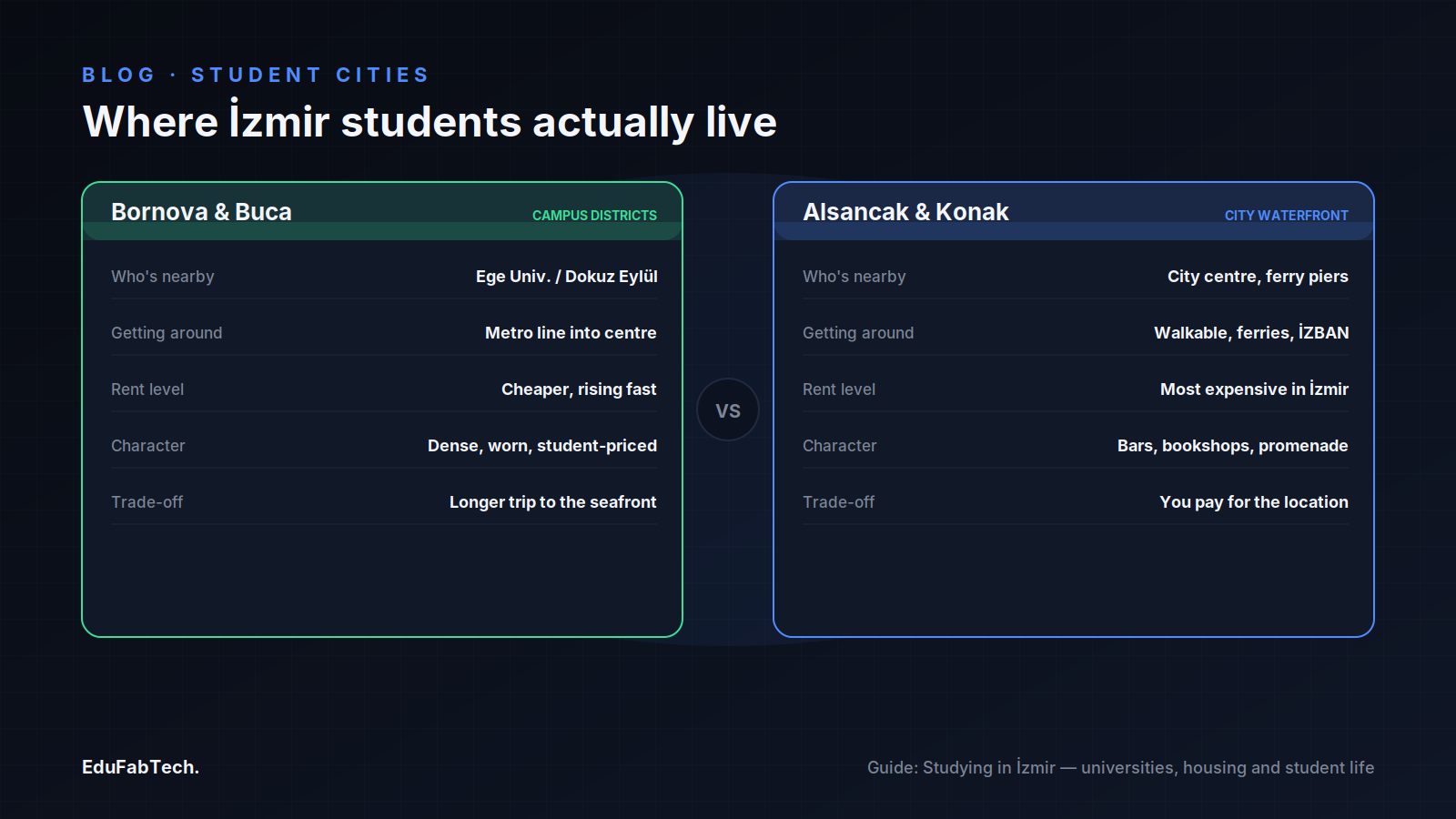
Bornova is the classic student district: Ege University's campus is here, Yaşar University sits on its edge, and the metro runs straight into the centre. It is dense, a little worn, and full of cheap eateries, copy shops and shared flats; rooms go quickly and prices have risen, but nowhere else puts you closer to a large campus. Buca, to the south, plays the same role for Dokuz Eylül and İzmir Tınaztepe University — a big, sprawling, working-class-to-middle-class district with a lot of student housing and a longer trip into town.
Alsancak and the central Konak waterfront are where students live if they want the city rather than the campus: bars, bookshops, the seafront promenade and the ferry piers are on the doorstep, and it is the most expensive and most sought-after part of the map. Karşıyaka and neighbouring Bostanlı, across the bay to the north, are calmer, greener and popular with students who don't mind commuting by ferry or the İZBAN commuter train — the crossing itself is one of the nicest parts of living here.
Balçova, on the western shore, is the natural base for İzmir University of Economics and for Dokuz Eylül's health faculties, with a tram line along the coast. Çiğli, in the north near İzmir Kâtip Çelebi University, is cheaper and more suburban, reached by the İZBAN line; it trades atmosphere for lower rent. Further out, students at the Menemen or Urla campuses often simply live in those towns to avoid a daily two-way haul across the whole city.
You can browse what is currently available across all of these areas through the city's İzmir student listings, and narrow to specific campuses such as near Ege University.
Finding a room — and not getting scammed
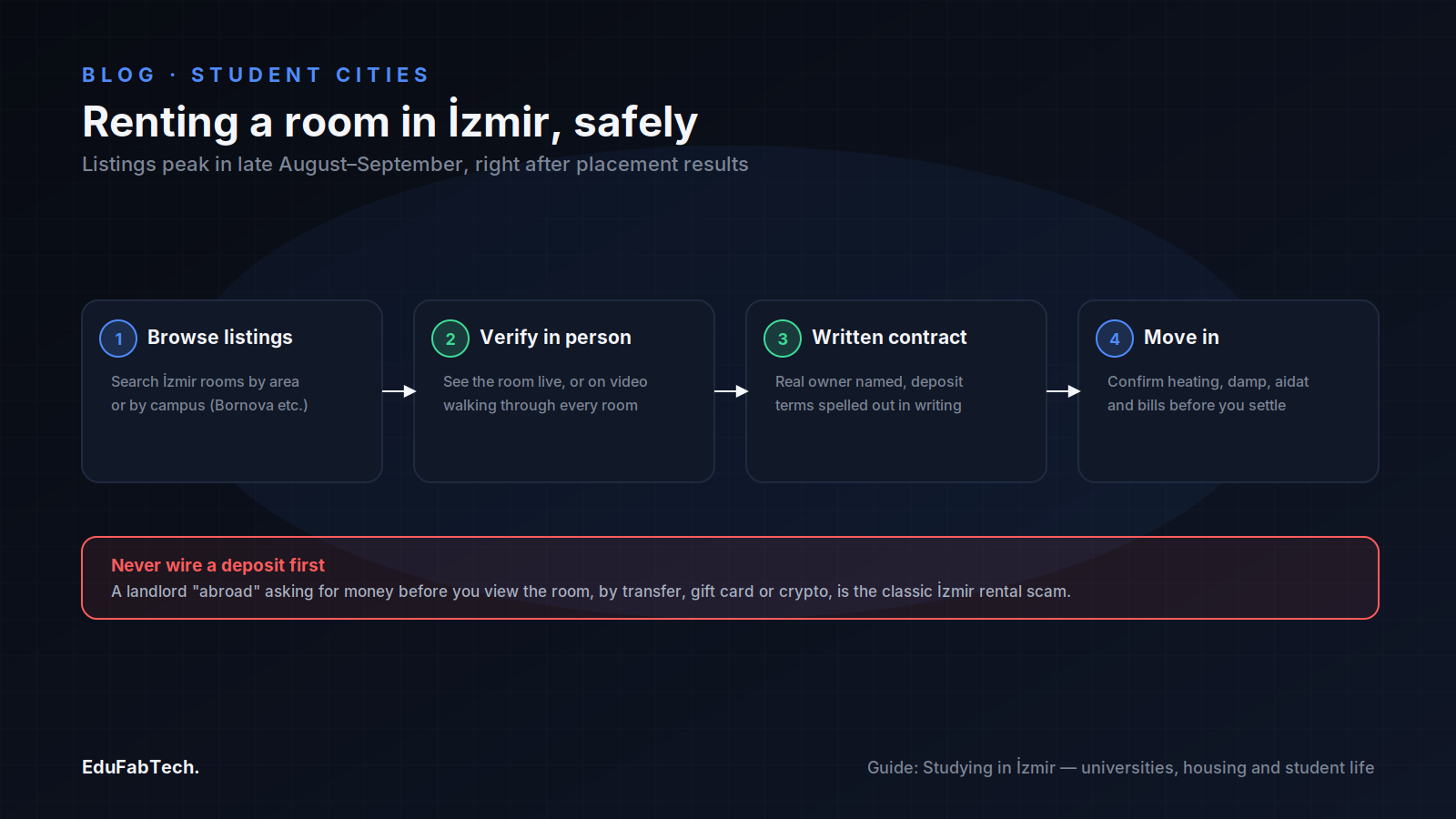
Most students live in one of three ways: a bed in the state dormitory system or a private dormitory; a room in a shared flat; or, less often, a whole small flat split between friends. Dormitory places are cheapest but limited and allocated centrally, so many people fall back on the private market. The market moves in a clear season: listings and prices peak from late August through September, as results from the national university placement come out and everyone looks at once. If you can, arrange something before you arrive only provisionally, and finalise it in person; if you can't, budget for a week in cheap short-term accommodation while you view rooms. Start looking early, and keep looking after you sign — turnover is high. You can see current rooms on the İzmir rooms listings.
Before you pay anything, check the basics in person: that the person showing the room actually controls it, that a written contract names the real owner, that the deposit amount and what triggers its return are written down, and that heating, damp, water pressure and the state of the building are what the photos claimed. Ask what the monthly running costs — aidat (building fees), electricity, gas, water, internet — really come to, because a cheap rent with high bills is common.
On scams, be blunt with yourself. The classic fraud is a too-good room, a landlord who is conveniently abroad, and a request to wire a deposit to "hold" it before you can visit. Never do this. See the place in person, or at the very least on a live video call where the person moves through the actual rooms on request, before any money changes hands. Never send a deposit or "reservation fee" by bank transfer, gift card or cryptocurrency to someone you have not met, and never hand over original documents. If a listing pressures you to decide today or pay to secure a viewing, walk away — real rooms in İzmir do not require a crypto deposit.
Furnishing a room for next to nothing
İzmir is a good city for second-hand living. Its flea markets — bit pazarı — are where students furnish a room for a fraction of retail: Daily Sabah counts four flea markets in the city and singles out the Bornova one, busiest on Sundays, as the best place to track down older and antique pieces, while the Özkanlar market in Bornova is a long-standing fixture for everyday household goods. Beyond the flea markets, almost every district holds a weekly street market (semt pazarı or the Thursday sosyete pazarı) selling cheap textiles, kitchenware and produce, so you rarely need to go far.
For the bigger items — a desk, a mattress, a fridge — it is usually cheaper and less wasteful to buy from a departing student than from a shop. EduFabTech's own second-hand and used-furniture listings for İzmir are worth checking against the markets, and at the start and end of term people often give things away outright, which is worth watching before you spend anything at all. Buy a fan early; you will want it in September.
Working part-time: what the rules allow
This is an area where guessing is dangerous, so treat what follows as orientation and rely on the official source, not on hearsay. A student residence permit, issued by the national migration authority, does not by itself allow you to work: the country's official guidance for international students is clear that a separate work permit is required. The international students' office at Middle East Technical University sets out the structure that follows in more detail: a residence permit is not a work permit; undergraduates may only apply for a work permit after they have completed their first year, and only for part-time work off campus; postgraduate students have more scope; and in every case it is the employer — not the student — who files the work-permit application, after you have been offered a job. Rules change, so before you accept any job confirm the current position through the official channel and your own university's international office. This is general information, not legal advice.
In practice, İzmir's tourism, hospitality, call-centre, tutoring and translation sectors are where student-friendly part-time work tends to appear; on-campus roles are often the easiest first step. You can see what is currently advertised on the İzmir jobs listings.
Libraries, study spaces and getting around
Each university runs its own library — Ege University's central library in Bornova and Dokuz Eylül University's central library in Buca are the largest, and foundation universities such as İzmir University of Economics and Yaşar University have modern, long-hours libraries that are the practical study hub for their students. The city also runs public reading rooms and neighbourhood libraries, and cafés along the Alsancak and Karşıyaka waterfronts double as informal study spots outside exam season. If you need a quiet desk that isn't your own room, the İzmir study-spaces listings are a place to start.
Getting around is built on one integrated ticket. The İzmirim Kart works across the metro, the İZBAN commuter railway, city buses, the trams and the passenger ferries, and transfers within a 90-minute window are included in a single fare — which matters in a city this spread out, where a trip often chains a ferry to a metro to a bus. Note one recent change the same operator announced: from 1 December 2025 the reduced "student" fare category is replaced by a "young" (Genç) category open broadly to those aged 7–26, so eligibility now follows an age band rather than enrolment. Register your card and check the current terms, because the discount is worth having. The ferries deserve a special mention: crossing the gulf by boat is cheap, scheduled and genuinely one of the pleasures of living here.
What it costs, the trade-offs, and your first weeks
On money, be wary of any specific rent figure you read online, including here — the housing market has moved fast and quoted numbers date quickly. The reliable relative picture is this: rooms in Bornova, Buca and Çiğli are cheaper than Alsancak and the central waterfront; the western coast at Balçova and the north-shore districts of Karşıyaka and Bostanlı sit in between; and a low rent far from your campus can be eaten up by daily transport and lost time. Weigh rent, bills and commute together, not rent alone.
The honest trade-offs
İzmir's strengths are real: a mild, sunny climate for most of the year, an easy-going and secular-leaning student culture, the sea and its ferries, good food, and a scale that is large enough to be interesting but less overwhelming than Istanbul. The hard parts are equally real. Housing is tight and has become expensive, and the September rush is stressful. The city is physically spread around a gulf, so commutes are long and you will spend real time in transit. Early-autumn heat is punishing in un-airconditioned buildings. And, as everywhere, prices have been volatile, which makes budgeting harder than a single monthly figure suggests.
A first-weeks checklist
- Sort your legal status first: begin the residence-permit process with the national migration authority within the required window after arrival, and keep copies of everything.
- Don't lock into a long lease sight-unseen; take short-term accommodation, then view rooms in person before paying a deposit.
- Get and register an İzmirim Kart, and confirm which reduced-fare category you now qualify for.
- Find your campus library's opening hours and your university's international office in the first week — they answer most administrative questions.
- Furnish from the flea markets, weekly street markets and departing students before buying anything new, and watch for things given away free at term boundaries.
- Learn your commute as an actual journey — ferry plus metro plus bus — not as a line on a map, and time it before you sign a lease.
- Ege University. About Ege University. Ege University, 2026. link
- Dokuz Eylül University. About Dokuz Eylül University. Dokuz Eylül University, 2026. link
- İzmir Institute of Technology. General Information. İzmir Institute of Technology, 2026. link
- İzmir Metropolitan Municipality. Geography of İzmir. İzmir Büyükşehir Belediyesi, 2026. link
- İzmirim Kart. Genç (Youth) İzmirim Kart. İzmir Metropolitan Municipality Transport Services, 2025. link
- Study in Türkiye. Work Opportunities for International Students. Study in Türkiye, 2026. link
- International Students Office, Middle East Technical University. Work Permits. Middle East Technical University, 2026. link
- Daily Sabah. Turkey's best antique and flea markets. Daily Sabah, 2020. link