Studying in Jena: universities, housing and student life
A practical, sourced guide to Jena in the Saale valley — its two universities plus the Weimar pair down the line, where students find rooms, what they pay, and the honest trade-offs of a small optics city.
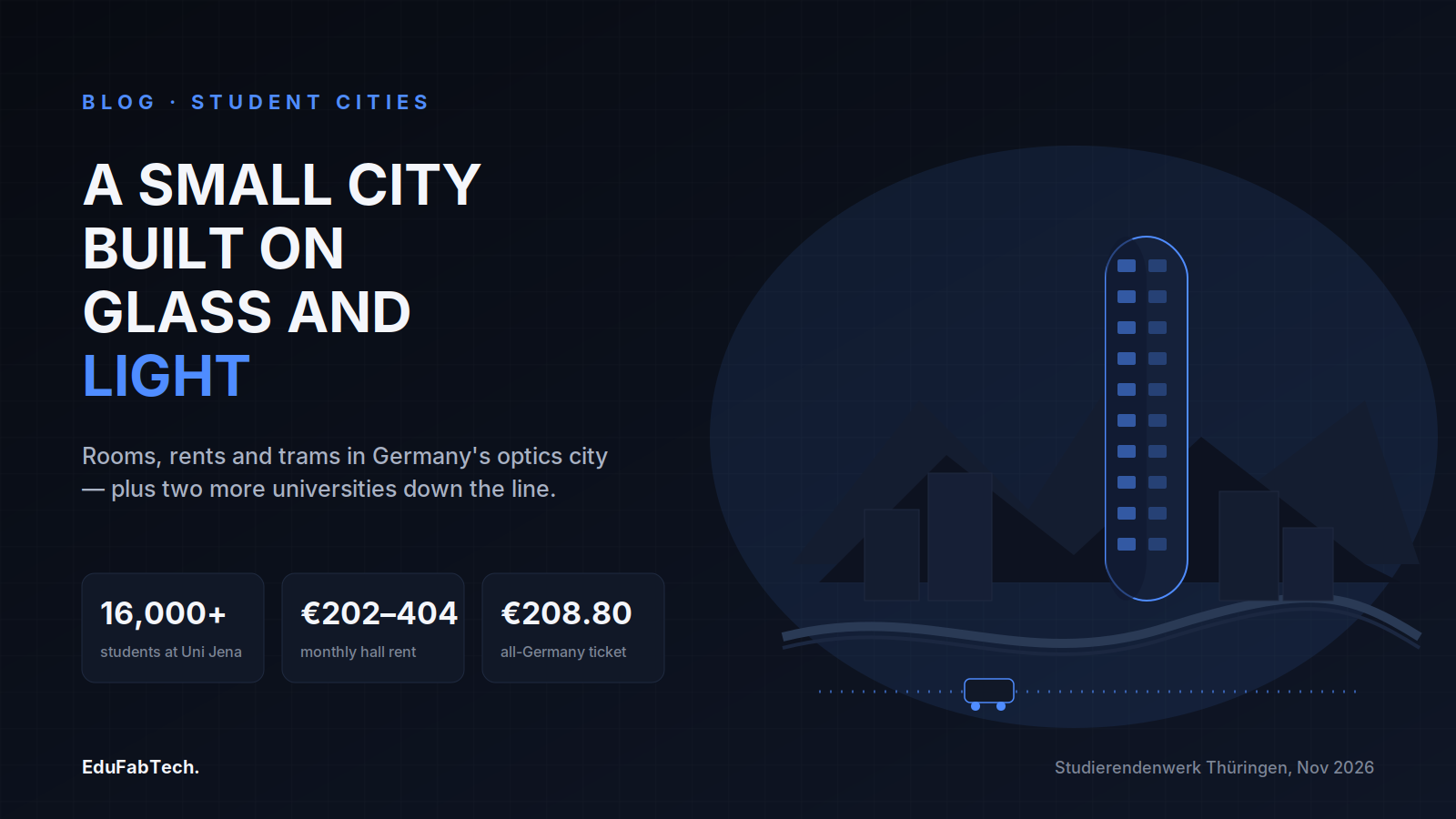
Jena sits in a narrow bend of the Saale, hemmed in by wooded limestone slopes that rise straight out of the suburbs — the Kernberge to the east, the Landgrafen ridge to the north-west. It is a town built around glass and light: the lens-maker Carl Zeiss, the physicist Ernst Abbe and the glassmaker Otto Schott worked here, and the optics firms that grew from their work still shape the skyline, including the cylindrical JenTower that marks the city centre. For students the geography matters in a plain way. Everything is close. You can walk from the main lecture halls to the river meadows of the Paradies park, or to a tram stop that reaches the edge of the hills, in minutes.
This guide covers the universities Jena has, where students actually find rooms and what they pay, how to furnish a place cheaply, the libraries and the tram network, the rules that govern part-time work, and the parts of life here that are genuinely harder than the brochures admit. Two of the degree-granting institutions a Jena student might choose sit in Weimar, about twenty minutes down the railway line, and the same semester ticket reaches them, so they belong in the picture too.
Two universities in town, two more down the valley
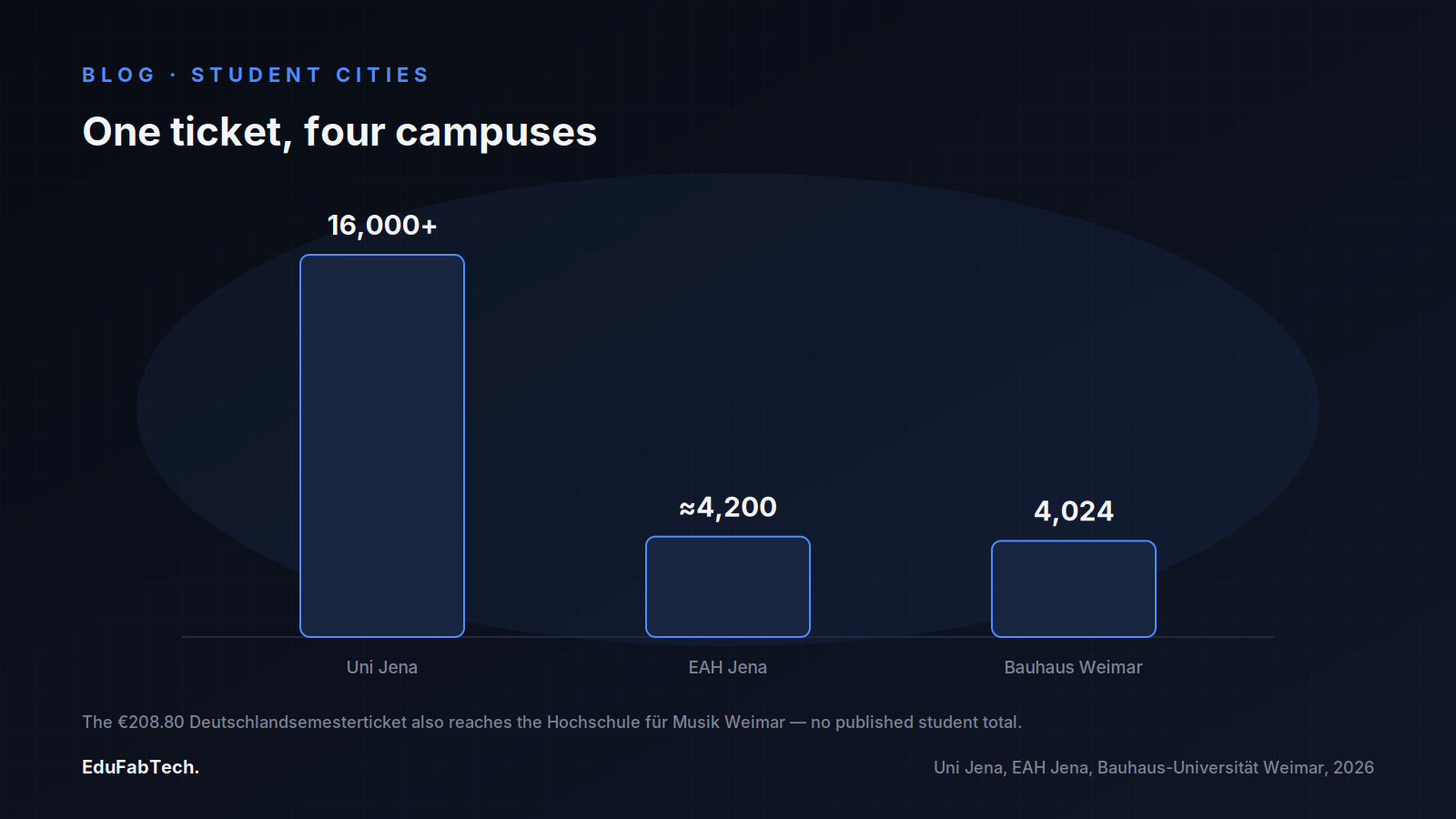
Friedrich Schiller University Jena — the University of Jena, usually just "Uni Jena" — is the city's anchor. Founded in 1558, it is the only comprehensive university in Thuringia, and its own profile pages report more than 16,000 students and over 200 study programmes spread across ten faculties, from theology and law to physics and medicine. Teaching is scattered through the centre rather than penned into one campus: the central cluster around Ernst-Abbe-Platz, the new Inselplatz campus a few streets north, the science institutes on the Beutenberg hill in the south, and the university hospital out in the Lobeda district. The university announced it had succeeded in the German Excellence Strategy and is set to be awarded University of Excellence status in 2027.
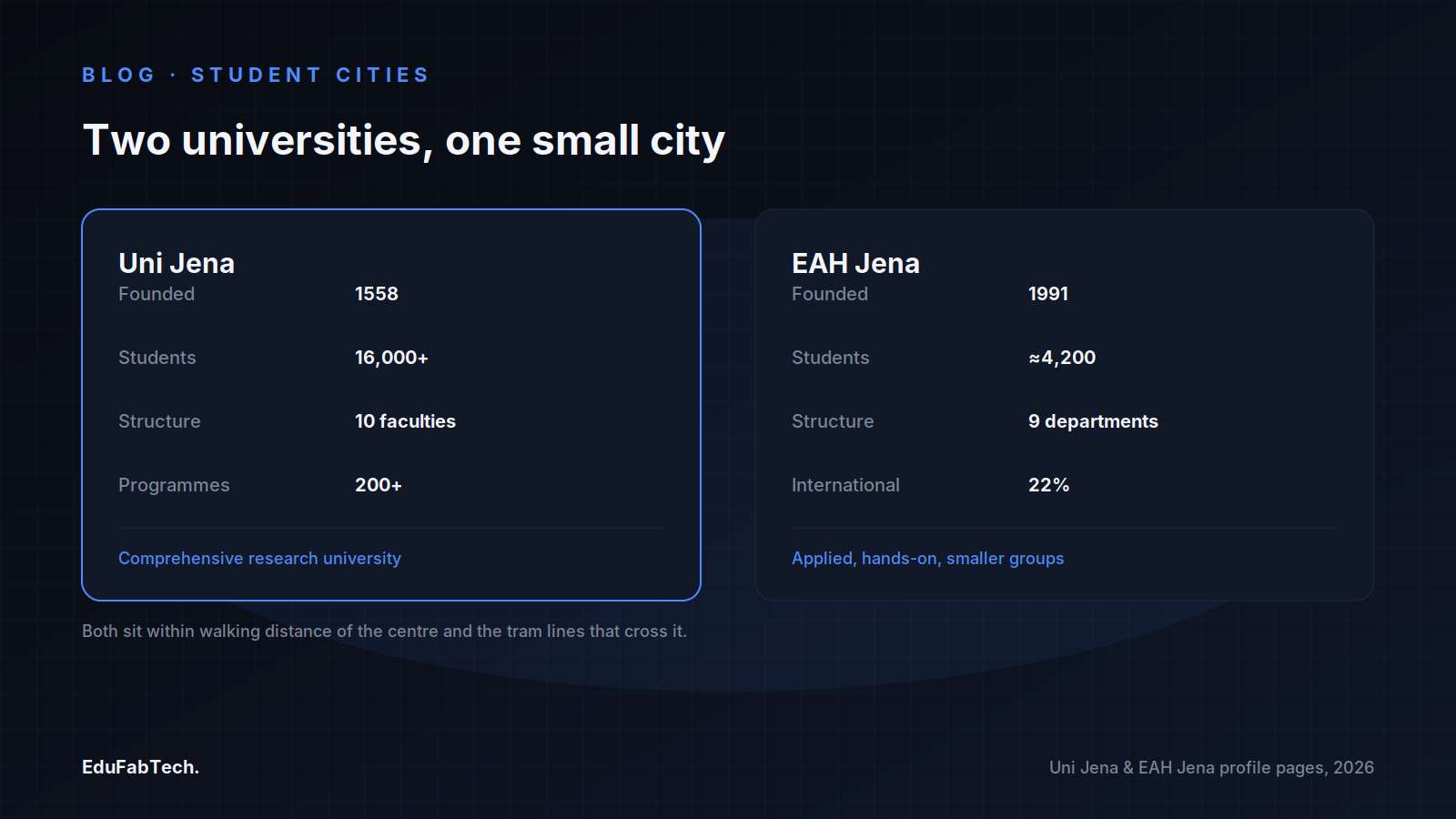
The University of Applied Sciences Jena — the Ernst-Abbe-Hochschule Jena, or EAH — is the younger, more hands-on neighbour. Its profile page describes a university founded in 1991 with around 4,200 bachelor's and master's students, roughly 22% of them international, organised into nine departments covering engineering, business, social work and health sciences, and calls itself Thuringia's largest university of applied sciences. Its campus sits close to the centre, near the Carl-Zeiss works, and the teaching leans towards laboratories, workshops and smaller groups than you find in the big faculties up the hill.
If you are drawn to art, architecture or music, two more institutions are within commuting range in Weimar. Bauhaus-Universität Weimar traces its line to the State Bauhaus that Walter Gropius founded in 1919; its own newsroom reports 4,024 students, almost 32% of them international, in four faculties — Architecture and Urbanism, Civil and Environmental Engineering, Art and Design, and Media. The Hochschule für Musik Franz Liszt Weimar is a conservatoire with deep roots: the school states it was founded in 1872 as the first orchestra school in Germany and has borne the name of Franz Liszt since 1956, staging more than 300 concerts and performances a year. Both are in Weimar, not Jena, but the regional transport that your semester fee pays for connects the two towns.
Where a room in Jena comes from
Jena's student districts are easy to read off a map once you know the pattern. The medieval centre and the streets just around it — the Damenviertel, the area near the Paradies park and the West station — are the most sought-after and the priciest, because you can walk to lectures. The two large prefab (Plattenbau) estates in the south, Neulobeda and Winzerla, offer the cheapest rooms and the best-connected trams, at the cost of a fifteen-to-twenty-minute ride into town. Wenigenjena, across the river to the east, and the northern streets around the Nordschule are quieter residential options in between.
The Studierendenwerk Thüringen, the public student-services body, runs the halls of residence and is the first place to apply. Its Jena listing covers more than a dozen houses across these districts, and its monthly all-in rents (rent plus running costs), as the Studierendenwerk lists them in November 2026, range from about €202 to €404 depending on the house and the room type, with a single-semester minimum stay; the rooms come furnished with a bed, table, chair, cabinet and shelf. That is below most private-market rents in the centre, which is why places are limited and fill early; the Studierendenwerk advises applying as soon as you have an admission, not after you arrive. The same body also hosts a private-room placement board where students can search offers from private landlords and post their own; the Studierendenwerk notes it cannot vouch for the quality of the rooms, so the same in-person checks apply before you pay anything.
A word on the thing that catches newcomers out. Shared flats — the Wohngemeinschaft, or WG — are how most students here live after their first year, and a room in one usually opens up mid-semester as someone graduates or moves. Browse the city's current rooms and WG vacancies on EduFabTech's Jena rooms page, and keep an eye on the wider Jena listings for everything else students are passing on.
Signing for a room without losing your money
The scams that appear in Jena are the ones that appear in every German student town, and they cluster where demand is highest: cheap, photogenic rooms near the centre or the West station, posted just before the semester starts, from someone who cannot meet you because they are "abroad". The defence is boring and it works. See the room in person, or have someone you trust see it, before any money changes hands. A normal deposit (Kaution) in Germany is one to three months' cold rent, held in trust and returned when you leave; the Studierendenwerk halls take a set deposit stated in the contract. No legitimate landlord, and certainly no Studierendenwerk house, will ask you to send a deposit by bank transfer to an overseas account, by gift card or in cryptocurrency to "hold" a room you have not seen. If a listing pushes you to pay before viewing, walk away. Register your tenancy and get the landlord's confirmation (Wohnungsgeberbestätigung), which you will need for your city registration.
Furnishing a room for almost nothing
A room in a shared flat or a private let often comes unfurnished — no bed, no desk, sometimes no lamp — but Jena makes furnishing one cheap. The Jenaer Trödelmarkt, the city's flea market, is run by the municipal culture office JenaKultur and held in the city centre; its 2026 calendar lists nine market days, each open 08:00 to 17:00, with stalls of clothing, furniture, books and kitchen things. Because it moves through the centre you can carry a chair or a lamp home on foot or on the tram.
Between market days, the quickest wins are online and local. EduFabTech's Jena second-hand page gathers what students here are selling, and the end of each semester — late July and late February, when graduates clear out — is when beds, desks and bikes change hands for a few euros or for the cost of carrying them away. Ask in your hall's chat group too; a departing resident would often rather give a shelf to a neighbour than haul it to the recycling yard.
Libraries and places to sit and work
The Thüringer Universitäts- und Landesbibliothek (ThULB) is both the university library and the state library of Thuringia, and it runs branch libraries by subject rather than one central building. Its main humanities house at Bibliotheksplatz 2 keeps long hours — the library's own schedule lists it open Monday to Friday 08:00–22:00, Saturday 10:00–20:00 and Sunday 10:00–18:00 — with separate branches for law, economics and social sciences on Carl-Zeiss-Straße and for the natural sciences at Ernst-Abbe-Platz. The weekend and late-evening opening matters most during exam weeks, when the reading rooms fill. For a desk closer to home, or a café corner that tolerates a laptop for an afternoon, EduFabTech's Jena study-spaces page collects the quieter options around the city.
Getting around: trams, buses and the semester ticket
Jena is small enough to cross on foot, but the hills and the strung-out shape of the valley make the tram worth having, and the network — run by Jenaer Nahverkehr, the municipal operator — ties the southern estates, the centre and the northern districts together on a few frequent lines. The cost is folded into your enrolment. The student union of the EAH Jena states that from the 2025/26 winter semester the Deutschlandsemesterticket costs €208.80 per semester and is valid on regional and local public transport across the whole of Germany, as part of a total semester contribution it gives as €310.25. In practice that single ticket covers the Jena trams and buses, the regional trains to Weimar and Erfurt, and travel far beyond Thuringia. Jenaer Nahverkehr issues it through the MeinJena app, valid only together with an official photo ID, and students must re-activate it each semester. A bicycle is the honest alternative for the flat valley floor; the climbs to Beutenberg or into the hills are another matter.
Working alongside your studies
Most students here take a job at some point — in the Zeiss and Jenoptik supply chain, in labs as student assistants, or in the cafés and shops of the centre. The rules depend on your passport, and they are not something to take from a forum. The DAAD, the German academic exchange service, states that international students from outside the EU, EEA and Switzerland may work 140 full days or 280 half days per year without extra permission, with academic-assistant posts treated separately; going beyond that needs approval from the Federal Employment Agency and the foreigners' office. This is not legal advice, and the limits and definitions change — confirm your own case with the university's International Office and with Jena's foreigners' authority (Ausländerbehörde) before you sign a contract. Current openings students are sharing are on EduFabTech's Jena jobs page.
What it costs, and what is hard
The fixed costs are the easiest to pin down. The semester contribution of €310.25 and a hall rent between €202 and €404 a month, both sourced above, are the backbone of a Jena budget; food, phone and health insurance sit on top, as they do anywhere in Germany. The city's strengths for a student are real: it is compact and walkable, the hills and the river are genuinely on the doorstep, the two universities give it a young feel out of proportion to its size, and rents — while rising — remain below Munich, Frankfurt or Berlin levels.
The hard parts are worth saying plainly. Cheap, central rooms are scarce, and the Studierendenwerk halls fill fast, so a late applicant can end up commuting from Lobeda or Winzerla by default. Jena is a small city, not a metropolis: the nightlife and cultural range are modest next to Leipzig or Berlin, and some students find the valley closes in during the grey, sometimes foggy winter months. The teaching is spread across several sites, so a timetable can send you from the centre up to Beutenberg and back in a day. None of this is a reason to stay away; it is the texture of a particular place, and worth knowing before you arrive.
A checklist for your first weeks
- Apply for a hall before you arrive. Put your name in with the Studierendenwerk Thüringen the moment you have an admission; do not wait until you land.
- See any private room in person first. Never wire a deposit abroad or pay by gift card or crypto to hold a place you have not viewed.
- Register your address. Book a slot at the Bürgerservice, bring your landlord's confirmation, and keep the registration certificate — you need it for almost everything else.
- Activate your semester ticket. Set up the MeinJena app and load the Deutschlandsemesterticket; carry a photo ID with it.
- Get a library card and find your branch. Note the ThULB hours for the subject library you will actually use.
- Check the work rules for your status. Confirm the day limits with the International Office and the Ausländerbehörde before taking a job.
- Furnish from the flea market and second-hand first. Time big buys to the end-of-semester clear-outs in late July and late February.
A quick question for readers
Do you work part-time while you study?
Many students work to pay the bills. See how common it is — and how many hours people really do.
Pick an answer, create a free account in a minute, and your vote counts. Already a member? Sign in
Comments 3
Comment-
The Excellence Strategy line is the one I'd slow down on before repeating it anywhere - the piece says the university "announced it had succ…
-
The line that jumps out is the Excellence Strategy claim: the university says it succeeded and is "set to be awarded" status in 2027 — that'…
-
The thing I'd want pinned down is that €310.25 total versus the €202-404 hall rent range - the piece treats both as "the backbone of a budge…
Join free to read the full comments and reply Comments are between members; an account takes a minute.
Source: Friedrich Schiller University Jena
Sources (5)
- Friedrich Schiller University Jena. Friedrich Schiller University Jena (university profile). Friedrich Schiller University Jena, 2026. uni-jena.de ↗ · checked 14 Nov 2026
- Ernst-Abbe-Hochschule Jena. Profile of the University of Applied Sciences Jena. Ernst-Abbe-Hochschule Jena, 2026. eah-jena.de ↗ · checked 14 Nov 2026
- Studierendenwerk Thüringen. Student halls of residence (Wohnheime), Jena. Studierendenwerk Thüringen, 2026. stw-thueringen.de ↗ · checked 14 Nov 2026
- StuRa Ernst-Abbe-Hochschule Jena. Information on the Deutschlandsemesterticket. Studierendenrat EAH Jena, 2026. stura.eah-jena.de ↗ · checked 14 Nov 2026
- DAAD. Side jobs: working while you study. Deutscher Akademischer Austauschdienst, 2026. daad.de ↗ · checked 14 Nov 2026