Studying in Karlsruhe: universities, housing and student life
A practical, sourced guide to Karlsruhe's universities, its student neighbourhoods, finding a room safely, markets and second-hand furniture, transport, part-time work and what the city costs.
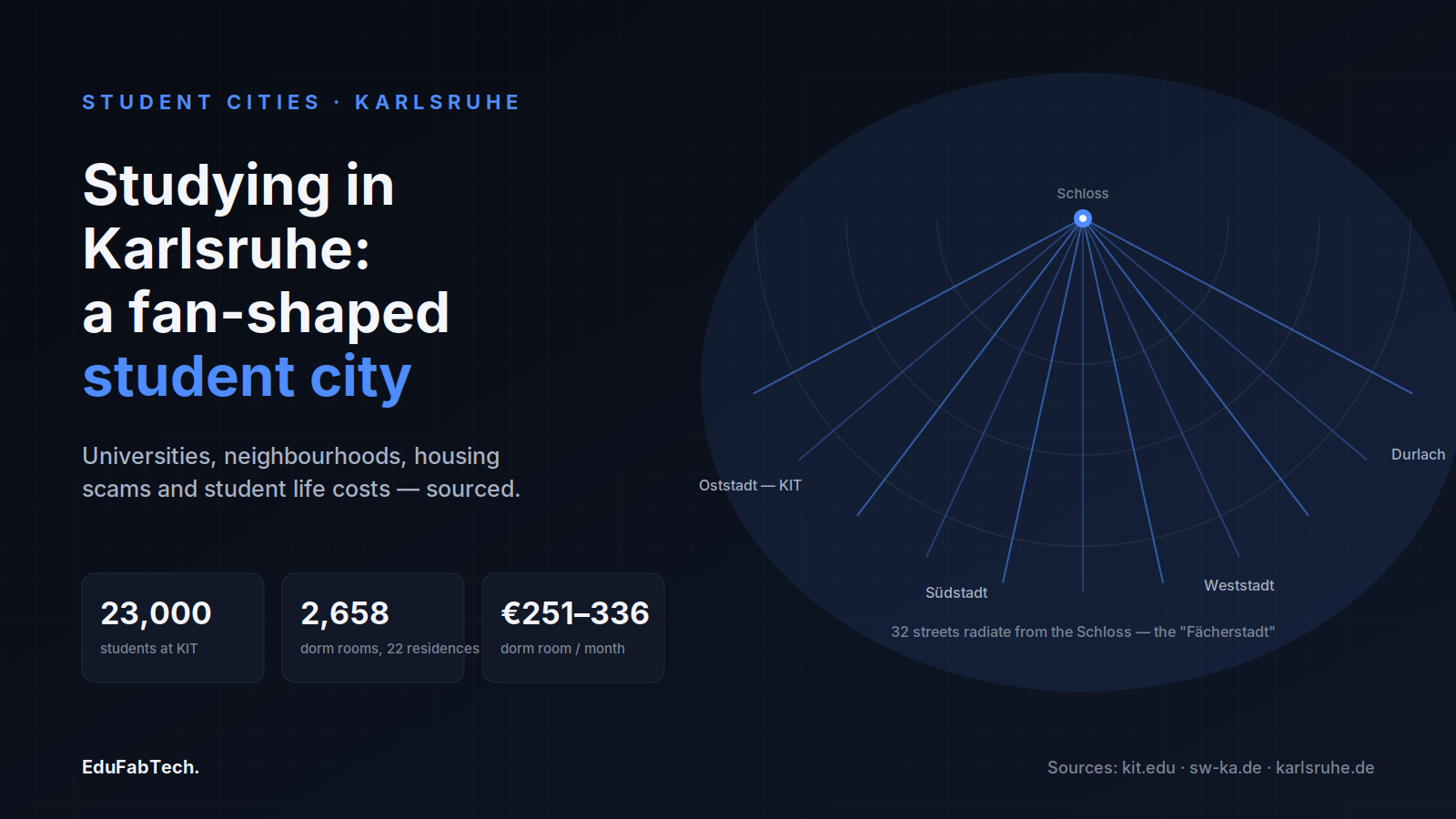
Karlsruhe is young for a German city — laid out in 1715 and still shaped by that founding idea. Thirty-two streets fan out from the tower of the baroque Schloss like the ribs of a folding fan, which is why locals call it the Fächerstadt, the fan city. The plan makes the centre unusually legible: stand at the palace and the whole town radiates away from you in straight lines. It sits in the warm Upper Rhine plain in the south-west of the country, close to the French border and the Vosges, and it is flat enough that almost everywhere is a short bicycle ride away.
It is also a working technical and legal city rather than a tourist one. Germany's Federal Constitutional Court (Bundesverfassungsgericht) and Federal Court of Justice (Bundesgerichtshof) both sit here, which is why Karlsruhe is sometimes called the Residenz des Rechts, the seat of law. Alongside the courts is a dense cluster of engineering, computing and design — and a student population large enough that the tram you board in the morning is half full of people carrying laptops and lab coats.
For a student the appeal is concrete: a compact, bikeable centre, a serious research university, and rents that are still below Munich or Stuttgart — though, as everywhere in Germany's university towns, the room market tightens sharply every September and April. What follows is a practical walk through the universities, the neighbourhoods, finding a room without being cheated, and what daily life actually costs.
The universities, from KIT to the art academy
The anchor is the Karlsruhe Institute of Technology (KIT), which its own profile page describes as a University of Excellence in the Helmholtz Association with roughly 23,000 students (kit.edu). It exists in its current form because the old Universität Karlsruhe merged with the Forschungszentrum Karlsruhe on 1 October 2009 (kit.edu/history), so the historic "University of Karlsruhe" is now part of KIT rather than a separate school. KIT's teaching heart is Campus South, pressed up against the Schlossgarten just north-east of the centre; its large research installations sit on Campus North near Eggenstein-Leopoldshafen, with smaller Campus East and West sites. It is strongest in engineering, computer science, physics and the natural sciences.
The city has a second large institution in Karlsruhe University of Applied Sciences (Hochschule Karlsruhe, HKA), whose main campus is on Moltkestraße west of the centre and which teaches applied engineering, computer science, architecture and business across six faculties (h-ka.de). Teacher training is the job of the Karlsruhe University of Education (Pädagogische Hochschule) on Bismarckstraße, which grants primary- and secondary-school teaching degrees. Cooperative, employer-linked "dual" study — where semesters alternate with paid company placements — is offered by DHBW Karlsruhe on Erzbergerstraße.
Three smaller, specialised schools give the city its creative edge. The Academy of Fine Arts, Karlsruhe (Staatliche Akademie der Bildenden Künste) on Reinhold-Frank-Straße trains fine artists and art teachers; the Hochschule für Musik Karlsruhe occupies the Gottesaue castle grounds east of the centre and runs degrees from performance to music informatics; and the Karlsruhe University of Arts and Design (Staatliche Hochschule für Gestaltung, HfG) shares the former munitions-factory building on Brauerstraße with the ZKM centre for art and media, teaching media art, communication and exhibition design. Rounding out the list is Karlshochschule International University, a small state-recognised private business school on Karlstraße in the centre. Browse all Karlsruhe student listings or what is near KIT to see how the housing map follows these campuses.
Neighbourhoods students actually settle in
Because the campuses sit in different parts of town, where you study shapes where you look for a room. The Oststadt, directly behind KIT Campus South, is the classic KIT quarter: shared flats, a short walk or a two-stop tram to lectures, quieter than the centre but very hard to get into near term-start. The Südstadt, just south of the main station axis, has become the liveliest student quarter, with cafés and cheap eats around the Werderplatz and Marienstraße and rents that tend to sit a little below the smarter western districts.
The Weststadt, between HfG, the art academy and HKA's Moltkestraße campus, is handsome nineteenth-century housing and correspondingly popular and pricier. Mühlburg and Grünwinkel, further west toward the Rhine, are more ordinary and generally cheaper, well connected by tram but a longer ride from Campus South. Durlach, the old town absorbed into Karlsruhe, is a district in its own right — green, family-friendly, roughly fifteen minutes on tram line 1 from the centre — and often better value if you do not mind the commute. The Innenstadt around the Marktplatz is convenient and noisy, and rarely the cheapest option.
Finding a room, and the scams that circle the listings
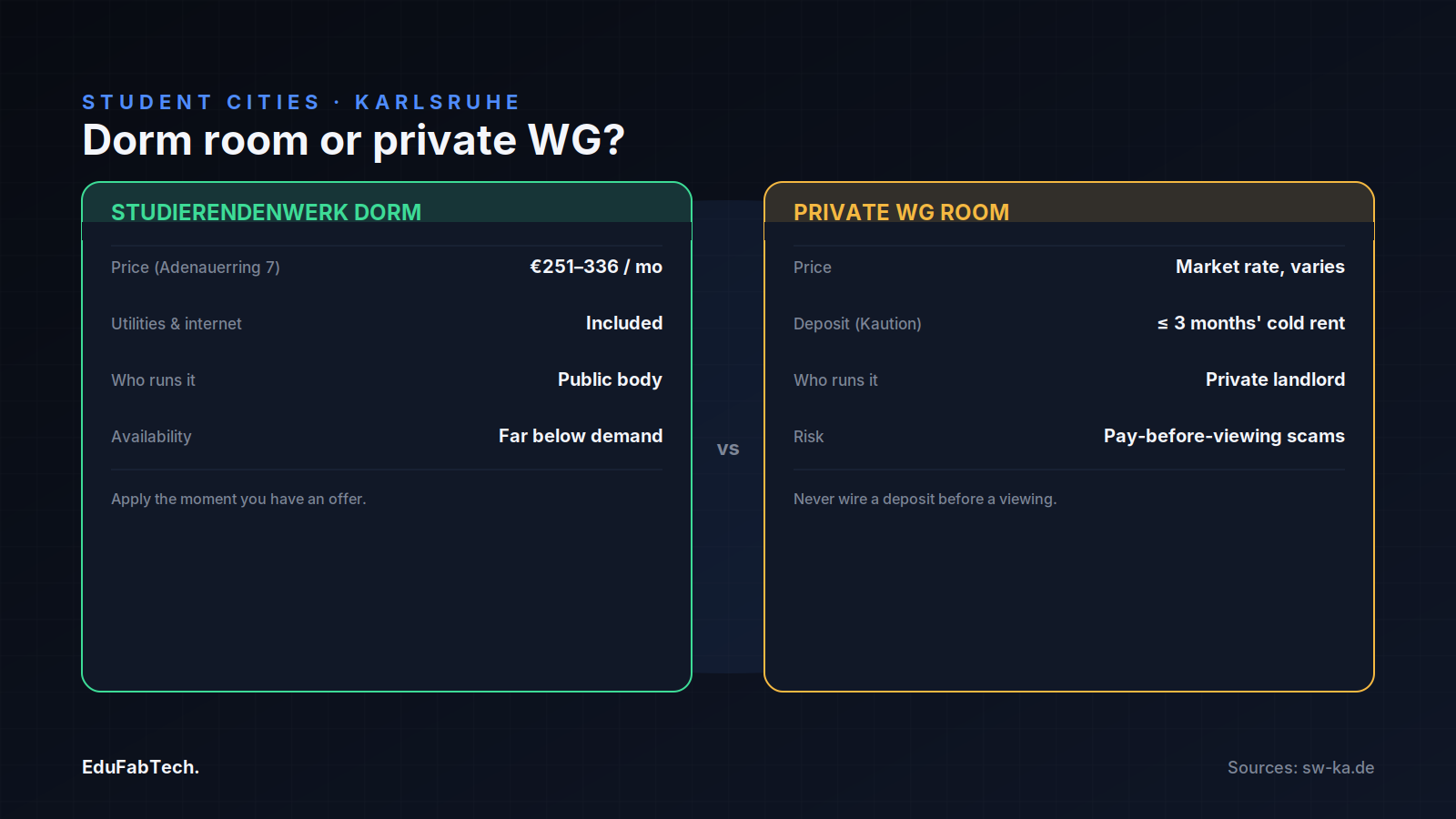
Most purpose-built student housing comes from the Studierendenwerk Karlsruhe, the public body that runs dormitories and dining halls. It says it operates 22 residences with 2,658 rooms across Karlsruhe and Pforzheim and also runs a free private-room service matching landlords and students (sw-ka.de). Rooms are cheaper than the open market: at its central Adenauerring 7 residence on KIT Campus South, the Studierendenwerk lists single rooms at €251–336 a month in 2026, utilities such as heating, water, electricity and internet included (sw-ka.de). Demand far outstrips supply, so apply the moment you have an admission offer rather than waiting for enrolment, and treat a dorm place as a bonus, not a guarantee.
Most students end up in a private shared flat (a WG, Wohngemeinschaft). The market is seasonal and brutal in the weeks before each semester starts in October and April, which is exactly when fraudulent listings multiply. The usual Karlsruhe scam is a too-cheap, too-nice flat whose supposed owner is "abroad" and wants a deposit wired to hold it before any viewing. Do not do it. A deposit (Kaution) in Germany is normally up to three months' cold rent, paid only after you have signed a contract and seen the place — in person, or at the very least on a live video walk-through where you can ask the person to show a specific window or the street name. Never send money by bank transfer, gift card or cryptocurrency to reserve a room you have not viewed, and be wary of anyone who refuses a viewing or pushes you to decide within the hour. Start from the rooms listings for Karlsruhe and the Studierendenwerk's own service rather than unvetted offers.
Furnishing a room without spending much
An empty German room usually means no furniture and sometimes no kitchen, so second-hand buying is a rite of passage. Karlsruhe's big draw is the Großflohmarkt, the large flea market held several Saturdays a year on the Messplatz, where sellers pay €10 per metre and stalls run from collectors' pieces to furniture in various states of repair (karlsruhe.de). The same page notes a smaller city flea market on the first Saturday of each month behind the Postgalerie on Stephanplatz. For everyday food shopping, the city's weekly markets are spread across the districts — Stephanplatz, Werderplatz in the Südstadt and the Durlach market square among them, most running from early morning to early afternoon (karlsruhe-erleben.de). For beds, desks and the small stuff, the EduFabTech pages for second-hand furniture and second-hand things in Karlsruhe are a practical first stop.
Working alongside your studies
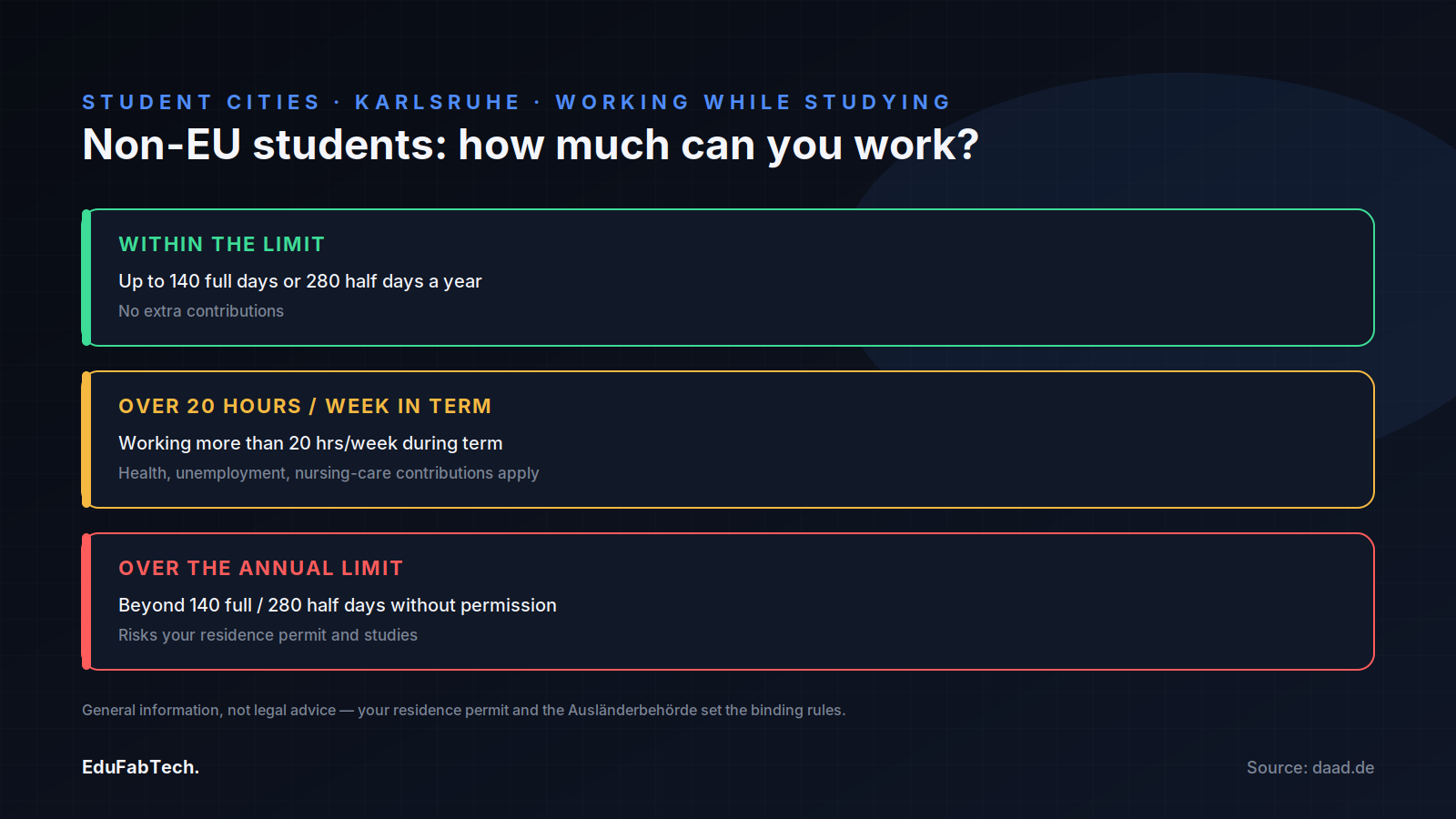
Many students take a part-time job, and the rules matter most for those from outside the EU. The DAAD states that international students from non-EU countries may work 140 full days or 280 half days per year, and warns that working more than 20 hours a week during term means paying health, unemployment and nursing-care contributions and risks your studies (daad.de). This is general information, not legal advice: your own residence permit sets the binding conditions, so check the exact wording on your permit and with the Karlsruhe foreigners' authority (Ausländerbehörde) before you commit. Campus noticeboards, the Studierendenwerk and the Karlsruhe jobs listings are reasonable places to look for student roles.
Libraries and places to study
Study space is one of the things Karlsruhe does unusually well. The KIT Library is open 24 hours a day and offers around 1,600 study spaces across its locations, from the main library to subject libraries and the learning centre (bibliothek.kit.edu). For a different atmosphere, the regional Badische Landesbibliothek (BLB) near the Schloss has large reading rooms open to the public. HKA, the PH and the art schools each keep their own libraries. If every desk is taken in exam season, the study-spaces listings for Karlsruhe collect further options around the city.
Getting around: tram-trains and the youth ticket
Local transport is run by the Karlsruher Verkehrsverbund (KVV) and is a point of local pride: Karlsruhe pioneered the "tram-train", where the same light-rail vehicles run on city tram tracks and then continue onto mainline railways into the surrounding region. Campus South sits beside the Durlacher Tor stop, and Durlach, Ettlingen and villages well beyond the city are reachable without changing. The flat, compact layout also makes cycling genuinely practical for most trips.
On fares, the useful ticket for most students is the nationwide D-Ticket JugendBW, which the KVV prices at €45 a month as of 1 January 2026 for students, apprentices and volunteers up to age 27 (and children and young people up to 21) who live or study in Baden-Württemberg, and which is valid on local and regional public transport across Germany (kvv.de). The older KVV student card (Studikarte) was discontinued in 2026. A separate, cheaper Deutschlandsemesterticket — priced at 60 percent of the standard Deutschlandticket — exists in principle, but the KVV states that no university in its area currently has an agreement to offer it, so it is not available to Karlsruhe students at the time of writing (kvv.de). Confirm the current fare before you buy, since these arrangements change from term to term.
The honest balance, and a first-weeks checklist
What is good about Karlsruhe for a student is its scale and its ease: a strong research university, several specialised schools, a flat and bikeable centre, round-the-clock library space, and living costs below the big southern metros. The creative-technical mix — engineers, designers and the ZKM in one small city — gives it a distinct character. What is hard is the familiar German housing squeeze: too few rooms for the people arriving each October and April, which is when scams cluster and prices bite. The Upper Rhine valley is one of Germany's warmest corners, so summers can be genuinely hot in an un-air-conditioned attic room. And the nightlife is modest next to Berlin or Hamburg — this is a city you grow to like for its liveability rather than its spectacle.
A short checklist for the first weeks: register your address at the city's Bürgerbüro within the legal window after moving in; enrol and collect your student card; set up German health insurance and a bank account; apply for the Studierendenwerk dorm waiting list and keep hunting for a WG in parallel; buy the D-Ticket JugendBW if you are under 27; and furnish the room slowly from the flea markets rather than all at once. Start from the Karlsruhe listings hub, keep every deposit tied to a viewing, and give yourself a few weeks — the fan city is small enough to learn quickly once you are in it.
A quick question for readers
Do you work part-time while you study?
Many students work to pay the bills. See how common it is — and how many hours people really do.
Pick an answer, create a free account in a minute, and your vote counts. Already a member? Sign in
Comments 3
Comment-
The number worth sitting with is 2,658 dorm rooms, run by one body, covering both Karlsruhe and Pforzheim, against a single institution's 23…
-
The number I'd want more of is the €251–336 dorm range next to that D-Ticket detail: the discontinued Studikarte and the unavailable Deutsch…
-
The number worth sitting with is that Deutschlandsemesterticket: cheaper at 60% of the standard price, exists "in principle," and precisely…
Join free to read the full comments and reply Comments are between members; an account takes a minute.
Source: Studierendenwerk Karlsruhe
Sources (5)
- Studierendenwerk Karlsruhe. Wohnheim Adenauerring 7 (dormitory rents). Studierendenwerk Karlsruhe, 2026. sw-ka.de ↗ · checked 13 Nov 2026
- Karlsruher Verkehrsverbund (KVV). D-Ticket JugendBW. KVV, 2026. kvv.de ↗ · checked 13 Nov 2026
- DAAD. Side jobs: working during your studies. Deutscher Akademischer Austauschdienst, 2026. daad.de ↗ · checked 13 Nov 2026
- Karlsruhe Institute of Technology. KIT Library: study and work. KIT, 2026. bibliothek.kit.edu ↗ · checked 13 Nov 2026
- City of Karlsruhe. Großflohmarkt auf dem Messplatz. Stadt Karlsruhe, 2026. karlsruhe.de ↗ · checked 13 Nov 2026