Studying in Kassel: universities, housing and student life
A practical, sourced guide to Kassel's universities, finding a room, second-hand markets, part-time work, libraries, the semester ticket and what living there actually costs.
Kassel sits in the hilly north of the German state of Hesse, strung along the river Fulda, roughly halfway between Frankfurt and Hanover on the high-speed line. It is an unusual mix: a working industrial city that is also, every five years, host to documenta, the international contemporary-art exhibition that draws hundreds of thousands of visitors, and the custodian of the Bergpark Wilhelmshöhe, which the German National Tourist Board notes has been a UNESCO World Heritage Site since 2013, crowned by the giant Hercules monument above its baroque water cascades. For a student, that combination means a city that is cheaper and less crowded than the big southern university towns, with hills to climb, forests at the edge of the tram map, and an art scene disproportionate to its size.
It is not a famous "student city" in the way Heidelberg or Münster are, and that is part of the appeal and part of the difficulty: rooms are more findable than in Munich, but the city is quieter, the winters are grey, and some of what students want is spread across campuses that are not all in the centre. This guide walks through the universities, where and how to live, what things cost, working, studying and getting around — with every figure tied to the page it came from.
If you are weighing Kassel against other German cities, the city listings on EduFabTech's Kassel page collect rooms, second-hand goods, jobs and events in one place, and the sections below explain how to use each of those safely.
The universities, and what studying here is like
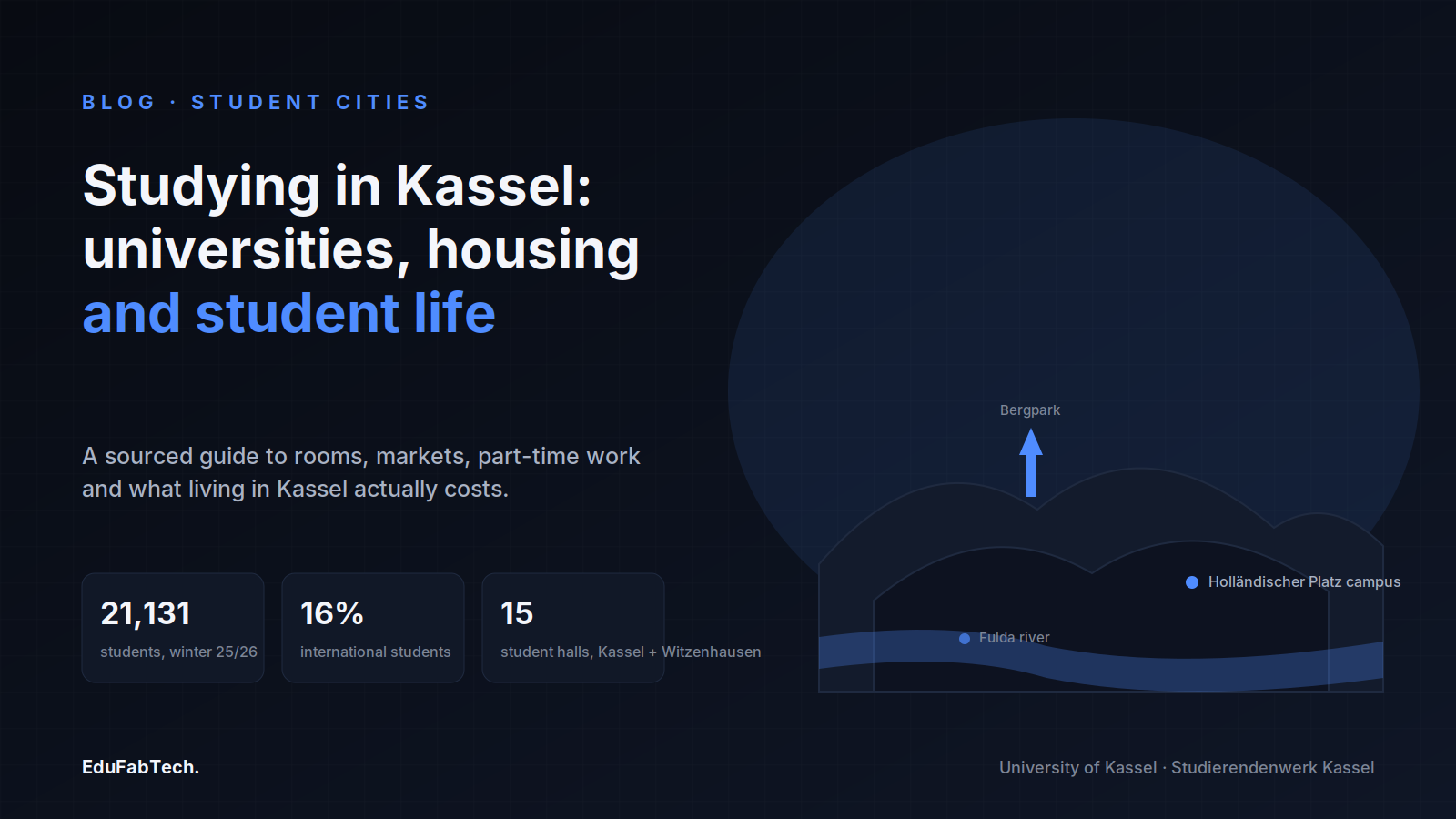
The dominant institution is the University of Kassel. Its own Facts and Figures page records 21,131 students in the 2025/26 winter semester, of whom 3,357 (16 per cent) are international and 4,775 are in their first semester, taught by 319 professorships (111 of them held by women) among a total staff of 3,406. The main campus is Holländischer Platz, a redeveloped quarter a short walk north of the Hauptbahnhof; science and mathematics sit further out at Oberzwehren on Heinrich-Plett-Straße, and the agricultural sciences are in Witzenhausen, a small town east of the city. The university is known for engineering and for sustainability research, and it keeps a strong art and design school, the Kunsthochschule, woven into the same institution.
Two smaller degree-granting schools round out the picture. The YMCA University of Applied Sciences — in German the CVJM-Hochschule — is a small, state-recognised private university in Kassel focused on social work and community education, offering bachelor's and master's degrees to a student body of a few hundred. The VWA und Berufsakademie Göttingen is not in Kassel at all but in Göttingen, about an hour north by regional train; it runs dual, work-integrated bachelor's programmes in business administration, health-care management and social work, and is worth knowing only if a Göttingen dual study place is what you are after.
Studying at Kassel has the texture of a mid-sized German public university: lectures and seminars in German for most programmes, a growing number of English-taught master's courses, and a semester rhythm built around the winter (starting October) and summer (starting April) terms. Listings close to the main campus are gathered on EduFabTech's University of Kassel page.
Finding a room: dormitories, shared flats and the October crunch
Most students live either in a Studierendenwohnheim (a hall run by the Studierendenwerk Kassel) or in a Wohngemeinschaft — a WG, or shared flat — in neighbourhoods like the Nordstadt around the main campus, Vorderer Westen with its handsome older buildings, or Wesertor closer to the river. The Studierendenwerk Kassel is the public body for student welfare and the first place to apply; its student-halls listing covers 13 halls in Kassel and two in Witzenhausen. These are the safest option for a newcomer because the contract, the rent and the deposit are all set by a public institution rather than a stranger on the internet.
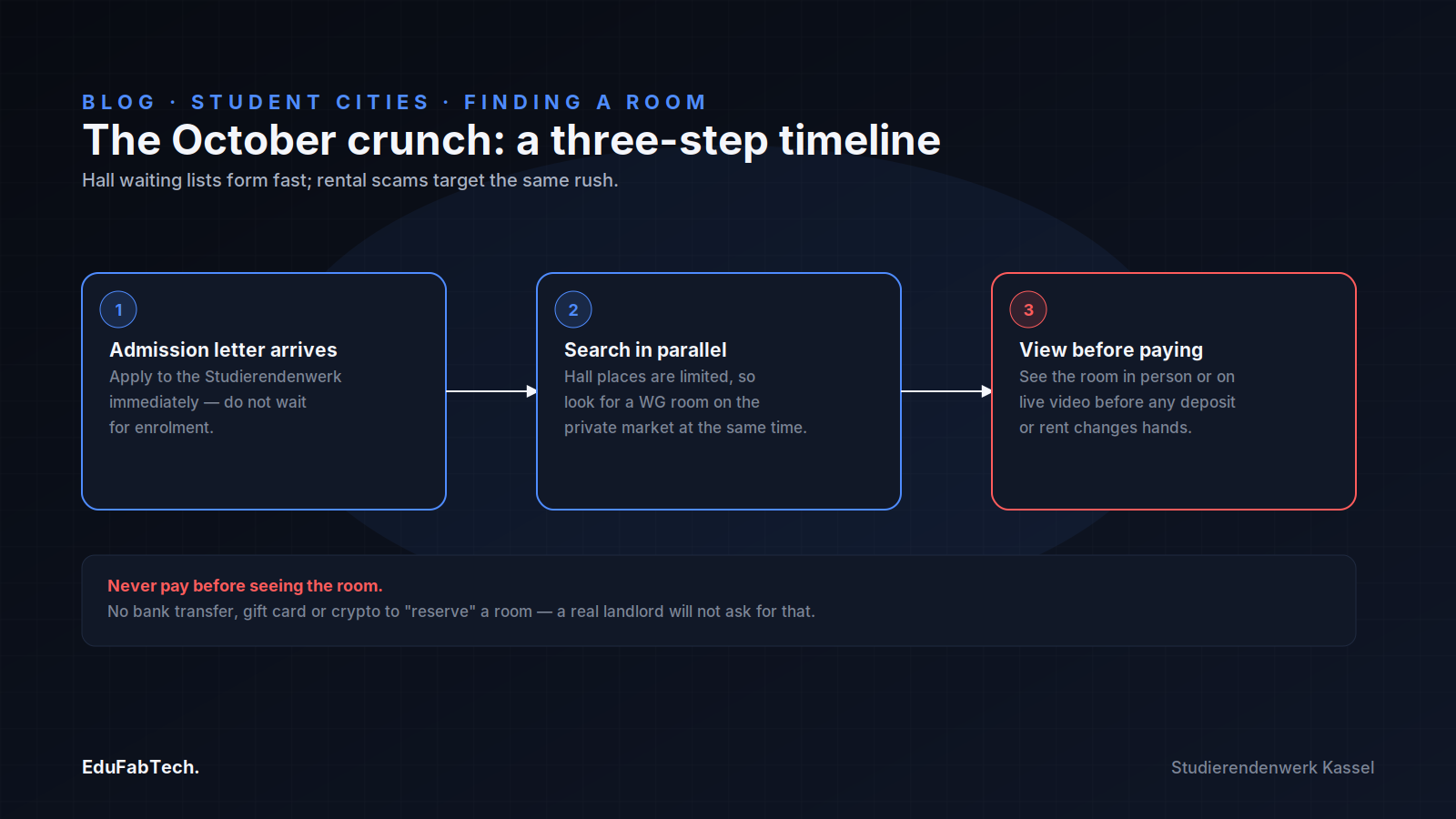
Demand peaks sharply in September and October as the winter semester fills. Apply to the Studierendenwerk as soon as you have an admission letter rather than waiting for enrolment, and in parallel search for a WG room, because hall places are limited and waiting lists form. For the private market, treat the autumn weeks as a scramble: viewings get booked out, and good rooms in the Vorderer Westen go quickly.
Renting without being cheated
The rental scams that target students in Kassel follow a familiar script: a room near Holländischer Platz or in the Vorderer Westen is advertised at a suspiciously good price, the "owner" says they are abroad and cannot show it in person, and they ask for a deposit or the first month's rent up front to "reserve" it. Do not pay anything before you have seen the place — in person, or at least on a live video call where the person shows you the actual flat and the street outside. Never send money by bank transfer, gift card or cryptocurrency to hold a room; a genuine landlord or the Studierendenwerk will not ask for that.
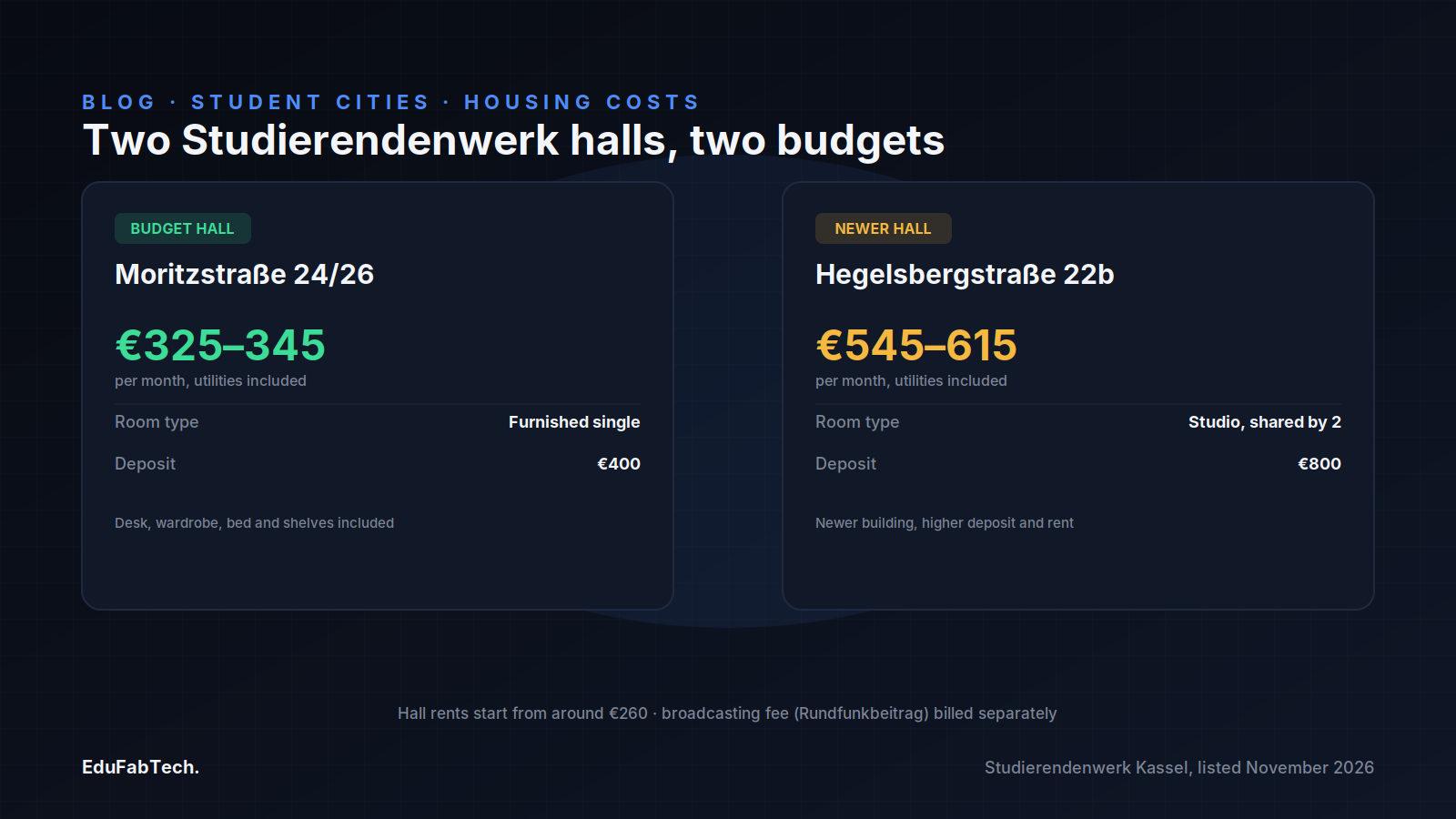
Before any money changes hands you should have a written tenancy agreement (Mietvertrag) naming the parties and the rent, and you should understand the deposit (Kaution). Deposits at the Studierendenwerk are modest and transparent — for example, its Moritzstraße 24/26 hall lists a €400 deposit and the Hegelsbergstraße 22b studios an €800 one — and on the private market a deposit of one to three months' cold rent is the normal range. If a "landlord" wants far more than that, or wants it before you have keys and a signed contract, walk away. Rooms and verified listings for the city are collected on EduFabTech's Kassel rooms page.
What a room costs, and the money you must show
Kassel is one of the cheaper German university cities, and the dormitory rents reflect that. As currently listed by the Studierendenwerk Kassel (November 2026), a furnished single room in the Moritzstraße 24/26 hall costs €325–€345 a month with internet, electricity, water and heating included — the room already fitted with a desk, wardrobe, bed and shelves. At the higher end, the newer Hegelsbergstraße 22b studios, each shared by two people, run €545–€615 a month including utilities. The Studierendenwerk's own hall list shows rents starting from around €260. Private WG rooms vary more, but Kassel's cold rents sit well below those of Frankfurt or Munich.
One cost to plan for separately is the broadcasting fee (Rundfunkbeitrag), which the halls note is not included in rent, and — for students from outside the EU — proof of funds for the visa, which is set by the German authorities and changes; confirm the current figure with the German mission in your country rather than relying on a number from memory. The one transport cost is fixed and known: see the fares section below.
Furnishing a room for little: markets and second-hand
You can furnish a Kassel room cheaply if you buy used. The Kasseler Markthalle near the centre is the city's covered market; its own opening-hours page gives market-hall trading on Thursday and Friday 7:00–18:00 and Saturday 7:00–14:00, with the open-air Wochenmarkt (weekly market) on Thursday 7:00–13:00 and Saturday 7:00–14:00 — the place for fresh food rather than furniture, but a good anchor for your weekly shop. For furniture, kitchenware and bikes, the cheapest routes are flea markets, student noticeboards and end-of-term giveaways when leases turn over in March and September.
Because flea-market dates and second-hand shops change through the year, use current local listings rather than a fixed address: EduFabTech keeps running pages for second-hand things, used furniture and items given away free in Kassel, which is often where a departing student's desk or shelf finds its next owner.
Working while you study
Many students work part-time, and the rules depend on your nationality. Students from the EU and EEA may work much like German students. For students from outside the EU, the DAAD's guidance on side jobs states the standard allowance is 140 full days or 280 half days per year before additional permission from the employment authorities is needed. This is a general description of the framework, not legal advice for your case: the authoritative word on what your specific residence permit allows is the local immigration office — the Ausländerbehörde of the city of Kassel — and the condition printed on your permit, so check both before taking a job.
Typical student work in Kassel includes university jobs as a research or teaching assistant (Hilfskraft), hospitality, retail and tutoring. Current openings are gathered on EduFabTech's Kassel jobs page. Keep a record of the days you work, because the day count, not just the weekly hours, is what the rules turn on.
Libraries and places to study
The University Library is the backbone of study space. Its locations and opening-hours page lists the Campus Library at Diagonale 10 on the Holländischer Platz campus as open Monday to Friday 8:00–22:00 and weekends 10:00–21:00, with group study rooms and individual desks. The same page lists the historic Murhard Library and State Library at Brüder-Grimm-Platz, open Monday to Friday 9:00–18:00 and Saturday 10:00–13:00, plus branch libraries at Oberzwehren for the sciences and in Witzenhausen for agriculture. In the busy exam weeks these fill early, so arriving in the morning matters. Quieter desks, cafés with power sockets and other study corners around the city are listed on EduFabTech's Kassel study-spaces page.
Getting around: trams, RegioTram and the semester ticket
Kassel runs on trams. The city network is operated by the Kasseler Verkehrs-Gesellschaft (KVG), extended by the RegioTram that reaches out into the surrounding countryside, and the whole region is organised under the Nordhessischer VerkehrsVerbund (NVV). For students the key fact is the ticket: the NVV's Deutschlandsemesterticket page states that, since the 2026/27 winter semester, University of Kassel students pay €37.80 a month for the ticket, which is valid nationwide on local public transport in second class and, within the NVV area, lets you take a bicycle, a dog and young children along at no extra charge. It is paid as part of the semester fee under a solidarity model, so every enrolled student has it.
That ticket is what makes Kassel's geography workable: it covers the trams between the campuses, the regional trains out to Witzenhausen, and — because it is the nationwide Deutschlandticket in student form — weekend travel across Germany. Kassel-Wilhelmshöhe is the city's high-speed station on the Frankfurt–Hanover line, so getting away for a few days is genuinely easy.
The honest balance
What is good about Kassel for a student: it is affordable by German standards, with dormitory rooms from the low €300s and no shortage of green space, from the Bergpark to the Fulda meadows; the semester ticket is cheap and national; and the city carries real cultural weight for its size, especially in the documenta years. What is harder: the campuses are split across the city, so a science student at Oberzwehren and a humanities student at Holländischer Platz lead different daily lives and commute times add up; the weather is grey and cool for much of the year; the city centre, heavily rebuilt after wartime destruction, is functional rather than pretty, which some newcomers find a let-down; and the autumn room search is competitive even if less brutal than in the big cities. Nightlife and the English-speaking scene are smaller than in a Berlin or a Cologne, so a lot depends on plugging into student groups early.
A checklist for the first weeks
- Apply to the Studierendenwerk Kassel for a hall place as soon as you are admitted, and search for WG rooms in parallel — do not wait for enrolment.
- Never pay a deposit before seeing a room in person or on a live video call, and never by gift card, crypto or transfer to a "landlord abroad."
- Register your address at the city's residents' office (Anmeldung) within the first weeks — you need it for almost everything else.
- Complete enrolment and activate your Deutschlandsemesterticket online so your travel is covered from day one.
- Get a library account and find your nearest branch — Campus Library for Holländischer Platz, Oberzwehren for the sciences.
- If you are a non-EU student, check your residence permit's work condition with the Kassel Ausländerbehörde before taking any job.
- Furnish from second-hand markets and end-of-term giveaways rather than buying new.
- Join a student group or departmental Fachschaft in the first fortnight; in a quieter city, that is how the social side starts. Local Kassel events listings are a way in.
A quick question for readers
Do you work part-time while you study?
Many students work to pay the bills. See how common it is — and how many hours people really do.
Pick an answer, create a free account in a minute, and your vote counts. Already a member? Sign in
Comments 3
Comment-
The rent numbers in here don't quite line up. The detailed examples are Moritzstraße at €325–345 and Hegelsbergstraße at €545–615, but then…
-
The €260 'starting from' figure is the weak link in an otherwise well-sourced piece. Every other rent number here is tied to a specific name…
-
The deposit comparison is the useful bit: €400 at Moritzstraße versus €800 at the newer Hegelsbergstraße studios, both from the Studierenden…
Join free to read the full comments and reply Comments are between members; an account takes a minute.
Source: Studierendenwerk Kassel
Sources (5)
- University of Kassel. Facts and Figures. University of Kassel, 2026. uni-kassel.de ↗ · checked 18 Nov 2026
- Studierendenwerk Kassel. Student Halls in Kassel. Studierendenwerk Kassel, 2026. studierendenwerk-kassel.de ↗ · checked 18 Nov 2026
- Nordhessischer VerkehrsVerbund (NVV). Deutschlandsemesterticket für Kasseler Studierende. NVV, 2026. nvv.de ↗ · checked 18 Nov 2026
- DAAD. Side jobs. Deutscher Akademischer Austauschdienst, 2026. daad.de ↗ · checked 18 Nov 2026
- University of Kassel Library. Opening hours / Locations / Contact. University of Kassel, 2026. uni-kassel.de ↗ · checked 18 Nov 2026