Studying in Kiel: universities, housing and student life
A practical, sourced guide to Kiel's four degree-granting institutions, where students find rooms on both sides of the Förde, what a semester costs, and the honest trade-offs of a Baltic port city.
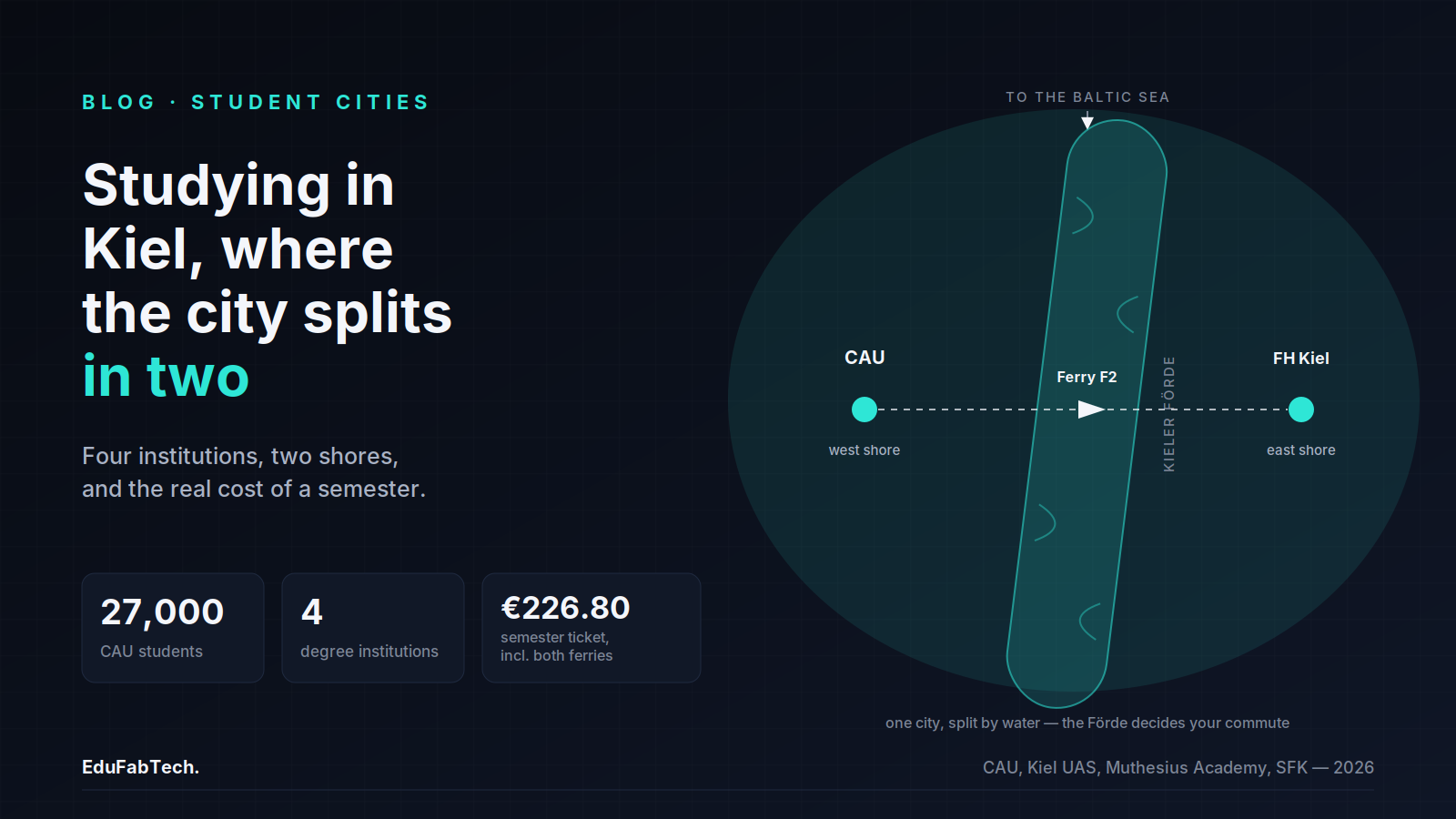
Kiel sits at the head of the Kieler Förde, a long Baltic inlet that runs into the middle of the city and splits it in two. It is the capital of Schleswig-Holstein, Germany's northernmost federal state, and a working port: naval yards, ferries to Gothenburg and Oslo, and each June the sailing regatta Kieler Woche. Much of the centre was rebuilt after the Second World War, so students who arrive expecting a medieval old town find instead a flat, functional, wind-blown harbour city whose best views are of water and cranes. The water is the organising fact of student life here — it decides which side of the Förde your faculty is on, how long your commute is, and, unusually, whether a ferry counts as public transport (it does).
Four places to earn a degree
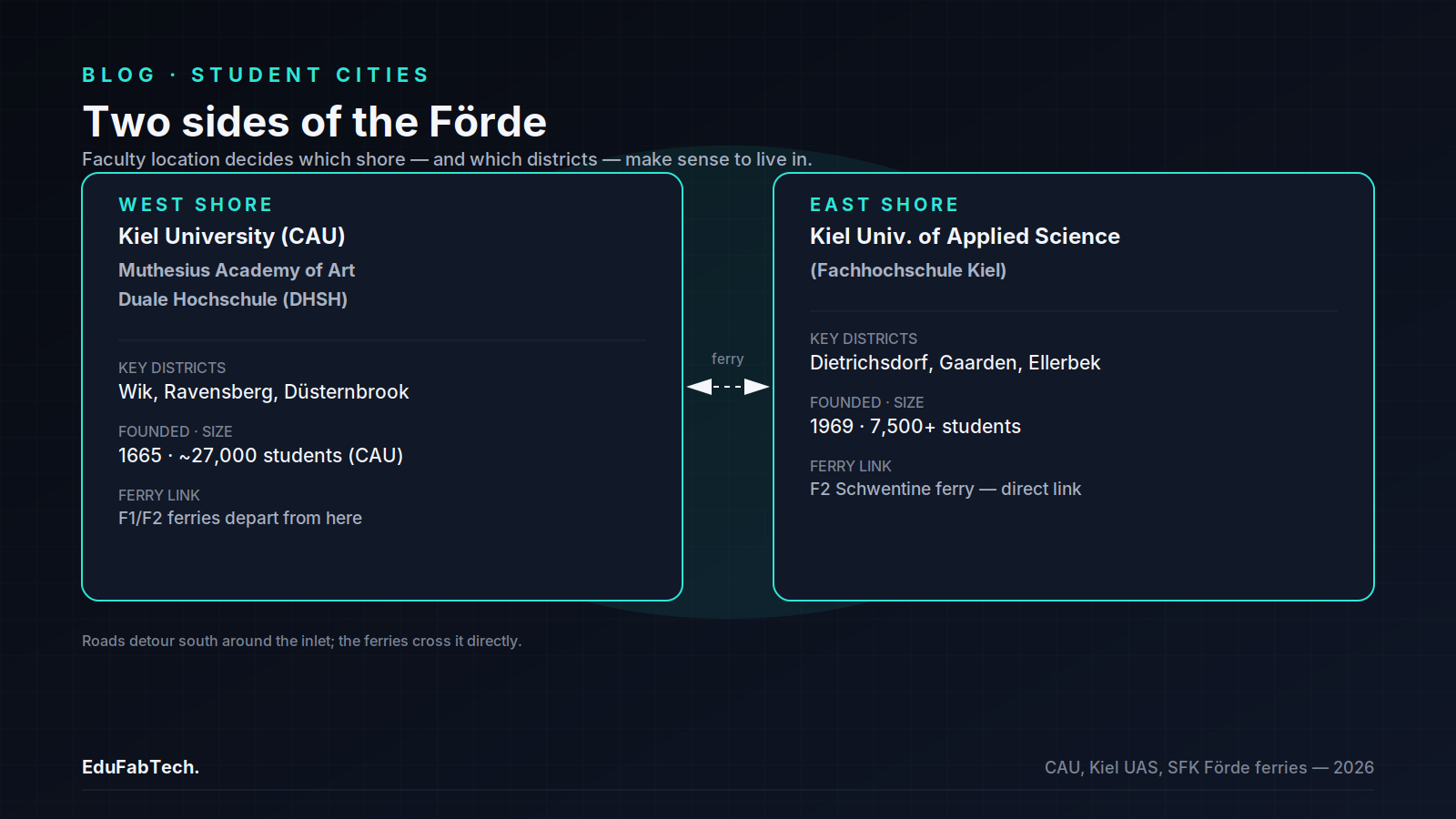
The largest by far is Kiel University (Christian-Albrechts-Universität zu Kiel, CAU). Its own profile page describes it as Schleswig-Holstein's oldest, largest and only fully-fledged university, founded in 1665, with around 27,000 students and about 3,700 staff, eight faculties from Theology to Engineering, two Clusters of Excellence (PMI, on precision medicine in inflammation, and ROOTS, on social and environmental connections in past societies), and seven Nobel laureates among those who have worked there. Kiel is strongly a marine-science city, tied to the GEOMAR ocean-research centre and the Kiel Institute for the World Economy, and the university belongs to the SEA-EU alliance of coastal universities. Kiel University of Applied Science (Fachhochschule Kiel) is the practical counterpart: its own pages report over 7,500 students, seven faculties and around 40 Bachelor's and Master's degrees, founded on 1 August 1969, with a campus set directly on the waterfront of the Förde in the Dietrichsdorf district (its agriculture faculty sits out in Osterrönfeld near Rendsburg).
Two smaller institutions complete the list. The Muthesius Academy of Art (Muthesius Kunsthochschule), founded in 1907 and an art academy since 2005, teaches fine art, communication and industrial design and spatial strategies from Legienstraße 35 in the Damperhof district, a short walk from the city centre; it is small and admission is portfolio-based rather than grade-based. The Duale Hochschule Schleswig-Holstein runs dual-study bachelor's programmes — business administration, business informatics, software engineering and social work — in which study phases alternate with paid phases at a partner company, taught across sites in Kiel, Lübeck and Flensburg. If you are browsing what each institution has nearby, EduFabTech keeps city-wide listings at /in/germany/kiel and campus-specific ones at /near/kiel-university and /near/kiel-university-of-applied-science.
The two sides of the Förde
Where you study shapes where it makes sense to live. CAU's main campus is on the west side, around Westring, Olshausenstraße and Leibnizstraße, in the Ravensberg–Wik belt north of the centre; the Muthesius academy and DHSH are also on the western, central side. Kiel University of Applied Science, by contrast, is across the water in Dietrichsdorf on the eastern shore. Crossing the Förde by road means a detour south through the city; crossing it by ferry is direct. That geography pulls CAU students toward the western and northern districts — Wik, Ravensberg, Schreventeich, Südfriedhof, Blücherplatz — and Fachhochschule students toward the eastern districts of Dietrichsdorf, Neumühlen and Ellerbek, or toward Gaarden, the denser and generally cheaper quarter above the eastern yards.
Kiel is not a huge city, and few places are truly far, but wind and rain off the Baltic make a fifteen-minute bike ride feel longer in January than the map suggests. Think about which side of the water your timetable lives on before you sign anything. Along the western shore, Düsternbrook is the leafy, expensive stretch; the student-heavy, more affordable rooms cluster inland and toward Gaarden on the east.
Finding a room, and not losing a deposit doing it
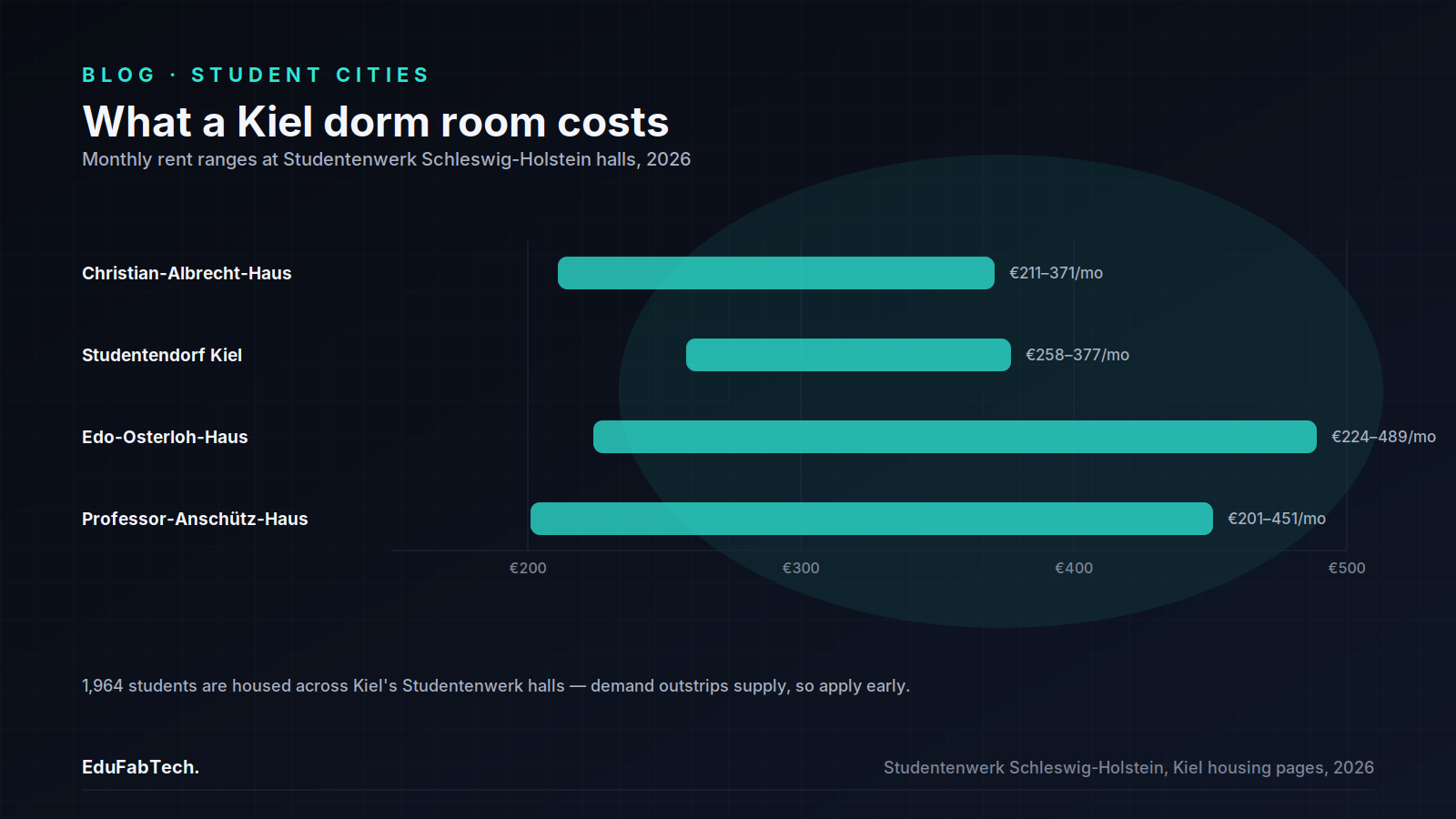
The cheapest reliable option is a hall of residence run by Studentenwerk Schleswig-Holstein, the public body for student welfare. Its Kiel page states that it houses 1,964 students across its Kiel homes, with furnished and unfurnished rooms in shared flats and some single apartments. As of 2026 the listed monthly rents run, for example, from €211–371 at the Christian-Albrecht-Haus, €258–377 at the Studentendorf Kiel, €224–489 at the Edo-Osterloh-Haus, and €201–451 at the Professor-Anschütz-Haus. Demand outstrips supply, so apply early through the Studentenwerk's online application; a hall place is also the one kind of Kiel housing you can usually arrange from abroad without viewing it.
Most students, though, end up in a private shared flat — a WG (Wohngemeinschaft) — or a studio found on the open market, and that is where care is needed. The scam pattern in Kiel is the same one seen across German university cities and it clusters at the start of each semester, when thousands of newcomers are searching at once: an attractive, under-priced room, a landlord who is conveniently abroad, and a request to wire a deposit or the first month's rent to "reserve" it before you can see the place. Do not. A deposit (Kaution) in Germany is normally up to three months' cold rent, held and returned at the end — never paid in gift cards, cryptocurrency or an instant bank transfer to hold a room sight-unseen. View the room in person or over a live video call, ask to see the flat and meet a flatmate, and only sign a written contract. If you cannot get to Kiel in time, a Studentenwerk hall is the safer bridge for the first months. EduFabTech's room listings for the city are at /in/germany/kiel/rooms.
Furnishing a room for very little
An unfurnished room is cheaper on paper, but a bed, desk and lamp add up. Kiel has a substantial second-hand infrastructure built partly around its social economy. ECHT.GUT., a second-hand department store run by the Kieler Stadtmission (stadt.mission.mensch), describes itself as the largest second-hand Kaufhaus in Kiel and sells used furniture, household goods and clothing from Hasseer Straße 49 in Hassee, with a smaller branch at Holstenstraße 51–53 in the centre. The municipal waste utility, Abfallwirtschaftsbetrieb Kiel, runs a used-furniture scheme in cooperation with ECHT.GUT.: residents upload photos of serviceable furniture online for collection and resale rather than throwing it out, which keeps a steady supply of beds and cabinets in circulation.
For produce and the ordinary rhythm of a market, the Wochenmarkt Exerzierplatz runs on Wednesdays and Saturdays from 08:00 to 13:00 and has stood on that square since 1902; the Blücherplatz market runs earlier in the week. Between the social shops, the ABK scheme and the usual give-away culture at move-out time, a room can be furnished for a fraction of new-furniture prices. EduFabTech aggregates local second-hand and free listings at /in/germany/kiel/second-hand, /in/germany/kiel/furniture and /in/germany/kiel/free-stuff.
Libraries and study spaces
The university library (Universitätsbibliothek Kiel) centres on the Zentralbibliothek at Leibnizstraße 9, on the CAU campus. Its own page gives opening hours of Monday to Friday 9:00–22:00, Saturday 9:00–20:00 and Sunday 10:00–18:00 (with Sundays closed in August and September), and lists workspaces for laptop use, Wi-Fi, internet workstations, scanners and reader-printers. Beyond the central building, CAU runs subject libraries attached to its faculties, and Kiel University of Applied Science has its own library in Dietrichsdorf; for art and design students the Muthesius academy keeps specialist holdings on its central-city site. When term-time seats run short around exams, EduFabTech lists additional desks and study spaces at /in/germany/kiel/study-spaces.
Getting around — including by boat
Kiel has no tram or U-Bahn; local transport is run by buses, operated by the municipal company KVG, plus the Förde ferries that cross the water the buses have to go around. Enrolled students at CAU, Kiel University of Applied Science and the Muthesius academy receive the nationwide Deutschland-Semesterticket as part of their fees. NAH.SH, the state transport authority, sets the student price at a 40% discount on the ordinary Deutschlandticket — €37.80 per month, i.e. €226.80 per semester, when the base ticket is €63 a month — valid on second-class local buses and regional trains across Germany. The practical bonus for Kiel is the water: SFK, the company that runs the Förde ferries, states that the Deutschland-Semesterticket is valid on both ferry lines F1 and F2, including the F2 Schwentine ferry — the direct link between the city and the Fachhochschule side at Dietrichsdorf. The ticket is issued as a mobile ticket in the NAH.SH app rather than on paper.
What a semester costs
There are no tuition fees at the public institutions, but there is a per-semester contribution. Kiel University of Applied Science sets out the breakdown clearly: the semester fee of €337.70 is made up of €89.00 for the Studentenwerk, €20.00 for the student union (AStA), €226.80 for the Deutschland-Semesterticket and €1.90 for a regional culture ticket. From the summer semester 2026 an additional administrative fee of €60.00 per semester applies at the state universities, bringing the re-registration total to €397.70.
Housing is the real variable. The dormitory figures above — roughly €200–490 a month depending on the hall and room type, per the Studentenwerk's 2026 listings — are the clearest dated anchor for what a room costs in Kiel; private-market rents in a WG vary more widely and should be checked against each actual offer rather than a city average. Budget separately for health insurance, the broadcasting fee and food.
| Item | Amount (source, year) |
|---|---|
| Semester fee, Kiel University of Applied Science | €337.70 (+€60 admin from summer 2026) — Fachhochschule Kiel, 2026 |
| Deutschland-Semesterticket (student rate) | €37.80/month, €226.80/semester — NAH.SH, 2026 |
| Studentenwerk hall rents, Kiel | ~€200–490/month by hall and room type — Studentenwerk Schleswig-Holstein, 2026 |
Working alongside your studies
Many students take a part-time job. The rules depend on your nationality, and you should confirm your own case with the authorities rather than with a guide. According to the DAAD, students from the EU, Iceland, Liechtenstein, Norway and Switzerland have effectively unrestricted access to the German labour market, while non-EU international students are allowed to work 140 full days or 280 half days per year; working beyond that needs permission from the Agentur für Arbeit (Federal Employment Agency) and the foreigners' office. In Kiel the latter is the city's Ausländerbehörde, which also handles your residence permit, so it is the office to ask about your limit before you commit to shifts. This is general information, not legal advice. EduFabTech's local jobs board is at /in/germany/kiel/jobs.
What is good, and what is hard
The good: Kiel is affordable by German big-city standards, the water is genuinely part of daily life, a ferry rides on your semester ticket, and the city is compact enough to cross by bike. The second-hand economy is strong, the Studentenwerk halls are reasonably priced, and the marine- and engineering-focused institutions give the place a clear identity rather than a generic one. The hard: the climate is grey, wet and windy for much of the year, and the rebuilt centre is practical rather than charming — students who want postcard architecture are in the wrong city. Student housing is tight at the start of each semester, which is also when scams surface. And the Förde that makes Kiel distinctive also divides it: if your home and your faculty end up on opposite shores, your day acquires a ferry or a long bus loop. None of this is unmanageable, but it is worth knowing before you arrive. For what is happening once you are there, EduFabTech lists local events at /in/germany/kiel/events.
A checklist for the first weeks
- Apply for a Studentenwerk hall place as early as possible; treat it as your safe fallback if a private room falls through.
- Never send a deposit to hold a room you have not seen in person or over live video; a Kaution in Germany is normally up to three months' cold rent, paid only on a signed contract.
- Register your address (Anmeldung) at the city's Bürger- und Ordnungsamt soon after moving in.
- Order the Deutschland-Semesterticket through the NAH.SH app and check the F2 Schwentine ferry if your campus is in Dietrichsdorf.
- Furnish from ECHT.GUT. and the ABK used-furniture scheme before buying anything new.
- Non-EU students: confirm your work-day limit with Kiel's Ausländerbehörde before taking on regular shifts.
- Get a library card for the Zentralbibliothek on Leibnizstraße and find a back-up study spot for the exam crunch.
A quick question for readers
Do you work part-time while you study?
Many students work to pay the bills. See how common it is — and how many hours people really do.
Pick an answer, create a free account in a minute, and your vote counts. Already a member? Sign in
Comments 3
Comment-
The 'clearest dated anchor' line is doing more work than it should. €200–490 a month is the Studentenwerk range, fine, but that covers 1,964…
-
The fee table buries a timing oddity: "from the summer semester 2026 an additional administrative fee of €60 applies" is written like a futu…
-
Buried in the admin-fee line is the detail I'd flag: an extra €60 per semester from summer 2026, stacked on a semester fee that's otherwise…
Join free to read the full comments and reply Comments are between members; an account takes a minute.
Source: Studentenwerk Schleswig-Holstein
Sources (5)
- Studentenwerk Schleswig-Holstein. Wohnheime in Kiel. Studentenwerk Schleswig-Holstein, 2026. studentenwerk.sh ↗ · checked 15 Nov 2026
- Kiel University. Kiel University — The University. Christian-Albrechts-Universität zu Kiel, 2026. uni-kiel.de ↗ · checked 15 Nov 2026
- Kiel University of Applied Sciences. Fees. Fachhochschule Kiel, 2026. haw-kiel.de ↗ · checked 15 Nov 2026
- NAH.SH. Deutschland-Semesterticket — Konditionen. NAH.SH GmbH, 2026. nah.sh ↗ · checked 15 Nov 2026
- DAAD. Side jobs. Deutscher Akademischer Austauschdienst, 2026. daad.de ↗ · checked 15 Nov 2026