Studying in Kingston upon Hull: universities, housing and student life
A practical, sourced guide to the University of Hull, where students live, what rooms and transport cost, and the honest trade-offs of studying in this Humber port city.
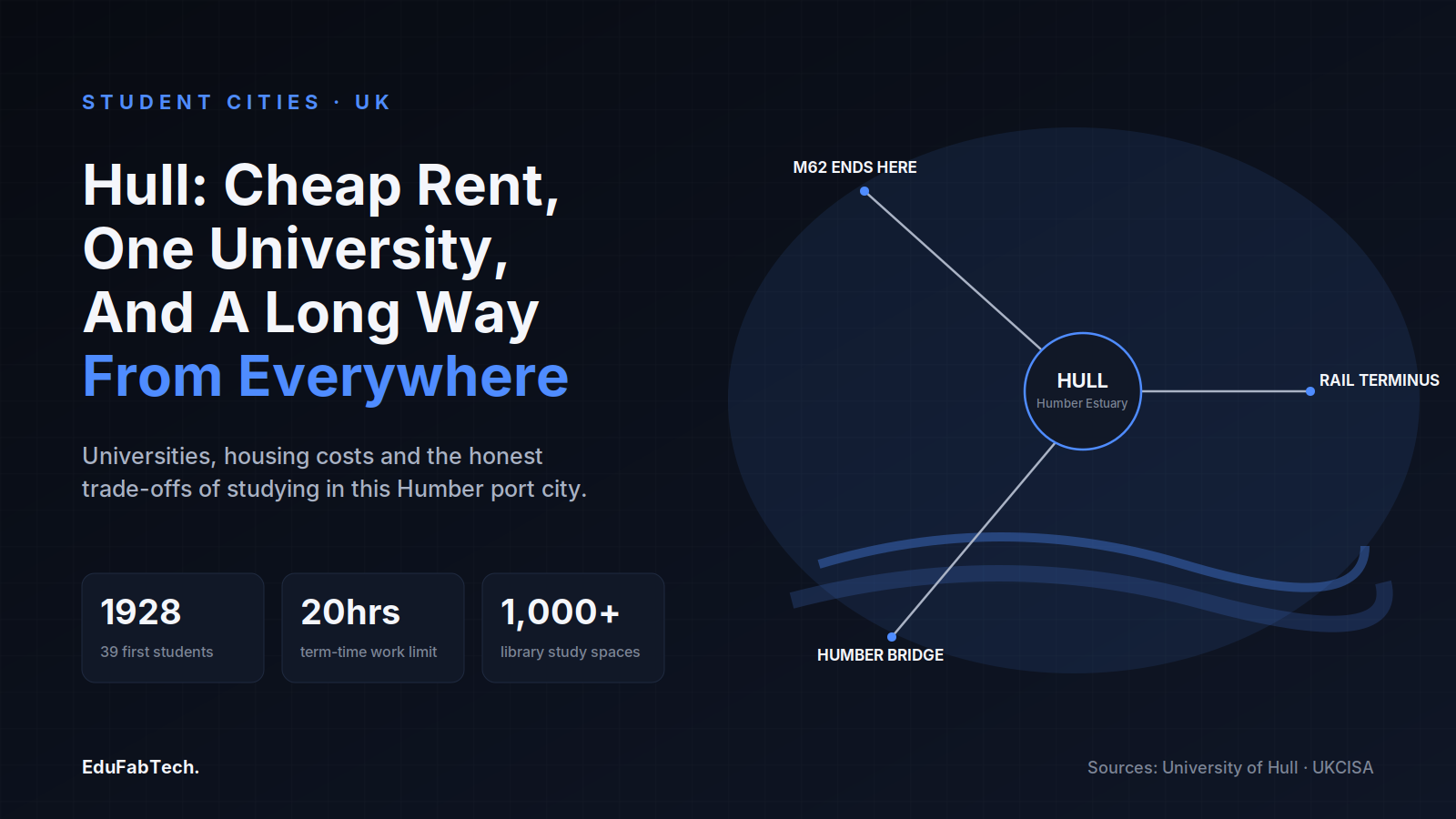
Kingston upon Hull sits on the north bank of the Humber estuary in the East Riding of Yorkshire, where the small River Hull drains into the wide, brown tidal water that gives the city its working character. It is a terminus: the M62 ends here, the railway stops at Hull Paragon Interchange, and the Humber Bridge at nearby Hessle carries road traffic south into Lincolnshire. The land is flat, the skies are big, and the centre is compact enough to cross on foot. Hull held the UK City of Culture title in 2017, a year the city still measures itself against, and the Old Town's cobbled lanes, museums and the marina date much of their current life to that period, as Hull City Council set out in its legacy plan.
For students this is a city with one principal university, some of the cheapest private rents in England, and a student culture concentrated in a few northern avenues rather than spread across a sprawl. It is affordable and walkable; it is also a long way from anywhere else, and the weather off the North Sea is not gentle. The sections below set out the universities and colleges, where people live, what things cost with sources, and the parts that are genuinely hard.
The university, and the colleges around it
The University of Hull is the city's one degree-awarding university. Its main campus is a single, clearly defined site on Cottingham Road in north Hull, a couple of miles from the centre. The university traces itself to 1927, when it opened as University College Hull thanks to a £250,000 gift from the local businessman and philanthropist Thomas Ferens; it records on its own history page that it admitted around 39 students on 11 October 1928 and received its Royal Charter, allowing it to award its own degrees, on 6 September 1954. The same page notes the work of Professor George Gray, whose 1973 research on liquid crystals underpinned the LCD screens that followed, and the three decades the poet Philip Larkin spent as the university's librarian from 1955. Medicine is taught through the Hull York Medical School, a partnership with the University of York established in 2003 and based on the Hull campus.
Around the university sit several further-education providers that also teach degree-level courses, usually validated by a partner university. Hull College runs most of its teaching from an eight-storey tower overlooking Queen's Gardens in the city centre, and offers higher-education options such as foundation degrees and HNCs alongside its further-education work. Bishop Burton College, a few miles west in the village of Bishop Burton near Beverley, is a land-based specialist; through University Centre Bishop Burton it teaches degree-level courses in agriculture, animal science, equine studies, sport and floristry, with its own working farm and equine centre. East Riding College, also in Beverley, is mainly a further-education college. A historic teacher-training institution, the Kingston upon Hull College of Education, no longer operates independently. If you are weighing where to apply or looking for what is nearby, EduFabTech keeps the city's student listings at /in/united-kingdom/kingston-upon-hull.
Where students live: Newland, Cottingham Road and the Avenues
Because the campus is in north Hull rather than the centre, student housing clusters around it instead of around the river. The spine of student life is Newland Avenue, a long northwest street lined with cafés, takeaways, independent shops and bars, with rows of converted Victorian and Edwardian terraces behind it — most of them three- and four-bedroom houses that suit groups. Cottingham Road itself and Beverley Road put you within walking distance of lectures, and the nearby "Avenues" quarter (Princes Avenue and the leafy tree-named streets off it) is a little more polished and slightly dearer. Further out, the large village of Cottingham — often described as one of England's biggest villages — houses students who want somewhere quieter and still has a direct run into campus.
First-year undergraduates usually take a room in university-managed halls; after that, most people move into a shared house with friends made in that first year. The private market here is dominated by whole-house shares rather than purpose-built studio blocks, which keeps per-person rents low but means you take on a joint tenancy with housemates. Browse what is currently going in the city on /in/united-kingdom/kingston-upon-hull/rooms before you commit to anything.
Signing for a house share: what to check before you pay
The sensible rhythm in Hull is calmer than in cities with acute shortages: you do not need to sign a house-share in November for the following September, and groups that wait until the spring term of first year still find plenty. Hall contracts with the university come in 43- or 51-week lengths, so check which one you are signing for and whether it covers the summer.
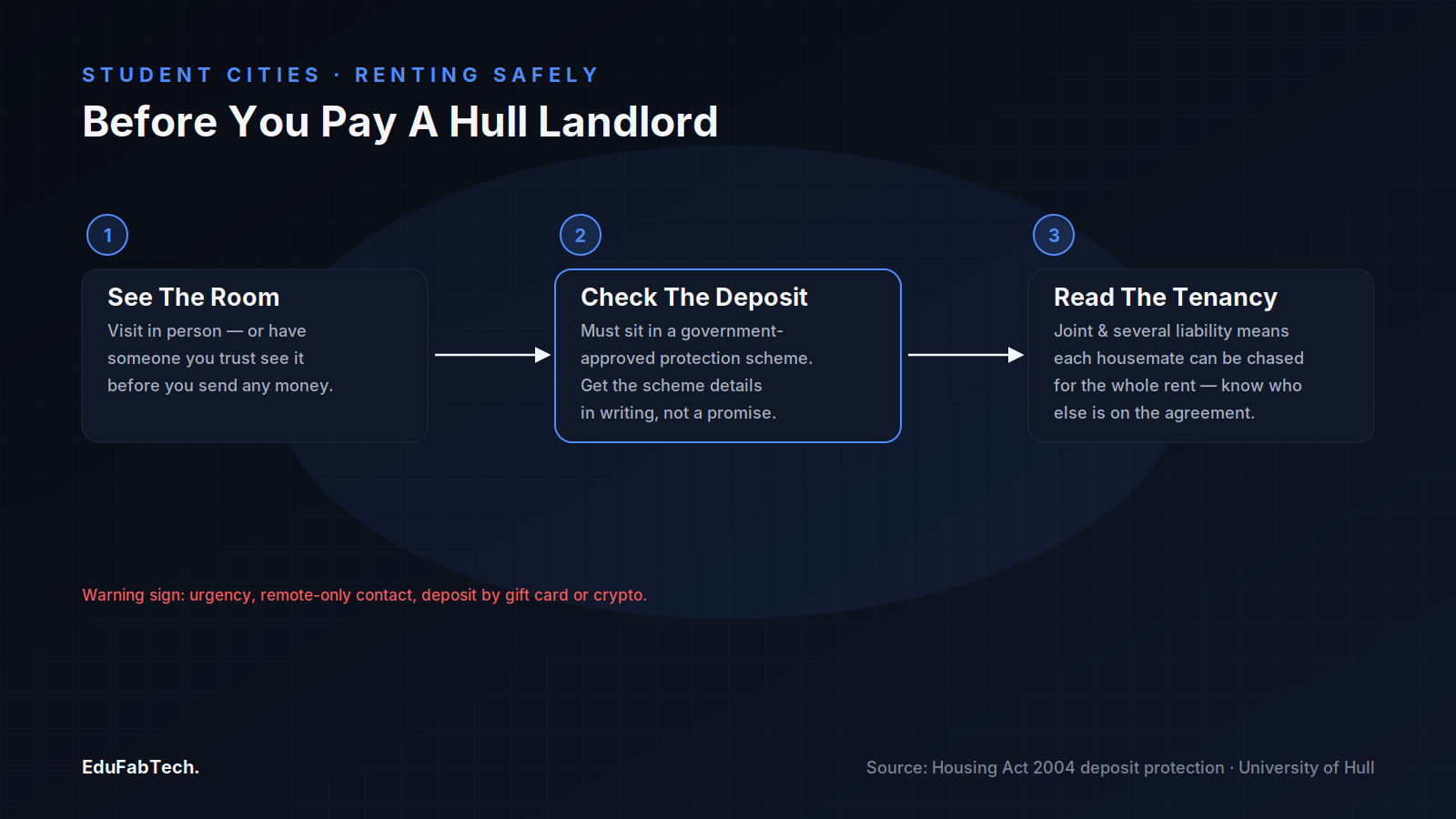
Before any money changes hands, see the actual room in person — or have someone you trust see it — because the common Hull scam is a "landlord" advertising a Newland Avenue or Avenues terrace they do not control, then pressing you to secure it fast from a distance. Treat urgency as the warning sign. Never send a deposit by bank transfer, gift card or cryptocurrency to "hold" a room you have not seen and whose tenancy you have not read. For an assured shorthold tenancy in England a deposit must by law be protected in a government-approved scheme, and you should get the scheme details in writing; a landlord unwilling to confirm that is one to walk away from. Ask who manages repairs, read the joint-and-several liability clause (it means each housemate can be chased for the whole rent), and keep every message. If a deal only exists over a messaging app and the keys are always "with someone else," stop.
Furnishing a room cheaply: Trinity Market, Hepworth Arcade and charity shops
A house share almost always needs filling out — a desk lamp, a kettle, a frying pan, a second chair — and Hull is a good city for doing that without buying new. In the Old Town, Trinity Market on North Church Side is an indoor market hall that, as Hull City Council describes it, opened in 1904 as the city's second market hall and now holds 49 stalls mixing traditional traders with a street-food hub after its refurbishment. It adjoins the late-Victorian Hepworth Arcade, a covered parade of small independent shops, so the two make one easy afternoon of browsing for records, groceries and odds and ends.
Beyond the markets, the charity shops along Newland Avenue, Princes Avenue and Beverley Road are the practical source for cheap kitchenware, bedding and furniture, and students leaving at the end of the year routinely pass on or give away whole kitchens. Start with the second-hand listings on EduFabTech at /in/united-kingdom/kingston-upon-hull/second-hand — collecting a desk someone is giving away a few streets over beats paying for delivery of a new one.
Part-time work and the hours rule
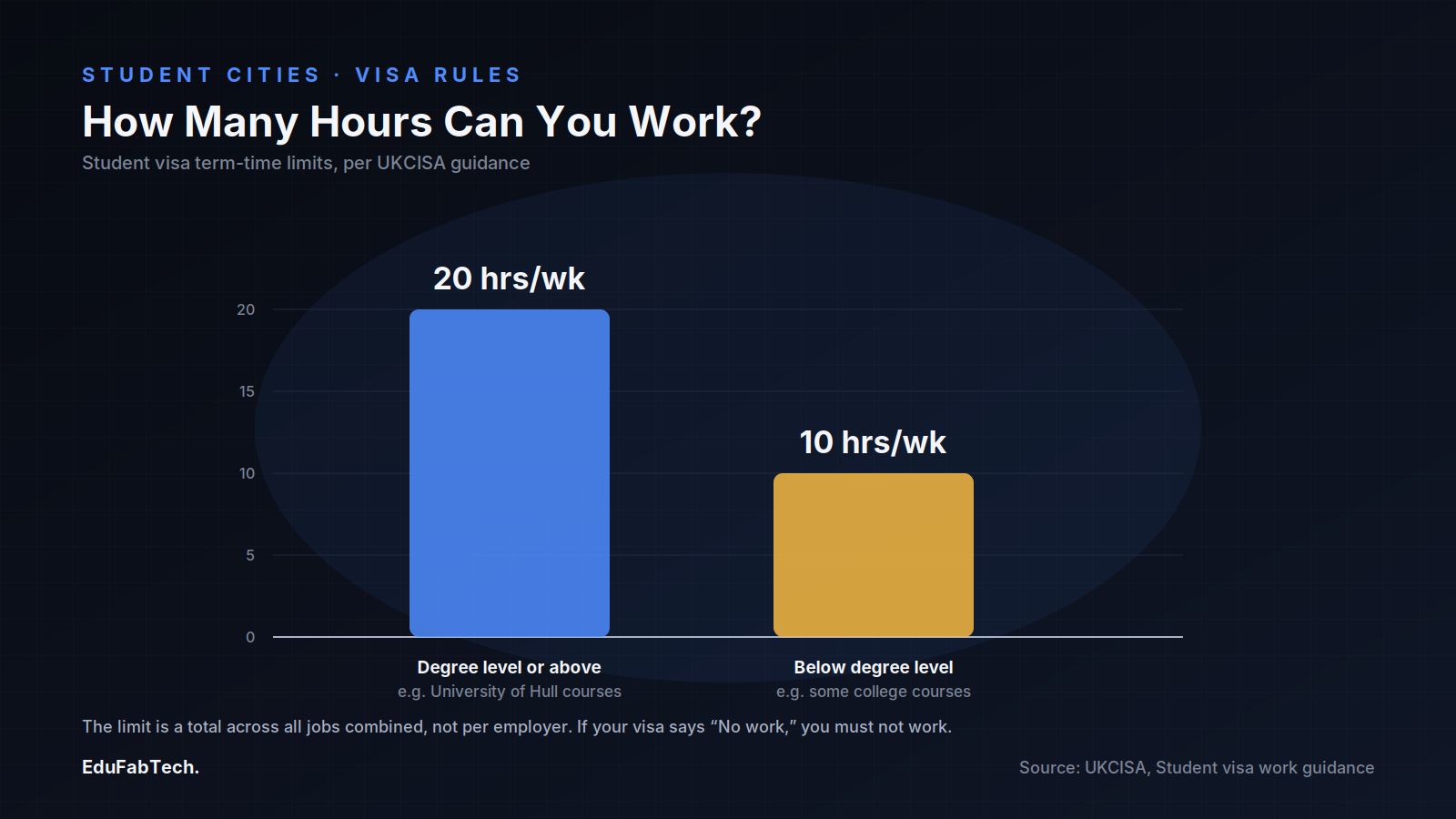
Hull's hospitality, retail and campus jobs are the usual student earners, and the compact centre means a shift on Newland Avenue or in town is a short bus ride or cycle away. If you are an international student, your right to work and the number of hours you may work are set by your visa, not by your employer, so check the official guidance rather than a recruiter's word. UKCISA, the UK Council for International Student Affairs, states that a Student visa holder studying at degree level or above can work up to 20 hours a week in term time, while those on courses below degree level are limited to 10 hours a week, and that you must always check your own immigration document — if it says "No work," you must not work. The 20-hour limit is a total across all jobs, not per employer.
This is guidance to read, not legal advice to rely on from a web page: your own visa, your sponsor's term dates and your course level decide your exact position, and breaching the limit has serious consequences. When you are ready to look, the city's part-time openings are collected at /in/united-kingdom/kingston-upon-hull/jobs.
Where to study: the Brynmor Jones Library and beyond
The main study building is the Brynmor Jones Library on campus, named after Sir Brynmor Jones and known locally for the nine-storey tower that opened in 1969 and the £28 million redevelopment it went through from 2012. The library reports over 1,000 study spaces and more than 500 PCs across its floors, with group and quiet areas, bookable rooms, a café and an art gallery; during assessment periods it runs 24 hours a day, seven days a week. There is even an observatory on the seventh floor.
Off campus, the cafés of Newland Avenue double as informal study spots, and Hull's public libraries give you a quiet desk without a university card. If the library is full in exam season — and it does fill — plan around it rather than against it. EduFabTech lists desks and bookable study spaces around the city at /in/united-kingdom/kingston-upon-hull/study-spaces.
Getting around Hull
Hull is flat and small, which makes walking and cycling genuinely practical for a campus two miles north of the centre; a bike is often faster than the bus for the Cottingham Road run. Local buses are run by two operators, East Yorkshire and Stagecoach, and a single ticketing range covers both. Hull City Council's travel service lists the fares: a Hull Card gives unlimited travel on both operators' city services at £6.90 for a day or £27.50 for a week, while students can buy a Hull Uni Seven-Day Ticket for £22 covering all Stagecoach and East Yorkshire routes, bought through the operators' apps with a student filter and shown with student ID on boarding. The residents' KAT Card, for under-20s, is £20 a week. Rail and bus share one building, Hull Paragon Interchange, from which trains run west across the Pennines; prices for those change constantly, so check before you travel rather than trusting a figure from memory.
What a week costs
Hull's headline advantage is price. In the private market, the Office for National Statistics reports that the average monthly private rent in Kingston upon Hull was £695 in September 2026, up 7.5% from £647 in September 2025 — among the lowest of any English city, and a figure that falls further once a house is split between three or four tenants. University halls carry their own published prices: for 2026/27 the University of Hull advertises rooms at Taylor Court from £99 a week (ranging up to £180), and at Westfield Court from £135 up to £315 a week, both on 43- or 51-week contracts with all bills, WiFi and possessions insurance included, correct as of January 2026. The university's accommodation pages note over 2,300 rooms in total and a postgraduate rate of £146 a week with bills included. Against housing this cheap, the bus pass, groceries and a night out are the variable costs, and Hull is forgiving on all three.
The honest trade-offs
The case for Hull is straightforward: low rents, a walkable and cyclable city, one focused campus, and a real student quarter rather than a scatter of blocks. The culture that the 2017 year built up — museums, the marina, the Old Town pubs — is still there and mostly free to wander.
The case against is just as plain. Hull is geographically isolated; it is the end of the line, and a weekend trip to another city is a commitment, not a whim. The North Sea climate is cold, grey and wind-blown for much of the year, and the flat landscape offers little shelter. The housing stock is largely older terraces, so damp, single glazing and tired kitchens are common complaints in the private market — worth inspecting for before you sign. And a smaller student city has a smaller nightlife and job market than Leeds or Manchester down the line. None of this is hidden, which is itself a point in the city's favour: what you see on Newland Avenue in October is what you get in February.
A checklist for your first weeks
- Register with the university, collect your student ID, and — if you are an international student — confirm what your visa says about working before you take any job.
- Sort a bus plan: decide whether the £22 Hull Uni Seven-Day Ticket, pay-as-you-go, or a bike makes sense for your Cottingham Road commute.
- Register with a local GP and a dentist early, while waiting lists are shorter.
- Walk Newland Avenue and the Avenues in daylight to learn where you would want to live next year — then don't rush to sign.
- Furnish from Trinity Market, Hepworth Arcade and the Beverley Road charity shops before buying anything new.
- Find your study backup for exam season, when the Brynmor Jones Library's 24-hour spell still fills up.
- If you rent privately, see the room in person, read the joint tenancy, and confirm your deposit is in a government-protected scheme before paying a penny.
- Check EduFabTech's events listings to find the freshers' and community happenings worth your first fortnight.
A quick question for readers
Do you work part-time while you study?
Many students work to pay the bills. See how common it is — and how many hours people really do.
Pick an answer, create a free account in a minute, and your vote counts. Already a member? Sign in
Comments 3
Comment-
The rent number is doing a lot of work here and I don't think it holds up on its own. £695 a month sounds cheap until you read three lines l…
-
The rent number is the part worth sitting with: £695/month average in September 2026, up 7.5% from £647 a year earlier. That's a real-terms…
-
The rent jump is the number I'd actually flag for anyone budgeting: £647 to £695 in a year is 7.5%, which is a much faster climb than "cheap…
Join free to read the full comments and reply Comments are between members; an account takes a minute.
Source: University of Hull
Sources (5)
- University of Hull. Our history. University of Hull, 2026. hull.ac.uk ↗ · checked 9 Nov 2026
- Office for National Statistics. Private rent and house prices: Kingston upon Hull. Office for National Statistics, 2026. ons.gov.uk ↗ · checked 9 Nov 2026
- University of Hull. Taylor Court student accommodation. University of Hull, 2026. hull.ac.uk ↗ · checked 9 Nov 2026
- Hull City Council. Hull bus travel cards. Hull City Council, 2026. travel.hull.gov.uk ↗ · checked 9 Nov 2026
- UKCISA. Working as an international student. UK Council for International Student Affairs, 2026. ukcisa.org.uk ↗ · checked 9 Nov 2026