Studying in Knoxville: universities, housing and student life
A practical, sourced guide to studying in Knoxville, Tennessee — its universities, where students live, what a room costs, study spaces, part-time work and getting around.
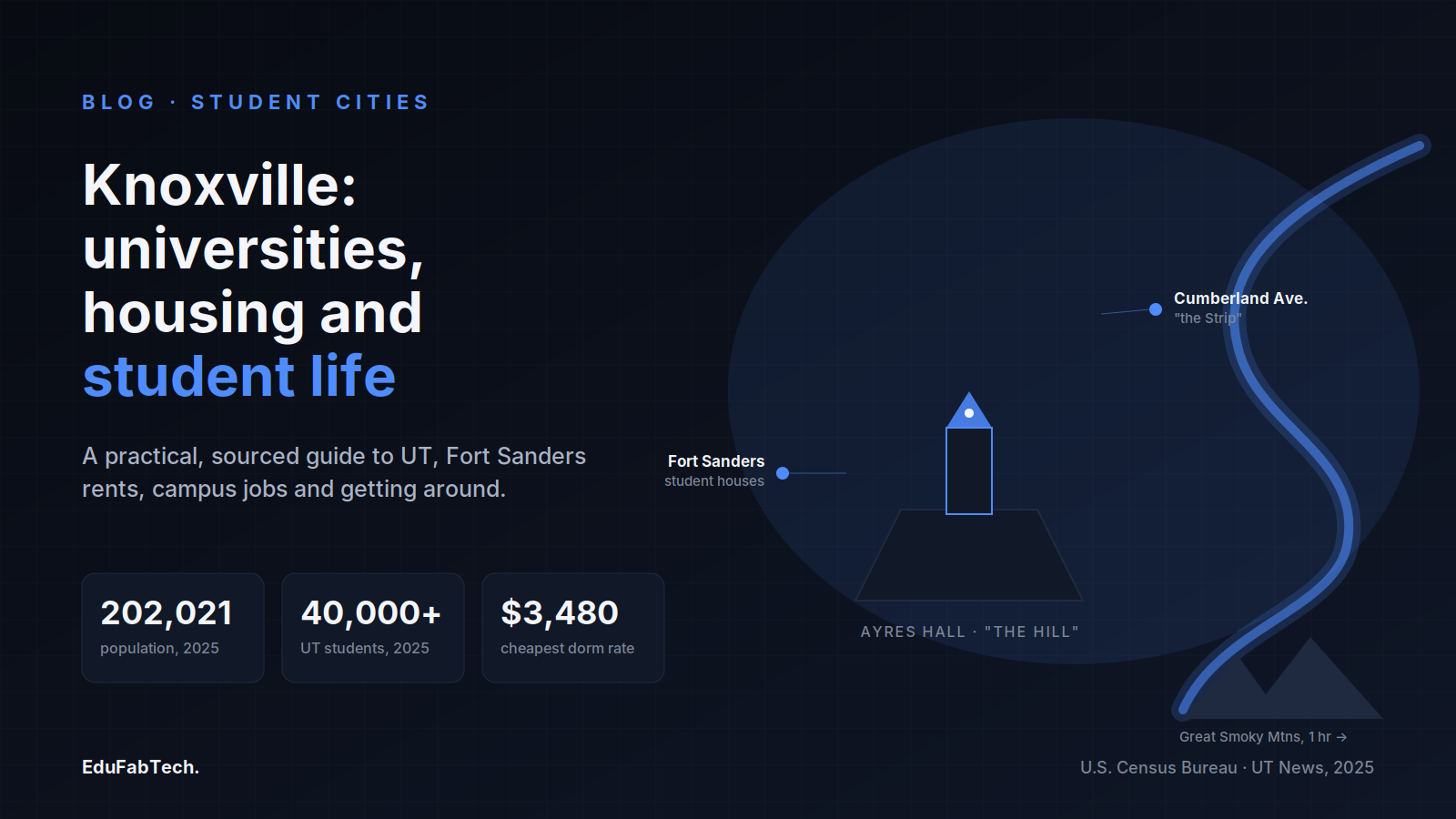
Knoxville sits in a bend of the Tennessee River in the eastern end of the state, where the land starts folding up toward the Great Smoky Mountains an hour to the south-east. It is a mid-sized Southern city — the U.S. Census Bureau's QuickFacts page put its population at about 202,021 as of July 2025 (census.gov) — and for much of the year its rhythm is set by the University of Tennessee, whose orange "Power T" turns up on storefronts, bridges and bumper stickers across town. For a student arriving from another state or another country, Knoxville is walkable at its core, hilly, humid in summer, and cheaper than most American university cities of its size. This guide covers the campuses, where people actually live, what rooms cost, and how to get the practical things right in the first weeks.
Three very different campuses on the Tennessee River
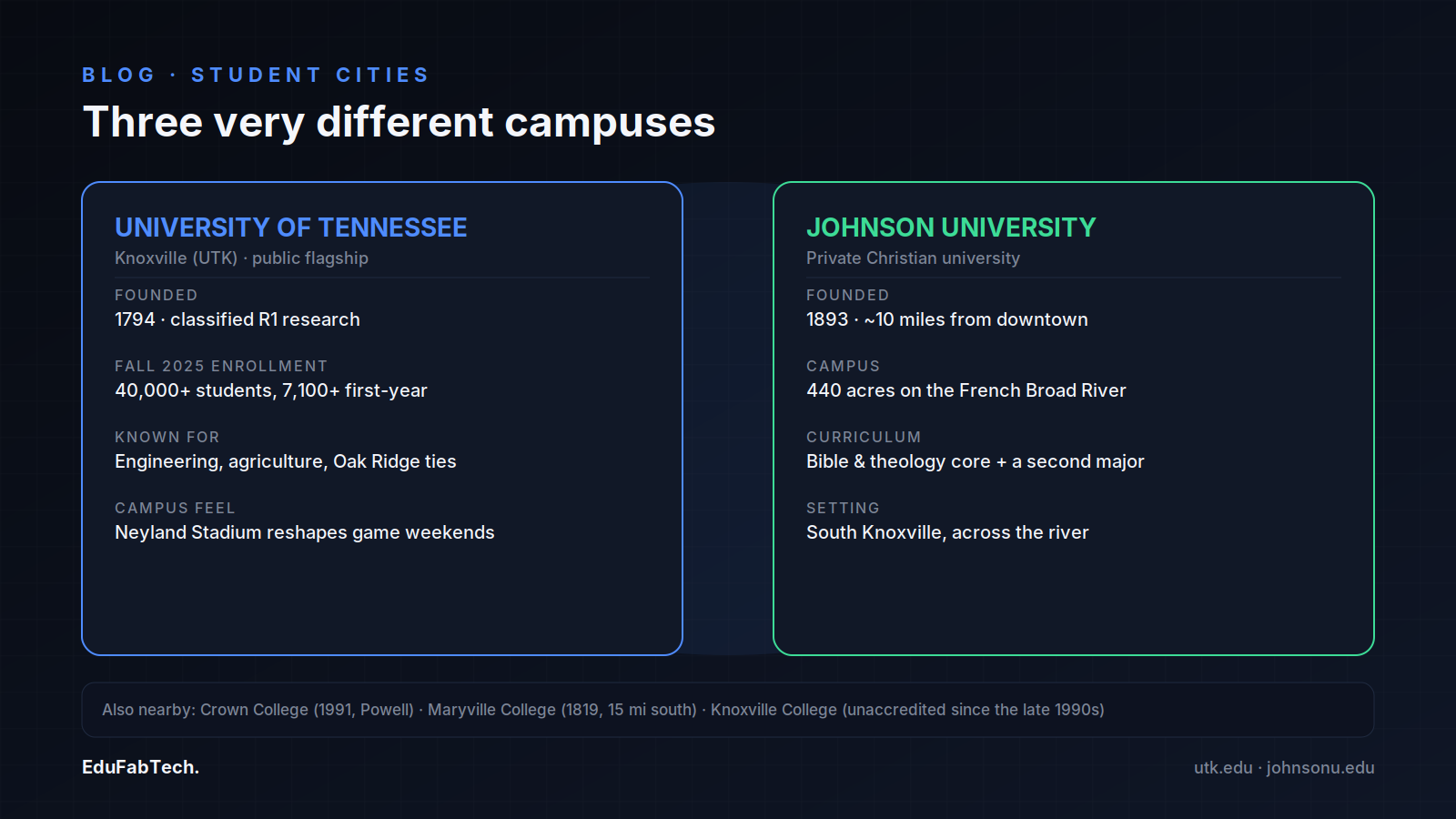
The University of Tennessee, Knoxville (UTK) is the city's defining institution: a public land-grant flagship that the university dates to 1794, now classified R1 for research, with a main campus climbing "the Hill" above the river beneath the Neoclassical tower of Ayres Hall (utk.edu). UT reported record total enrollment "surpassing 40,000" students when the fall 2025 semester opened, with more than 7,100 first-year students (UT News, 2025). It is known for engineering, agriculture and its ties to nearby Oak Ridge National Laboratory; students carry a campus ID called the VolCard, and the sports teams are the Volunteers. Studying here means a large, football-centred state university where home games at Neyland Stadium reshape a whole weekend.
Johnson University is a private Christian university on a 440-acre campus along the French Broad River in south Knoxville, roughly ten miles from downtown; founded in 1893, it has undergraduates pair a Bible and theology core with a second major chosen from a long list (johnsonu.edu). Crown College, in the Powell area north of the city, is an independent Baptist Bible college founded in 1991 that grants associate, bachelor's and graduate degrees in biblical and ministry fields (thecrowncollege.com). Two others are worth knowing: Maryville College, a Presbyterian-affiliated liberal arts college about 15 miles south in Maryville, between Knoxville and the national park, traces its founding to 1819 (maryvillecollege.edu); and Knoxville College, a historic Black college west of downtown, has operated without accreditation since the late 1990s and is working slowly to rebuild it, so prospective students should confirm its current standing directly before enrolling.
Fort Sanders, the Strip and where students settle
The student heart of Knoxville is Fort Sanders — "the Fort" — a dense grid of Victorian houses and low apartment blocks immediately north-west of the UT campus, much of it carved into rooms and shared flats within walking distance of class. It is bordered by Cumberland Avenue, known locally as "the Strip," a rebuilt corridor of restaurants, bars and newer student apartment towers. Beyond the Fort, upper-year students spread west toward Bearden and the Sutherland Avenue area, south across the river into South Knoxville near Johnson University, and into the suburbs of West Knoxville where rents fall but a car becomes close to essential.
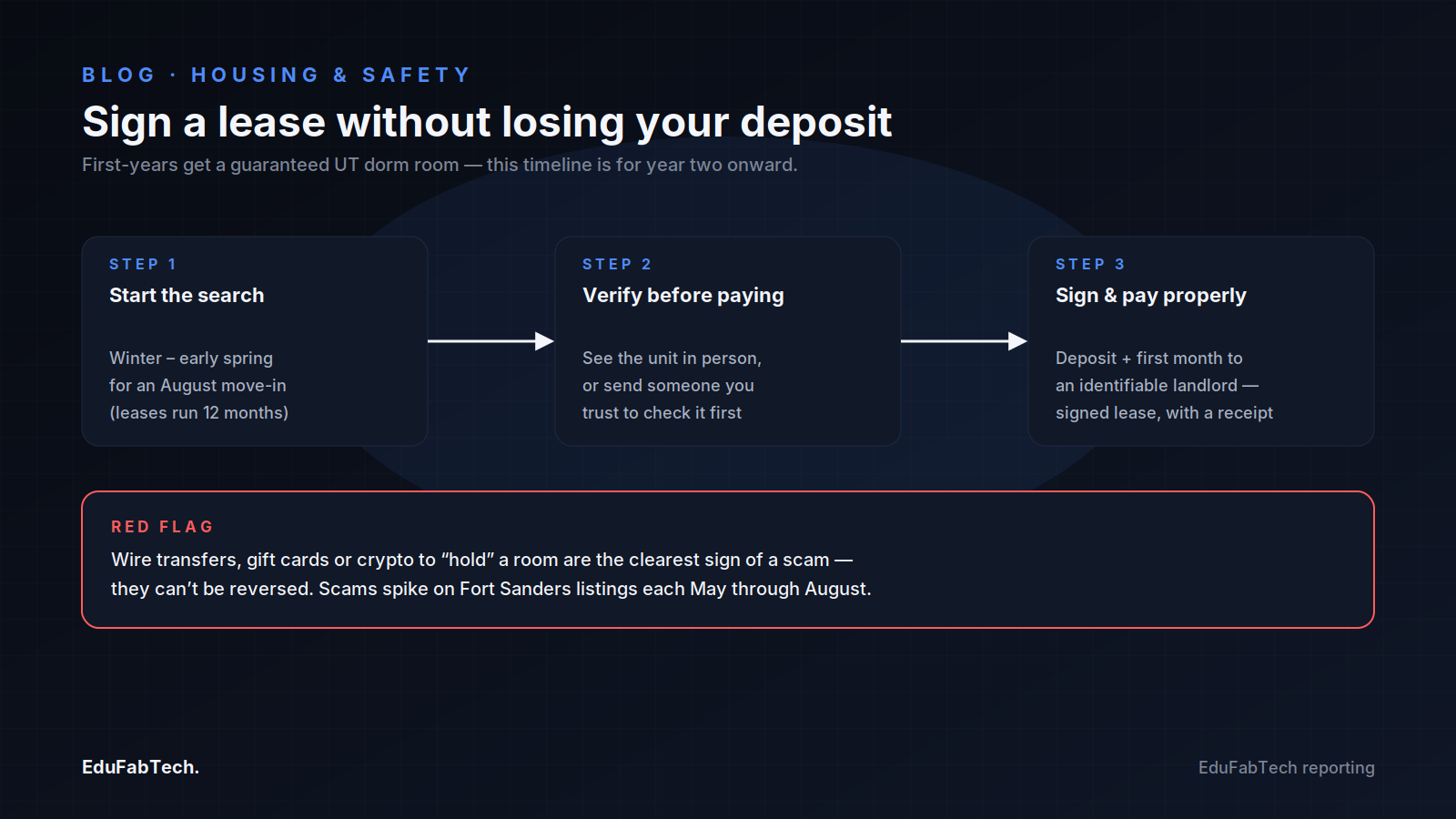
First-year undergraduates at UT have less to decide: the university requires all first-year students to live on campus and guarantees them a room (studentlife.utk.edu), so the Fort-versus-suburb question really begins in second year. If you are aiming for Fort Sanders housing, start looking in the winter or very early spring for an August move-in, because the best-placed houses near campus turn over fast and leases there usually run a full twelve months. You can browse what current students are listing on EduFabTech's own pages for the city — all Knoxville listings, rooms and places to stay, and listings filtered to be near the University of Tennessee.
Signing a lease without losing your deposit
Most rental fraud aimed at Knoxville students follows the same pattern: a "landlord" posts a Fort Sanders house or a Cumberland Avenue apartment at a suspiciously low rent, claims to be out of town, and asks you to send money to reserve it before you have seen inside. Do not. See the actual unit in person — or have someone you trust see it — before paying anything, and be especially wary in the busy May-to-August window when scams spike alongside real listings. In Knoxville a normal move-in cost is a security deposit plus first month's rent, paid to an identifiable person or management office with a signed written lease and a receipt. No legitimate landlord in this city needs a deposit by bank wire, gift card or cryptocurrency to "hold" a room; those payment methods are the clearest sign of a scam because they cannot be reversed. Confirm that the person taking your money is actually tied to the address before you hand anything over.
Furnishing a room: the Expo Center flea market and Market Square
Knoxville is a good city for furnishing a room cheaply if you know where to look. The Knoxville Flea Market is held five times a year at the Knoxville Expo Center on Clinton Highway, with free admission and parking and over 275 vendor booths selling furniture, housewares, clothes and odds and ends (stewartpromotions.com) — worth timing a trip around if your move-in lands near a market weekend. For food rather than furniture, the Market Square Farmers' Market downtown runs Wednesdays and Saturdays from May through October (Saturdays only in the colder months), and by rule everything sold is grown locally or made by a vendor in the East Tennessee region (downtownknoxville.org). Between those, student-to-student handovers at the end of each academic year are the cheapest source of all — see the EduFabTech page for second-hand things in the city.
Working while you study
On-campus jobs — in dining halls, libraries, labs and recreation centres — are the usual first paid work for UT students, and they are coordinated through the university rather than the city. For international students the rules are set by federal immigration law, not the university, and they are strict. U.S. Citizenship and Immigration Services states that students on an F-1 visa "may not work off-campus during the first academic year," but may accept on-campus employment subject to conditions, and that later off-campus training through Curricular Practical Training (CPT) or Optional Practical Training (OPT) must be authorised in advance by the school's Designated School Official (uscis.gov). This is a guide, not legal advice: check your own status with UT's international student office and the official USCIS page before accepting any job. Local part-time listings students post are gathered on EduFabTech's Knoxville jobs page.
Where to study: Hodges, the Commons and Lawson McGhee
The main academic study building is the John C. Hodges Library on Volunteer Boulevard, opened in 1987, whose second-floor Learning Commons gathers research help, technology and group study rooms in one place; during the semester Hodges stays open 24 hours a day, five days a week, plus weekend hours (lib.utk.edu), which makes it the default late-night workspace for UT students. Off campus, the Lawson McGhee Library — the main branch of the Knox County Public Library at 500 West Church Avenue downtown — is open to everyone and offers quiet reading areas and study space (knoxcountylibrary.org); the library system's regional research archive, the Calvin M. McClung Historical Collection, sits a few blocks away at the East Tennessee History Center on Gay Street (knoxcountylibrary.org). For a change of scene, the cafés around Market Square and Gay Street downtown are within a short trolley ride of campus. More desks and quiet rooms that students share are listed on the EduFabTech study spaces page.
Getting around: KAT, the VolCard and the trolleys
The city bus system is Knoxville Area Transit (KAT), which runs fixed routes and trolley lines across the city. Since August 2024, UT students, faculty and staff ride all KAT buses free simply by using their VolCard, under a partnership between the university and the city (UT News, 2024) — a genuine benefit worth setting up before you buy any car. The downtown trolley lines connect the campus edge, Cumberland Avenue, Gay Street and the Old City. For students who drive, the same partnership offers an annual park-and-ride permit at $99 to use the Civic Coliseum lot and shuttle in to campus (UT News, 2024). Outside the campus-and-downtown core, though, Knoxville is a spread-out, car-oriented city, and evening and weekend bus service is thinner than in the daytime.
What it costs, and what to weigh
On the housing side, UT's own dormitory fees are the clearest dated figure. For 2026–2027 the university's cheapest rooms are a triple-shared space in Hess Hall at $3,480 and a double-shared Hess room at $3,930, each per person per semester, with most other halls falling between about $4,300 and $6,600 per person per semester; the university notes these are proposed rates, subject to change and pending Board of Trustees approval (studentlife.utk.edu). For the private market, the U.S. Census Bureau's QuickFacts page reports a median gross rent across Knoxville of $1,191 for 2020–2024 (census.gov) — a city-wide figure, so expect Fort Sanders rooms near campus to sit above it and West Knoxville shares below. Tennessee has no state income tax, which modestly helps anyone earning here.
What is genuinely good about student Knoxville: it is affordable by U.S. standards, the Fort Sanders–campus–downtown core is walkable, KAT is free with a VolCard, and the Smokies and the river are close enough for cheap weekends outdoors. What is hard: summers are hot and humid; the terrain is hilly and the city sprawls once you leave the centre, so life beyond walking distance leans on a car; football Saturdays flood the streets and parking around campus; and older Fort Sanders housing stock varies widely in quality, so an in-person look matters. None of this is unusual for a Southern university town, but it is worth going in with eyes open rather than expecting a compact, transit-first European-style city.
A checklist for your first weeks
- Activate your VolCard and use it to ride KAT buses and trolleys free from day one.
- If you are a first-year UT student, confirm your guaranteed on-campus room assignment before worrying about Fort Sanders.
- Never pay a deposit before seeing a place in person, and never pay by wire, gift card or crypto.
- International students: meet UT's international student office about work rules before accepting any job, and keep the USCIS page to hand.
- Set up a study base early — claim a spot in Hodges Library, and register for a Knox County Public Library card at Lawson McGhee downtown.
- Time a furniture run to a Knoxville Flea Market weekend, and check end-of-year student handovers for cheap basics.
- If you will live outside the campus core, budget for a car or check KAT's evening coverage on your route before signing a lease.
- Browse current local rooms and all Knoxville listings on EduFabTech to settle in faster.
A quick question for readers
Do you work part-time while you study?
Many students work to pay the bills. See how common it is — and how many hours people really do.
Pick an answer, create a free account in a minute, and your vote counts. Already a member? Sign in
Comments 0
CommentNo comments yet. Members start the conversation.
Source: University of Tennessee, Knoxville
Sources (5)
- University of Tennessee, Knoxville. 2026–2027 University Housing Rates. University of Tennessee, Knoxville, 2026. studentlife.utk.edu ↗ · checked 9 Oct 2026
- University of Tennessee, Knoxville. UT Kicks Off Fall Semester with Record Enrollment, Campus Upgrades. UT News, 2025. news.utk.edu ↗ · checked 9 Oct 2026
- U.S. Census Bureau. QuickFacts: Knoxville city, Tennessee. U.S. Census Bureau, 2025. census.gov ↗ · checked 9 Oct 2026
- University of Tennessee, Knoxville. UT, City of Knoxville Announce Transportation Partnership. UT News, 2024. news.utk.edu ↗ · checked 9 Oct 2026
- U.S. Citizenship and Immigration Services. Students and Employment. USCIS, 2025. uscis.gov ↗ · checked 9 Oct 2026