Studying in Köln: universities, housing and student life
A practical, honest guide to the Rhineland's biggest student city — its universities on both banks of the Rhine, the districts students settle in, how to find a room safely, and what it all costs.
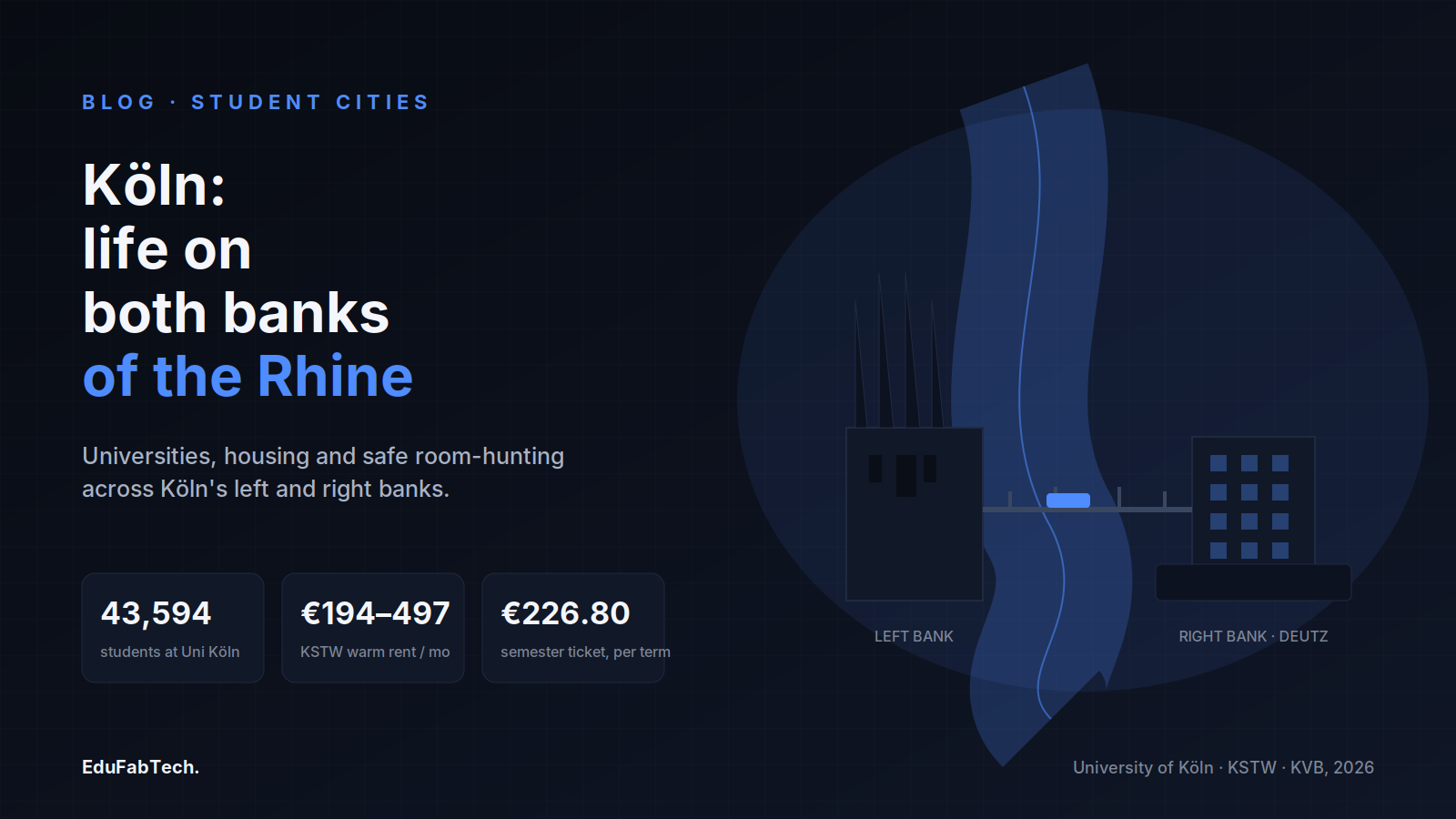
Köln sits on a bend of the Rhine, and almost everything about student life here is organised around which bank you are on. The old town, the cathedral and the main university lie on the left bank; the big applied-sciences campus, the trade-fair halls and a fast-growing cluster of student housing sit across the water in Deutz on the right. The river is not a barrier so much as a timetable: a tram under the Rhine takes a few minutes, and the two sides have quite different rents and moods.
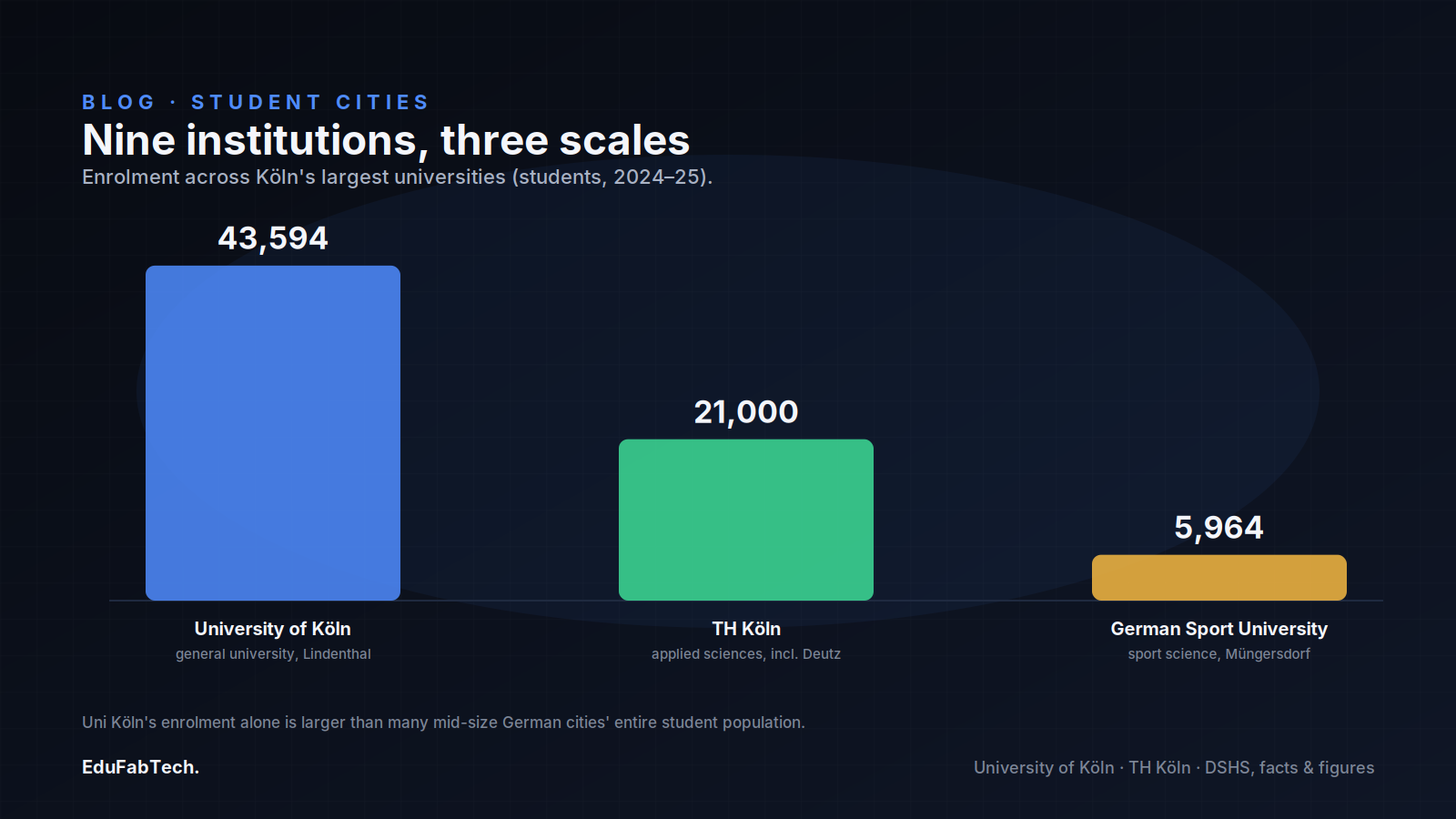
This is a large, multi-degree city rather than a single-campus town. The University of Cologne alone recorded 43,594 students in 2024, according to the university's own At a glance page, and it is only one of several institutions scattered across the Rhineland. That scale shapes the housing market, the libraries and the nightlife more than any single faculty does.
Nine institutions, from the cathedral to the fairgrounds
The University of Cologne is the anchor. Its main campus is in leafy Lindenthal, west of the centre, and the university's At a glance page lists six faculties and 43,594 students as of 2024, making it one of the largest in the country. Roughly 30 km upriver and easily reached by regional train, the University of Bonn has been one of Germany's designated Universities of Excellence since 2019, as its own Facts and Figures page notes; its baroque main building and the Hofgarten park in front of it are a Rhineland landmark.
Köln's practical and artistic schools give the city its particular flavour. TH Köln – University of Applied Sciences teaches around 21,000 students across campuses in Cologne, Gummersbach and Leverkusen, according to its profile; its engineering heart is the Deutz campus on the right bank. The German Sport University Cologne, out at Müngersdorf beside the sports park, is Germany's only university devoted entirely to sport science, with 5,964 students on its facts and figures page. The Hochschule für Musik und Tanz Köln, a conservatoire with its main house in central Köln and branches in Aachen and Wuppertal, and the Academy of Media Arts Cologne, a small, portfolio-entry school for film and media art, round out the creative side. Three more institutions sit in the wider region and are reachable on a student travelcard: the University of Düsseldorf (Heinrich Heine University), a large general university around 40 km downriver whose Bilk campus adjoins its university hospital; Bonn-Rhein-Sieg University of Applied Sciences, with its main campus in Sankt Augustin; and the Fachhochschule des Bundes für öffentliche Verwaltung in Brühl, which trains federal civil servants on a dual-study basis tied to a traineeship.
The districts students call home
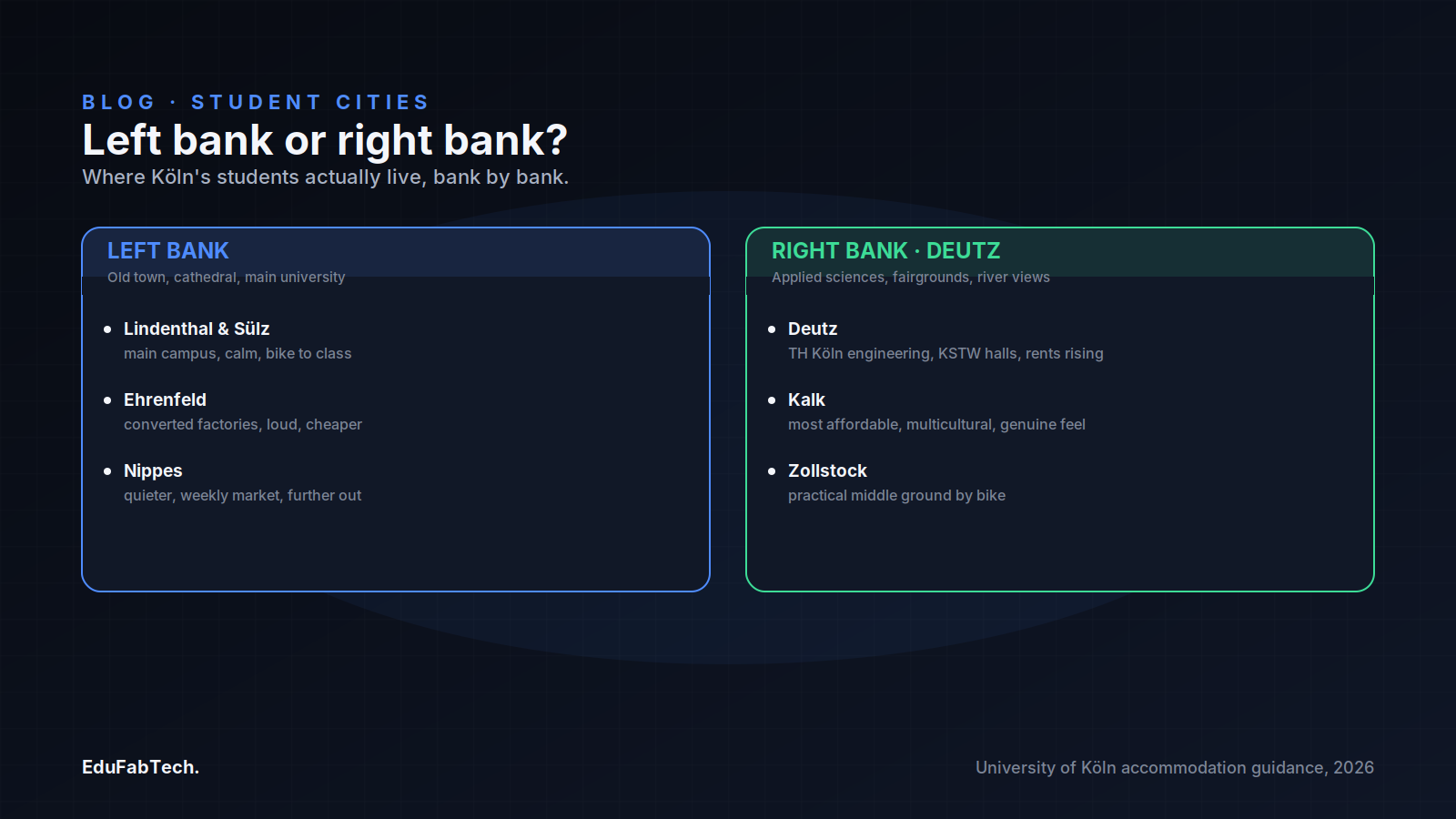
The University of Cologne's own accommodation guidance names Lindenthal, Sülz and Ehrenfeld as the popular student districts. Sülz and neighbouring Klettenberg, just south of the main campus, are the classic choice: calm, residential, full of bakeries and shared flats, with the university a bike ride away. Lindenthal itself wraps around the campus and the green belt; it is pleasant and well connected but not cheap. Ehrenfeld, north-west of the centre, is the loud counterpart — converted factories, music bars and a strong immigrant history — and remains more affordable than the inner districts while staying well linked by the S-Bahn and tram.
Nippes, further north, is quieter and cheaper, with tree-lined streets and its own weekly market. On the right bank, Deutz puts you next to the TH Köln engineering campus and the fairgrounds; the Kölner Studierendenwerk runs several halls here, though rising demand has pushed rents up. Kalk, one stop further east, is the most working-class and multicultural of the student areas and still one of the more affordable, trading polish for lower rent and a genuine neighbourhood feel. Zollstock, to the south, is a practical middle ground — close to the university by bike and cheaper than the districts right beside the campus. If the inner districts are beyond your budget, neighbouring towns such as Hürth sit within about half an hour by tram or bike.
Finding a room before the October crush
Köln's market tightens sharply each autumn, when thousands of new students arrive at once. The safest first move is the Kölner Studierendenwerk (KSTW), the public body that runs student halls; it operates around 5,000 rooms across roughly 90 residences in Köln, Gummersbach and Leverkusen-Opladen. Its published dormitory overview, valid from April 2025, quotes all-inclusive warm rents (heating, electricity, water and internet together) from about €194 to €497 a month depending on the hall and room type — for example, rooms in the Theresienstraße hall near the main campus from €198, and the Deutzer Ring hall beside the TH Köln from €380. The University of Cologne's accommodation page advises applying for KSTW housing three to six months before your course starts.
For a private room or a place in a shared flat (a WG), be alert to the specific way scams appear here. They cluster around the cheapest-looking central listings — rooms advertised in the student quarter around Zülpicher Straße, or glossy flats priced well below the market — and the trick is almost always the same: a "landlord" who is conveniently abroad, cannot show you the place, and asks you to wire a deposit or the first month to "reserve" it. Never send money to hold a room you have not seen, and never pay a deposit by bank transfer abroad, gift card or cryptocurrency. See the room in person or on a live video call, insist on a signed contract first, and remember that German tenancy law caps a rental deposit at three months' cold rent — anyone demanding more, or demanding cash up front, is a warning sign. EduFabTech's rooms listings for Köln and the wider city page are a starting point, but the same checks apply wherever you look.
Furnishing a room: flea markets and the Ehrenfeld hunt
Most KSTW rooms come furnished, but a private flat usually arrives empty, and Köln is a good city for second-hand kit. KölnTourismus's own guide to the city's flea markets points to the long-running market at the Alte Feuerwache in the Agnesviertel, held in the brick courtyard of a former fire station, where much of what is sold — books, crockery, furniture, bric-à-brac — comes straight from the neighbourhood; and to the market on Wilhelmplatz in Nippes, with more than 150 stalls. Ehrenfeld and Kalk host regular markets too, and the city's rotating used-bicycle markets are the cheapest honest way to get a working bike. For furniture you can't carry home on the tram, EduFabTech's Köln pages for second-hand furniture and things given away free are worth checking before you buy new.
Working alongside your degree
Students here commonly take a Minijob or a university assistant post to cover rent. The rules depend on your passport. The DAAD's guidance on side jobs states that students from outside the EU, Iceland, Liechtenstein, Norway and Switzerland may work 140 full days or 280 half days per year without special permission, and that work as an academic assistant (a HiWi job) at your own institution is not capped in the same way, though you must inform the foreigners' authority. Those limits are not advice for your individual case — the binding decision sits with Köln's foreigners' authority (the Ausländerbehörde within the city administration) and your visa conditions, so confirm your own situation with them and your university's International Office before you sign anything. EduFabTech also lists local openings on its Köln jobs page.
Where to read: the USB and the faculty libraries
The city's main academic library is the Universitäts- und Stadtbibliothek Köln (USB), which doubles as Köln's public research library. It lists 830 learning and work stations on its facts and figures page. Be warned that the building is mid-renovation: the USB's 2026 refurbishment notice explains that the reading rooms on the first and second floors are closed while they are rebuilt into better-lit study space with large tables, power sockets and acoustic partitions, so desks are tighter than usual for now. Faculty and departmental libraries across the Lindenthal campus, plus the TH Köln libraries in Deutz and the Südstadt, take up much of the slack, and EduFabTech keeps a running list of study spaces and desks in Köln.
Getting around on the KVB and the Deutschlandsemesterticket
Local transport is run by the Kölner Verkehrs-Betriebe (KVB) — a dense tram and U-Bahn network, some of it underground through the centre, plus buses, inside the VRS regional tariff. Enrolled students do not buy KVB tickets separately: the Deutschlandsemesterticket is bundled into the semester fee. According to the KVB, for the winter semester 2026/2027 it costs €37.80 per month, or €226.80 for the semester, and is recognised anywhere the nationwide Deutschlandticket is valid — that means local buses and trams in Köln and second-class regional trains across Germany, though it does not cover a free guest or a bicycle. In practice it turns the whole Rhineland — Bonn, Düsseldorf, the dormitory towns — into commuting distance, and makes a car unnecessary for most students.
The money, and the honest trade-offs
On paper Köln is one of Germany's more affordable big cities to study in: there are no tuition fees at the public universities for most students, a KSTW hall can cost under €300 a month all-in, and the semester travel ticket is fixed and cheap. The real pressure is the private rental market. Rooms near the university, in Sülz or Ehrenfeld, now rent for well above what the subsidised halls charge, and the gap between a €200 dormitory place and an open-market room is the single biggest variable in a Köln budget. That is why starting the KSTW application months ahead matters so much.
What is good about the city is genuine: it is flat and bikeable, friendly and informal, open late, and famous for a Carnival season that effectively shuts the universities for a week in late winter. What is hard is equally real. Housing is scarce and competitive at term start; the right-bank and outer districts mean some students face a real commute; the renovation has thinned out library desks; and the Rhineland winter is grey and wet rather than picturesque. None of this is a reason to stay away — but it is worth knowing before you arrive rather than after.
Your first two weeks in Köln
- Register your address (the Anmeldung) at a Bürgeramt soon after you move in; you will need the landlord's confirmation, and almost everything else depends on it.
- Complete your enrolment and pay the semester fee so your Deutschlandsemesterticket is active before you start travelling.
- Open a German bank account and arrange statutory health insurance, both usually needed to finish matriculation.
- If you are a non-EU student, book your residence-permit appointment with Köln's Ausländerbehörde early — slots fill fast at term start — and confirm your work allowance there.
- Apply to the Kölner Studierendenwerk for a hall place even if you have a room, and keep looking: dormitory offers move during the first weeks.
- Get your USB library account, find your nearest faculty library while the main reading rooms are closed, and pick up a cheap second-hand bike at one of the city's used-bike markets.
A quick question for readers
Do you work part-time while you study?
Many students work to pay the bills. See how common it is — and how many hours people really do.
Pick an answer, create a free account in a minute, and your vote counts. Already a member? Sign in
Comments 3
Comment-
The library note is the one that would annoy me most if I were moving there this term: first and second floor reading rooms shut right now,…
-
The number that doesn't survive the piece's own summary is the KSTW rent. Up top it's honestly reported as a range, €194 to €497 a month dep…
-
The detail that actually matters for budgeting is the asymmetry buried in the DAAD rule: non-EU students are capped at 140 full days or 280…
Join free to read the full comments and reply Comments are between members; an account takes a minute.
Source: Kölner Studierendenwerk
Sources (5)
- University of Cologne. University of Cologne: At a glance. University of Cologne, 2024. uni-koeln.de ↗ · checked 12 Nov 2026
- Kölner Studierendenwerk. Wohnheime des Kölner Studierendenwerk – Übersicht (Warmmiete ab 04/2025). Kölner Studierendenwerk, 2025. kstw.de ↗ · checked 12 Nov 2026
- Kölner Verkehrs-Betriebe. Deutschlandsemesterticket. Kölner Verkehrs-Betriebe (KVB), 2026. kvb.koeln ↗ · checked 12 Nov 2026
- Deutscher Akademischer Austauschdienst. Side jobs. DAAD, 2026. daad.de ↗ · checked 12 Nov 2026
- KölnTourismus. Flea markets in Cologne: seven vintage hotspots. KölnTourismus GmbH, 2026. magazine.cologne-tourism.com ↗ · checked 12 Nov 2026