Studying in Konstanz: universities, housing and student life
A practical, sourced guide to Germany's southernmost university city — its three institutions, a tight housing market on the lake, transport, work rules, study spaces and what it really costs.
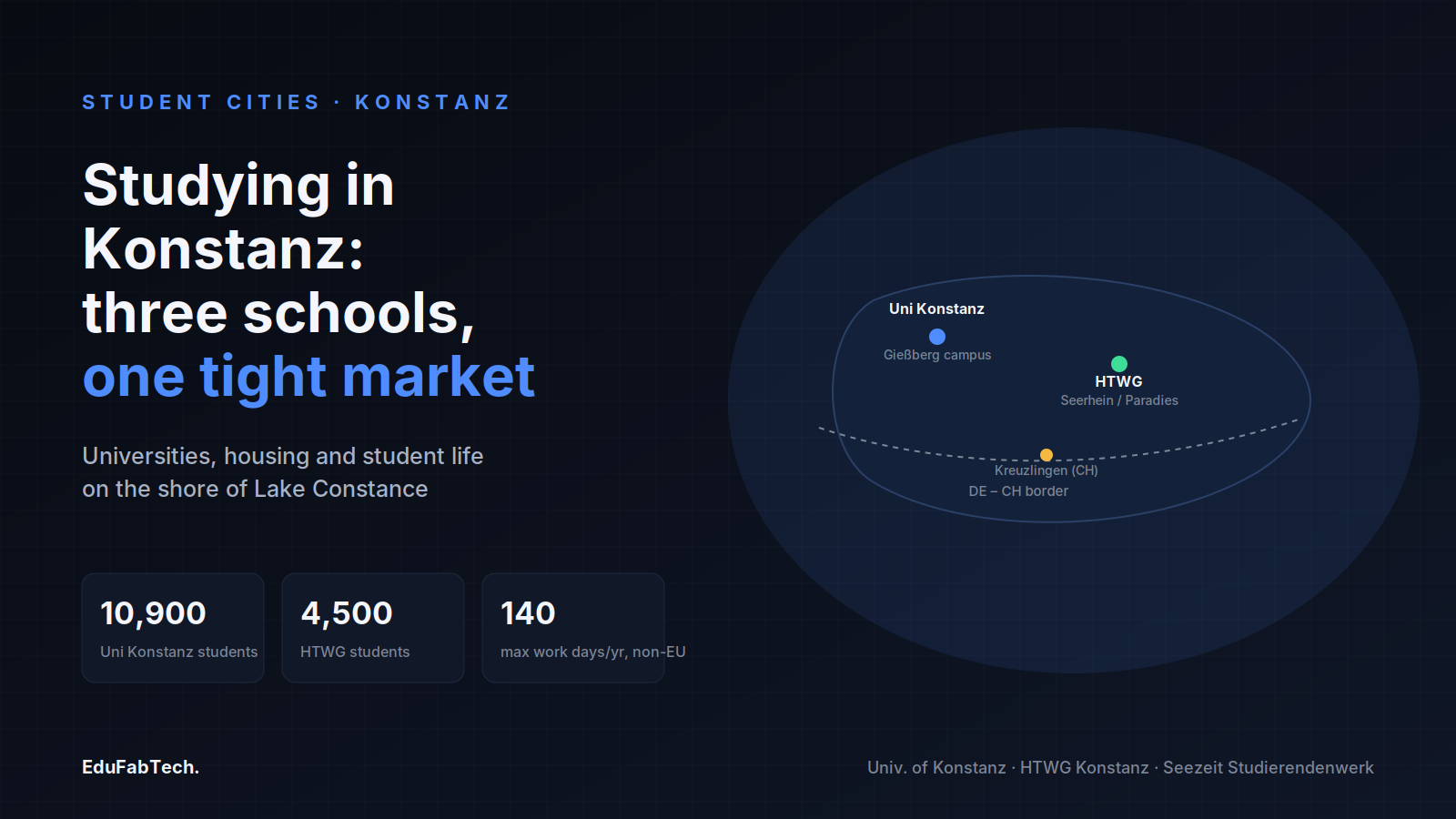
Konstanz occupies the far southern tip of Germany, on the shore where Lake Constance — the Bodensee — narrows and drains into the Rhine. The national border runs straight through the built-up area: the Swiss town of Kreuzlingen begins a few streets south of the medieval old town, and the University of Konstanz lies roughly four kilometres from that border. The lake, not a ring road, is the thing the city is organised around. Ferries cross it, the Seerhein cuts through it, and in term time the bike paths along the water fill with students riding between lectures, the Mensa and the shore.
For its size — Konstanz is a mid-sized city, not a metropolis — it carries an unusual concentration of higher education. The University of Konstanz reports some 10,900 students on its own profile page, and HTWG Konstanz, the university of applied sciences, counts around 4,500 more. A third institution, the private Zeppelin University, sits across the water in Friedrichshafen. Together they give a compact lakeside town a large, visible student population and, as a direct consequence, a housing market under constant pressure.
This guide walks through the parts of that life a new arrival actually has to solve: which institution is which, where students live and how to find a room without being cheated, how to furnish it cheaply, the rules on working, where to study, how to get around a border city, and what the whole thing costs — with the figures tied to the pages that publish them.
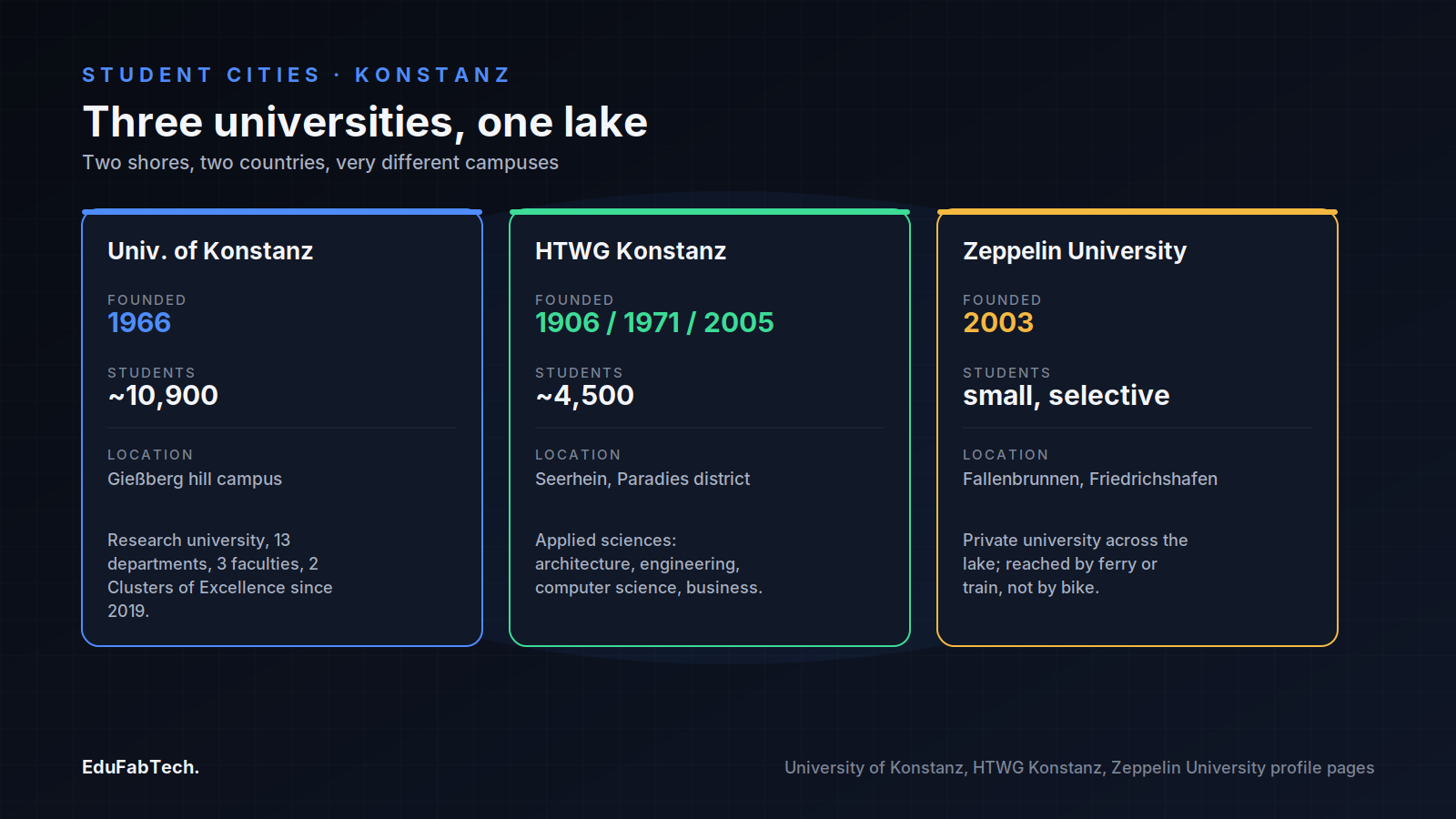
Three universities, two shores of the lake
The University of Konstanz was founded in 1966 as a reform university and, according to its own profile, now teaches around 10,900 students across about 100 degree programmes, organised into thirteen departments and three faculties — Sciences, Humanities, and Politics, Law and Economics. Its campus is a single large complex on the Gießberg, a wooded hill on the city's western edge with the lake below it, so that nearly everything — departments, the library, the canteens, student services — sits under one connected roof. The university lists two Clusters of Excellence funded since 2019 under Germany's Excellence Strategy, a reminder that it is research-intensive despite its modest student numbers. Listings for rooms, jobs and study spots near the campus are collected on EduFabTech's University of Konstanz page.
HTWG Konstanz — the Hochschule Konstanz Technik, Wirtschaft und Gestaltung, known in English as the Constance University of Applied Sciences — is the applied-sciences counterpart. Its own history page dates its origin to 1906, when the engineer Alfred Wachtel founded the Technikum Konstanz with 28 students and four lecturers; it became a Fachhochschule in 1971 and took the name Hochschule Konstanz in 2005. Today HTWG describes itself as home to roughly 4,500 students in six faculties, spanning architecture and design, civil engineering, electrical engineering and information technology, computer science, mechanical engineering, and business, cultural and legal studies. Its campus sits right on the Seerhein in the Paradies district, close to the old town — a very different feel from the hilltop university. Listings near this campus are gathered on EduFabTech's Constance University of Applied Sciences page.
Zeppelin University is the outlier. A private, state-recognised university founded in 2003, it is not in Konstanz at all but across the lake in Friedrichshafen, on its Fallenbrunnen campus, and concentrates on economics, culture, communication and politics. It is small and selective, and reaching it from Konstanz means a ferry or a train around the lake rather than a bike ride; most people studying there live on the Friedrichshafen side.
Where a room is, and why it is hard to get
Housing is the single hardest part of moving to Konstanz, and the city's own institutions say so plainly. The University of Konstanz's accommodation page warns that there are usually more requests than places and that the search is time-consuming, advising students to start early. The structural reason is geography: Konstanz is hemmed in by the lake on one side and the Swiss border on the other, so the city cannot simply sprawl outward to add cheap flats.
The largest single provider is Seezeit Studierendenwerk Bodensee, the regional student-services body, which runs the halls of residence. The university's accommodation page describes roughly 2,400 rooms across thirteen Seezeit residences, with rents for single or shared-flat (WG) rooms running between 280 and 550 euros per person. Because demand outstrips supply, Seezeit allocates rooms by lottery rather than first-come, and applications open about six months before the intended move-in date. A hall place is the cheapest reliable option and worth applying for the moment you have an admission offer; EduFabTech also gathers current openings on its rooms in Konstanz page.
On the private market, students cluster in the districts within cycling distance of one campus or the other — Petershausen and Fürstenberg north of the Seerhein, Paradies around HTWG, and the villages of Wollmatingen and Litzelstetten further out. Some look across the border to Kreuzlingen in Switzerland, where rooms exist but rents are quoted in Swiss francs and tend to be higher, and living in another country adds its own registration steps. Wherever you land, you must register your address with the city (Bürgeramt) within two weeks of moving in, as the university's accommodation page notes.
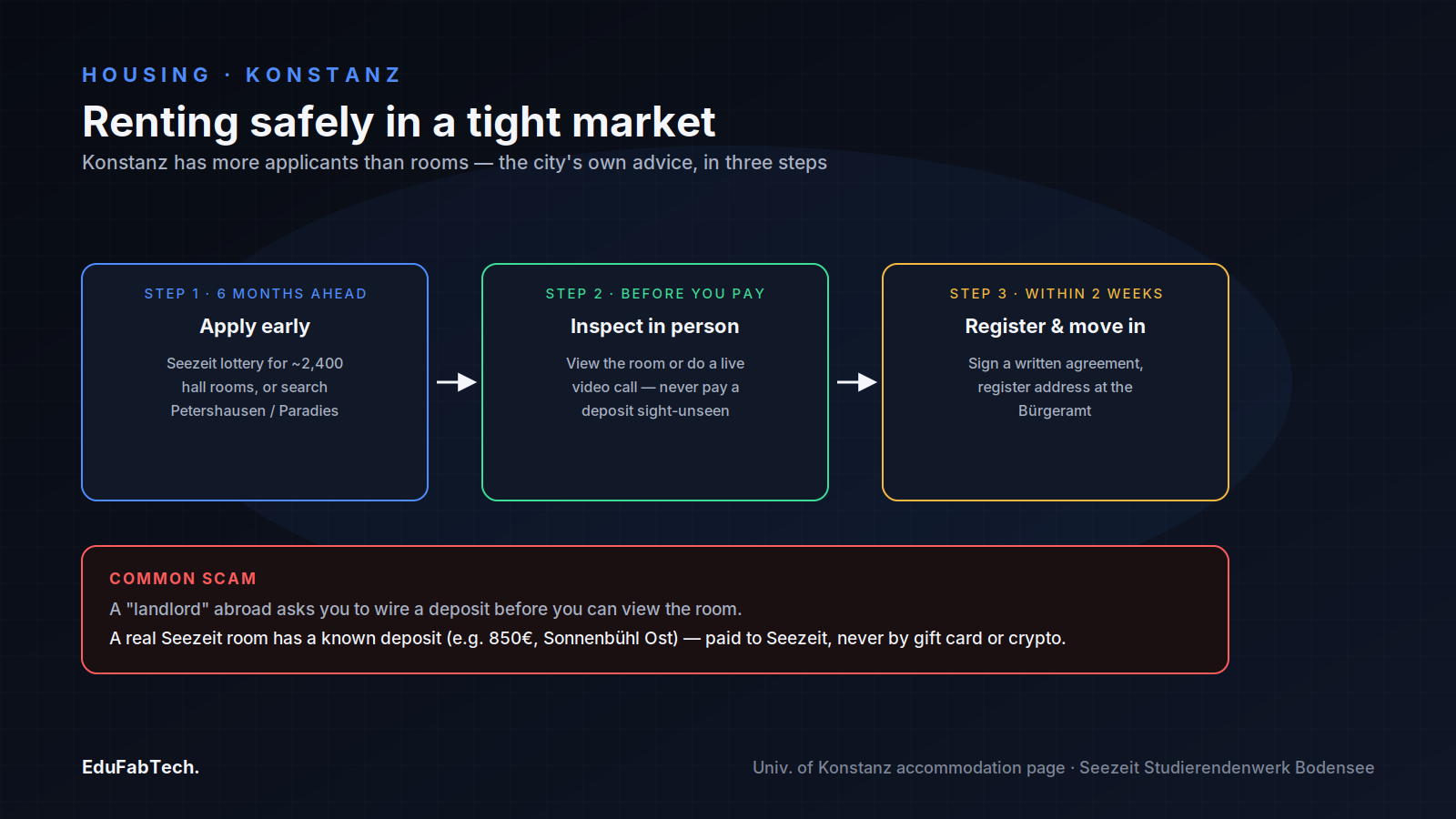
The tight market is exactly the condition rental scams exploit. The classic Konstanz version appears on online flat-share portals and social-media housing groups: an attractive room at a believable price, a "landlord" who is conveniently abroad, and a request to wire a deposit to "hold" it before you can view. Do not. The University of Konstanz's accommodation page is explicit that you should make no advance payment without inspecting the room and reaching a binding written agreement. See the place in person, or at the very least on a live video call; a legitimate Seezeit room carries a deposit of a known size — 850 euros for a place in the Sonnenbühl Ost hall, per Seezeit's own residence listing — paid through the organisation, never by gift card, cryptocurrency or an instant transfer to a stranger.
Furnishing a room without spending much
An empty room is an opportunity to buy second-hand, and Konstanz has a genuinely notable event for it. The cross-border flea market along the lakefront between Konstanz and Kreuzlingen is described by the regional tourist board, bodensee.eu, as "the largest and most attractive flea market in southern Germany and the area around Lake Constance", with over 1,000 stands running for 24 hours across nine kilometres and two countries each spring. It is the kind of place to find a desk lamp, crockery and a bike in one afternoon.
For everyday supplies, the city runs weekly produce markets that, per the market's own schedule, set up at St.-Stephans-Platz on Tuesdays and Fridays, at St.-Gebhard-Platz on Wednesdays and Saturdays, and in Wollmatingen on Thursdays — useful for cheap vegetables rather than furniture, but part of the weekly rhythm. For the larger items — a shelf, a mattress, a second bike — the quickest route is often other students moving out. EduFabTech lists local second-hand things, used furniture and items given away for free in Konstanz, which is where a lot of departing students post their desks and kitchenware at the end of each semester.
Working alongside your studies
Many students take a side job, and the rules depend on where you are from. The University of Konstanz's International Office page on working while you study states that non-EU/EEA students may work a total of 140 days or 280 half-days per year, where a day over four hours counts as a full day and a day up to four hours as a half day. The same page notes that work as a student assistant employed by the university does not count toward that limit, and that mandatory internships forming part of a study programme are also excluded. EU and EEA students are generally treated like German students. None of this is legal advice — the binding conditions are whatever is written on your own visa or residence permit, and questions about them go to the local immigration office. Current openings are collected on EduFabTech's jobs in Konstanz page.
Libraries and places to study
The University of Konstanz library is run by the KIM information centre as one large, mostly open building integrated into the campus, and it has historically been known for very long opening hours. Those hours have been trimmed and restored more than once in recent years, so check the KIM library site for the current schedule before planning a late night. HTWG, for its part, has its own modern library on the Seerhein campus. Beyond the libraries, the canteens, departmental common rooms and — in warm weather — the lakeshore itself all serve as study spots; EduFabTech also indexes bookable study spaces around the city.
Getting around a city built around a lake
Konstanz is small enough that many students simply cycle, and the terrain near the water is flat. For buses and the lake ferry there is the Studiticket, run by Stadtwerke Konstanz, the municipal transport operator. Its 2026 tariff overview lists the Studiticket at 65.30 euros per semester, valid for unlimited bus travel within the city and the ferry across to Meersburg; a single adult city bus ticket is listed at 3.30 euros for 2026. Part of the student-services fee is a solidarity contribution that lets enrolled students use the city buses free in the evenings. For travel beyond the city, students can add a VHB upgrade — 72.30 euros per semester, per the Verkehrsverbund Hegau-Bodensee — which extends the ticket across the wider regional network. The car ferry and passenger boats across the Bodensee are part of normal life here, not a tourist add-on, and the Studiticket's inclusion of the Meersburg ferry reflects that.
What it costs
Tuition is where nationality matters most. Baden-Württemberg charges non-EU/EEA students a tuition fee, and the University of Konstanz's fees page lists it at 1,709 euros per semester, effective from the summer semester 2026; EU/EEA students and most others pay no tuition. Every student, regardless of nationality, pays a semester contribution, which the same page gives as 209 euros per semester — this funds Seezeit services, the student body and the transport solidarity contribution rather than teaching. Within that, Seezeit's own fees page puts the University of Konstanz student-services component at 115 euros.
Housing is the dominant monthly cost. As a concrete, current example, Seezeit's Sonnenbühl Ost high-rise lists shared-flat rooms from 309 euros for about 8 square metres up to 362 euros for about 13 square metres, a single apartment at 458 euros and a double at 624 euros, with an 850-euro deposit, on its residence page (confirmed November 2026). Those hall rents sit at the lower end of the 280-to-550-euro range the university cites for student rooms across the city; on the open private market, and especially across the border in Switzerland, expect to pay more. Against that, the Seezeit canteens offer subsidised meals, and the Studiticket keeps transport close to a rounding error.
The good and the hard, honestly
What is good about Konstanz is easy to see. It is a small, walkable, bike-friendly city on a lake, with an intact old town, mild lakeside summers, swimming off the shore in warm months, and the novelty of a border you can cross on foot into Switzerland. The University of Konstanz campus concentrates everything in one place, and the student population is large enough to sustain real student life without the anonymity of a big-city university.
What is hard is mostly the flip side of the same geography. Lake and border cap how far the city can grow, so rooms are scarce and relatively expensive, and the lottery for a Seezeit place means a first-year arrival can face weeks of searching. Being in a corner of the country also means longer journeys to anywhere else in Germany; the fast connections run around the lake rather than straight through. Proximity to Switzerland pushes up prices in the shops as well as the rents. And the climate, while gentle in summer, brings grey, damp, fog-prone winters common to the Bodensee. None of this makes Konstanz a poor choice — but a realistic new student plans the housing search first and treats everything else as easier.
A checklist for the first weeks
- Apply for a Seezeit room the day you are admitted — applications open about six months ahead and places are allocated by lottery, so early entry only helps.
- Never pay a deposit before viewing. See any private room in person or on a live video call, and never wire money to "hold" a place sight unseen.
- Register your address at the Bürgeramt within two weeks of moving in.
- Buy the Studiticket (65.30 euros for 2026) and, if you will travel in the region, the VHB upgrade; a second-hand bike pays for itself fast.
- Check your work allowance — non-EU/EEA students face the 140-day / 280-half-day limit — against your own residence permit, and ask the immigration office if unsure.
- Find your study base early: the KIM library on campus or HTWG's library on the Seerhein, depending where you study.
- Browse the local listings for rooms, jobs and second-hand gear on EduFabTech's Konstanz pages before the semester fills up.
A quick question for readers
Do you work part-time while you study?
Many students work to pay the bills. See how common it is — and how many hours people really do.
Pick an answer, create a free account in a minute, and your vote counts. Already a member? Sign in
Comments 3
Comment-
The library bit is where this piece goes soft: 'historically known for very long opening hours' that have been 'trimmed and restored more th…
-
Funny how the one claim in this whole piece that isn't pinned to a source is the library hours line — 'trimmed and restored more than once i…
-
The number that jumps out is the work limit: 140 days or 280 half-days a year for non-EU/EEA students, with student-assistant jobs and manda…
Join free to read the full comments and reply Comments are between members; an account takes a minute.
Source: University of Konstanz
Sources (5)
- University of Konstanz. Profile and mission statement. University of Konstanz, 2026. uni-konstanz.de ↗ · checked 16 Nov 2026
- HTWG Konstanz. Geschichte der Hochschule. Hochschule Konstanz (HTWG), 2026. htwg-konstanz.de ↗ · checked 16 Nov 2026
- Seezeit Studierendenwerk Bodensee. Sonnenbühl Ost Hochhaus — hall of residence. Seezeit, 2026. seezeit.com ↗ · checked 16 Nov 2026
- Stadtwerke Konstanz. Tarife — Bus: Übersicht aller Bustarife für Konstanz. Stadtwerke Konstanz, 2026. stadtwerke-konstanz.de ↗ · checked 16 Nov 2026
- Internationale Bodensee-Tourismus. Cross-border flea market in Constance / Kreuzlingen. bodensee.eu, 2026. bodensee.eu ↗ · checked 16 Nov 2026