Studying in Lansing: universities, housing and student life
A practical, sourced guide to studying in Lansing and East Lansing, Michigan — the universities, where students find rooms, what things cost, how to get around on CATA, and the honest trade-offs.
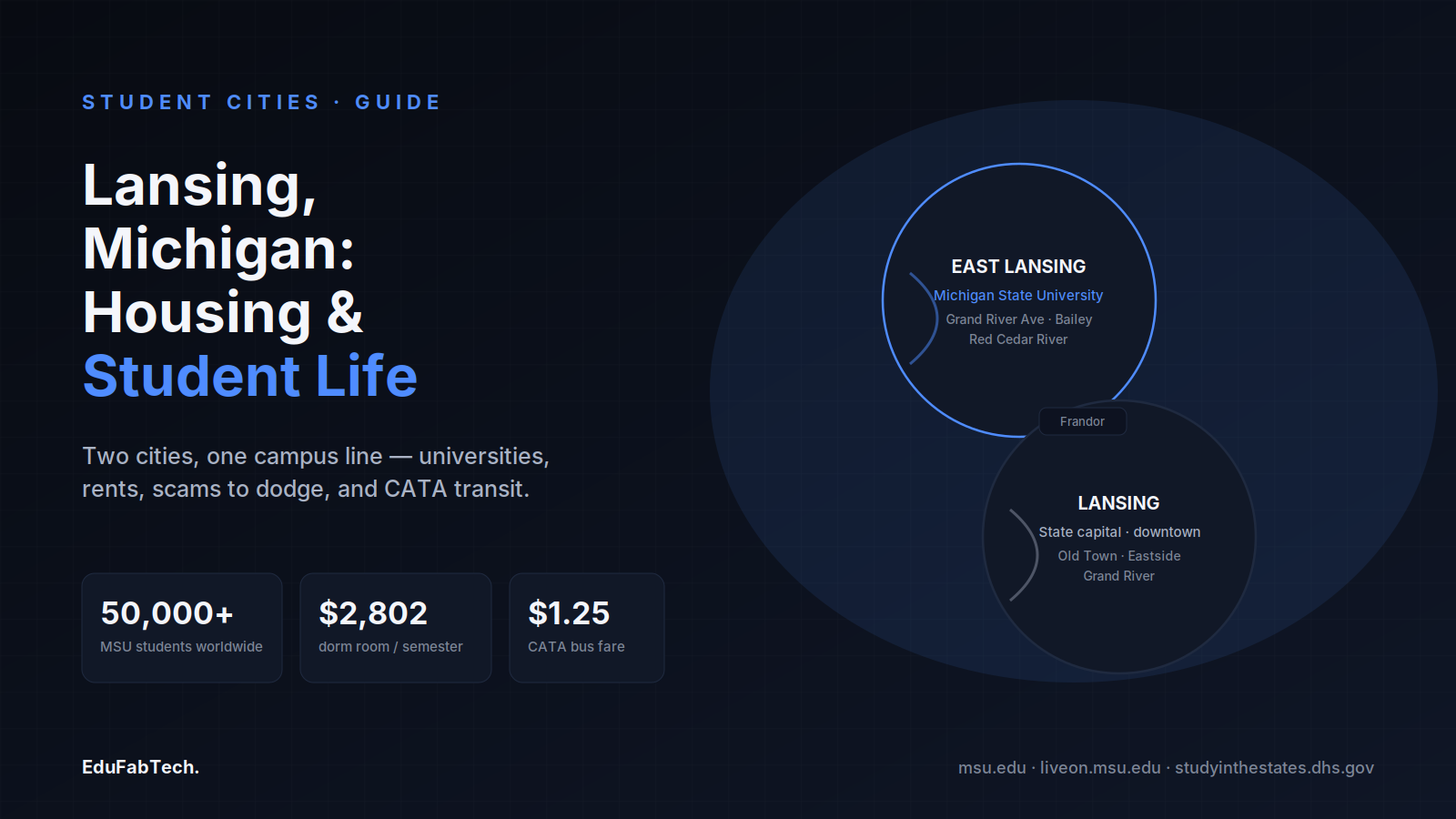
Lansing is two places that students learn to read as one. The city proper is Michigan's state capital, with the domed Capitol downtown, the Grand River running through the middle of it, and neighbourhoods — Old Town, REO Town, the Eastside — that have little to do with campus crowds. Three miles east, across a city line most people never notice, East Lansing is a college town built around Michigan State University and the Red Cedar River that winds through its grounds. Between them sits Frandor, a shopping district that belongs to neither. Where you live, what you pay and how long your commute runs all depend on which side of that invisible line you land on.
This guide is for anyone weighing a move here to study — from elsewhere in Michigan, or from abroad. It names the institutions, the transit operator and the markets by their real names, and every figure is tied to the page it came from so you can check it yourself before it changes.
The universities: Michigan State and Great Lakes Christian College
Michigan State University (MSU), in East Lansing, is the anchor of the whole region. The university describes itself as a top global public research university with more than 50,000 students drawn from all 50 states and 133 other countries, and more than 400 programs of study, according to its own about page (msu.edu). It is a land-grant institution, and that history still shows in its strengths — agriculture, education, communication, and a sprawling campus that includes working farms and research fields out past the teaching buildings. Day to day, studying here means scale: large lecture halls for first-year courses, a campus you cross by bus as often as on foot, and the social gravity of a football Saturday at Spartan Stadium that can shut ordinary plans down for a day.
Great Lakes Christian College (GLCC) is the city's other degree-granting institution — a small, Christ-centred college at 6211 West Willow Highway in Lansing, accredited by the Association for Biblical Higher Education, offering programmes aimed at ministry, business, education and the arts, per its own site (glcc.edu). It is a very different experience from MSU: intimate, faith-based, residential on a small scale. Many people studying in Lansing are also at Lansing Community College, the two-year public college downtown, which feeds transfer students into MSU; if that is your path, the room-hunting and transport advice below applies to you just as much.
Where students find rooms in Lansing and East Lansing
The densest student housing sits along and just south of Grand River Avenue in East Lansing — the strip of apartments, older houses and the student-heavy blocks locals call Bailey, within walking distance of MSU's north edge. Rents fall as you move outward: into the quieter East Lansing streets, south toward the Okemos and Haslett edges, or across the line into Lansing itself, where the Eastside and downtown put you on a bus route rather than a walk. International and first-year students often start in MSU housing and move off-campus later once they know the map.
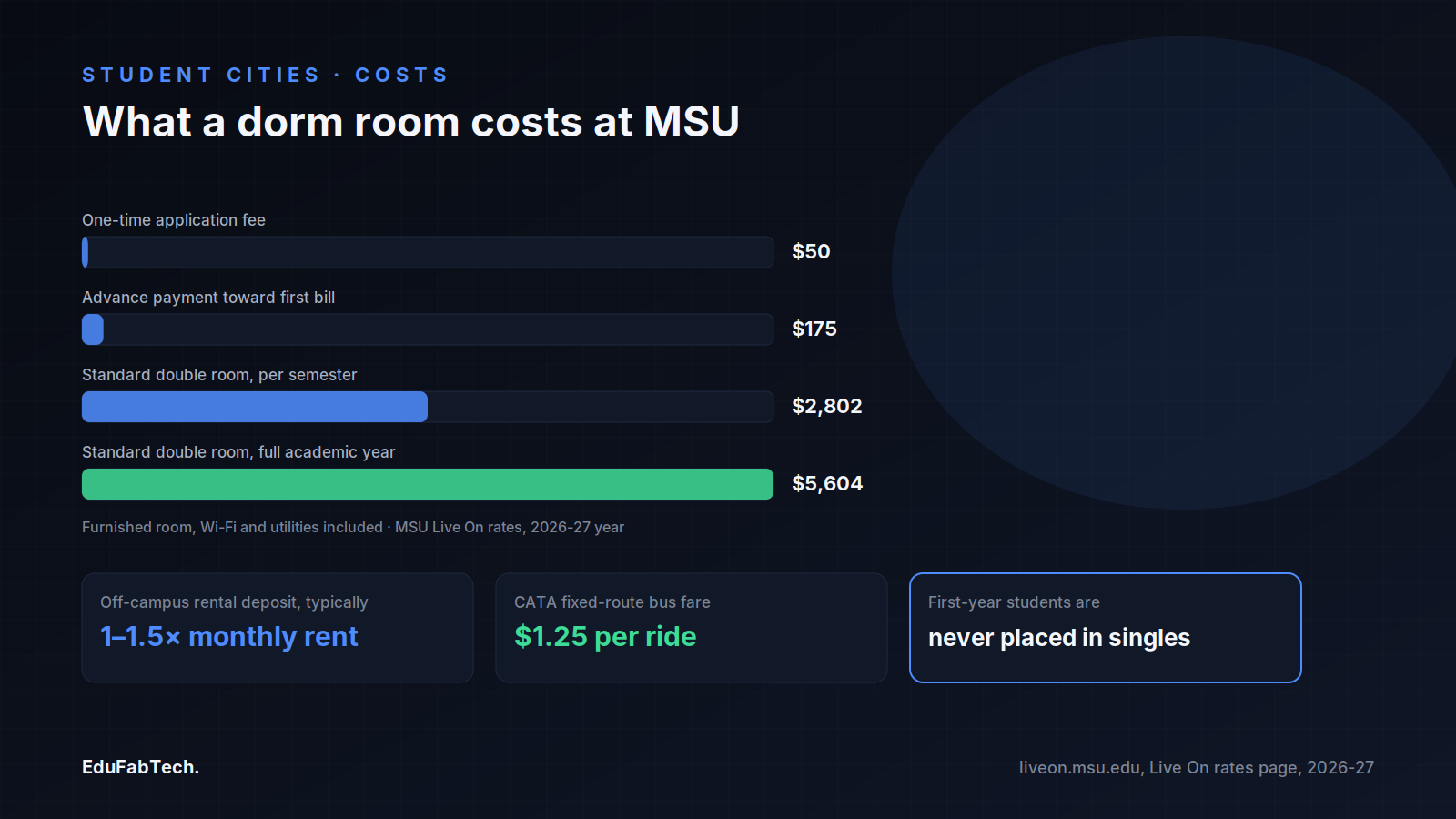
For first-year undergraduates, campus housing is the default. MSU's own rates for the 2026-27 year put a standard double residence-hall room at $2,802 per semester, or $5,604 for the academic year, with the room fully furnished and in-room Wi-Fi and utilities included, according to the university's Live On rates page (liveon.msu.edu). That page also lists a one-time, non-refundable $50 application fee and a $175 advance payment toward the first-semester bill, and notes that first-year students are not placed in single rooms. A dated, dependable off-campus figure is harder to anchor to a single public page; MSU's dorm rate is the cleanest sourced housing number for the city, and private rents around campus run higher than quieter Lansing neighbourhoods.
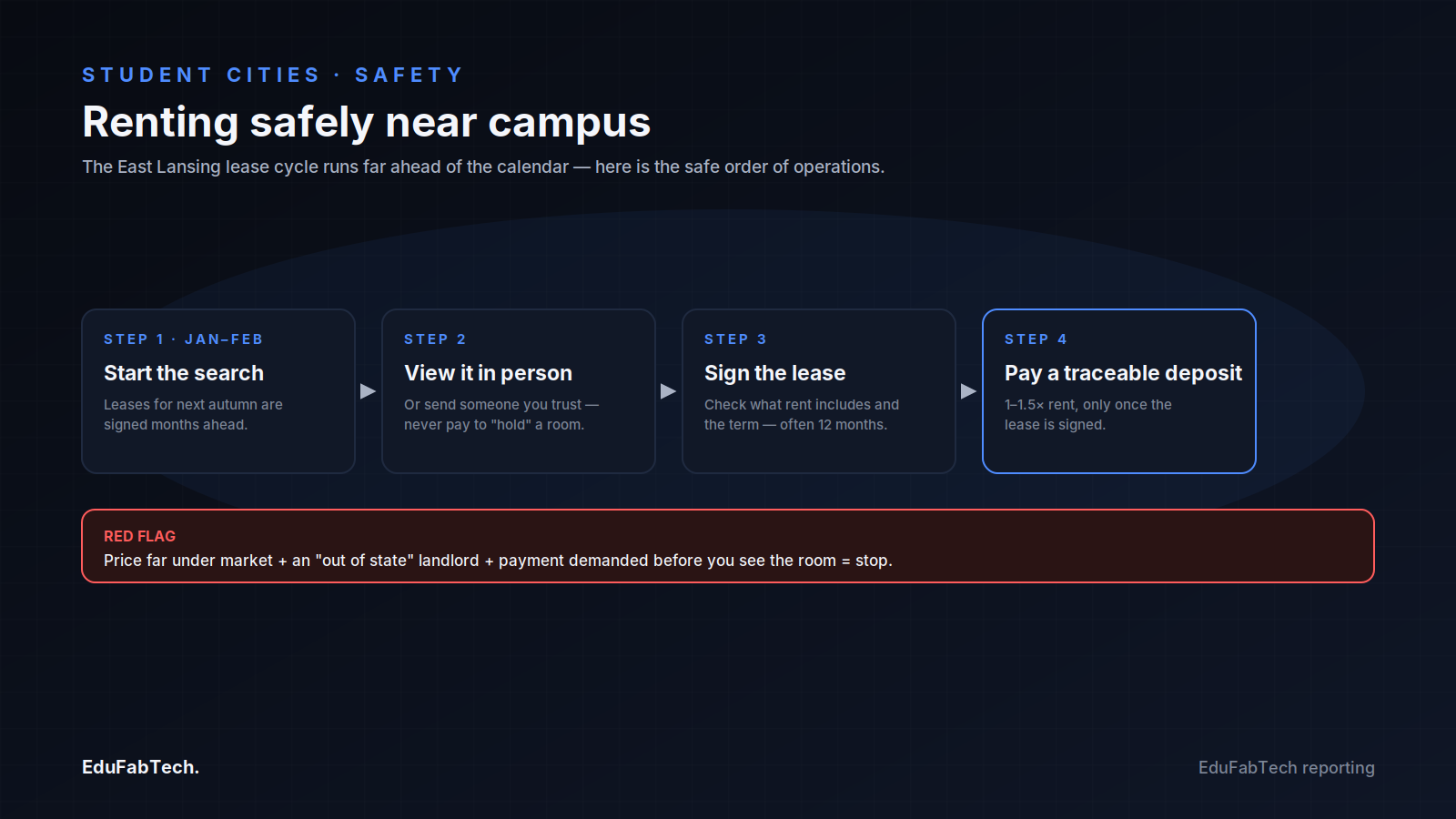
Timing is the thing people get wrong. The East Lansing lease cycle runs far ahead of the calendar: many near-campus places for the following autumn are signed in the preceding winter, so serious searching for a September room often starts in January or February. Before you pay anything, see the actual unit — not a show apartment — check what the rent includes (heating a Michigan flat through winter is not trivial), confirm who handles snow clearing and repairs, and read the lease term, because many are twelve months, not nine. You can browse what is currently listed in the city on EduFabTech's rooms page for Lansing, and filter to places near Michigan State University.
Paying a deposit without being cheated
Rental scams in Lansing cluster where the pressure is highest: the cheap-looking listing a short walk from Grand River Avenue, and the spring sublet when a student leaving for the summer or for study abroad needs someone to take over a room fast. The pattern is familiar — a price that undercuts everything nearby, a "landlord" who is conveniently out of state, and a request to send money to "hold" the room before you have seen it. Treat that as a stop sign. Never send a deposit by bank transfer, gift card or cryptocurrency to reserve a place; those payments are effectively unrecoverable, and no legitimate East Lansing landlord or leasing office needs them. View the unit in person, or have someone you trust view it for you, and meet the management at their office. Expect a deposit in the range of one to one-and-a-half months' rent, paid by a traceable method only once you have a signed lease in hand. If a deal only works if you act before you can see the place, it is not a deal.
Furnishing a room: the Eastside market, thrift and the May move-out
You do not need to buy a room's worth of furniture new. Lansing's best standing market for food and local goods is the Allen Farmers Market on the city's Eastside, which runs every Wednesday from 3:00 to 6:30 pm year-round — outdoors in the warm months and indoors in the colder months — and which in 2005 became the first farmers market in Michigan to accept SNAP/EBT, according to the Allen Neighborhood Center (allenneighborhoodcenter.org). Its Double Up Food Bucks programme matches SNAP spending with up to $50 a day in tokens for fresh produce, which is worth knowing if you qualify. (The old Lansing City Market downtown, which some older guides still mention, closed in 2019, so do not go looking for it.)
The real furniture bargains come with the calendar. MSU's academic year ends in spring, and the student move-out in late April and May floods the Eastside and East Lansing with cast-off desks, chairs, lamps and mini-fridges — some sold cheap, some simply left at the kerb. Arriving in autumn, you will find thrift and resale shops across the Lansing area stocked from that turnover. EduFabTech keeps running local lists for exactly this: second-hand things in Lansing and things being given away free. Buy the big items used and local; shipping a desk is never worth it.
Working while you study
If you are on an F-1 student visa, the rules on employment are set by the U.S. federal government, not the university, and you should treat your school's international office as the first stop. The U.S. Department of Homeland Security's Study in the States service states that an F-1 student doing on-campus employment "may not work more than 20 hours per week when school is in session," and that active F-1 students may apply for on-campus work up to 30 days before classes begin, adding that "in order to apply, talk to your DSO" — your designated school official — per its working-in-the-United-States page (studyinthestates.dhs.gov). At MSU the office that plays the DSO role is the Office for International Students and Scholars. Nothing here is legal advice; off-campus work and practical training have their own conditions, so confirm your own case with that office and the official source before you accept a job. Current openings students are posting locally sit on EduFabTech's Lansing jobs page.
Libraries and places to study
MSU's Main Library at 366 West Circle Drive, on the north bank of the Red Cedar, is the serious study building: it keeps 24-hour hours Monday through Thursday during the semester, with shorter weekend hours, as posted on the Libraries' hours page (lib.msu.edu) — always worth checking, because term, break and exam schedules shift them. Beyond the stacks it has long tables, plentiful outlets and a café, and the branch libraries across campus spread the load during exam weeks. If you are not an MSU student, or you want a desk on the Lansing side of the line, the public Capital Area District Libraries system has branches downtown and around the city. More student-posted desks, quiet rooms and co-working spots are gathered on EduFabTech's Lansing study-spaces page.
Getting around on CATA
Public transport here is run by the Capital Area Transportation Authority (CATA), and for a student it is the single biggest cost-saver in the city. A regular fixed-route fare is $1.25, but students with a valid student ID ride for a discounted 60 cents, according to CATA's discounted-fares page (cata.org). Better still for anyone at MSU: CATA's own fares page (cata.org) lists the on-campus MSU routes as free. In practice the campus fixed routes run through the residence halls, apartments and commuter lots during fall and spring semesters at no charge to riders, so a near-campus room plus the campus bus can mean a near-zero transport bill.
For travel beyond campus, CATA sells student passes that undercut the adult ones: a student 31-day pass is $18 against $35 for the adult version, a student first-semester pass is $50, and a student 10-ride fixed-route card is $6, per CATA's online pass products (cata.org). You can buy in person at the CATA Transportation Center at 420 South Grand Avenue downtown or at the Capital Area Multimodal Gateway at 1240 South Harrison Road in East Lansing. One honest caveat: Lansing winters are long, grey and snowy, waiting for a bus in January is genuinely cold, and off-campus evening and weekend service is thinner than the weekday campus network — plan errands around it rather than assuming a bus is always minutes away.
Costs, and the honest trade-offs
The sourced numbers above set the frame: a standard MSU double at $5,604 for the 2026-27 academic year including utilities and Wi-Fi (liveon.msu.edu), free campus buses for MSU students and a 60-cent student fare elsewhere (cata.org), and a weekly market that takes SNAP on the Eastside (allenneighborhoodcenter.org). Against the national picture, greater Lansing is not an expensive place to be a student, and that is its strongest card.
What is genuinely good: a major research university and a state capital in one metro, a flat and walkable campus core, an unusually generous campus transit deal, and real neighbourhoods — Old Town, REO Town, the Eastside — with character beyond the student strip. What is hard: the winter is long and the snow is real, so budget for warm clothing and factor weather into every commute; the near-campus lease cycle moves early and punishes late starters; off-campus evening transit is limited; and on football Saturdays the whole area fills up and slows down. None of these is a reason to stay away, but all of them are easier to handle if you expect them.
A checklist for the first weeks
- Sort housing first and early — if you want a near-campus room for autumn, the East Lansing cycle means hunting in winter, not summer. See the rooms listings and listings near Michigan State University.
- See any place in person before paying, and never wire a deposit, send gift cards or pay in crypto to "hold" a room.
- If you are an international student, visit your school's international office (the DSO) before taking any job, and read the DHS work rules yourself.
- Get your student ID early so you can ride CATA at the 60-cent student fare — and, if you are at MSU, use the free campus routes.
- Decide on a CATA pass once you know your routine: the $18 student 31-day or $50 semester pass pays off fast if you travel off-campus.
- Furnish from the May move-out and local resale, not from a shipping box — start with the second-hand and free-stuff lists.
- Find your study building in week one — MSU's Main Library or a Capital Area District Libraries branch — before exam season makes seats scarce.
- Buy real winter clothing before December; the first cold snap always arrives sooner than newcomers expect.
A quick question for readers
Do you work part-time while you study?
Many students work to pay the bills. See how common it is — and how many hours people really do.
Pick an answer, create a free account in a minute, and your vote counts. Already a member? Sign in
Comments 0
CommentNo comments yet. Members start the conversation.
Source: Michigan State University
Sources (5)
- Michigan State University. 2026-27 Residence Hall Rates. MSU Live On (liveon.msu.edu), 2026. liveon.msu.edu ↗ · checked 9 Oct 2026
- Capital Area Transportation Authority. Discounted Fares. CATA, 2026. cata.org ↗ · checked 9 Oct 2026
- Allen Neighborhood Center. Allen Farmers Market. Allen Neighborhood Center, 2026. allenneighborhoodcenter.org ↗ · checked 9 Oct 2026
- U.S. Department of Homeland Security. Working in the United States. Study in the States (SEVP), 2025. studyinthestates.dhs.gov ↗ · checked 9 Oct 2026
- Michigan State University. About MSU. Michigan State University, 2026. msu.edu ↗ · checked 9 Oct 2026