Studying in Lawrence, Kansas: universities, housing and student life
A practical guide to living and studying in Lawrence — the University of Kansas on Mount Oread, nearby Baker and Haskell, where students find rooms, what housing costs, the fare-free buses, and the honest trade-offs.
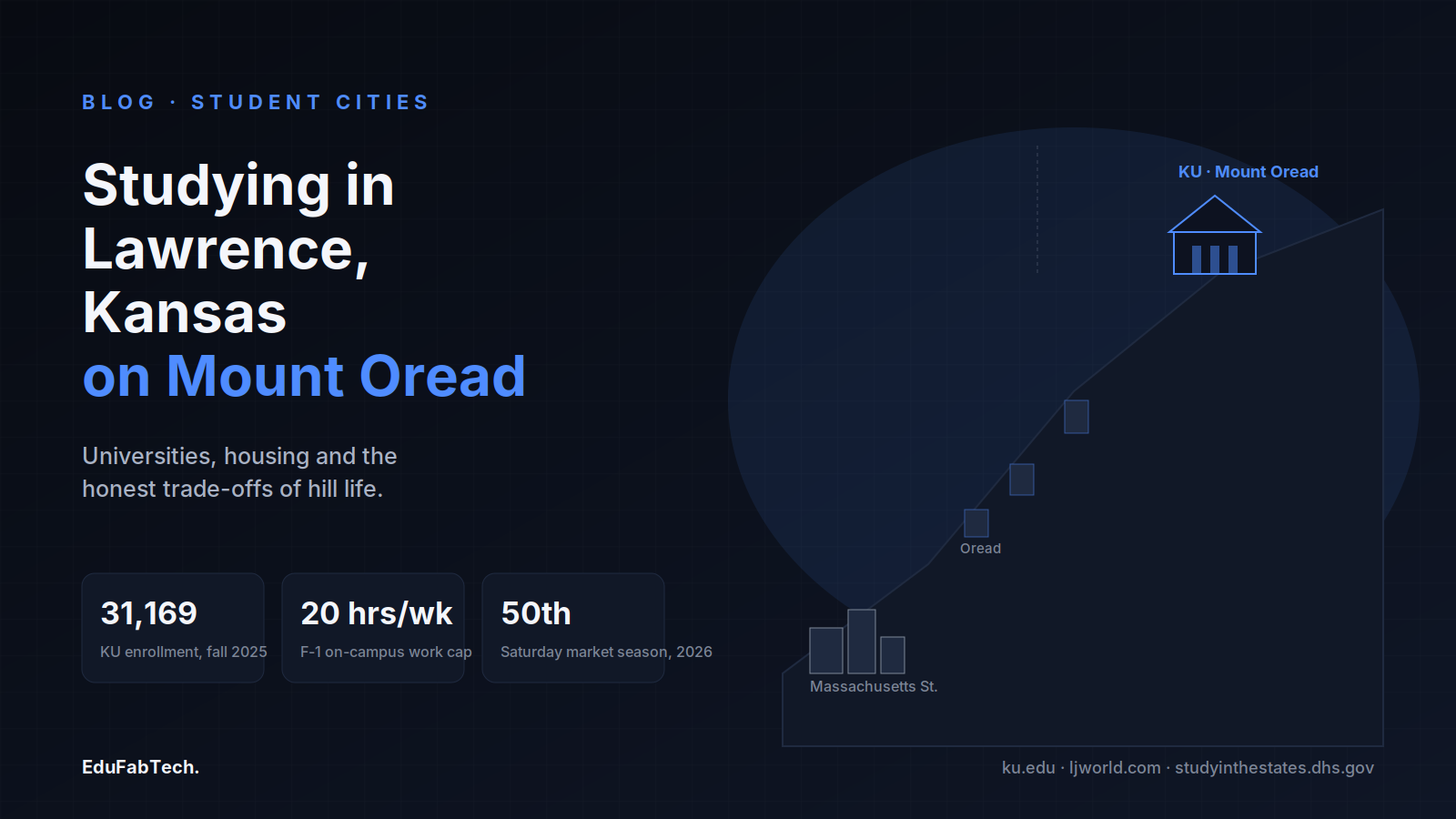
Lawrence sits on a ridge above the Kansas River in the northeast corner of the state, roughly between Kansas City and Topeka. The ridge has a name — Mount Oread — and the University of Kansas has stood on top of it since the campus opened, so the city and its biggest university are physically layered: downtown along Massachusetts Street at the bottom of the hill, the campus and its limestone buildings at the top, and student neighbourhoods filling the slopes between them. It is a town built around walking uphill to class and coasting back down afterwards, and that geography shapes almost every decision a student makes here, from which bus to take to how much a room costs.
For a city of its size, Lawrence carries an unusually dense student population and a settled reputation as a college town rather than a city that happens to have a college. That has advantages — a walkable centre, live music, a long-running Saturday market — and costs, chiefly that the rental market tightens hard every August. This guide covers the universities, where people live and how to rent without being cheated, furnishing a room cheaply, work rules for international students, study spaces, transport and what it actually costs, with the trade-offs stated plainly.
If you want to see current student listings in the city as you read, EduFabTech keeps them collected at /in/united-states/lawrence-ks.
The universities on and around the hill
The University of Kansas (KU) is the anchor. Its main campus is in Lawrence, on the Mount Oread ridge, and KU's own about page traces the institution "from our first class of 55 students in 1866 to our current enrollment of over 31,000" (ku.edu/about). The Lawrence Journal-World reported in October 2025 that KU set a record for the second straight year, with overall enrolment reaching 31,169 students and the Lawrence campus (which includes the Edwards Campus in Johnson County) growing to 27,212 (ljworld.com). KU is a public research university that runs on a semester calendar, with schools that include engineering, business, journalism, nursing, law and pharmacy. Listings near the campus are gathered at /near/university-of-kansas.
Haskell Indian Nations University is also in Lawrence, on the south side of town, and it is unlike any other school a student here will encounter. The Haskell Foundation describes it as "founded in 1884 as a residential boarding school for American Indian children" that has since grown into an accredited university offering both associate and baccalaureate degrees, with alumni "representing more than 140 tribes nationwide" (haskellfoundation.org). It is a federally run institution serving Native American students, and its campus and the surrounding wetlands are part of the south side of the city. Its listings sit at /near/haskell-indian-nations-university.
Baker University is a short drive south, in Baldwin City in the same county. Baker describes itself as "founded in 1858 as the first university in Kansas," a small private institution with long-standing ties to the United Methodist Church, set on a campus that doubles as a registered arboretum (bakeru.edu/about). It is a different experience from KU — small classes, a village setting rather than a city one — and students who choose it generally live in Baldwin City rather than Lawrence. Its listings are at /near/baker-university.
Where students actually settle
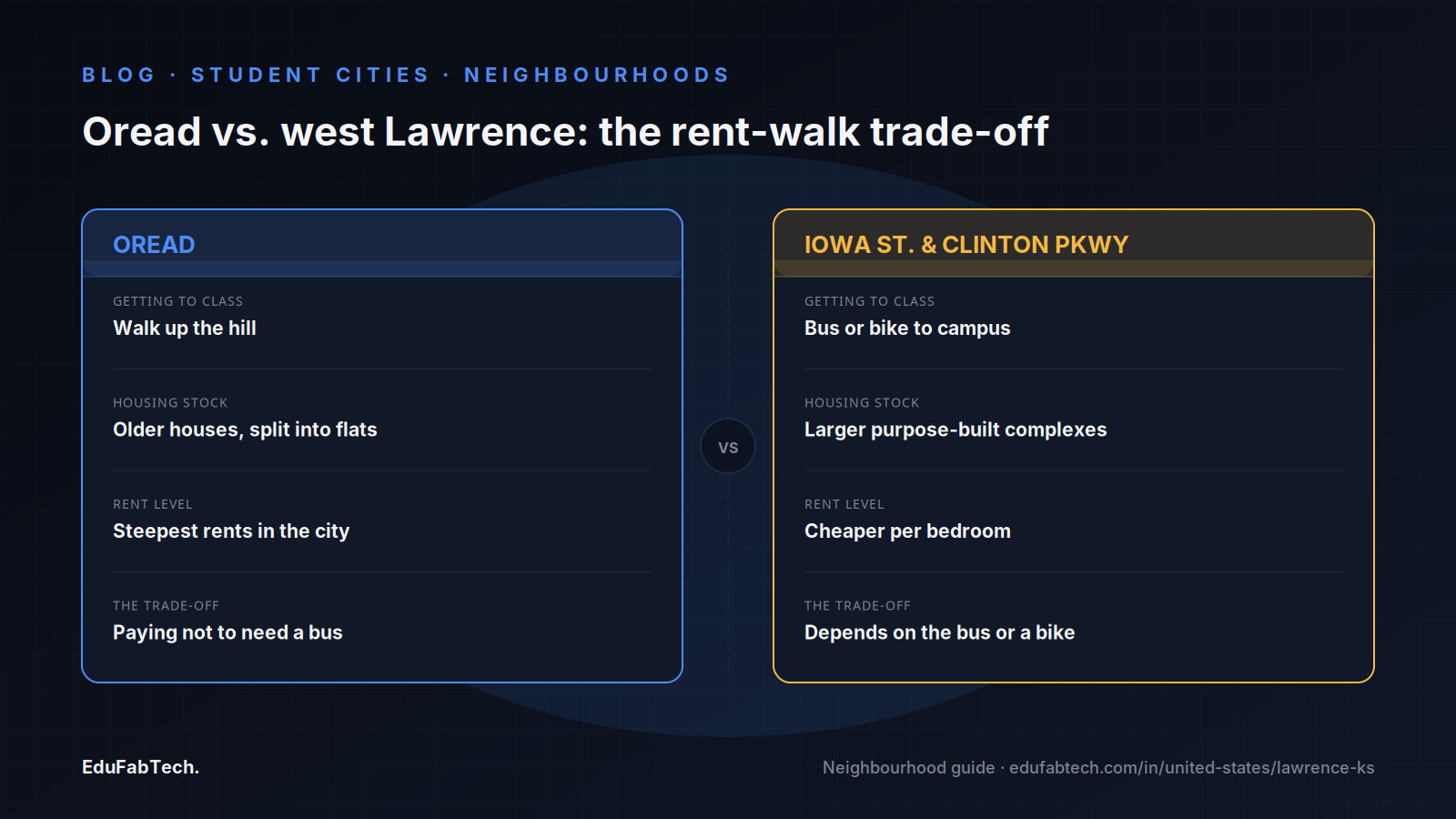
The closest-in student neighbourhood is Oread, the grid of streets wrapped around the north and east edges of campus. This is the classic walk-to-class territory: older houses split into apartments, a handful of purpose-built blocks, and the steepest rents because you are paying not to need a bus. Down the hill toward the river, East Lawrence and the blocks behind Massachusetts Street are quieter, a little cheaper, and put you within walking distance of downtown's cafes, the library and the Saturday market rather than the lecture halls. Farther west and south — around Iowa Street and Clinton Parkway — the housing turns toward larger apartment complexes aimed at students, often cheaper per bedroom but dependent on the bus or a bike to reach campus.
First-year KU students largely live in university housing on or beside campus, in the residence halls strung along Daisy Hill and in the scholarship halls, where residents share cooking and cleaning in exchange for lower rent. After the first year most students move off campus, which is where the real rental market begins — and where the timing matters. Browse rooms collected for the city at /in/united-states/lawrence-ks/rooms.
Renting without being cheated
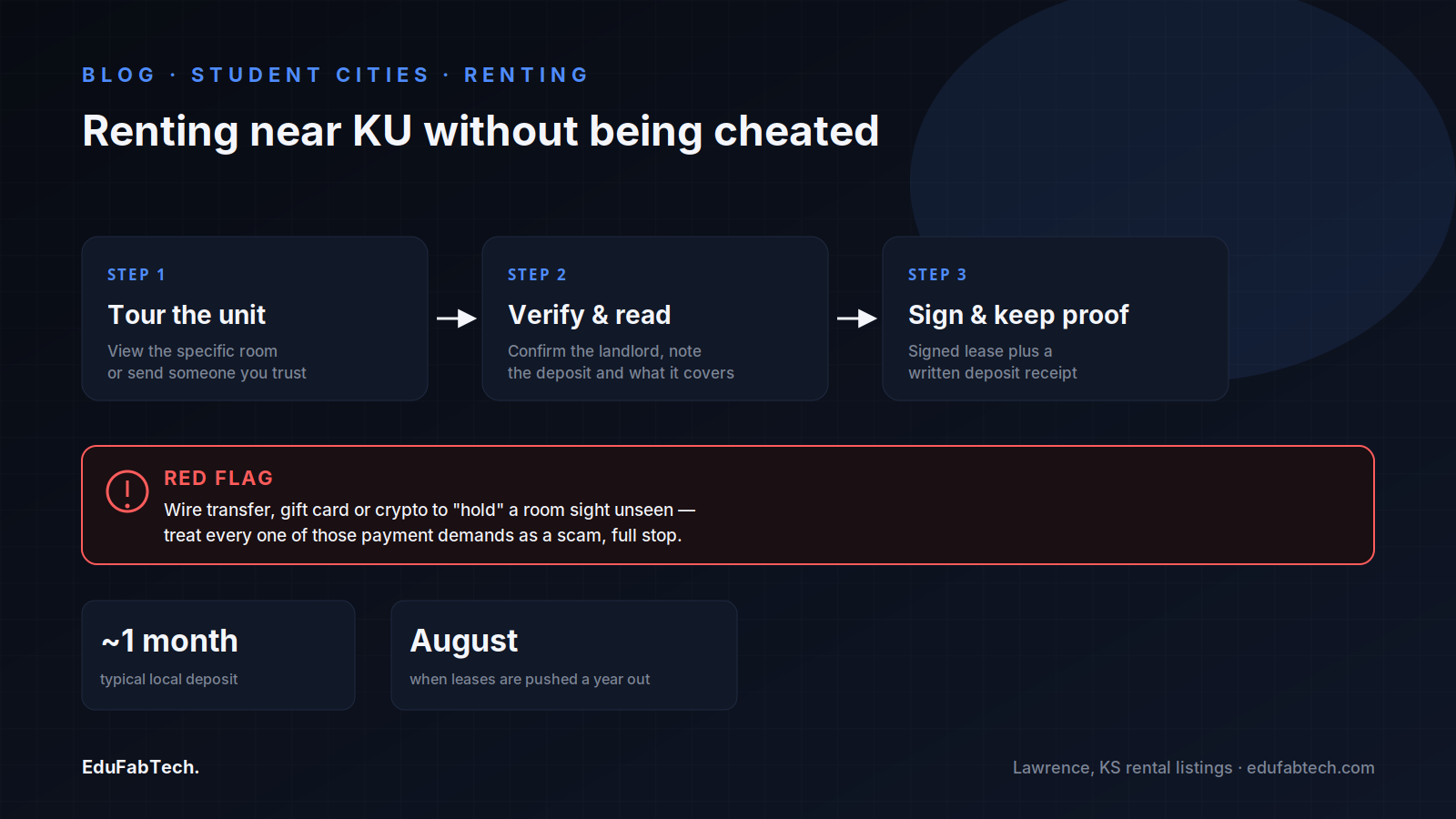
Lawrence has a short, sharp leasing season. Landlords and large complexes near KU often push students to sign for the following August as early as the preceding autumn, which creates pressure to commit to a place — and hand over money — long before you can see it. That pressure is exactly what rental scams exploit. The most common pattern aimed at students here is a listing for an Oread or west-side apartment priced a little below the others, posted by someone who says they are out of town and asks you to wire a deposit or pay with a gift card or cryptocurrency to "hold" the room before you tour it. Treat any of those payment demands as a scam, full stop: a legitimate Lawrence landlord will let you see the actual unit, or a comparable one in the same building, and will take a deposit by normal means with a signed lease and a written receipt.
Before you pay anything: view the specific unit in person or have someone you trust do it; confirm the person collecting rent is genuinely tied to the property; read the lease and note the deposit (a deposit of around one month's rent is typical locally) and exactly what it covers; and never send money by bank wire, gift card or crypto to reserve a room sight unseen. If a deal is only available if you pay today, that urgency is the warning, not the opportunity. Arriving from abroad makes in-person viewing harder — if you cannot visit before term, lean on university housing for the first year or a short initial lease, and tour before signing anything longer.
Furnishing a room cheaply, and the markets
Lawrence is a good town for second-hand things, largely because the student turnover each May pushes furniture, bikes and kitchenware back into circulation as leases end — the end-of-semester giveaways and resale are where the real savings sit. Downtown's Massachusetts Street — "Mass Street," the city's spine — is lined with independent shops; Explore Lawrence notes that the city "glories in locally-owned shops" (explorelawrence.com), among them vintage and resale stores better suited to clothes, records and small finds than to a sofa. For big furniture, watch the May move-out window and the EduFabTech listings below.
For food and local goods, two markets are worth knowing, both listed by Explore Lawrence. The Lawrence Farmers Market runs Saturdays, 7:30–11:30 a.m., April through November, in the parking lot at 824 New Hampshire Street downtown, with over 80 vendors; the smaller Cottin's Hardware Farmers Market runs year-round at 1832 Massachusetts Street, 4:00–6:30 p.m. April–September and 4:00–6:00 p.m. October–March (explorelawrence.com). The Journal-World reported that the Saturday market had its first season in 1976 and is celebrating its 50th season in 2026 (ljworld.com). EduFabTech also collects local second-hand goods at /in/united-states/lawrence-ks/second-hand, furniture at /in/united-states/lawrence-ks/furniture and free items at /in/united-states/lawrence-ks/free-stuff.
Part-time work, and the rules for international students
Plenty of students work part-time in Lawrence — in campus dining and libraries, in the Mass Street shops and restaurants, and in local services. For students on an F-1 visa, the rules are specific and worth reading from the source rather than from hearsay. The U.S. Department of Homeland Security's Study in the States site states that on-campus employment is open to F-1 students whose status is active in SEVIS, that you may apply up to 30 days before classes start, and that you "may not work more than 20 hours per week when school is in session" (studyinthestates.dhs.gov). It also notes that any student who wishes to work must apply for a Social Security Number, and that off-campus employment for F-1 students is a separate category with its own authorisation. The single most useful step is to talk to your Designated School Official (DSO) in KU's international office before accepting any job; this guide is not legal advice, and your DSO and the DHS page are the authorities that bind. Local openings are gathered at /in/united-states/lawrence-ks/jobs.
Libraries and places to study
KU Libraries run a network of locations across campus rather than one central building. Watson Library holds the main general collections; Anschutz Library is the heavily used study-and-research building; Spencer Research Library houses special collections and archives; and there are branches for art and architecture, music and dance, and engineering (the Spahr Engineering Library), with current hours and study-room booking listed at lib.ku.edu/locations-hours. Beyond the university, the Lawrence Public Library downtown is open to everyone, a useful neutral ground away from campus crowds and a reminder that not every desk in this town belongs to KU. If you want a desk near where you live rather than at the top of the hill, EduFabTech lists study spaces at /in/united-states/lawrence-ks/study-spaces.
Getting around: two fare-free bus systems
Lawrence is small enough to walk or bike across, and the city is flat along the river and steep only on the hill itself. Its public transport is also, unusually, free to ride. The City of Lawrence's transit page states plainly that "Lawrence Transit fixed-route and paratransit buses are free"; the only charge is a newer On Demand service at a $3 one-way fare, which the page says began on 1 March 2026 (lawrencetransit.org/fares/). Alongside the city routes, KU on Wheels runs the campus bus network, which KU students ride free by showing a KU ID, funded through a student fee that the student body approved in 2008 to make the buses fare-free (transportationservices.ku.edu). The practical upshot is that you can live on the cheaper west side and commute to campus without ever paying a fare — a real saving over a year. Check current routes and times on the operators' own pages before you rely on a particular stop, since schedules thin out on weekends and during breaks.
What it costs
The clearest, dated housing figures come from KU's own residence system. For the 2026–2027 academic year, KU Student Housing lists residence-hall rates ranging from $7,242 to $13,564 per academic year, per person, with the cheapest option a two-person room with a sink in Ellsworth or Hashinger Hall at $7,242; the scholarship halls, where residents share the chores, run from $3,568 to $5,894 a year (Miller and Watkins Halls are the lowest at $3,568). The page is explicit that "a KU dining plan is required for a residence hall contract, and is NOT included" in those numbers (housing.ku.edu/2026-2027-rates). Those figures are a reliable anchor; off-campus rents vary too much by neighbourhood, unit and lease date to quote a single trustworthy number here, so treat the dorm rates as your baseline and compare individual listings against them.
Beyond rent, the two biggest swings in a Lawrence student budget are the required dining plan (if you live in a residence hall) and transport — and transport, as above, can be close to zero if you use the free buses and a bike. Food costs can be trimmed at the Saturday market and the second-hand economy; textbooks and furniture are where the May turnover saves real money.
The honest trade-offs
What is good about Lawrence for a student is tangible: a compact, walkable town where the university, downtown and the river are all within reach on foot or on a free bus; a strong second-hand and market culture; a genuine college-town atmosphere with music and independent shops rather than a generic campus strip; and a public-transit system that does not charge you to use it. The academic draw is real too, from KU's breadth of programmes to Haskell's singular place in Native education.
What is hard is mostly about housing and scale. The rental market is tight and front-loaded, so students who wait until summer to look often find the best-located, best-priced rooms gone, and the pressure to sign early is precisely what scammers exploit. The city is small, which is charming until you want the amenities, nightlife variety or job market of a large metro — Kansas City is close but not walkable, and you will likely need a car or a rideshare to reach it. Winters are cold and summers are hot and humid, and Mount Oread's slope, pleasant on the way down, is a daily climb on the way up. None of this is unusual for a Midwestern college town, but it is worth knowing before you arrive expecting a big city.
A short checklist for the first weeks
- Sort housing first, and never wire money, buy gift cards or send crypto to hold a room you have not seen. View the actual unit; expect a deposit near one month's rent with a signed lease and a written receipt.
- If you are an international student, meet your DSO in KU's international office before taking any job, and read the DHS Study in the States rules on the 20-hours-per-week on-campus limit; apply for a Social Security Number if you will work.
- Get your KU ID and learn the two bus networks — city Lawrence Transit and campus KU on Wheels — both fare-free for the fixed routes; a bike covers the rest of the compact town.
- Walk Massachusetts Street for the resale and vintage shops and go to the Saturday Lawrence Farmers Market early; furnish from the May turnover and the EduFabTech free-stuff and second-hand listings.
- Find your study base early — Anschutz and Watson on campus, the Lawrence Public Library downtown — and check current hours at lib.ku.edu before finals week, when demand for desks peaks.
A quick question for readers
Do you work part-time while you study?
Many students work to pay the bills. See how common it is — and how many hours people really do.
Pick an answer, create a free account in a minute, and your vote counts. Already a member? Sign in
Source: University of Kansas Student Housing
Sources (5)
- University of Kansas Student Housing. 2026-2027 Rates. University of Kansas, 2026. housing.ku.edu ↗ · checked 7 Oct 2026
- Lawrence Transit. Fares. City of Lawrence, Kansas, 2026. lawrencetransit.org ↗ · checked 7 Oct 2026
- Study in the States. Working in the United States. U.S. Department of Homeland Security, 2025. studyinthestates.dhs.gov ↗ · checked 7 Oct 2026
- Rochelle Valverde. KU sets record enrollment for second straight year; total student numbers top the 31K mark. Lawrence Journal-World, 2025. www2.ljworld.com ↗ · checked 7 Oct 2026
- Explore Lawrence. Farmers Markets. Explore Lawrence (Douglas County CVB), 2026. explorelawrence.com ↗ · checked 7 Oct 2026