Studying in Lebanon, New Hampshire: universities, housing and student life
A practical, sourced guide to living and studying in Lebanon and the Upper Valley — Dartmouth and Thayer a few miles north in Hanover, free Advance Transit buses, where rooms are, and what they cost.
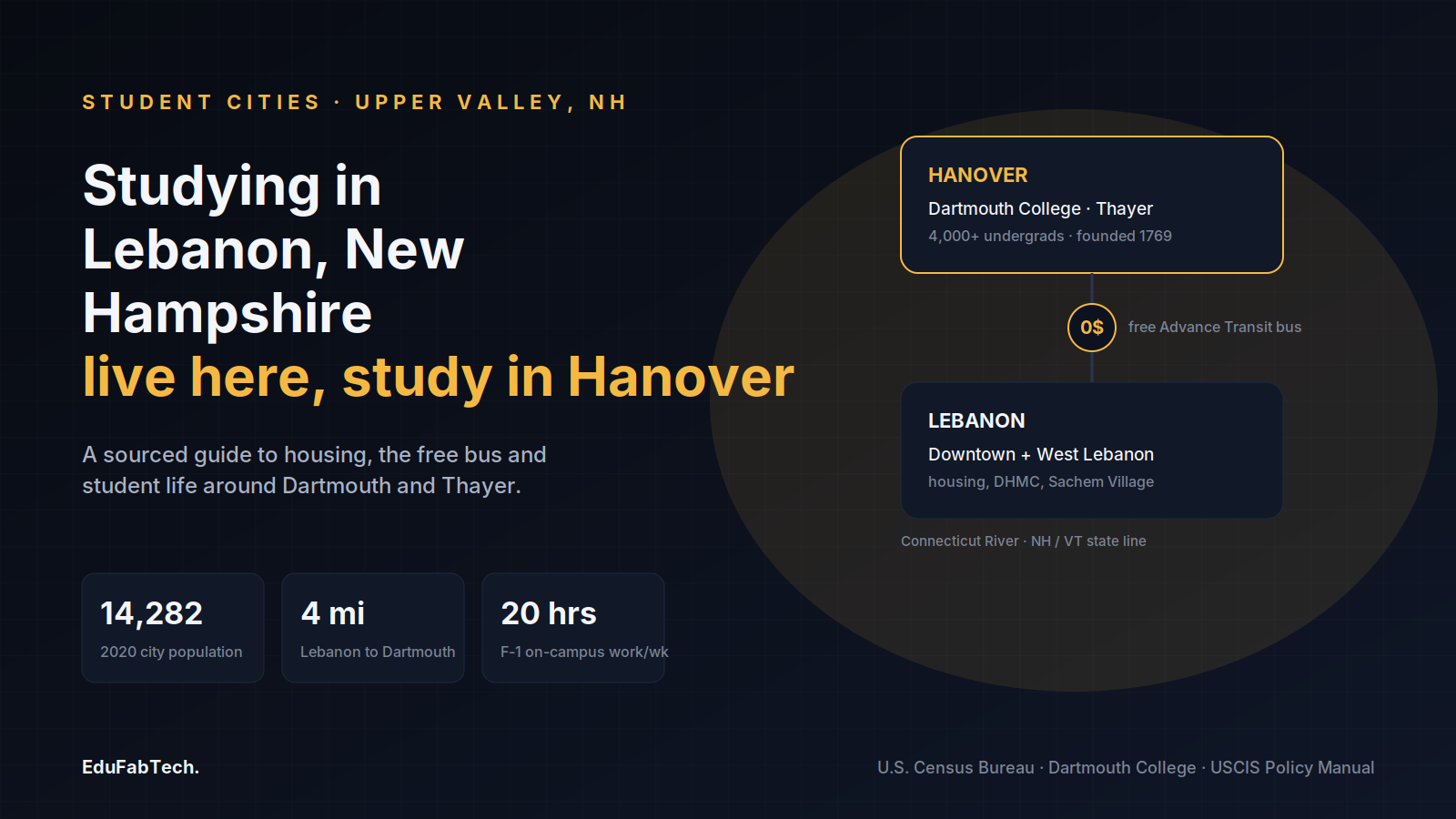
Lebanon sits on the New Hampshire bank of the Connecticut River, which here forms the border with Vermont, and it is the only incorporated city in Grafton County. It anchors the cluster of towns on both sides of the river known as the Upper Valley, a region with no single large city but a lot of shared life: people cross the state line several times a day without thinking about it. The population recorded at the 2020 census was 14,282, according to the U.S. Census Bureau. That makes Lebanon small by the standards of most college towns — but it carries more weight than its size suggests, because it is home to Dartmouth Hitchcock Medical Center, a major teaching hospital, and it sits a few minutes from one of the oldest universities in the country.
That is the thing to understand first. The degree-granting institutions are not in Lebanon itself; they are just across the town line in Hanover. So a student's life in Lebanon is a slightly unusual arrangement: you often live, shop, eat and do laundry in one town and study in another, stitched together by a free bus. It works well, but it shapes every decision about where to live and how to get around.
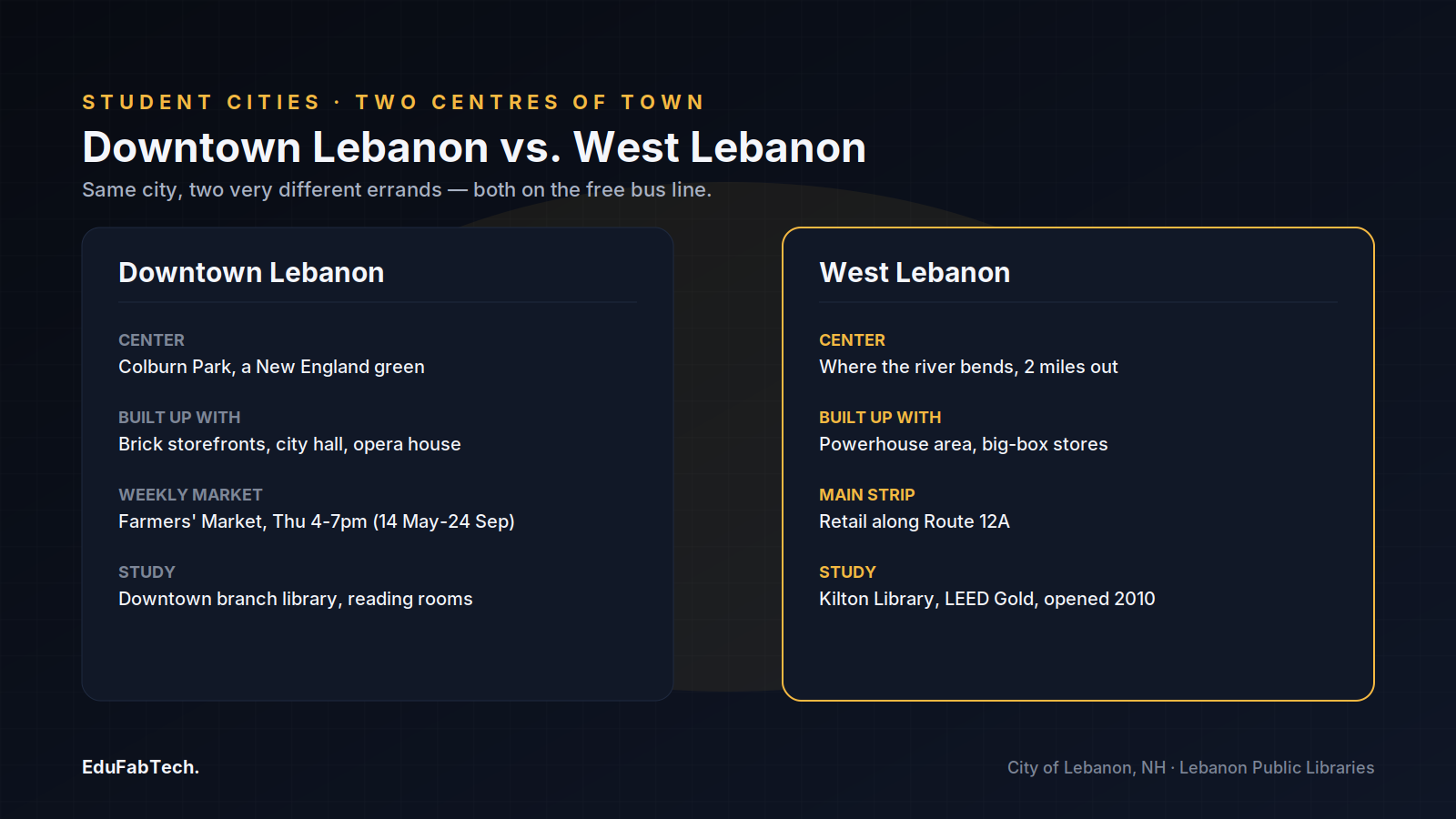
Lebanon has two distinct centres. Downtown Lebanon is built around Colburn Park, a classic New England green ringed by brick storefronts, the city hall and the opera house. West Lebanon, a couple of miles away where the river bends, is the commercial end — big stores, the Powerhouse area, the retail strip along Route 12A — and it is where a lot of the everyday errands actually happen. Knowing which part of town someone means when they say "Lebanon" saves a lot of confusion.
Dartmouth, Thayer, and studying just over the town line
The main reason students are in Lebanon at all is Dartmouth College, four miles north in Hanover. Dartmouth's own About page describes it as founded in 1769, with "4,000+ Undergraduates" and a 7-to-1 undergraduate student-to-faculty ratio, according to Dartmouth College. It is an Ivy League institution and one of the small number of colleges that pre-date American independence. Undergraduate life is concentrated on the Hanover campus around the Green; the surrounding woods, the river and the White Mountains are close enough that outdoor life is a genuine part of the culture rather than a brochure line.
Engineering at Dartmouth runs through the Thayer School of Engineering, also in Hanover. Thayer traces its founding to 1867, endowed by the Dartmouth graduate and West Point superintendent Sylvanus Thayer, and it describes its signature undergraduate path as a Bachelor of Arts in engineering sciences followed by a five-year Bachelor of Engineering, with graduate work up to the PhD and a long-running Master of Engineering Management, according to the Thayer School of Engineering. Thayer's pitch is deliberately broad: it teaches engineering without hard departmental walls, alongside the liberal arts, so students move between disciplines more freely than at a conventional engineering faculty.
One institution often listed with the Upper Valley is Kimball Union Academy, but it is a secondary boarding school in the village of Meriden, not a degree-granting college, and it is not in Lebanon — so it is not somewhere you would enrol as a university student. For a sense of what else is listed locally, EduFabTech keeps a running set of student listings for the city at /in/united-states/lebanon-nh and listings gathered around campus at /near/dartmouth-college.
Where students live when the campus is in another town
Housing in the Upper Valley is tight, and that is the single most important fact for anyone arriving. Demand comes from three directions at once — Dartmouth students and staff, the thousands of people who work at Dartmouth Hitchcock Medical Center, and a limited supply of rental stock in a region of small towns. The practical result is that rooms go quickly and prices are high for a place this size.
Most students live in one of a few ways. Undergraduates typically stay in Dartmouth's residential houses in Hanover. Graduate students, medical residents and anyone priced out of Hanover often look in Lebanon proper, where Dartmouth also runs family and graduate housing at Sachem Village on the Lebanon side of the line, a few miles from the Hanover campus. Beyond university housing, the realistic options are a room in a shared house or a flat in downtown Lebanon or West Lebanon, where rents tend to be lower than directly beside the college and the free bus still reaches you.
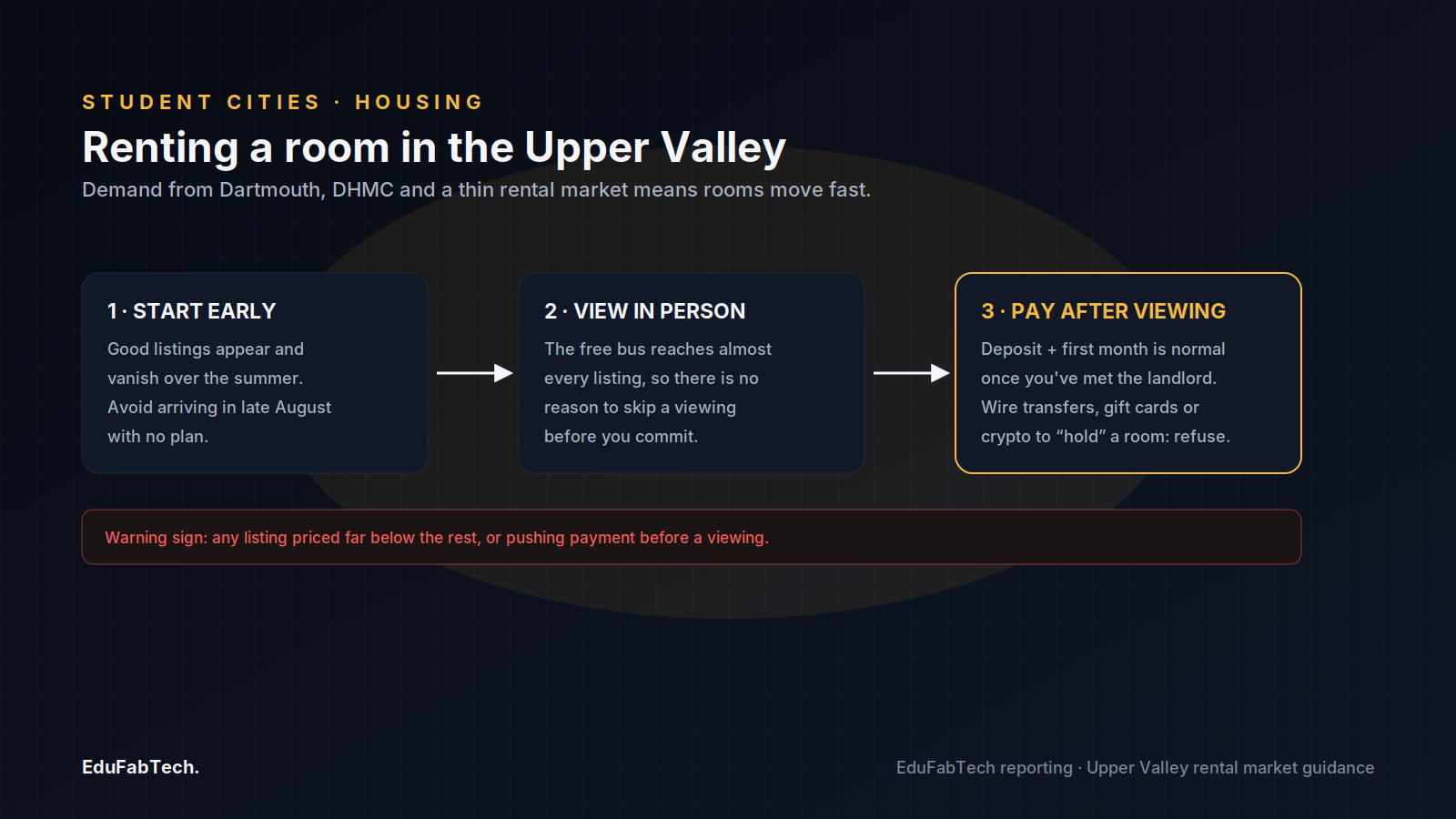
Start looking early. Because the market is thin, the good listings appear and vanish within the summer, and the worst time to arrive without a plan is late August, when the hospital's new intake and the college term collide. If you can, line up a short-term or temporary place first and search for the real room once you are on the ground and can view in person. EduFabTech's room listings for the city are at /in/united-states/lebanon-nh/rooms.
On avoiding scams, the pattern in the Upper Valley is specific: because so many people are hunting for anything "near Dartmouth" or "near DHMC," listings that are priced noticeably below everything else, or that push you to commit before viewing, deserve suspicion. The region is compact and the buses are free, so there is almost never a good reason you cannot see a place in person before paying — do that. A deposit and first month's rent paid after you have stood in the room and met the person renting it is normal; a request to wire money, send a gift card, or pay in cryptocurrency to "hold" a room you have not seen is the warning sign, every time. Never transfer a deposit to secure a place sight-unseen, however plausible the story about why the owner cannot meet you.
Furnishing a room without spending much
The Upper Valley has an unusually good second-hand economy for its size, largely because of LISTEN Community Services. LISTEN — the name stands for Lebanon In Service To Each Neighbor — was incorporated in the winter of 1972 and runs thrift stores in Lebanon, Canaan and White River Junction, Vermont, with proceeds funding food, heating and housing help for local residents, according to LISTEN Community Services. The Lebanon store sits on Miracle Mile and is the obvious first stop for a bed frame, a desk, kitchen things and winter clothing at a fraction of new prices — and because it is a charity, your spending does something useful locally.
In the warmer months, the Lebanon Farmers' Market runs in Colburn Park downtown on Thursday afternoons from 4 to 7 p.m.; the City of Lebanon lists the 2026 season as running from 14 May to 24 September, according to the City of Lebanon. It is the easiest way to buy local produce and get a feel for the town's rhythm. For the hunt beyond the thrift store — people selling up at the end of a term, or giving things away outright — EduFabTech tracks second-hand goods and free items for the city at /in/united-states/lebanon-nh/second-hand.
Part-time work and the rules behind it
Students on an F-1 visa should know the basic shape of the rules before counting on a wage. United States immigration guidance allows an F-1 student to work on campus for up to 20 hours per week while school is in session, and full-time during official breaks, generally without separate work authorisation; off-campus work is far more restricted, especially in the first academic year, according to the USCIS Policy Manual (Volume 2, Part F, Chapter 6). This is a summary, not advice for your situation: the people who can tell you what you are actually permitted to do are the Designated School Officials in your institution's international office, and you should talk to them before accepting any job. On-campus roles — library desks, dining, labs, administrative work — are the usual route because they fit the rules and the term calendar. Local job listings gathered for the city are at /in/united-states/lebanon-nh/jobs.
Libraries and places to study
Lebanon Public Libraries runs two branches, which is generous for a city this size. The Kilton Public Library in West Lebanon opened in July 2010 and was built to a high environmental standard — the city describes it as the first LEED Gold new library in New Hampshire — and it keeps regular weekday and weekend hours, according to the City of Lebanon. The downtown branch on the green rounds out the public provision with reading rooms and bookable community space. For most degree students, though, the serious study happens at Dartmouth's libraries in Hanover, with Baker-Berry Library as the main hub — easy to reach on the free bus and a natural place to settle in between classes. Desks, quiet corners and study-space listings for the city are collected at /in/united-states/lebanon-nh/study-spaces.
Getting around: the free bus is the whole system
The Upper Valley's public transport is Advance Transit, and its defining feature is that it is free. Advance Transit describes itself as providing "free bus service in the Upper Valley" across six communities in New Hampshire and Vermont — Hanover, Lebanon, Hartford, Norwich, Enfield and Canaan — on fixed weekday routes, according to Advance Transit. There is no fare and therefore no fare card to buy or top up. For students the key line is the Blue route, which links downtown Lebanon with Dartmouth's campus, the medical center and Hanover; other routes reach West Lebanon and White River Junction. Because there is no ticket to worry about, the practical constraints are the timetable and the fact that service is lighter in the evenings and on weekends — plan around the schedule rather than the cost.
For longer trips, Dartmouth Coach runs scheduled buses from Hanover to Boston's South Station and Logan Airport and to New York City, according to Dartmouth. That matters a lot in a region with no passenger rail station in town and a small local airport: the coach is how most students without a car get to a major airport or a big city. Within the Upper Valley itself, many people cycle or walk in the warmer months, but distances between the two ends of Lebanon are real and the winters are long, cold and snowy, so a reliable plan for dark, icy mornings is part of living here.
What it costs
Lebanon is not a cheap place to rent, and the numbers bear that out. The U.S. Census Bureau reports a median gross rent of $1,744 for Lebanon city over the 2020–2024 period, with a median value of owner-occupied homes of $385,400 and an owner-occupancy rate of 51.2 percent, according to the U.S. Census Bureau QuickFacts. A median gross rent is the midpoint for whole units across the city, not what a student pays for one room in a shared house — a room is usually less — but it is a fair signal that housing is the dominant line in any Upper Valley budget, well above what students pay in many inland American college towns. Against that, the free Advance Transit bus genuinely removes a recurring cost that students elsewhere carry every month, and the thrift economy keeps the one-off cost of setting up a room low. The honest framing is that transport and furnishing can be cheap here, but the roof over your head will not be.
What is good, and what is hard
The good is real. For a city of its size, Lebanon gives students an outsized set of institutions — a leading university and its engineering school minutes away, a major teaching hospital, two public libraries, a working downtown around a green — and a free public transport network that most larger cities would envy. The setting is genuinely beautiful: the river, the hills and the outdoors are on the doorstep, and the pace is calm. The community is small enough that people recognise each other, and the second-hand and farmers'-market culture makes frugal living pleasant rather than grim.
The hard parts are equally real and worth naming before you commit. Housing is scarce and expensive, and the competition from hospital and university workers is relentless, so finding the right room takes effort and early planning. Winters are long and the dark comes early; without a car you are tied to a bus timetable that thins out in the evening. The city is small, so if you want the noise and variety of a big urban scene, you will travel for it — Boston and New York are a coach ride, not a walk. And because the degree institutions are in Hanover rather than Lebanon, student life can feel split across two towns until you find your routine. None of this is a reason to stay away; it is simply the shape of the place.
A short checklist for your first two weeks
- Register with your institution's international office straight away, and ask the Designated School Officials what work, if any, you may do before you rely on a wage.
- Pick up an Advance Transit route map and learn the Blue route between Lebanon and Hanover; there is no fare to arrange, so this is pure timetable planning.
- Do not pay any deposit for a room you have not seen in person — and never by wire transfer, gift card or cryptocurrency.
- Furnish from the LISTEN thrift store on Miracle Mile before buying anything new.
- Get a Lebanon Public Libraries card and find your study spots — Kilton in West Lebanon, the downtown branch, and Dartmouth's Baker-Berry in Hanover.
- If you arrive in the warmer half of the year, go to the Thursday farmers' market in Colburn Park; it is the quickest way to feel at home.
- Sort out a plan for winter mornings — proper boots, a coat, and a bus you can count on in the dark.
Lebanon rewards students who plan: settle the housing, learn the bus, and the rest of the Upper Valley opens up cheaply from there.
A quick question for readers
Do you work part-time while you study?
Many students work to pay the bills. See how common it is — and how many hours people really do.
Pick an answer, create a free account in a minute, and your vote counts. Already a member? Sign in
Source: U.S. Census Bureau
Sources (5)
- U.S. Census Bureau. QuickFacts: Lebanon city, New Hampshire. U.S. Census Bureau, 2024. census.gov ↗ · checked 6 Oct 2026
- Dartmouth College. About. Dartmouth College, 2026. home.dartmouth.edu ↗ · checked 6 Oct 2026
- Advance Transit. Fare-free Upper Valley Public Transit. Advance Transit, 2026. advancetransit.com ↗ · checked 6 Oct 2026
- LISTEN Community Services. Who We Are. LISTEN Community Services, 2026. listencs.org ↗ · checked 6 Oct 2026
- U.S. Citizenship and Immigration Services. Policy Manual, Volume 2, Part F, Chapter 6: Employment. USCIS, 2026. uscis.gov ↗ · checked 6 Oct 2026