Studying in Leicester: universities, housing and student life
A practical, sourced guide to Leicester's universities, the neighbourhoods students rent in, what a room costs, second-hand kit, libraries, buses and the honest trade-offs.
Leicester sits almost exactly in the middle of England, a dense, flat, walkable city in the East Midlands where the two main universities are a short walk apart and a great deal of student life happens on foot. It is one of the United Kingdom's most ethnically mixed cities, and that is obvious within an hour of arriving: the jewellers and grocers along Belgrave Road, the long-standing vegetarian restaurants, the range of places of worship, the food stalls in the centre. Visit Leicester's own guide calls Belgrave Road the "Golden Mile", home to "the largest Diwali celebrations outside Asia", which fall in early November and are worth planning around if you arrive in autumn.
The city also carries an outsized research story for its size. The University of Leicester's genetics department is where Sir Alec Jeffreys developed DNA fingerprinting in 1984, and the university went on to lead the 2012 excavation and 2013 identification of the skeleton of King Richard III, found beneath a council car park in the centre, as the university's own account records. None of that tells you where to live or what a room costs, which is what the rest of this guide covers.
The universities, named
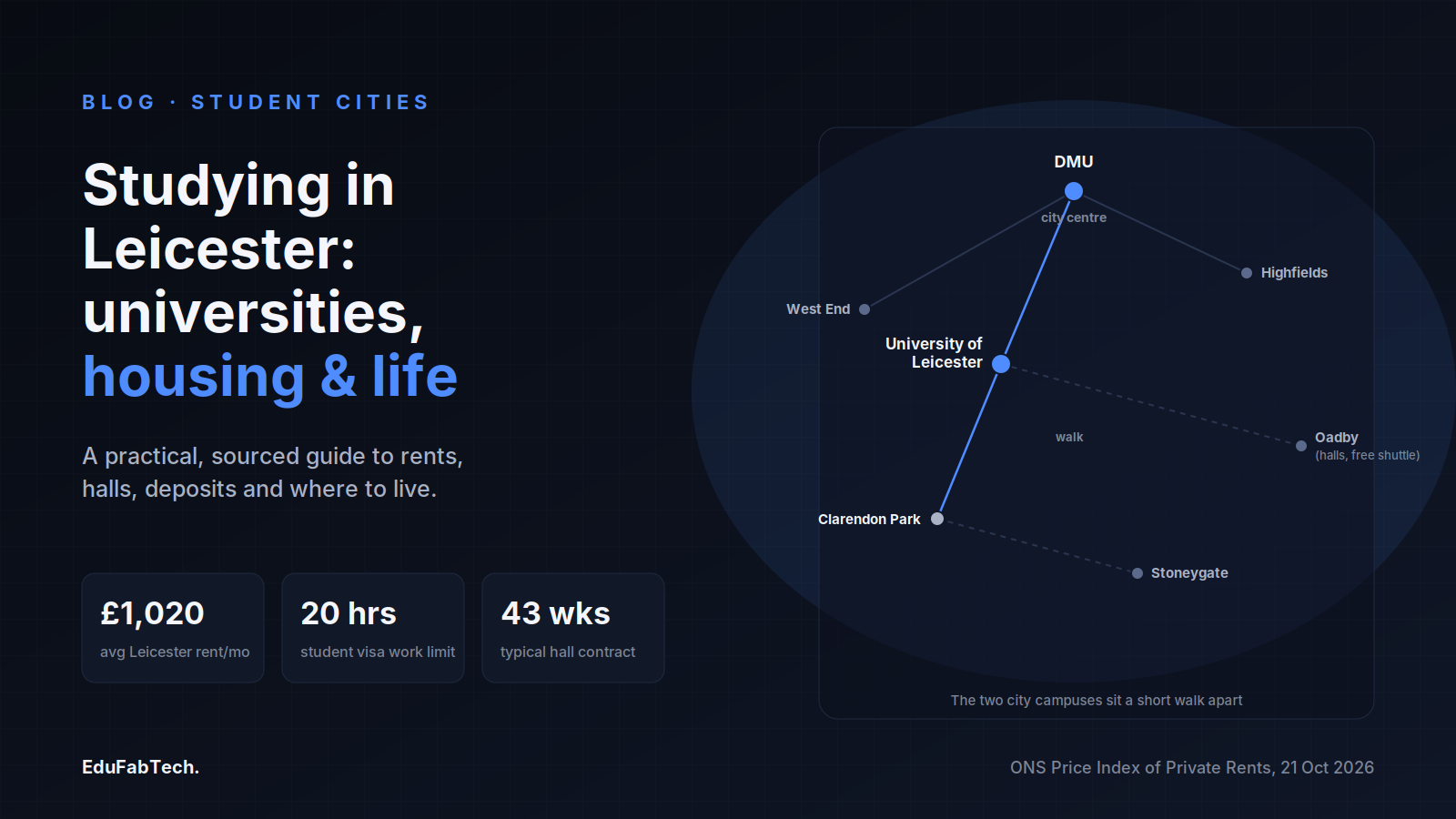
The University of Leicester has a compact campus about a mile south of the city centre, beside Victoria Park, and traces its teaching back to 1921 and its royal charter to 1957, per its campus history pages. Alongside genetics it is known for space and planetary science, archaeology and medicine. De Montfort University (DMU) is the city-centre option, built around The Gateway and the Grade II-listed Queen's Building; its own site describes it as "a campus-based university situated in the city centre", with particular strengths in art and design, media, law and health subjects. The two campuses are close enough that students routinely mix between them.
Loughborough University sits in the town of Loughborough, a short train ride north of Leicester, on a single large green campus. It is above all a sports university: its about page describes it as "number one in the world for sports-related subjects 10 years running" in the QS World University Rankings, and the campus hosts national governing bodies and elite training alongside degree teaching. If sport or sports science is your field, it is the obvious local choice.
Two further universities are a separate city to the south-west, in Coventry, which has its own student scene: Coventry University, with a city-centre campus, and Arden University, headquartered in Coventry and specialising in online and blended distance learning, which earned its own taught-degree awarding powers in 2014. Closer to Leicester, the Markfield Institute of Higher Education in the village of Markfield is a small, specialist centre for Islamic higher education whose undergraduate and postgraduate degrees are validated by partner universities. For vocational and access routes, Leicester College runs several city sites.
The neighbourhoods students settle into
Leicester's student housing map is small and legible. Clarendon Park, immediately south of the University of Leicester, is the classic terraced-house district: streets of red-brick Victorian houses running off Queens Road, which is lined with independent cafés, charity shops and small bars. It is the default for second- and third-year Leicester students who want to walk to campus. Stoneygate, just beyond it, is quieter and leafier, with larger Victorian villas; rooms there tend to cost a little more and attract postgraduates and sharers who want space.
Highfields, closer to the centre and the railway station, is one of the city's most multicultural neighbourhoods and generally cheaper than Clarendon Park, which makes it popular with budget-conscious students, though housing quality varies street by street. The West End, around Narborough Road, is a long run of independent shops, cafés and cuisines on the city's west side; it is affordable and lively, and within reach of both campuses by bike or bus. For University of Leicester students, Oadby — a suburb a few miles south-east — holds several of the university's halls set in parkland, trading a centre-of-town location for green surroundings and a free campus shuttle. Finally, living in the city centre itself suits DMU students in particular, who can reach lectures in minutes but pay for the convenience in purpose-built studios. You can browse what is currently listed across all of these at /in/united-kingdom/leicester.
Signing for a room without losing money
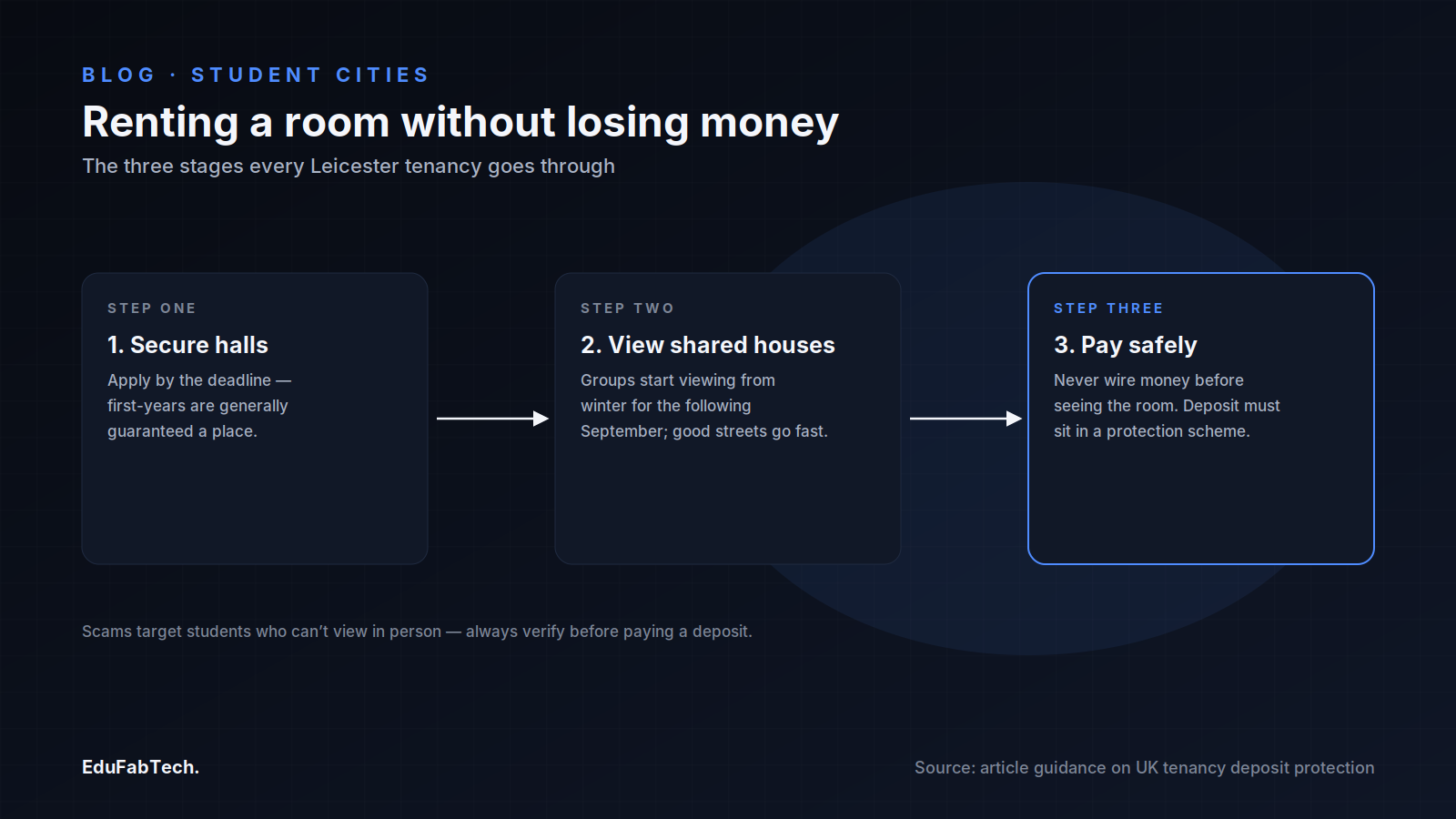
First-year undergraduates at both universities who apply by the published deadline are generally guaranteed a place in university-managed halls, which removes most of the risk for your first year. The pressure comes later: for a shared house in Clarendon Park, Stoneygate or the West End, groups typically start viewing from the winter months for the following September, and the better houses on the walkable streets go first.
Scams in Leicester follow a predictable pattern. They appear most often as too-good-to-be-true rooms advertised on social media and marketplace groups, frequently aimed at international students who cannot view in person before term. The single rule that defends against almost all of them: never send money — a "holding deposit", first month's rent, or anything else — by bank transfer, gift card or cryptocurrency to someone you have not met and a property you have not seen. See the place in person, or over a live video call where the person walks you through the actual rooms, before paying anything. For a shared house, the deposit is usually around a month's rent, and by law it must be placed in a government-backed tenancy deposit protection scheme — ask which one, and get a written tenancy agreement with names and an address before any money moves. Rooms currently advertised in the city are listed at /in/united-kingdom/leicester/rooms.
What a room actually costs — and working to pay for it
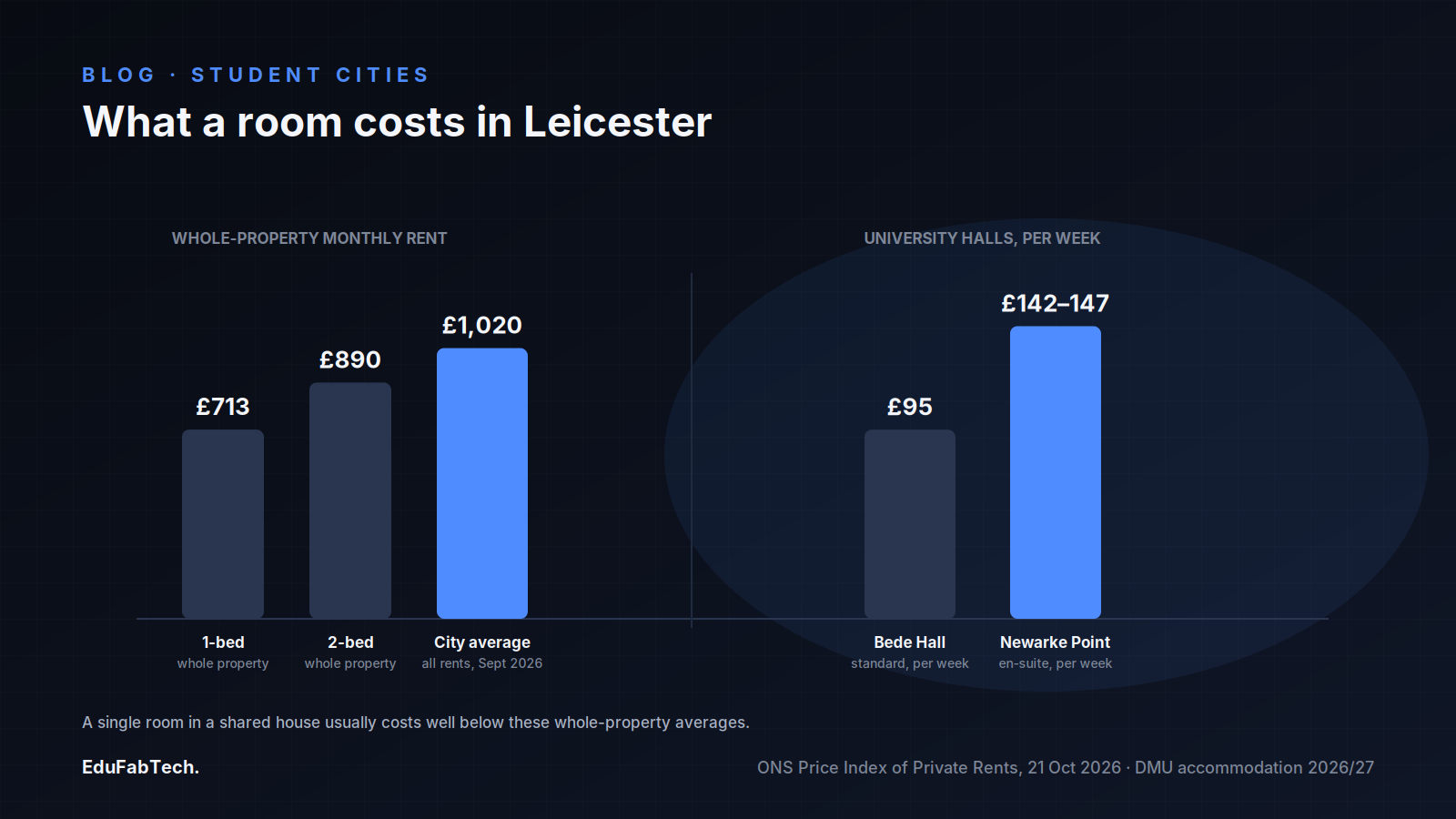
Leicester is one of the cheaper English cities to rent in. According to the Office for National Statistics Price Index of Private Rents, updated on 21 October 2026, the average monthly private rent in Leicester was £1,020 in September 2026, barely changed from £1,011 a year earlier; the same release puts one-bedroom homes at £713 and two-bedroom homes at £890 a month. Those are whole-property figures, so a room in a shared house usually costs well below them.
Halls give you a fixed, bills-included price to compare against. De Montfort University's accommodation pages for 2026/27 list standard rooms at Bede Hall from £95 a week and en-suite rooms at Newarke Point at £142 to £147 a week; most standard contracts run 43 weeks, from Friday 25 September 2026 to Friday 23 July 2027, though Bede Hall's own contract is a little shorter. The University of Leicester publishes its own hall prices, which likewise fold in utilities, Wi-Fi and insurance, on its accommodation search pages; compare the per-week rate and the contract length together, because a cheaper weekly rate on a longer contract can cost more overall.
If you are on a Student visa and plan to work part-time, know the limit before you take a job. UKCISA states that degree-level students can work "Up to 20 hours a week in term time if you are studying for a qualification at degree level or above", and up to 10 hours a week below degree level; UKCISA and the official UK government's Student visa pages also confirm you cannot be self-employed. The 20-hour limit is per week and cannot be averaged, and it covers all your jobs combined — check your own visa conditions, and treat this as a pointer to the official sources rather than legal advice. Part-time openings in the city are collected at /in/united-kingdom/leicester/jobs.
Kitting out a room: the market and the charity stores
A word on Leicester Market, because its status matters right now. The historic covered market is in the middle of a major redevelopment: Leicester City Council confirmed in July 2026 that traders are operating from the outdoor market on Green Dragon Square and the indoor Food Hall while the main square is rebuilt, with rents waived for licensed traders until 31 December 2026; the move back to the rebuilt square is expected around April 2027. So the market is open and useful for cheap fruit, vegetables and household bits — just not yet in its permanent home.
For furniture and appliances, the most reliable budget source is charity retail. The British Heart Foundation runs a dedicated Furniture & Electrical store on Charles Street in the city centre, selling second-hand sofas, beds, wardrobes and appliances with delivery available, and Age UK shops around the city take good-quality furniture too. The timing trick worth knowing: each summer Leicester City Council and the British Heart Foundation run the Pack for Good scheme, placing ten temporary reuse banks from late May until early September on the most-walked student streets — including Queens Road in Clarendon Park and sites around Westcotes and The Newarke — so arriving students can find near-new kit cheaply just as departing ones give it away. EduFabTech's own second-hand and furniture listings for the city are at /in/united-kingdom/leicester/furniture.
Libraries and places to study
The two campus libraries anchor study life. The University of Leicester's David Wilson Library, next to the main campus, publishes its hours — including 24-hour opening for much of the academic year — on its library pages, and DMU's Kimberlin Library sits in the heart of the Gateway campus. Usefully for everyone, Oadby & Wigston Borough Council confirms a joint scheme under which anyone aged 18 or over living, working or studying in Leicester, Leicestershire or Rutland can take out free membership of all three university libraries — Leicester, De Montfort and Loughborough — with access seven days a week and borrowing of up to 10 items, provided you bring photo ID and proof of address. Add the public Leicester Central Library in the city centre, and you have several very different desks within walking distance. More study spaces around the city are listed at /in/united-kingdom/leicester/study-spaces.
Getting around
Leicester is compact enough that many students walk or cycle, which is the cheapest option and often the fastest across the centre. For buses, the main operators are Arriva and First Bus, running from St Margaret's Bus Station and the Haymarket; both offer student tickets through their own apps and websites, which are worth comparing before you commit to a term pass. The University of Leicester also runs a free shuttle bus, operated by Centrebus, linking the main campus with its Oadby halls (The Village) in term time, free on showing your student ID, as set out on its travel pages. The railway station is a 10-to-15-minute walk from the University of Leicester campus and puts you on the Midland Main Line, with fast trains south to London St Pancras and north to Loughborough and Nottingham; a 16-25 or 26-30 Railcard pays for itself quickly if you travel home at weekends.
The honest trade-offs, and a first-fortnight checklist
What is good about Leicester for students is real: rents and living costs sit below much of urban England, as the ONS rent figures above show; the city is small, flat and walkable, so you rarely need a car; the food and cultural mix is genuinely among the richest in the country; and three strong university libraries are open to you cheaply or free. What is hard is also real and worth saying plainly. Much of the student housing is older terraced stock, so damp, draughts and variable landlords are common complaints — view before you commit. The flagship market is mid-rebuild and will not be back in its permanent home until around spring 2027. Nightlife is smaller and more spread out than in nearby Nottingham or Birmingham, bus fares and reliability draw regular grumbles, and the Midlands weather is the usual grey, wet English default. None of these are dealbreakers, but they shape the experience.
- If you are a first-year, apply for university halls before the guarantee deadline; if you are house-hunting, start viewing over winter for the following September.
- See any room in person or by live video before paying; never transfer a "holding deposit" by bank transfer, gift card or crypto to someone or somewhere you have not seen.
- Confirm in writing which tenancy deposit protection scheme your deposit goes into, and get a signed agreement with names and the address.
- Register with a local GP and with your university; sort your Student visa work conditions if they apply to you.
- Take out the free membership of the three university libraries, and get a bus app and a Railcard early.
- If you arrive in autumn, keep the summer Pack for Good reuse banks in mind for next year — and furnish your room now from the Charles Street charity store rather than buying new.
For everything currently on offer in the city — rooms, furniture, free items, jobs and events — the Leicester hub is at /in/united-kingdom/leicester, and the free giveaways worth checking before you buy anything are at /in/united-kingdom/leicester/free-stuff.
A quick question for readers
Do you work part-time while you study?
Many students work to pay the bills. See how common it is — and how many hours people really do.
Pick an answer, create a free account in a minute, and your vote counts. Already a member? Sign in
Comments 3
Comment-
The thing that'd actually move the needle isn't the Charles Street charity shop, it's Pack for Good, and the article buries it at the bottom…
-
The room-cost section flags its own weak spot and then walks right past it. You get three solid whole-property figures - £1,020 average, £71…
-
What jumps out is the library stacking: free membership across Leicester, DMU and Loughborough just for living, working or studying in the c…
Join free to read the full comments and reply Comments are between members; an account takes a minute.
Source: Office for National Statistics
Sources (5)
- Office for National Statistics. Private rent and house prices: Leicester (Price Index of Private Rents). Office for National Statistics, 2026. ons.gov.uk ↗ · checked 7 Nov 2026
- De Montfort University. Prices and contract lengths 2026/27. De Montfort University, 2026. dmu.ac.uk ↗ · checked 7 Nov 2026
- UKCISA. Working as an international student. UK Council for International Student Affairs, 2026. ukcisa.org.uk ↗ · checked 7 Nov 2026
- Leicester City Council. Pack for Good scheme helps students do their bit for charity. Leicester City Council, 2026. news.leicester.gov.uk ↗ · checked 7 Nov 2026
- Oadby & Wigston Borough Council. Easy access for local people to university libraries. Oadby & Wigston Borough Council, 2025. oadby-wigston.gov.uk ↗ · checked 7 Nov 2026