Studying in Lexington, United States: universities, housing and student life
A practical, sourced guide to Lexington, Kentucky for students — its universities, where to live, furnishing a room cheaply, Lextran, part-time work rules and the honest trade-offs.
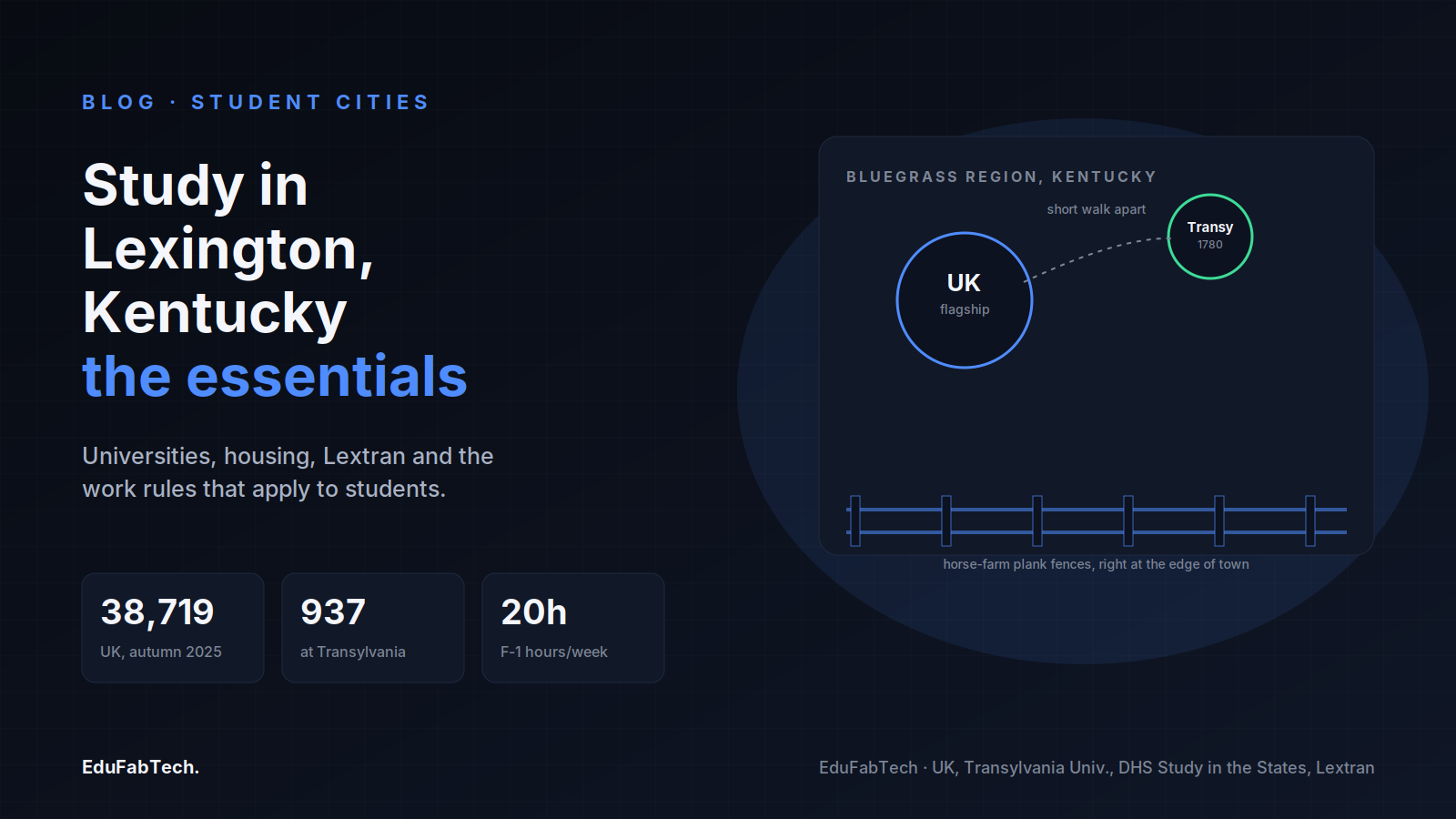
Lexington sits in the middle of the Bluegrass region of central Kentucky, on limestone country that drains well and grows the grass the thoroughbred industry is built on. The horse farms with their black and white plank fences start almost where the suburbs end, and the city markets itself, not unreasonably, as the horse capital of the world. For a student that setting matters in ordinary ways: the land is gently rolling rather than flat, the built-up core is compact and walkable, and beyond a ring road called New Circle the city thins quickly into farmland.
It is also, unusually for a city of its size, a place where two institutions founded centuries apart share the same few square miles. Transylvania University describes its home as "a thriving city of 344,000 people" on its own Quick Facts page, and that mid-sized scale is part of what students either love or find limiting. Lexington is big enough to have a real downtown, a transit system and a night economy, and small enough that you can cross most of the student districts by bicycle. The flagship university dominates the south side; a small liberal-arts college sits a short walk north, inside the historic grid.
One large public campus, one small college, and a ring of others
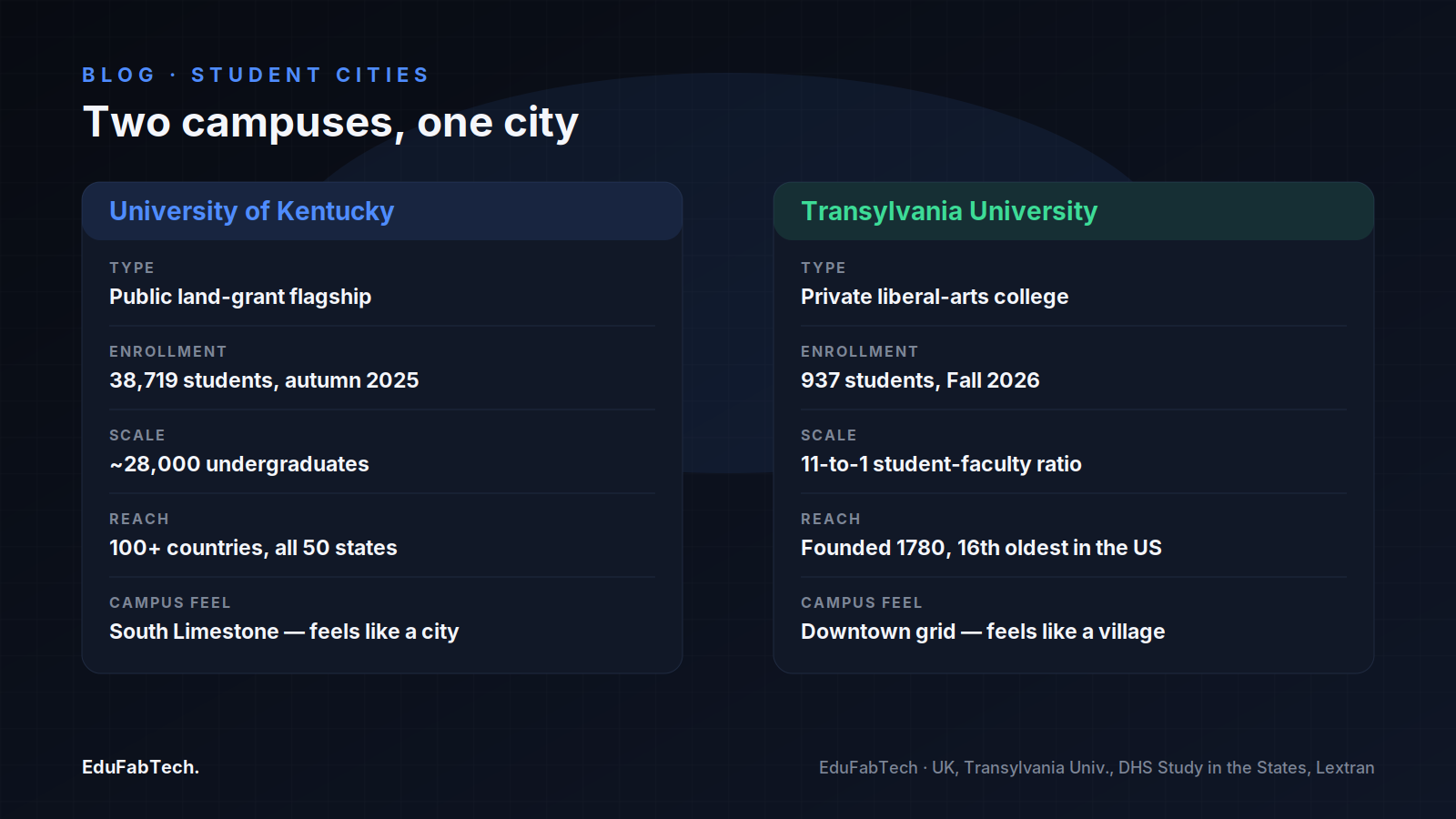
The University of Kentucky is the city's gravitational centre. It is the state's public land-grant flagship, and its campus runs along South Limestone and Euclid Avenue just south of downtown. In September 2025 the university reported a record preliminary autumn enrolment of 38,719 students — nearly 28,000 of them undergraduates — drawn from every county in Kentucky, all 50 US states and more than 100 countries. That scale brings a teaching hospital, Division I athletics (basketball is close to a civic religion here), and a business school, the Gatton College of Business and Economics, with its own building on campus. UK also runs the Patterson School of Diplomacy and International Commerce, a small graduate school that grants a Master of Arts in Diplomacy and International Commerce for students headed into foreign affairs, development and security work.
Transylvania University is the counterweight: a private liberal-arts college on a leafy campus at the edge of downtown, a few minutes' walk from the courthouse square. Its Quick Facts page records 937 students in Fall 2026, an 11-to-1 student-faculty ratio, and a founding date of 1780 that makes it, by its own account, the 16th college established in the United States. Where UK feels like a city, "Transy" feels like a village — small classes, a single quad, and most of student life inside a few blocks. The affiliation is historically with the Christian Church (Disciples of Christ), though the college says it welcomes all faiths.
Several more universities sit within a short drive and draw students into the same regional orbit. Eastern Kentucky University, according to its own catalog, is a regional public university in Richmond — about 26 miles south-east of Lexington — established in 1906 as the Eastern Kentucky State Normal School. Asbury University, on its About page, describes itself as an independent, nondenominational evangelical institution in the Wesleyan-Holiness tradition, founded in 1890 and located in Wilmore, "20 minutes southwest of Lexington," with students from 44 states and 39 countries. Both are commuter options if you want a smaller campus but a Lexington base.
Where students settle, from South Limestone to Chevy Chase
The single most convenient address is South Limestone itself — "South Lime" to everyone here — the street that runs straight into the academic core, lined with the older houses and purpose-built blocks within a walk of class. Push a little east and you reach Aylesford and the shops and bars of Chevy Chase; a little north and you cross into the historic South Hill streets that link campus to downtown. West of campus, the apartment clusters along the Nicholasville Road corridor and near the Red Mile harness track trade the short walk for lower rents and a bus or bike ride. Transylvania students, by contrast, mostly stay in the downtown grid or in college housing, because almost everything they need is already there.
On-campus, UK's own residence-hall rates for 2026-2027 run from a four-person suite ("4-Person Suite White") at $4,510 per semester up to University Flats apartment-style rooms at $6,497–$6,616 per semester, with most standard two-bedroom suites at $5,851 per semester. Those are per-semester figures, so budget for two. If you plan to live off campus, start looking in the spring for an autumn move: the best-located houses near South Lime are spoken for early, and the market tightens sharply in July and August as everyone arrives at once. You can see current rooms and shared houses, plus listings grouped by campus, on EduFabTech's Lexington rooms page and the listings near the University of Kentucky.
Renting without losing a deposit
Most of the trouble in Lexington shows up the same way: a listing for a room or small house near South Limestone or along Nicholasville Road, priced a little below everything else, posted by someone who says they are out of town and asks you to send a deposit to "hold" it before you can see it. Treat that as the warning sign it is. In Lexington a security deposit of roughly one month's rent, paid when you sign a lease and after you have seen the place, is normal; a request to pay by bank wire, gift card or cryptocurrency, or to send money to someone you have not met, is not. No legitimate landlord in this city needs crypto to reserve a room.
Before any money changes hands, see the actual unit — in person if you are already here, or on a live video walk-through if you are still abroad, with the person showing you the specific address and room, not a stock photo. Get the lease in writing and read what it says about the deposit, utilities and the end date. If you are arriving from overseas and cannot visit, it is safer to book a short first stay, or a university residence hall, and sign a longer lease only once you can inspect the place yourself.
Furnishing a room: Peddlers Mall, the ReStore and the markets
Lexington is good for furnishing a room cheaply because the second-hand trade is concentrated and easy to reach. The large Peddlers Mall on New Circle Road is a warehouse of independent booths selling used furniture, kitchenware and oddments; the Habitat for Humanity ReStore sells donated furniture and household goods with the proceeds going to local house-building; and there are Goodwill shops across the city for the small things — lamps, pans, a desk chair. For food and the feel of the place, the Lexington Farmers Market runs downtown at the Fifth Third Pavilion in Henry A. Tandy Centennial Park (the square older residents still call Cheapside), with Kentucky producers through the week and a large Saturday market in season.
Term start and term end are the best times to furnish for almost nothing, when departing students give away or cheaply sell whatever will not fit in a car. You can track what is on offer on EduFabTech's Lexington pages for second-hand things and used furniture, which fill up fastest in May and in August.
Getting around: Lextran and your Wildcard
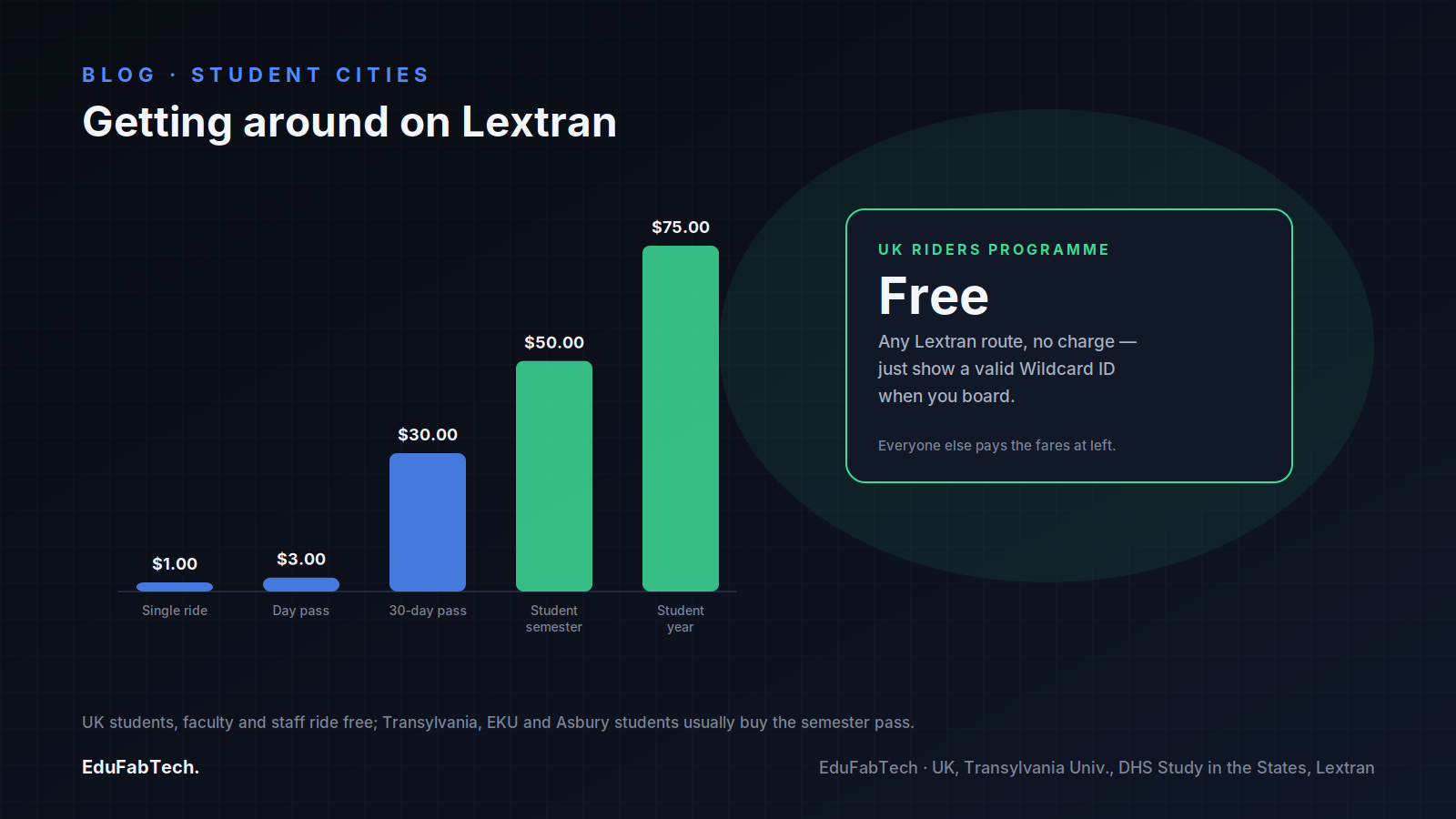
Public transport in Lexington is run by Lextran, whose buses radiate from a downtown transit centre on Vine Street and serve the campuses and main corridors. The main point for UK people is that it is free: Lextran's UK Riders programme lets all UK students, faculty and staff ride any route at no charge simply by showing a valid Wildcard ID each time they board. Everyone else pays modest fares — Lextran's Fares & Passes page lists a $1.00 single adult ride, a $3.00 day pass and a $30.00 30-day pass, and a Student Class Pass at $50.00 for a semester or $75.00 for the school year, which is the sensible buy for students at Transylvania, EKU or Asbury who commute by bus.
In practice many students near UK rarely need the bus: the core is walkable and the city is flat enough to cycle. The honest caveat is evening and weekend service — frequencies drop after the working day and on Sundays, so if your routine includes late library nights or a shift that ends near midnight, check the specific route's timetable before you rely on it. Beyond the inner neighbourhoods, Lexington is a car city, and the last mile from the cheaper apartment clusters is where a bike earns its keep.
Part-time work and the rules that apply
If you are an international student on an F-1 visa, the clearest and least complicated way to earn is on-campus work. The US Department of Homeland Security's Study in the States guidance states that on-campus employment is open to F-1 students whose record is active in SEVIS, and that "if you participate in on-campus employment, you may not work more than 20 hours per week when school is in session." Off-campus work, and training such as CPT and OPT, carries separate conditions and generally requires authorisation arranged through your school's Designated School Official before you start. This is a summary, not legal advice: confirm your own situation with your university's international office and the official DHS pages, because the rules turn on your individual status. Local part-time openings students actually use — campus jobs, cafés, shops — are collected on EduFabTech's Lexington jobs page.
Libraries and places to study
UK's central library is the William T. Young Library, a large building on the south of campus with general and subject collections, group and silent study space, computer labs, a writing centre and media studios; during term it keeps long overnight hours on weeknights, which is why it fills with students before exams. The wider UK Libraries system adds specialist branches — medical, engineering, agriculture, fine arts — close to the relevant colleges. Transylvania students have their own J. Douglas Gay Jr. Library downtown. Beyond the campuses, the Lexington Public Library's central branch and neighbourhood branches give you free, quiet desks off campus, which is useful if you live downtown or want a change of room. More study desks and bookable spaces around the city are listed on EduFabTech's study-spaces page.
The honest ledger, and a first-weeks checklist
What Lexington does well for students is cost and scale. Housing is cheaper than in coastal US cities, the walkable core keeps a car optional near UK, free Lextran rides remove a real monthly expense for the largest student population, and a mid-sized city with a strong downtown gives you music, food and sport without big-city prices. The horse-country setting is genuinely pleasant, and the two main campuses sit close enough that the city feels student-shaped.
What is harder is honest to name too. Rents near South Limestone have risen and the good addresses go early, so latecomers end up further out and more dependent on the bus or a bike. Evening and weekend transit is thin. Basketball and football weekends flood the south side with traffic and parking disappears. The climate swings — humid, sometimes very hot summers, and winters that bring the occasional ice storm that can shut a campus for a day. And for all its life, Lexington is a regional city, not a megacity: the international flight options and the sheer range of a New York or Chicago are not here, and some students feel that after a year.
A short checklist for the first few weeks:
- Collect your Wildcard (UK) or campus ID at once — at UK it is also your free Lextran pass, and you cannot ride without showing it.
- If you are international, visit your university's international office early to confirm your SEVIS record is active and to understand the 20-hour on-campus work limit before taking any job.
- Open a local bank account so you never need to wire money to a landlord to "hold" a room.
- See any off-campus room in person or on a live video call, read the lease, and pay a deposit of about one month's rent only after you have seen the place.
- Furnish from Peddlers Mall, the Habitat ReStore, Goodwill and the end-of-term giveaways rather than buying new.
- Find your study base early — the William T. Young Library, a Lexington Public Library branch, or a quieter campus library — before exam season makes seats scarce.
- Walk South Limestone, downtown and Chevy Chase on foot in week one; the city is small enough that knowing it quickly pays off.
Used well, Lexington is an affordable, legible place to be a student: a big university and a small college in one compact city, with cheap second-hand goods, free buses for most of its students, and farm country a short ride away. Go in knowing the rents, the bus timetable and the deposit rules, and few US cities of its size will stretch a student budget further.
A quick question for readers
Do you work part-time while you study?
Many students work to pay the bills. See how common it is — and how many hours people really do.
Pick an answer, create a free account in a minute, and your vote counts. Already a member? Sign in
Source: UKNow (University of Kentucky)
Sources (5)
- University of Kentucky. UK enrollment breaks new record. UKNow (University of Kentucky), 2025. uknow.uky.edu ↗ · checked 5 Oct 2026
- University of Kentucky. Residence Hall Rates (2026-2027). Wildcat Living, University of Kentucky, 2026. wildcatliving.uky.edu ↗ · checked 5 Oct 2026
- Transylvania University. Quick Facts. Transylvania University, 2026. transy.edu ↗ · checked 5 Oct 2026
- Lextran. Fares & Passes; UK Riders. Lextran (Transit Authority of Lexington), 2026. lextran.com ↗ · checked 5 Oct 2026
- U.S. Department of Homeland Security. Working in the United States. Study in the States, DHS, 2026. studyinthestates.dhs.gov ↗ · checked 5 Oct 2026