Studying in Lincoln, United Kingdom: universities, housing and student life
A practical, sourced guide to Lincoln's two universities, where students live on an uphill–downhill city, what rooms cost, and how to settle in your first weeks.
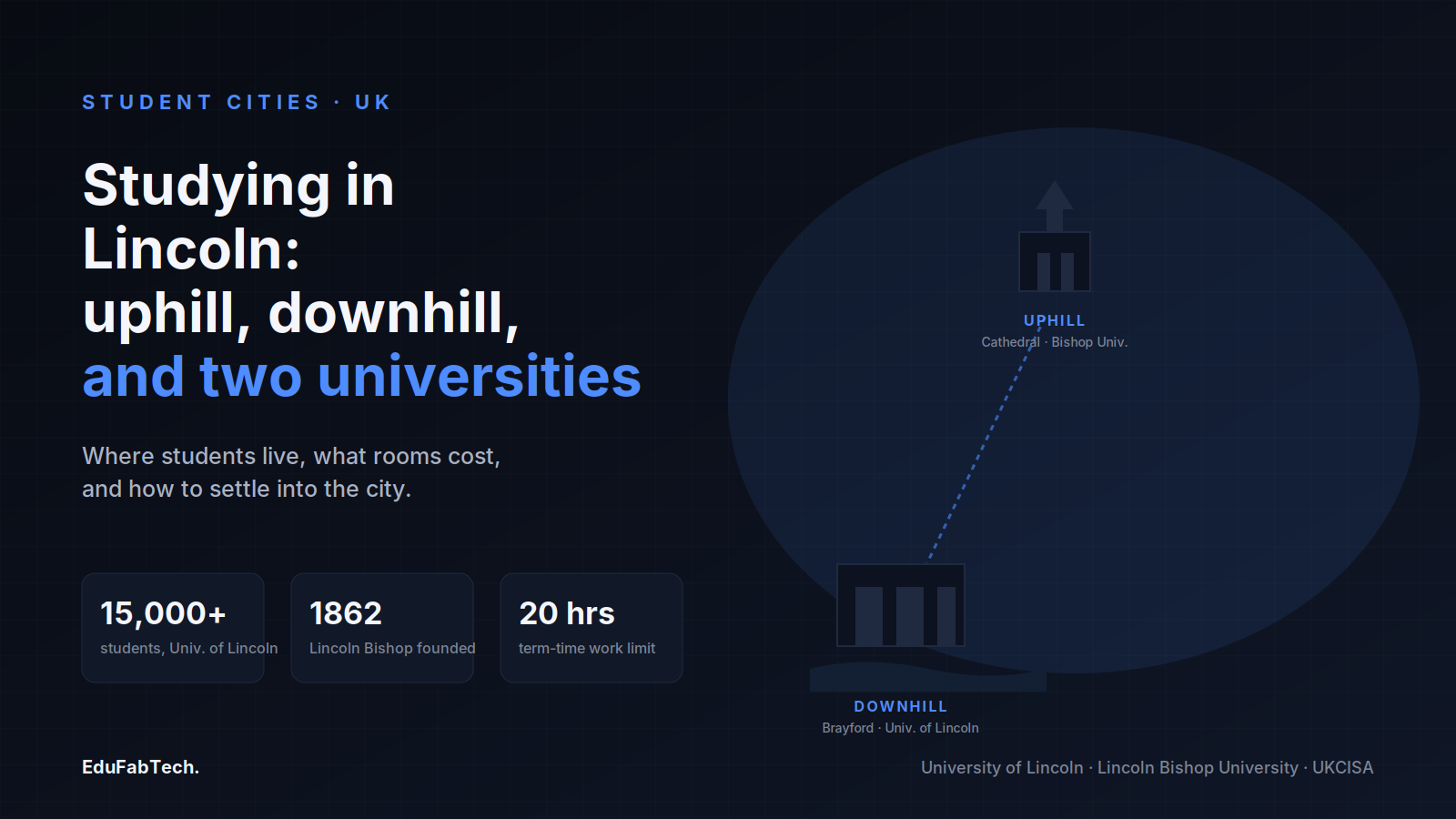
Lincoln sits on a limestone ridge in the East Midlands of England, where the ground rises sharply from the River Witham to a medieval cathedral and castle at the top. That geography shapes student life more than any prospectus admits: locals split the city into "uphill" and "downhill", and the two universities sit on opposite sides of that line. The University of Lincoln spreads along the waterfront at the bottom; Lincoln Bishop University keeps a compact campus up near the Cathedral Quarter. Working out which half of the city you will spend your days in is the first real decision a Lincoln student makes.
Two universities in one small city
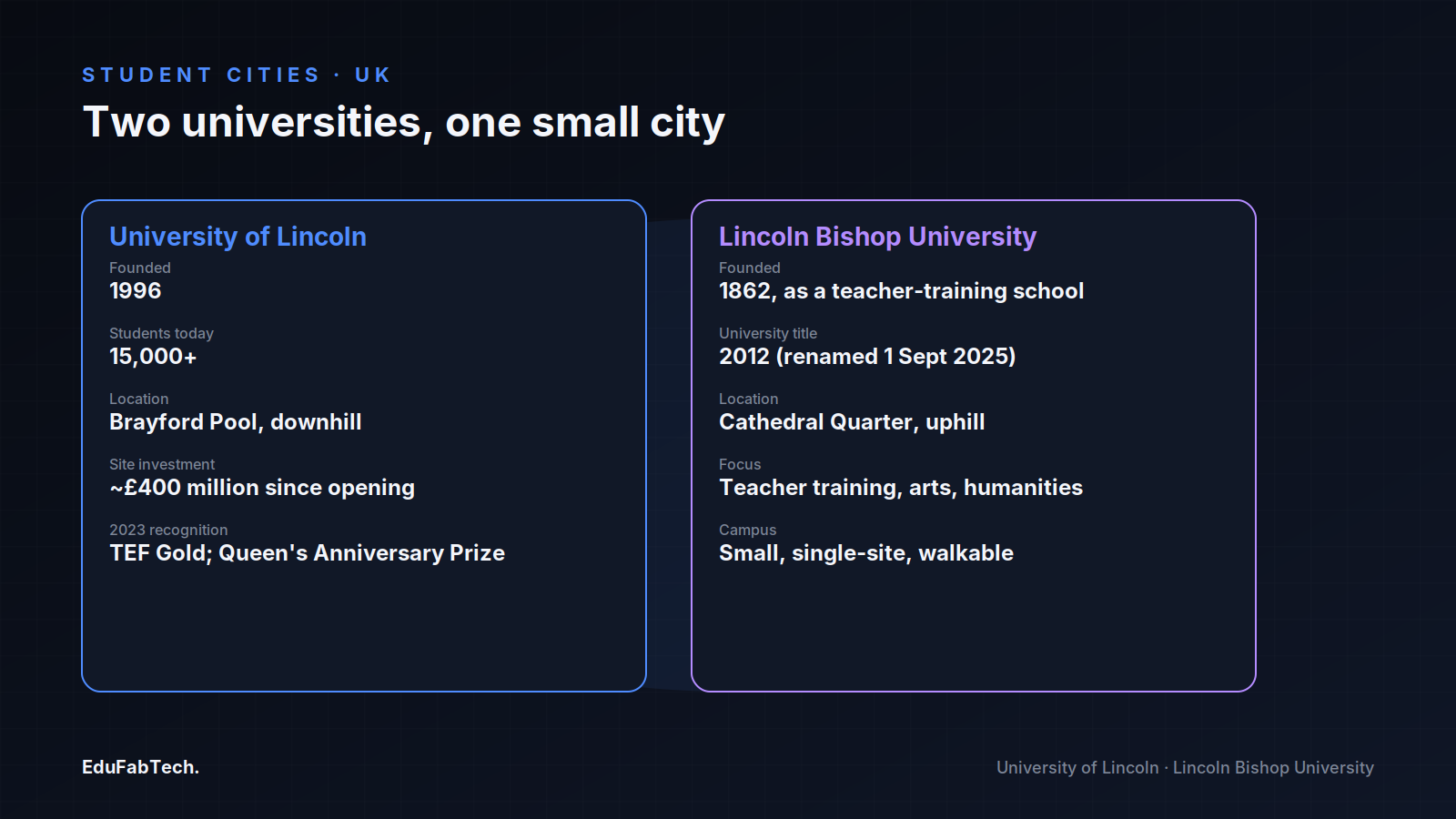
The University of Lincoln is the larger of the two, and the one most people mean when they say they study "at Lincoln". According to the University of Lincoln, it was established in 1996, its first building opened by Queen Elizabeth II that year, and it has grown from around 500 students then to more than 15,000 today. Its main campus runs along Brayford Pool, an inland harbour a few minutes' walk from the railway station and the shops. The university says it has invested around £400 million in the site, including the Isaac Newton Building (2017) for engineering and science and the Ross Lucas Medical Sciences Building (2021). It was awarded Gold in the national Teaching Excellence Framework in 2023 and a Queen's Anniversary Prize in November 2023 for work supporting the agri-food sector; much of that food and farming research runs from its Riseholme and Holbeach sites rather than the city centre.
Lincoln Bishop University is much smaller and far older. Its own history traces it to 1862, when the Lincoln Diocesan Training School for Mistresses was founded with the support of the Bishop of Lincoln to train women teachers for Church of England schools. It was renamed Bishop Grosseteste College in 1962, after the 13th-century Bishop of Lincoln Robert Grosseteste, and gained full university title in 2012. It carried the name Bishop Grosseteste University until Monday 1 September 2025, when — after a consultation the university says involved over 600 stakeholders and a submission to the Office for Students in April 2024 — it became Lincoln Bishop University. Teacher training remains its backbone, alongside arts, humanities and social-science courses, and it keeps the feel of a small single-site campus a short walk north of the cathedral. Some students also study at Lincoln College, a further education college in the city centre.
Uphill, downhill, and where students live
First-year students usually begin in managed halls. The University of Lincoln runs residences including Cygnet Wharf, The Gateway, St Marks, 179 High Street and Valentine Court, listed on its accommodation pages and clustered on or beside the Brayford campus, so the walk to a lecture is minutes rather than a bus ride. Lincoln Bishop, being small, keeps its own halls on and around its uphill campus. If you want to compare what is actually available in each part of the city, the EduFabTech listings for rooms in Lincoln and the pages for listings near the University of Lincoln and near Lincoln Bishop University are a sensible starting point.
After first year most students move into shared houses. The familiar student streets lie downhill and west: the West End directly behind the University of Lincoln, the roads off Carholme Road and Newland, and the tight brick terraces of Sincil Bank south of the High Street, which are among the cheapest rooms in the city and within walking distance of campus. Uphill — Bailgate, the streets around the castle and cathedral, and the area near Lincoln Bishop — is older, quieter and generally pricier, and it means a daily climb if your classes are at the Brayford. Lincoln is compact enough that many students never need a car, but the uphill–downhill gradient is a genuine factor in choosing where to sign.
Renting without losing your deposit
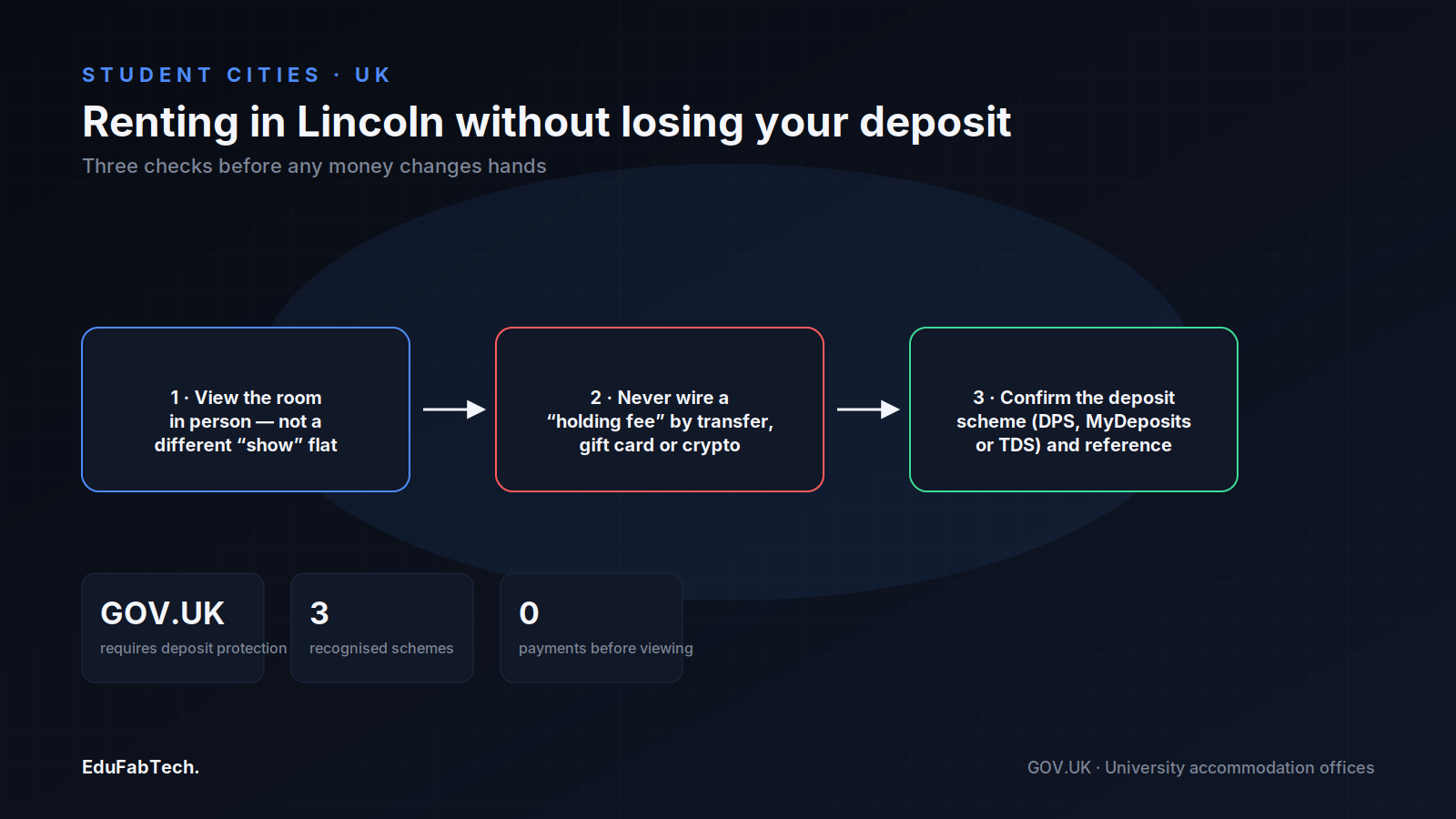
Start looking early but not frantically. Lincoln's private student market turns over in the winter and spring for the following September, and the cheaper Sincil Bank and West End terraces go first; there is rarely any need to commit in your first weeks of term. Before you hand over any money, see the actual room in person — not a different "show" flat — and meet the landlord or the current tenants. Because Lincoln is small and most student houses sit in a handful of walkable districts, an in-person viewing is realistic even if you are arriving from abroad a little later.
Scams in a city like Lincoln usually appear as a too-cheap room advertised on social media or a listings site before term, where whoever posted it pressures you to pay a "holding" fee or the first month's rent before you have seen the place. Never send money by bank transfer, gift card or cryptocurrency to reserve a room you have not viewed; those payments are almost impossible to recover. In England your deposit has legal protection: GOV.UK states that your landlord must put your deposit in a government-approved tenancy deposit scheme — the Deposit Protection Service, MyDeposits or the Tenancy Deposit Scheme — so ask which scheme protects yours and get the reference. Both universities' accommodation offices can also point you to recognised channels rather than leaving you to the open market.
Furnishing a room: charity shops and Cornhill Market
Lincoln's High Street — the long pedestrianised run downhill — is lined with charity shops, which is where most students kit out a room cheaply. Branches of the British Heart Foundation, Cancer Research UK, Scope, Mind and others sit within a few minutes of each other, and the British Heart Foundation also runs a separate furniture and electrical store in the city for larger second-hand items like desks, chairs and small appliances. For kitchenware, bedding and the small things a house always lacks, this strip does the job without a trip out of town.
The city's covered market is worth knowing. According to Cornhill Market Lincoln, the refurbished Cornhill Market — just off the lower High Street — held its official opening on Friday 17 May 2024, after a refurbishment costing about £8.7 million, funded by £5.9 million from the government's Towns Fund through the Be Lincoln Town Deal, £1.9 million from the City of Lincoln Council and £918,000 from Historic England. It is more a food-and-drink and independent-trader hall than a flea market, but it anchors the area where second-hand and street-market stalls appear. For hunting down cheaper furniture, giveaways and household odds and ends locally, the EduFabTech pages for second-hand things, second-hand furniture and free stuff in Lincoln collect what is going at any given time.
Working term-time as an international student
If you are on a Student visa, how much you can work is set by the conditions printed on your visa, not by your employer or your budget. The UK Council for International Student Affairs (UKCISA) states that Student visa holders may work up to 20 hours a week in term time if studying for a qualification at degree level or above, and up to 10 hours a week in term time if studying below degree level, and that certain work — being self-employed, working as a professional sportsperson, or taking a permanent full-time job — is not allowed. This is general information and not legal advice; always read the exact wording on your own visa and check the official GOV.UK Student visa guidance, because breaching the limit can cost you your visa. Casual part-time work in Lincoln clusters in High Street retail, hospitality around the Brayford and the Bailgate, and campus jobs through the students' union; current openings tend to surface on the Lincoln jobs listings.
Libraries and places to study
The University of Lincoln's main library, the Great Central Warehouse Library, sits in a converted 1907 railway warehouse on the Brayford campus and, the university says, holds 260,000 journals and 750,000 print and electronic books and opens seven days a week at peak times, with "Library Learning Lounges" — group screens, booths and PCs — spread across other campus buildings. Lincoln Bishop keeps its own library on its uphill campus, geared to education, arts and humanities. Away from the universities, Lincoln Central Library on Free School Lane (LN2 1EZ), in the city's Cultural Quarter, gives you a neutral, quiet place to work off-campus. When halls and libraries are full in deadline season, the EduFabTech study-spaces listings are worth a look for desks and quiet rooms around the city.
Getting around on Stagecoach — and on foot
Most downhill student life is walkable: the Brayford campus, the station, the High Street and the West End are all within an easy stroll of one another. For everything else the city buses are run by Stagecoach East Midlands. Its Lincoln bus passes include a Young Person 7 Day MegaRider at £16.50 and a 28 Day MegaRider at £62 for travel on Stagecoach services across Lincoln city, bought through the Stagecoach app, online or on board. The one stretch no bus solves is the climb between downhill and the Cathedral Quarter: Steep Hill, the cobbled street linking the two halves, is too steep for traffic and has to be walked. Lincoln's railway station is central, with direct services to Nottingham, Sheffield, Leicester, Peterborough and London, though journeys to the biggest cities are slower than from a mainline hub.
What it costs, and the honest trade-offs
Housing is the figure that matters most, and Lincoln's is modest by English standards. The University of Lincoln's accommodation pages list managed rooms from roughly £129 to £191 per week; its Cygnet Wharf residence, for example, is listed at £169 per week for the 2027/28 academic year, with bills typically bundled into managed-hall rents rather than charged on top. Shared private houses downhill are often cheaper per person but usually bill utilities separately, so compare "all in" figures, not headline rents. For a rough comparison with other cities you may be weighing up, see the full set of Lincoln student listings.
What is genuinely good about Lincoln: it is small, walkable and affordable, with a striking historic core, a strong, well-equipped main library, and campuses close to the places students actually live. What is harder: the choice of a big city's nightlife, shops and job market is narrower here, the uphill–downhill gradient turns a cross-city trip into a real climb, the cheaper terraces vary a lot in quality, and uphill rooms cost more for the privilege of the view. The surrounding Lincolnshire landscape is flat and the winters are cold and grey, and rail links to the largest cities take longer than from a mainline city. None of that is a reason to stay away; it is simply the shape of the place, and a reader from Lincoln will recognise every line of it.
A checklist for your first fortnight
- Confirm which campus your timetable actually uses, and base your housing search on that half of the city — downhill for the University of Lincoln, uphill for Lincoln Bishop.
- If you are in halls, note your contract length and what the rent includes; if house-hunting, view in person and never pay by bank transfer, gift card or crypto to "hold" a room.
- Ask any private landlord which government-approved scheme protects your deposit, and keep the reference.
- Buy a Stagecoach MegaRider only if your route needs it — much of downhill Lincoln is walkable.
- Register with the Great Central Warehouse Library or Lincoln Central Library and find a quiet spot before deadlines arrive.
- On a Student visa, read the work conditions on your visa and the GOV.UK guidance before you take any job.
- Do a first furnishing run along the High Street charity shops and the British Heart Foundation furniture store; check the Lincoln events and free-stuff listings for the rest.
A quick question for readers
Do you work part-time while you study?
Many students work to pay the bills. See how common it is — and how many hours people really do.
Pick an answer, create a free account in a minute, and your vote counts. Already a member? Sign in
Comments 2
Comment-
The one piece of advice here that doesn't survive its own logic is "compare all-in figures, not headline rents." Fine in principle, but the…
-
The bit that jumps out is the fee math implied by the halls prices: £129-£191 a week with bills bundled, versus shared houses downhill that…
Join free to read the full comments and reply Comments are between members; an account takes a minute.
Source: University of Lincoln
Sources (5)
- University of Lincoln. About the University. University of Lincoln, 2026. lincoln.ac.uk ↗ · checked 9 Nov 2026
- Lincoln Bishop University. Our History. Lincoln Bishop University, 2026. lincolnbishop.ac.uk ↗ · checked 9 Nov 2026
- University of Lincoln. Accommodation. University of Lincoln, 2026. lincoln.ac.uk ↗ · checked 9 Nov 2026
- Cornhill Market Lincoln. Cornhill Market gets ready to officially open its doors on Friday 17 May. Cornhill Market Lincoln, 2024. cornhillmarketlincoln.co.uk ↗ · checked 9 Nov 2026
- UKCISA. Working during your studies: Student work. UK Council for International Student Affairs, 2026. ukcisa.org.uk ↗ · checked 9 Nov 2026