Studying in Liverpool, United Kingdom: universities, housing and student life
A practical, sourced guide to Liverpool's universities, where students live, finding a room safely, markets for furnishing it cheaply, work rules, study spaces, transport and real costs.
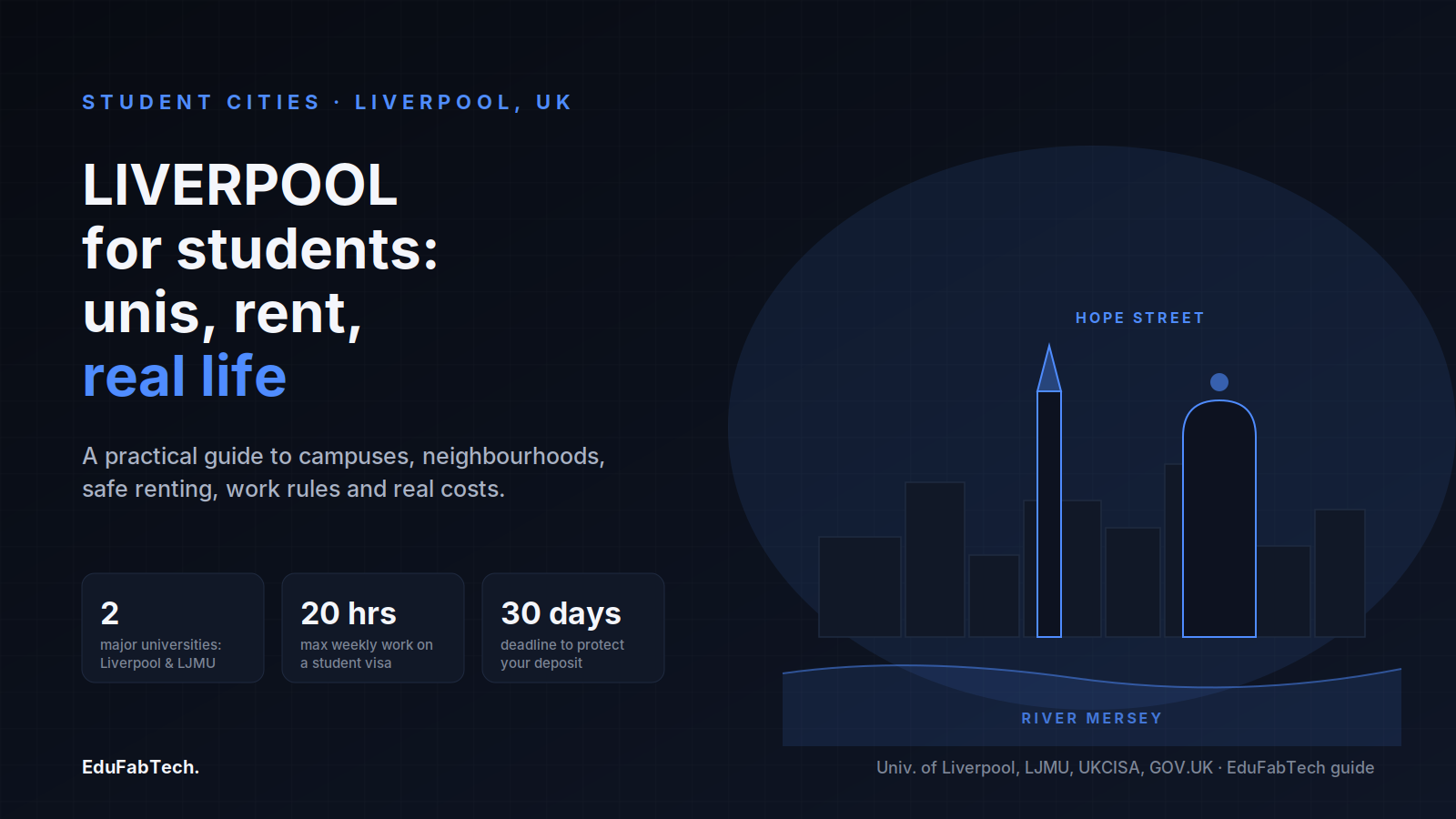
Liverpool sits on the eastern bank of the River Mersey, where the river widens toward the Irish Sea, and most of what a student needs is folded into a compact core between the waterfront and the two rises — Brownlow Hill and Mount Pleasant — where the biggest campuses cluster. It is a city that wears its history loudly: a global port turned cultural capital, with two cathedrals facing each other along Hope Street, a dense grid of Georgian terraces, and student houses spreading south along the old tram routes. You can walk from the main university quarter to the docks in under half an hour, which shapes almost everything about living here as a student. A fuller set of local listings — rooms, jobs, second-hand goods — sits at /in/united-kingdom/liverpool.
The institutions, from a red-brick civic university to a performing-arts conservatoire
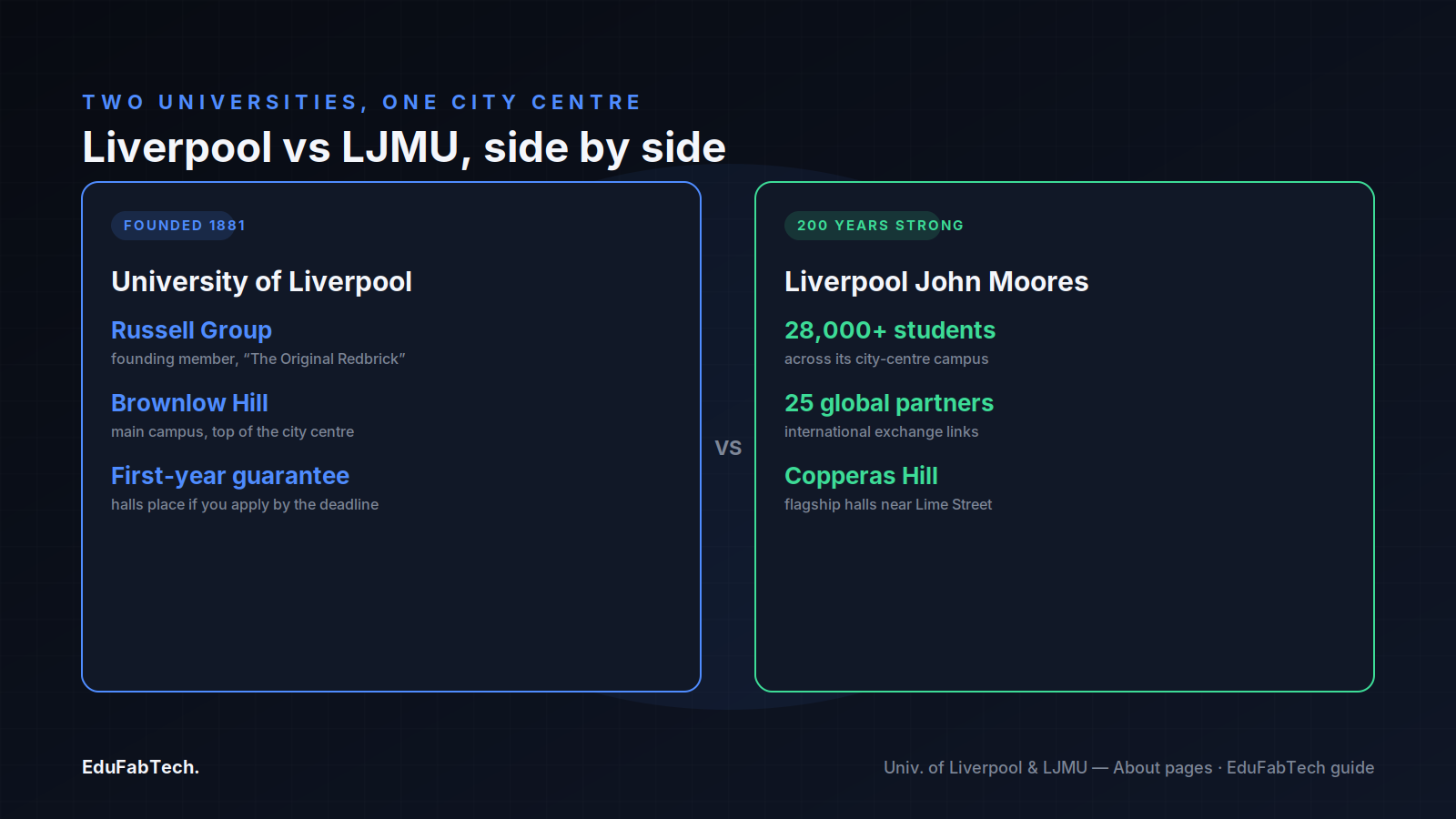
Two large universities dominate. The University of Liverpool describes itself on its About pages as advancing learning since 1881, a founding member of the Russell Group, and "The Original Redbrick" — its main campus climbs Brownlow Hill at the top edge of the city centre. Liverpool John Moores University (LJMU), whose About pages say it has been "the university for the people of Liverpool" for the past 200 years and now has more than 28,000 students across its campus and 25 global partners, runs its buildings across the city centre, including the flagship Copperas Hill development near Lime Street station. The two sit so close that students from one routinely drink, shop and share houses with students from the other.
Beyond the two big research universities, Liverpool has an unusually varied set of specialist and nearby institutions:
- Liverpool Hope University teaches mainly at Hope Park in the leafy suburb of Childwall, with a city-centre Creative Campus for performing and creative arts and a residential site at Aigburth Park, according to its campuses page.
- Edge Hill University is in Ormskirk, in West Lancashire outside the city, on a single large campus that its About page says serves almost 10,000 full-time students; many commute in from Liverpool.
- University of Chester is in the nearby walled city of Chester, in Cheshire; its history page records that the college opened in 1840 and that Chester College became the University of Chester in 2005, with the right to award its own degrees, and its Parkgate Road campus is still in use.
- Liverpool School of Tropical Medicine, founded in 1898, was — in its own words on its About page — the first institution in the world dedicated to research and teaching in tropical medicine; it runs postgraduate programmes near the city-centre hospital quarter.
- The Liverpool Institute for Performing Arts (LIPA) was granted its own degree-awarding powers, with the 2025–26 intake the first to enrol on degrees validated directly by LIPA; it says its degrees had previously been validated by LJMU.
- Liverpool Media Academy (LMA) is a creative institution in the city centre offering BA (Hons) and master's courses across six schools covering film, music, acting, games and creative business, per its Liverpool page.
The neighbourhoods students choose, from the city-centre towers to Smithdown Road
Liverpool is big enough that the choice of district genuinely changes your daily life, your rent and your commute. A handful of areas take most of the student population, and each has a distinct feel. Listings near the University of Liverpool's Brownlow Hill campus are grouped at /near/university-of-liverpool.
The city centre (around Ropewalks, the Baltic Triangle and the student towers near Lime Street) is where most first-years in purpose-built halls land. You can roll out of bed to a nine o'clock lecture, but it is the priciest option and you pay for the postcode rather than space.
The Georgian Quarter, around Hope Street, Canning and the two cathedrals, is handsome and central — cobbled streets, cafés and converted townhouses — and popular with postgraduates and later-year undergraduates who want character and a five-minute walk to campus, at a premium.
Kensington and Edge Hill sit immediately east of the universities. They hold a lot of cheaper shared houses within walking distance of lectures, which is why they fill fast; parts are rougher around the edges, so visit in daylight and at night before committing.
Smithdown Road, running south through Wavertree and toward Sefton Park, is the classic Liverpool student belt: miles of red-brick terraces, cheap takeaways, independent cafés and a genuine student community. Rents are lower than the centre, the trade-off is a couple of miles of commute by bus or bike.
Aigburth and Lark Lane, on the edge of Sefton Park, draw a slightly older, quieter crowd — brunch spots and green space rather than nightlife — and reward you for being willing to travel in.
Childwall and Allerton, further out in the leafy south-east, suit students at Liverpool Hope's Hope Park campus and anyone who prefers suburban calm; expect a longer bus ride into town.
Renting safely, from halls to the Smithdown terraces
Both big universities take the pressure off first-years. LJMU's accommodation pages say every new student is guaranteed city-centre accommodation with no deposit required, while the University of Liverpool guarantees accommodation to first-year undergraduates who apply by its published deadline. For later years, most students move into the private terraces of Smithdown, Kensington or Wavertree, and the house-hunting season starts early — groups often sign for the following September as early as the preceding winter. Resist that pressure: signing a house in November for a group you barely know is how friendships and tenancies both fall apart. Browse what is currently available at /in/united-kingdom/liverpool/rooms.
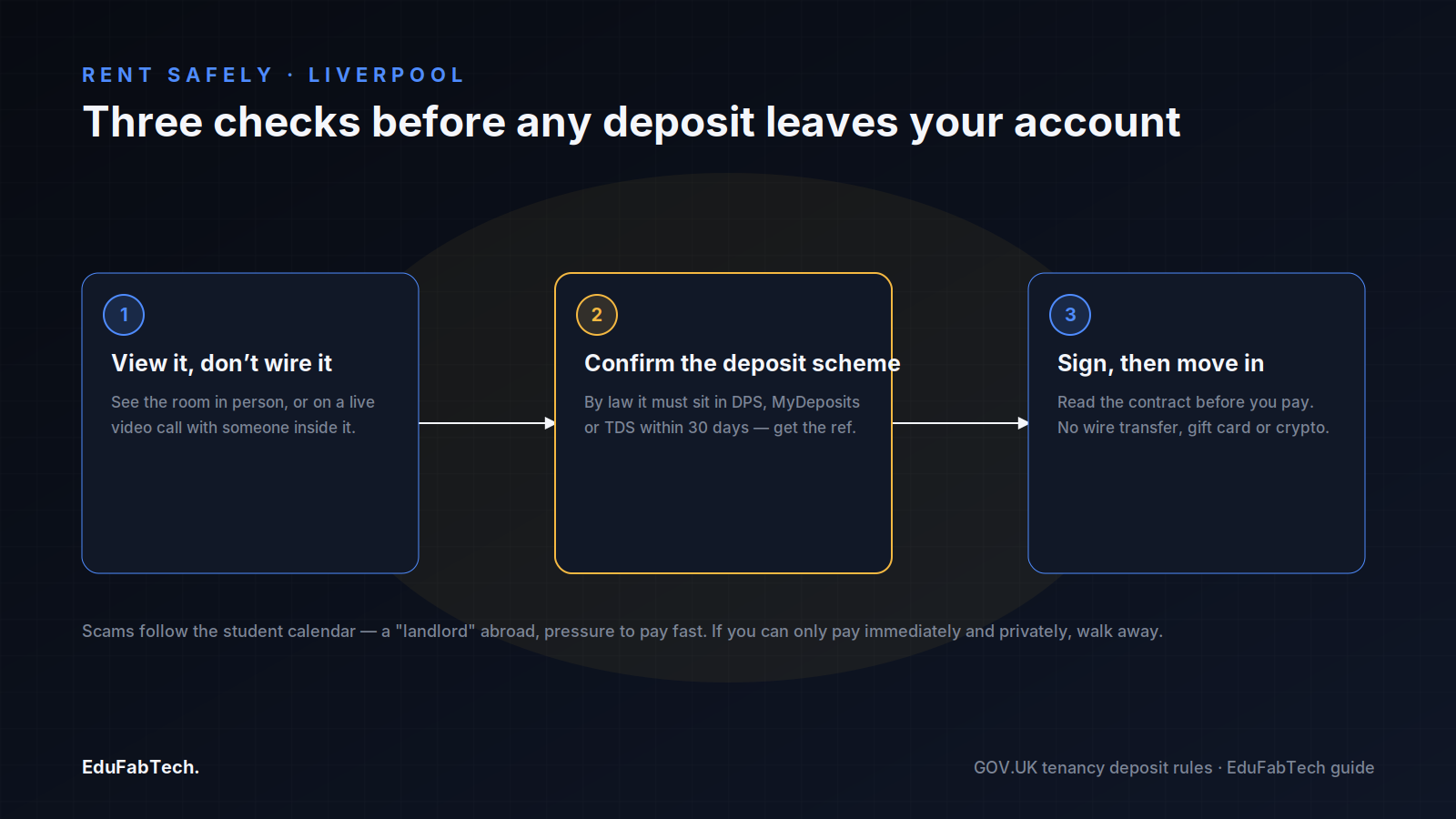
The safety rules in Liverpool are the same ones that protect every renter in England, and they are worth knowing before any money leaves your account. By law, a deposit on an assured tenancy must be placed in a government-approved tenancy deposit scheme — the Deposit Protection Service, MyDeposits or the Tenancy Deposit Scheme — within 30 days, according to GOV.UK. Ask which scheme will hold yours and get the reference in writing.
Scams here tend to follow the student calendar and the student areas: a too-good "room" advertised in a Smithdown or city-centre block, a "landlord" who is conveniently abroad, and pressure to pay a holding fee fast before someone else takes it. The single firmest rule is that you never send money by bank transfer, gift card or cryptocurrency to "hold" a room you have not seen. View the place in person (or on a live video call with someone physically inside it), meet the agent or landlord, confirm the deposit scheme, and read the contract before you transfer anything. If a deal only works when you pay immediately and privately, walk away.
Furnishing a room from Liverpool's markets
A bare room is cheap to fill if you buy second-hand, and Liverpool has real markets for it rather than just online listings. Great Homer Street Market — fondly known across the city as "Greatie" — runs on Saturdays from 7am to 3pm with over 140 stalls selling, among much else, homeware, per Liverpool City Council. For bric-a-brac, vintage and crafts, the community-run Granby Market in the Four Streets of L8 is held on the first Saturday of every month except January, from 10am to 3pm, according to the Granby Four Streets Community Land Trust. Charity shops cluster thickly along Smithdown Road and Allerton Road, and the end-of-term weeks see departing students give away furniture and kitchen kit. You can track local second-hand goods and furniture at /in/united-kingdom/liverpool/second-hand.
Working while you study
If you are an international student, how much you can work is set by your visa, not by the employer. The UK Council for International Student Affairs (UKCISA) states that most Student-route holders may work up to 20 hours a week in term time if studying at degree level or above, or up to 10 hours a week below degree level, that this is a per-week limit that cannot be averaged across weeks, and that self-employment is generally not permitted. Your exact conditions are printed on your visa or eVisa, so check them and treat UKCISA and your university's visa advice team as the authorities — this guide is not legal advice. Liverpool's hospitality, retail and events sectors absorb a lot of student labour; current openings are collected at /in/united-kingdom/liverpool/jobs.
Libraries and study spaces
Study space is one of Liverpool's quiet strengths. The council-run Liverpool Central Library on William Brown Street is free to use, with free wi-fi and computers, and the circular, Grade II-listed Picton Reading Room as a quiet study space; its council page lists hours of Monday to Friday 9am–8pm and Saturday 9am–5pm. The University of Liverpool names its Harold Cohen and Sydney Jones libraries, plus a Leahurst Campus Library in Wirral, on its library site. LJMU, in a 2025 update, says its libraries are now the City Campus Library (formerly Avril Robarts) and Mount Pleasant Campus Library (formerly Aldham Robarts), and that its Student Life Building stays open 24/7 with study space and IT support. More desks, bookable rooms and quiet corners around the city are indexed at /in/united-kingdom/liverpool/study-spaces.
Getting around: Merseyrail, buses and the ferry
Liverpool's great advantage is that the student core is walkable, so many never need a daily fare at all. Beyond walking distance, local transport is coordinated by Merseytravel, the region's transport body, and the backbone is Merseyrail, a frequent electric rail network whose Northern and Wirral lines reach the suburbs and under the river to Birkenhead. Buses, run mainly by Arriva and Stagecoach, cover the rest, and Mersey Ferries still cross to the Wirral. Pay-as-you-go and season tickets use Merseytravel's Metro smart card (the card formerly branded Walrus). Fares and any student or young-person tickets change, so confirm the current prices and eligibility directly on the Merseytravel website before you buy; students over 18 travelling on national rail should also compare a 16–25 or 26–30 Railcard, which gives a third off most Great Britain rail fares.
What it costs, and what is hard
Housing is the figure that decides your budget. For university halls, the University of Liverpool's accommodation listings price a self-catered single room at Crown Place at £197.33 per week on a 39-week contract for 2026 entry, per the room's own page; rooms across its residences sit above and below that depending on size and catering. In the private market, the Office for National Statistics reports the average monthly private rent in Liverpool was £916 in September 2026, up 5.4% from £869 a year earlier — cheaper than the UK as a whole, which is a large part of the city's appeal.
The honest picture: Liverpool is one of the better-value big UK student cities, with lively, affordable neighbourhoods and short commutes, strong free study space, and a culture that is famously warm and sociable. The hard parts are real too. Rents are rising faster than many budgets, the best private houses in Smithdown and Kensington get snapped up far too early each year, some student areas feel very different after dark than at a daytime viewing, and the weather off the Irish Sea is wet and grey for long stretches. The city centre nightlife is a draw and a distraction in equal measure. None of this is a reason to stay away — but go in with your eyes open and your deposit protected.
Your first fortnight: a checklist
- Register with your university and, if you are an international student, confirm your exact work conditions with the visa advice team rather than assuming the 20-hour rule applies to you.
- Get a Merseytravel Metro smart card and work out your walking routes before relying on any fare.
- If you are already in a private tenancy, confirm in writing which government-approved scheme holds your deposit.
- Join a library — the free Central Library as well as your campus libraries — and find your preferred quiet or 24/7 space early.
- Furnish the gaps from Greatie, Granby Market and the charity shops on Smithdown and Allerton Road before buying anything new.
- Register with a local GP and open a UK bank account if you have not already.
- Walk your intended house-hunting areas by day and by night before signing anything for next year, and never pay to "hold" a room you have not seen.
A quick question for readers
Do you work part-time while you study?
Many students work to pay the bills. See how common it is — and how many hours people really do.
Pick an answer, create a free account in a minute, and your vote counts. Already a member? Sign in
Comments 2
Comment-
The two housing numbers in here don't actually line up against each other. Crown Place halls are quoted at £197.33 a week on a 39-week contr…
-
The number that'd actually make or break a house-hunting plan is buried as an aside: rents up 5.4% year on year to £916 average. That's not…
Join free to read the full comments and reply Comments are between members; an account takes a minute.
Source: University of Liverpool
Sources (4)
- University of Liverpool. About us. University of Liverpool, 2026. liverpool.ac.uk ↗ · checked 6 Nov 2026
- Office for National Statistics. Private rent and house prices, Liverpool. Office for National Statistics, 2026. ons.gov.uk ↗ · checked 6 Nov 2026
- UK Council for International Student Affairs. Working as an international student. UKCISA, 2026. ukcisa.org.uk ↗ · checked 6 Nov 2026
- GOV.UK. Tenancy deposit protection. HM Government, 2026. gov.uk ↗ · checked 6 Nov 2026