Studying in London, United Kingdom: universities, housing and student life
A practical, honest guide to studying in London — its universities, the districts students live in, renting safely, markets, part-time work rules, libraries, getting around and what it costs.
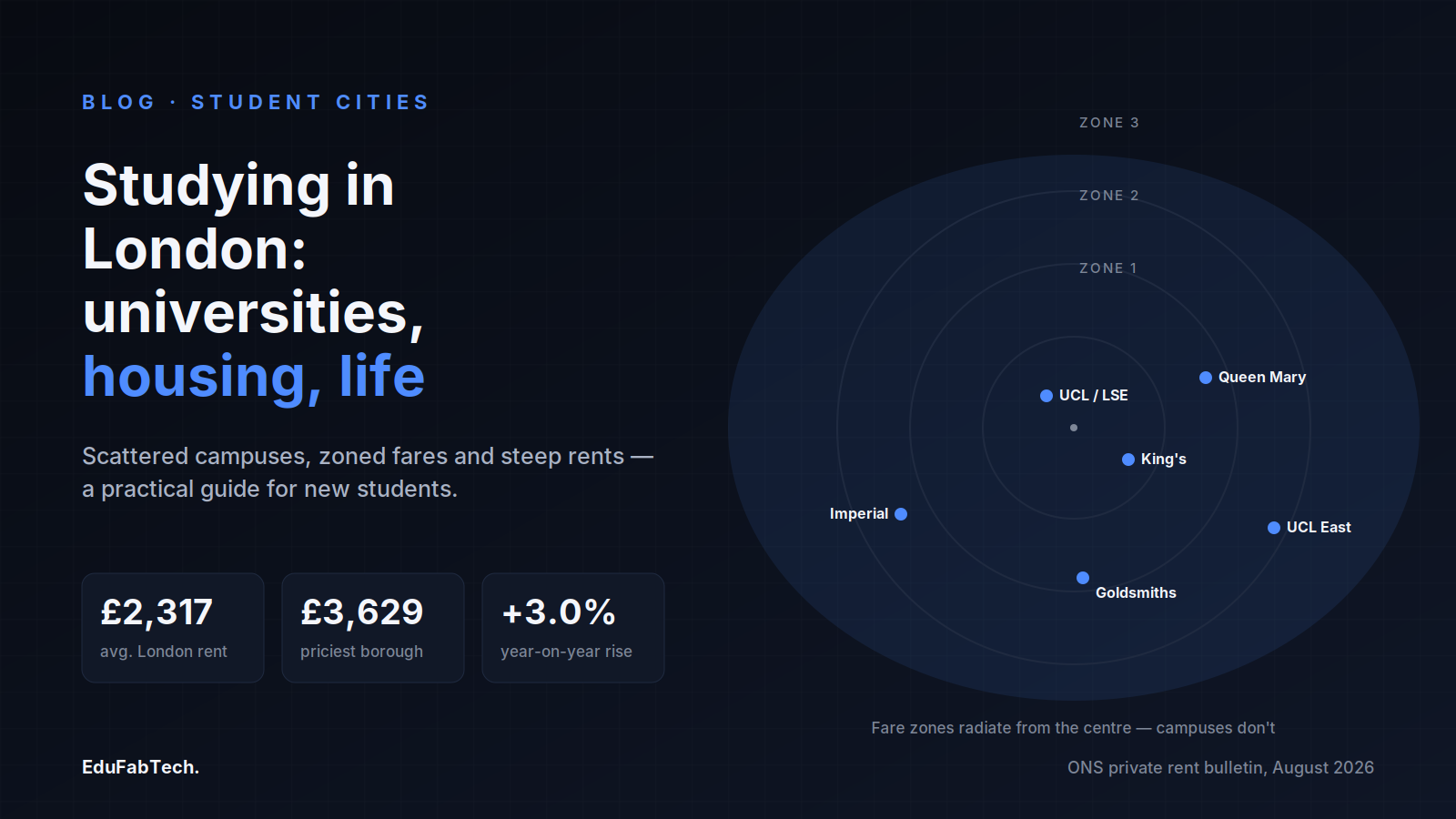
London is less a single student town than a cluster of them. Dozens of higher education institutions sit inside the city and its commuter belt, from world-ranked research universities to one-subject conservatoires, and most students experience London through ten or fifteen miles of lecture halls, shared flats and Underground lines rather than one compact campus. The University of London is itself a federation of independent institutions — University College London, the London School of Economics, King's and others each award their own degrees while belonging to it — and that arrangement captures the whole city: everything feels close together and is separately run at the same time.
What follows is a practical account for anyone about to study here, whether you grew up in a London suburb or are flying in from another continent: who teaches what and where, which districts students actually live in, how to rent a room without being cheated, where to furnish it cheaply, the rules on working, where to read, how to move around, and what the honest trade-offs are. Where a number appears, it is dated and linked to the body that published it. You can browse local listings for the whole city on EduFabTech's London page.
Two facts shape almost every decision a student makes here. First, travel is zoned: Transport for London (TfL) runs the Underground, buses, the Elizabeth line, the Docklands Light Railway, the Overground and trams, priced in fare zones radiating from the centre. Second, housing is expensive — the Office for National Statistics put the average private rent in London at £2,317 a month in July 2026, up 3.0% over the year (ONS, August 2026 bulletin). High rent and long commutes are the background to everything below.
The universities, and how they are scattered
The largest research universities form a rough arc. University College London occupies Bloomsbury in the centre, and takes in the Slade School of Fine Art, the UCL Institute of Archaeology and the UCL School of Pharmacy, with a newer campus, UCL East, at Stratford; you can see rooms and services near UCL. Imperial College London is based in South Kensington and, by its own description, concentrates on science, technology, engineering, medicine and business, having been founded in 1907. The London School of Economics and Political Science sits on Houghton Street off the Aldwych, a compact central campus devoted to the social sciences. King's College London, founded in 1829, spreads across five campuses with its main site on the Strand and counts fourteen Nobel laureates among its alumni and staff, according to its about page. Queen Mary University of London has its main campus at Mile End in the East End, per its own site.
Several more University of London members are household names in their fields:
- SOAS, University of London — Bloomsbury; the study of Asia, Africa and the Middle East.
- Birkbeck, University of London — Bloomsbury; long known for degrees taught in the evening for people who work by day.
- Goldsmiths, University of London — New Cross in south-east London; art, design, media and humanities.
- City St George's, University of London — formed when City, University of London, near Angel, joined with St George's medical school at Tooting; business, law, journalism, health and medicine.
- London School of Hygiene and Tropical Medicine — Bloomsbury; a postgraduate school of public and global health.
- The Courtauld Institute of Art — at Somerset House on the Strand; the history of art.
- The Institute of Cancer Research — a postgraduate research institution that awards University of London degrees in cancer science.
- London Business School — beside Regent's Park in the City of Westminster; postgraduate management and finance.
- Royal Academy of Music and Royal Central School of Speech and Drama — conservatoires near Regent's Park and Swiss Cottage, for music and for drama respectively.
- Royal Holloway, University of London (a Victorian campus at Egham in Surrey) and Brunel University London (a single campus at Uxbridge in west London).
The federation also runs the School of Advanced Study, which coordinates humanities research, and University of London Worldwide, through which students take London degrees by distance learning anywhere in the world.
A second tier of large universities serves huge numbers of Londoners across the outer zones: the University of Westminster (Regent Street and central sites), London Metropolitan University (Holloway and the City of London), London South Bank University (Elephant and Castle), the University of East London, whose University of East London Docklands Campus stands beside the Royal Docks with a second site at Stratford, the University of Greenwich (based at the Old Royal Naval College, with its University of Greenwich - Avery Hill campus in Eltham), the University of Roehampton (Wandsworth), Middlesex University (Hendon) and the University of West London (Ealing and Brentford, home to the London College of Music). Newer and smaller institutions include Northeastern University London and the London Interdisciplinary School, both in the centre, Regent's University London inside Regent's Park, Ravensbourne University London on the Greenwich Peninsula, plus professional and private providers: BPP University, LIBF (the London Institute of Banking & Finance), Pearson College London, Richmond, The American International University in London, American University in London, London Churchill College, Anglian College London, London College of Contemporary Arts (LCCA) and Polish University Abroad, which serves the city's Polish community.
London's density of arts, music and drama schools is unusual. University of the Arts London is the umbrella for Central Saint Martins, the London College of Fashion (now on the East Bank at Stratford), London College of Communication and Chelsea College of Art and Design. Alongside it sit the Royal College of Art (postgraduate art and design, in Kensington and Battersea), the Royal College of Music (South Kensington), the Guildhall School of Music and Drama (the Barbican), Trinity Laban Conservatoire of Music and Dance (Greenwich and Deptford), BIMM University (contemporary music), Rose Bruford College (drama, at Sidcup), the Rambert School of Ballet and Contemporary Dance (Richmond), The Royal Ballet School (Covent Garden and Richmond Park), Art Academy London and Christie's Education (the art market). Around the edge of the region you will also find Kingston University (Kingston upon Thames), St Mary's University, Twickenham, the University of Surrey (Guildford), the University of Hertfordshire (Hatfield), the University of Bedfordshire (Luton), Buckinghamshire New University (High Wycombe) and Writtle College near Chelmsford, which teaches land-based and agricultural subjects.
Which parts of London students call home
Because campuses are scattered, where you live is really a question of which line gets you to class. A few districts recur in student life:
Bloomsbury and King's Cross are the academic heart — UCL, SOAS, Birkbeck, the University of London's Senate House and, a few minutes away, the British Library. Walkable to class, but central Zone 1 rents are among the city's steepest, so most students here are in halls rather than private flats.
Mile End, Whitechapel and Bethnal Green in the east are Queen Mary and London Interdisciplinary School territory, well served by the Central line and Elizabeth line, cheaper than the centre and full of markets and canalside walks.
New Cross and Deptford, in the south-east, revolve around Goldsmiths: lower rents, a strong music and art scene, and London Overground links, though the Underground does not reach here.
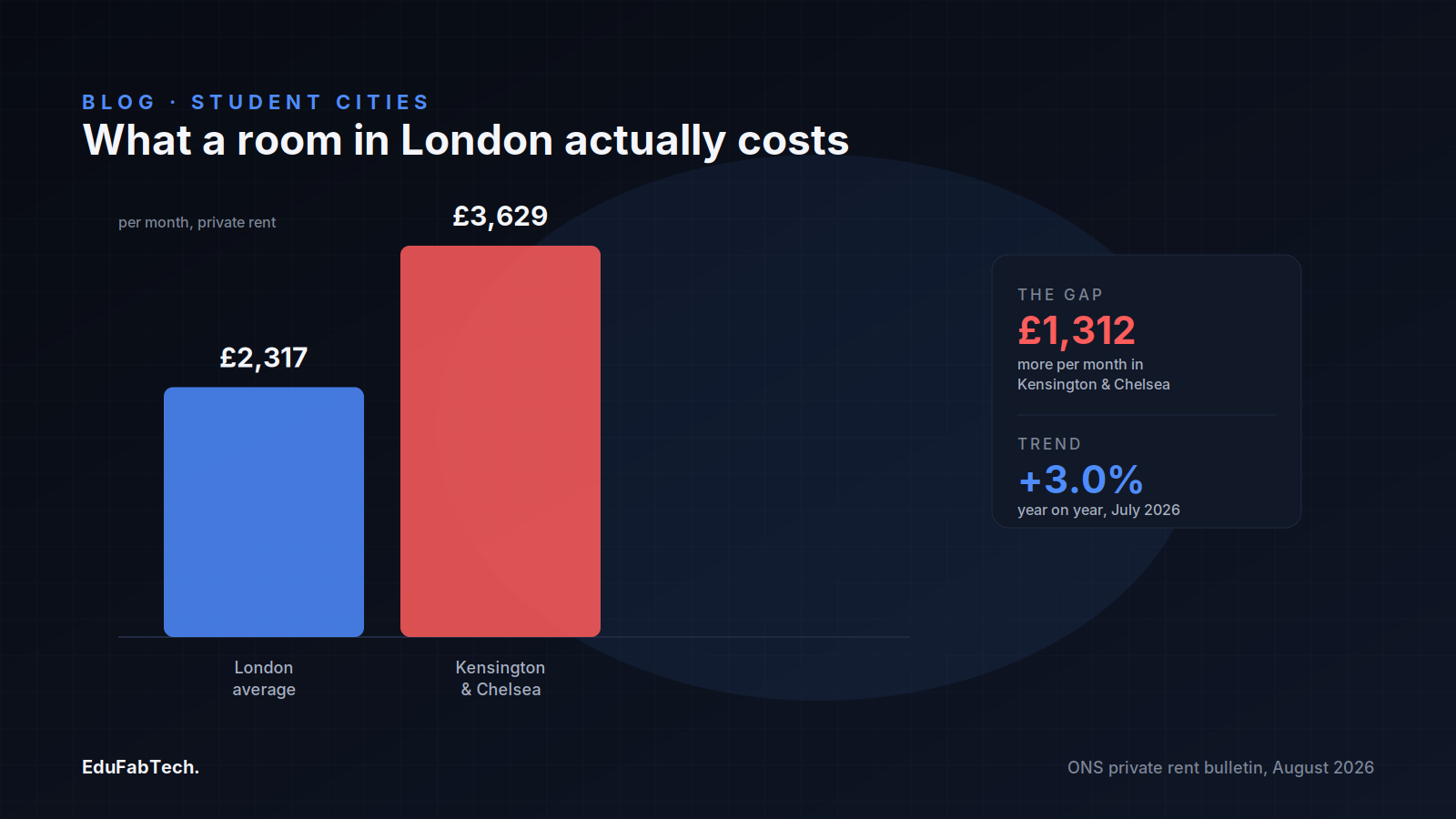
Camden and Kentish Town draw students from across north London for nightlife and the Northern line; South Kensington clusters Imperial, the Royal College of Art and the Royal College of Music beside the big museums, but it is costly — the ONS recorded the highest average rent of any UK local authority in Kensington and Chelsea at £3,629 a month in July 2026 (ONS, August 2026). Many students instead push west to Ealing and Acton or east to Stratford, where the arrival of UCL East and the London College of Fashion has made the old Olympic quarter a student district in its own right.
Finding a room without losing a deposit
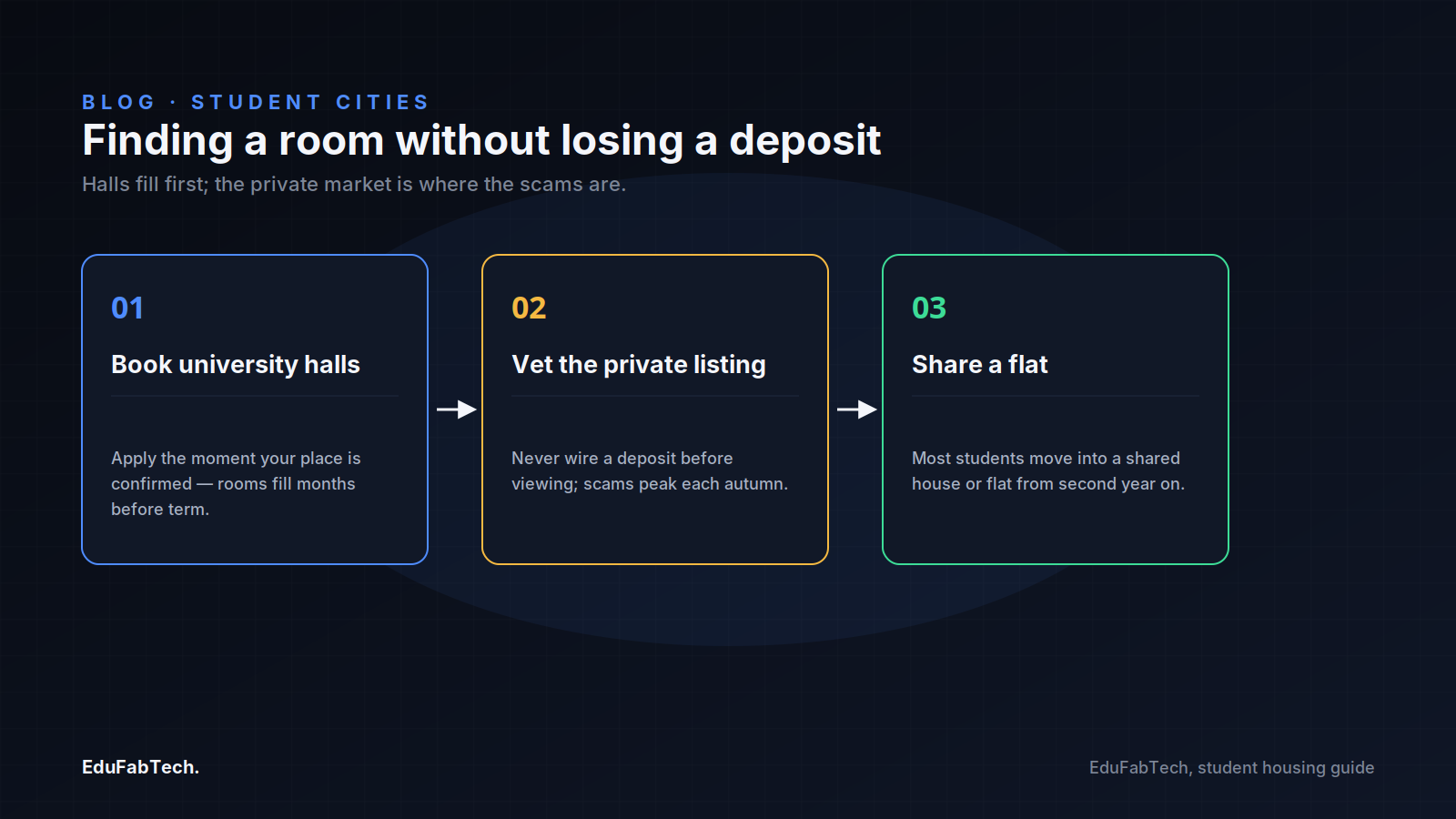
Most first-year students, and many international students, start in university halls or a private purpose-built student hall, then move into a shared house or flat in later years. Halls fill early, so apply as soon as your place is confirmed — often months before term. For an idea of hall pricing from a university's own page, LSE lists its College Hall in Bloomsbury at between £329.88 and £455.71 per week for 2026/27 depending on room type (LSE College Hall); other halls and private shares run both below and above that.
Scams cluster around the private market, especially in autumn when demand peaks and listings for cheap rooms in desirable areas appear overnight. The warning signs are consistent: a room far below the going rate, a "landlord" who is abroad and cannot show you the property, and pressure to pay a holding fee before you have seen anything. See the place in person or on a live video call, meet whoever is letting it, and never send money by bank transfer, gift card or cryptocurrency to "hold" a room. On a normal assured tenancy in England your deposit must be placed in a government-approved tenancy deposit protection scheme — the Deposit Protection Service, MyDeposits or the Tenancy Deposit Scheme — within 30 days (GOV.UK); if a landlord will not say which scheme they use, treat that as a red flag. Rooms listed by other students are on EduFabTech's London rooms page.
Furnishing a room the cheap way
London rewards patience with second-hand goods. Its markets are an institution: Portobello Road Market in Notting Hill is famous for antiques, vintage clothing, books and records, with Saturday its busiest day and antiques dealers trading Friday to Sunday (Portobello Road Market). Other long-running markets worth knowing are Camden Market in Camden Town, the Sunday stalls around Brick Lane and Old Spitalfields in the east, and Columbia Road's flower market. Charity shops line almost every high street and are the quickest source of cheap crockery, lamps and winter coats; several national charities also run dedicated second-hand furniture stores. Browse what other students are selling or giving away on EduFabTech's London second-hand listings and its free-stuff page before buying anything new.
Working while you study
If you are an international student, your right to work comes from your visa and is printed on it, so check that first. As a general guide, UKCISA states that Student visa holders whose sponsor has a track record of compliance may work up to 20 hours a week in term time at degree level or above, up to 10 hours a week below degree level, and full time outside term time (UKCISA). The 20 hours is a total across all jobs, not per employer, and the consequences of breaching it are serious. This is a summary, not legal advice; confirm your own conditions against the official guidance at GOV.UK's Student visa work page and your university's international student office. Term-time jobs for students are collected on EduFabTech's London jobs page.
Libraries and places to read
Beyond your own university library, London has public collections students lean on heavily. The British Library at St Pancras — 96 Euston Road, by King's Cross — issues a free Reader Pass to anyone aged 18 or over who registers and agrees to its terms of use, giving access to its reading rooms (British Library). The University of London's Senate House Library in Bloomsbury is another central option, and many college libraries open long hours during exam term. Desk space fills fast in May and June, so in peak weeks it is worth having a fallback — a second campus site, a public library, or a quiet café. Study spaces listed by others are on EduFabTech's London study-spaces page.
Getting around
You pay for TfL with a contactless card or an Oyster card, tapping in and out; daily and weekly caps limit what you spend. Students enrolled on a full-time course and living in London during term can apply for an 18+ Student Oyster photocard, which King's College London's student services describe as giving 30% off Travelcards and Bus & Tram season tickets for a £20 application fee, though it does not discount pay-as-you-go fares (King's College London). The same guidance notes that a 16-25 Railcard, linked to an Oyster card, adds a third off off-peak pay-as-you-go Tube fares. Buses are a flat fare and run through the night on many routes; cycling and walking are realistic in the central zones, where distances are shorter than the map suggests.
What is good, and what is hard
The upside of studying in London is hard to overstate: the concentration of universities, libraries, museums, employers and fellow students is unmatched in the country, and the city connects to the rest of Europe by rail and air. Term brings a steady supply of free lectures, gallery openings and club nights, and almost any interest finds a society or a scene.
The hard parts are equally plain. Rent is the dominant cost and, at an average of £2,317 a month across London in July 2026 (ONS), it squeezes everything else; a long commute from a cheaper outer zone is the usual trade-off for a lower rent. The city is crowded, the weather is grey and wet for much of the academic year, and the sheer size can be isolating until you build a routine. Going in with a clear budget and a realistic travel time makes the difference between enjoying London and merely surviving it.
A checklist for your first weeks
- Confirm your right to work from your visa, and read the official rules at GOV.UK before taking any job.
- Apply for your hall or arrange accommodation early, and never pay a deposit before seeing the place and confirming it will go into an approved deposit protection scheme.
- Get an Oyster card or use contactless, and apply for the 18+ Student Oyster photocard if you qualify.
- Register for your British Library Reader Pass and find your nearest quiet study sites before exam term.
- Learn two routes to campus — rail delays are routine — and note which night buses serve your area.
- Furnish from markets, charity shops and second-hand listings rather than buying everything new.
- Register with a local GP and your students' union in the first fortnight, while you have time.
NOTES — skipped (not named in the text):
- skipped: Kew Gardens — a botanic garden and plant-science research body, not a degree-awarding university.
- skipped: University of North London — merged into London Metropolitan University in 2002.
- skipped: London Guildhall University — merged into London Metropolitan University in 2002.
- skipped: Heythrop College — ceased operating in 2018.
- skipped: Institute of Education — merged into UCL in 2014 (now the UCL Institute of Education).
- skipped: Conservatoire for Dance and Drama — dissolved; its member schools are now independent.
- skipped: Sir John Cass College — a historic college, no longer an independent degree-awarding institution.
- skipped: The Royal College of Nursing — a professional body and trade union, not a degree-awarding university.
- skipped: University for the Creative Arts - Epsom; University for the Creative Arts - Maidstone; University for the Creative Arts - Rochester — branch campuses of UCA in Surrey and Kent, outside London.
- skipped: University of Kent - Tonbridge; Canterbury Christ Church University - Salomons — campuses in Kent, outside London.
- skipped: Main Building And Two Side Wings Of Berkshire College Of Art (Maidenhead) — a listed-building heritage record in Maidenhead, outside London, not a university.
- skipped: South-East Essex Technical College and School of Art (Barking) — a former/historic college name, not a current degree-granting university.
A quick question for readers
Do you work part-time while you study?
Many students work to pay the bills. See how common it is — and how many hours people really do.
Pick an answer, create a free account in a minute, and your vote counts. Already a member? Sign in
Comments 3
Comment-
The work-while-you-study section gives you the one number that doesn't help: 20 hours a week, capped, no per-hour pay attached to it. Fine a…
-
The detail I actually trust here is the £3,629 average for Kensington and Chelsea against the citywide £2,317 — that's the kind of compariso…
-
The number that'd make me go back and double-check my course choice is the Kensington and Chelsea rent: £3,629 a month, highest of any UK lo…
Join free to read the full comments and reply Comments are between members; an account takes a minute.
Source: Office for National Statistics
Sources (5)
- Office for National Statistics. Private rent and house prices, UK: August 2026. Office for National Statistics, 2026. ons.gov.uk ↗ · checked 4 Nov 2026
- UK Council for International Student Affairs. Working as an international student. UKCISA, 2026. ukcisa.org.uk ↗ · checked 4 Nov 2026
- London School of Economics and Political Science. College Hall. LSE, 2026. lse.ac.uk ↗ · checked 4 Nov 2026
- GOV.UK. Tenancy deposit protection. GOV.UK, 2026. gov.uk ↗ · checked 4 Nov 2026
- British Library. Reading Rooms. British Library, 2026. bl.uk ↗ · checked 4 Nov 2026