Studying in Los Angeles: universities, housing and student life
A practical, honest guide to studying in Los Angeles — the campuses, the neighbourhoods students actually live in, how to find a room safely, what things cost, and the trade-offs of a city built around the car.
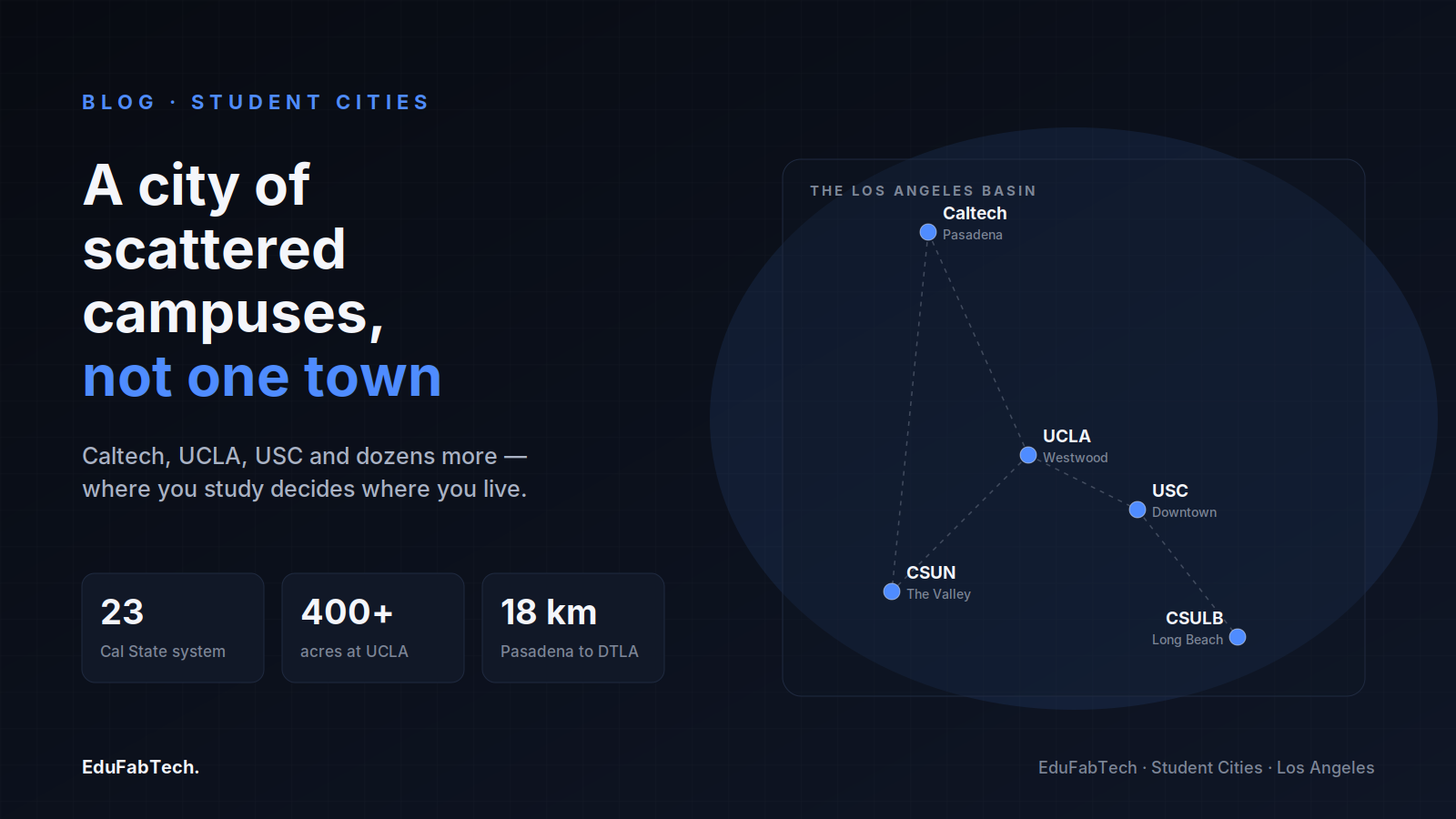
Los Angeles is less a city than a basin full of cities, and its universities are scattered across it the way the neighbourhoods are: a science institute in Pasadena, a vast public campus on the Westside, a private university just south of the towers Downtown, and dozens more in the valleys, along the coast, and out into Orange County. There is no single student quarter. Where you study largely decides where you live, how long you commute, and how much of your budget the rent eats.
That makes Los Angeles both generous and demanding for a student. Generous, because almost any field — film, aerospace, medicine, design, public policy, theology — has a serious institution here. Demanding, because the distances are real, the housing is tight, and a car is the city's unspoken assumption. This guide is for students arriving from across the country or from abroad, and it sticks to what can be checked.
The universities, and what studying here is like
The three names most people know sit within an hour of one another in good traffic. California Institute of Technology is in Pasadena, about 18 km northeast of Downtown; it is small, intense, and built around science and engineering, and it manages a federal space laboratory nearby. University of California, Los Angeles occupies a 400-plus-acre campus in Westwood, on the Westside near the Santa Monica foothills, and is one of the country's largest public research universities. University of Southern California sits in University Park, just south of Downtown, a large private university long associated with film, engineering and the health sciences; its engineering school, the USC Viterbi School of Engineering, and the newer USC Jimmy Iovine and Andre Young Academy for arts and technology both teach on that campus, as does the University of Southern California School of International Relations.
Public higher education also runs through the 23-campus California State University system, which places affordable, teaching-focused campuses around the region. California State University, Long Beach is a large campus near the coast in the south; California State University, Los Angeles sits on the eastern edge of the city; California State University, Northridge anchors the San Fernando Valley; and California State University, Dominguez Hills serves the South Bay. Further out are California State University, Fullerton in Orange County and two polytechnic colleges at California State Polytechnic University, Pomona — the Cal Poly Pomona College of Environmental Design and the Cal Poly Pomona College of Education and Integrative Studies — where learning is deliberately hands-on. UCLA's professional and research arms, including the UCLA School of Education and Information Studies, the UCLA Luskin School of Public Affairs (formerly the UCLA School of Public Affairs) and the UCLA Institute for Research on Labor and Employment, extend the public footprint.
The private and faith-based sector is unusually deep here. Pepperdine University looks over the Pacific from Malibu; Loyola Marymount University sits on a bluff above the Westside; Occidental College is a selective liberal-arts college in the Eagle Rock hills; and Chapman University in Orange is known for film and media. Christian universities include Biola University in La Mirada, Azusa Pacific University to the east, the University of La Verne, Vanguard University of Southern California in Costa Mesa, Concordia University Irvine, Hope International University, Bethesda University, Life Pacific University and Mount Saint Mary's University, Los Angeles, which teaches from campuses in the Santa Monica Mountains and near Downtown. Fuller Theological Seminary in Pasadena is one of the larger graduate seminaries in the country.
Art, design and specialist schools are a defining part of studying in Los Angeles. California Institute of the Arts, north of the city in the Santa Clarita Valley, is known for animation and performing arts; Art Center College of Design in Pasadena for product and transportation design; the Southern California Institute of Architecture (SCI-Arc) occupies a long former freight depot in the Downtown Arts District; and Woodbury University in Burbank teaches architecture and design. For public policy, the Frederick S. Pardee RAND Graduate School in Santa Monica trains doctoral researchers inside a major research institute.
Several health-sciences and graduate institutions round out the map: Charles R. Drew University of Medicine and Science in the Willowbrook area of South Los Angeles, Marshall B. Ketchum University in Fullerton (optometry and health professions), Southern California University of Health Sciences near La Mirada, and the small Irell & Manella Graduate School of Biological Sciences attached to a cancer research hospital in Duarte.
Other universities across the region
The region holds many smaller, specialist, online and adult-focused institutions. One true line each:
- University of the People — an online, non-profit, largely tuition-free university headquartered in Pasadena.
- Saybrook University — a graduate school of humanistic psychology, now based in Pasadena.
- University of Santa Monica — a private graduate school focused on spiritual psychology.
- American Jewish University — a small private university with a Westside presence.
- University of the West — a Buddhist-founded university in Rosemead, east of the city.
- Abraham Lincoln University — an online-focused private university offering law and business.
- University of West Los Angeles — a private school known for its law program.
- Columbia College Hollywood — a film and media college in the San Fernando Valley.
- Los Angeles Recording School — an audio and music-production school in the Hollywood area.
- Brandman University — an adult-focused institution based in Orange County, now part of UMass Global.
- Anaheim University, California Coast University, California Southern University, California Intercontinental University, Trident University International and Apollos University — online and distance-learning universities serving working adults.
- Stanton University (Garden Grove), Bristol University (Orange), Bethesda University and Veritas International University (Orange County) — small private institutions.
- Kingston University LA (Norwalk), South Coast College (Orange) and Piedmont University — small career- and transfer-oriented schools.
- Hubbard College of Administration International, California Pacific School of Theology, William Carey International University, The Grief Recovery Institute and UseIT — small training and specialist institutions in the region.
- Community colleges and districts with large student bodies: Los Angeles Mission College in the north Valley, the Rancho Santiago Community College District in Santa Ana, and the wider Los Angeles Community College District.
Community colleges deserve a mention of their own, because many students start there and transfer. Santa Monica College is one of the largest transfer feeders to UCLA; El Camino College near the South Bay, Mt. San Antonio College in Walnut and Los Angeles Harbor College in Lomita are substantial campuses. The Fashion Institute of Design & Merchandising, once a fixture Downtown, has wound down new enrolment, so check its current status before planning around it.
The neighbourhoods students actually live in
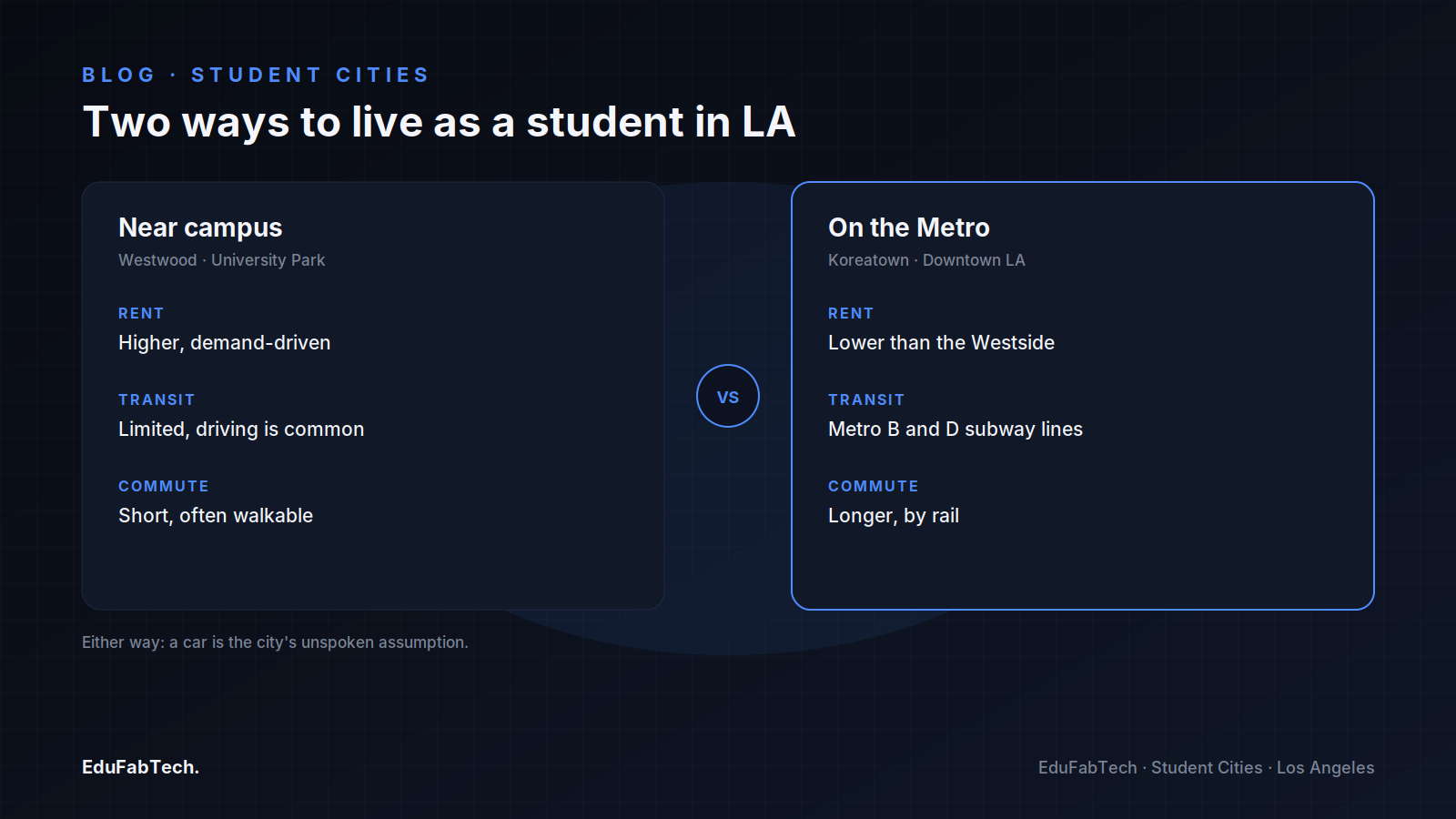
Westwood wraps around UCLA and is the closest thing the city has to a classic university village, with cafes and cinemas in Westwood Village — but it is one of the pricier places to rent, and demand from UCLA students keeps it that way. University Park, North University Park and West Adams, the neighbourhoods around USC, mix student housing with long-standing residential blocks; rents are lower than the Westside, though quality varies street by street and you should look carefully.
Koreatown, central and dense, is a favourite for its food, its relatively lower rents and its position on the Metro B and D subway lines, which makes it one of the few genuinely transit-friendly student areas. Downtown Los Angeles suits students at SCI-Arc or anyone who wants the rail hub on their doorstep; converted lofts and newer towers sit alongside areas in transition, so judge each block for yourself. East Hollywood, Los Feliz and Silver Lake draw a creative crowd and sit near the Metro B line, trading higher rents for walkability and nightlife.
Pasadena is quieter and leafier, well suited to Caltech, Art Center College of Design and Fuller Theological Seminary students who want the San Gabriel Valley rather than the Westside crush. Long Beach, coastal and more affordable than the Westside, revolves around California State University, Long Beach and has its own transit and a relaxed seaside character, at the cost of a longer trip into central Los Angeles. If your campus is in the San Fernando Valley — California State University, Northridge or Woodbury University — the Valley itself (Northridge, Van Nuys, Burbank) offers more space for the money, with hotter summers and a heavier reliance on driving.
Finding a room without getting burned
Most students rent a room in a shared apartment or house, a studio, or a bed in university or private housing. On-campus options at the larger universities fill fast and usually prioritise first-year students, so many people look privately. Start early: for a term beginning in late summer, serious searching from late spring is not too soon, because the best-value rooms near campus go quickly. Browse local student listings such as those on EduFabTech's Los Angeles pages and the dedicated rooms section, and if you have a campus in mind, filter by proximity — for example listings near University of Southern California, near University of California, Los Angeles or near California Institute of Technology.
Before you pay anything, see the place — in person, or at least on a live video call where the person shows you the actual room, the street and the building. Read the lease, check who else lives there, confirm what the rent includes (utilities, internet, parking), and ask how the deposit is returned. A legitimate landlord will let you verify the address and will not rush you.
On scams: never send a deposit or "holding fee" by bank wire transfer, gift card or cryptocurrency to secure a room you have not seen. A listing far below the going rate, a "landlord" who is conveniently abroad and cannot show you in, and pressure to pay immediately to "beat other applicants" are the classic warning signs. If anything about the payment feels engineered to be irreversible, treat it as a scam and walk away.
Furnishing a room cheaply: markets and second-hand
Los Angeles has a strong resale culture, which is lucky, because furnishing from scratch is expensive. The famous one is the Rose Bowl Flea Market in Pasadena, held on the second Sunday of every month — a sprawling market of furniture, vintage clothing and household goods. The Rose Bowl's own page lists admission tiers and times, so check before you go. Beyond the flea markets, thrift and charity shops across the city carry desks, chairs, lamps and kitchenware for a fraction of new prices, and neighbourhood "buy nothing" and free-stuff networks are active here.
For the practical side of kitting out a room, EduFabTech's second-hand and furniture listings are worth scanning, and the free-stuff page often has items left behind at the end of a term — the cheapest furniture in the city is the furniture someone is giving away because they are moving out.
Working while you study
Rules for working depend on your status, and this is where you should rely on official sources rather than advice from friends. For international students on the main student visa category (F-1), the U.S. federal immigration authority's own guidance explains that on-campus work is generally limited to 20 hours per week while classes are in session, with more allowed during official breaks, and that such on-campus work does not need separate work authorisation — the details and any off-campus provisions are set out in the federal immigration authority's policy manual. Treat that page as the authority and confirm your own situation with your university's international student office; nothing here is legal advice.
Part-time jobs that students commonly hold — campus libraries, cafes, tutoring, research assistantships, retail — are worth searching early, because the city is competitive. EduFabTech's Los Angeles jobs page collects local part-time listings.
Libraries and places to study
Every university here has its own libraries, and they are the default study space for enrolled students. Beyond campus, the public system is excellent. The Los Angeles Public Library's Central Library Downtown is an eight-floor building with seating for well over a thousand people, hundreds of free public computers, and the free Octavia Lab maker space with 3D printers and recording booths. A library card is free for California residents, which opens up quiet study rooms and resources across dozens of branches. For paid or reservable desks closer to home, EduFabTech's study-spaces listings are a starting point, and the events page can help you find study groups and meet-ups.
Getting around a city built for cars
Los Angeles is spread out, and its reputation for car dependence is earned. That said, the rail and bus network has grown. According to the Los Angeles County Metropolitan Transportation Authority (2026), a single one-way fare is $1.75, with a daily cap of $5 and a weekly cap of $18 when you tap the same card — so frequent riders never pay more than those limits. One important detail for students: the Metro GoPass programme, which gives fully free rides, covers K-12 and community-college students, not four-year university students, so if you are at a four-year campus, budget for the standard fares.
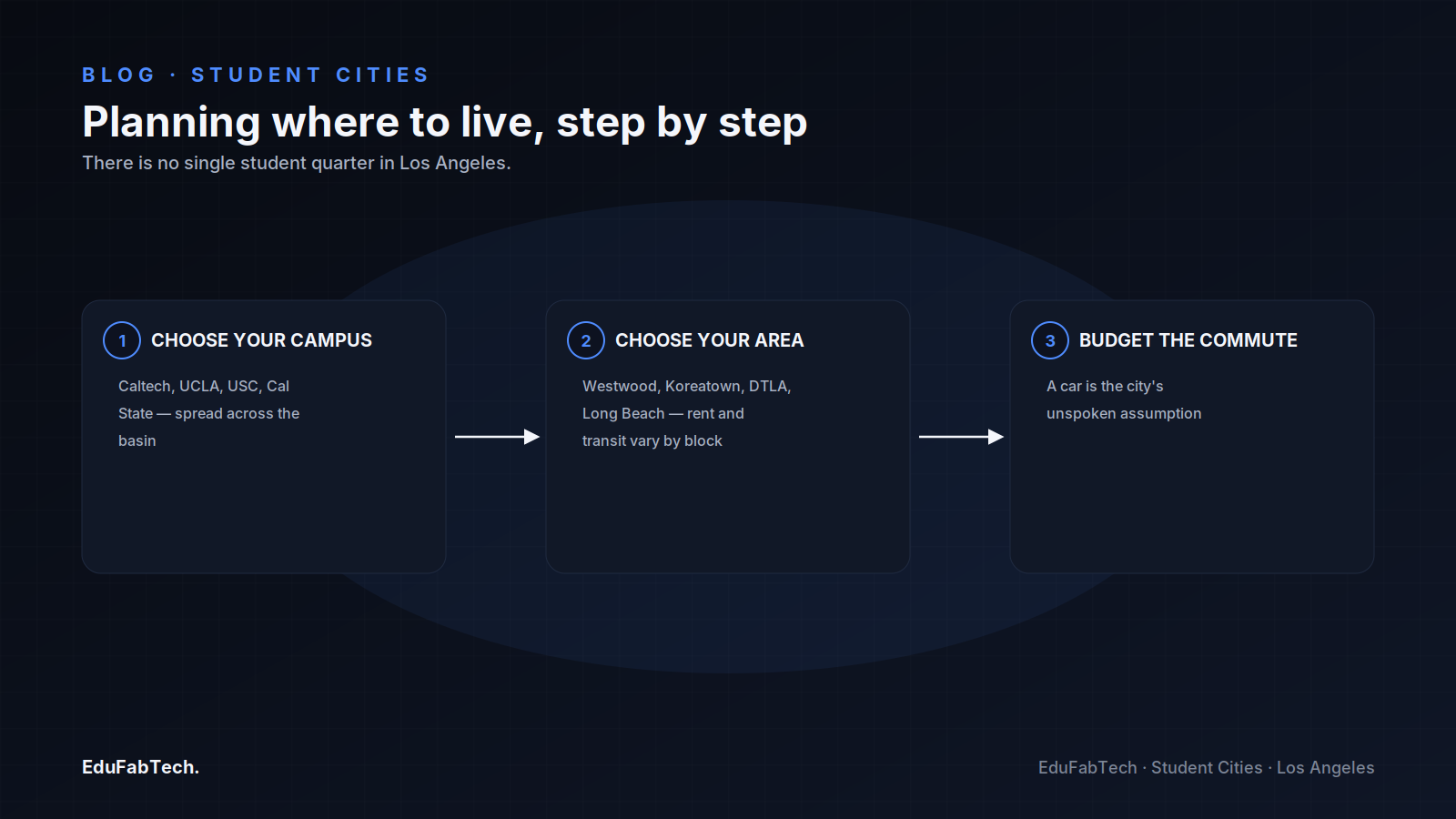
Where you live relative to a rail line matters enormously. Living near the B or D subway lines, or on a frequent bus corridor, can make a car optional; living in the hills or the outer valleys usually does not. Factor the realistic commute into any room you consider — a cheap room an hour and a half from campus is rarely the bargain it looks like.
What things cost
Housing is the largest and most variable cost. The U.S. Census Bureau's QuickFacts put the median gross rent in the city of Los Angeles at $1,933 per month for the 2020–2024 period — a figure for all households, not a student room, but a useful anchor for how expensive the market is. A room in a shared flat costs less than a whole apartment, and prices fall as you move away from the Westside and from campus. Beyond rent, your main costs are food, transport (the Metro caps above help), phone and internet, and course materials. Prices for groceries and everyday goods are not something a single sourced figure can capture fairly across such a large region, so treat the Westside and the coast as the expensive end and the central and eastern neighbourhoods as more affordable.
What is good, and what is hard
What is good: the sheer range of institutions and fields; the weather, which is mild and dry for most of the year; the food, shaped by one of the most diverse populations anywhere; and a creative, entrepreneurial student culture spread across film, tech, design and research. What is hard, honestly: cost, especially housing on the Westside; distance and traffic, which turn a short map line into a long day; a genuine housing shortage that keeps good rooms scarce; and the fact that much of the city still assumes you have a car. The climate has a sharper edge too — hot, dry autumns bring wildfire and poor-air-quality days, and the region is seismically active, so it is worth knowing your building's basics.
A checklist for the first weeks
- Confirm your room in person or by live video before sending any money; never pay a deposit by wire, gift card or crypto.
- Register with your university's international or student services office and ask them to confirm any work rules for your status.
- Get a transit card, set it up for fare capping, and work out your realistic campus commute.
- Sign up for a free public library card if you are eligible, and find one quiet study space near home.
- Furnish from flea markets, thrift shops and free-stuff listings before buying anything new.
- Learn your neighbourhood's basics — nearest rail stop, grocery, clinic — and keep your lease and ID documents somewhere safe.
A quick question for readers
Do you work part-time while you study?
Many students work to pay the bills. See how common it is — and how many hours people really do.
Pick an answer, create a free account in a minute, and your vote counts. Already a member? Sign in
- U.S. Census Bureau. QuickFacts: Los Angeles city, California — Housing. U.S. Census Bureau, 2024. link
- Los Angeles County Metropolitan Transportation Authority. Fares. LA Metro, 2026. link
- Los Angeles County Metropolitan Transportation Authority. GoPass for K-12 and Community College Students. LA Metro, 2026. link
- U.S. Citizenship and Immigration Services. Policy Manual, Volume 2, Part F, Chapter 6: Employment. U.S. Department of Homeland Security, 2026. link
- Rose Bowl Stadium. Rose Bowl Flea Market. Rose Bowl Operating Company, 2026. link
- Los Angeles Public Library. Central Library. Los Angeles Public Library, 2026. link