Studying in Lubbock: universities, housing and student life
A practical, honest guide to studying on the South Plains — Texas Tech and Lubbock Christian University, the neighbourhoods students pick, what housing costs, and how to get around.
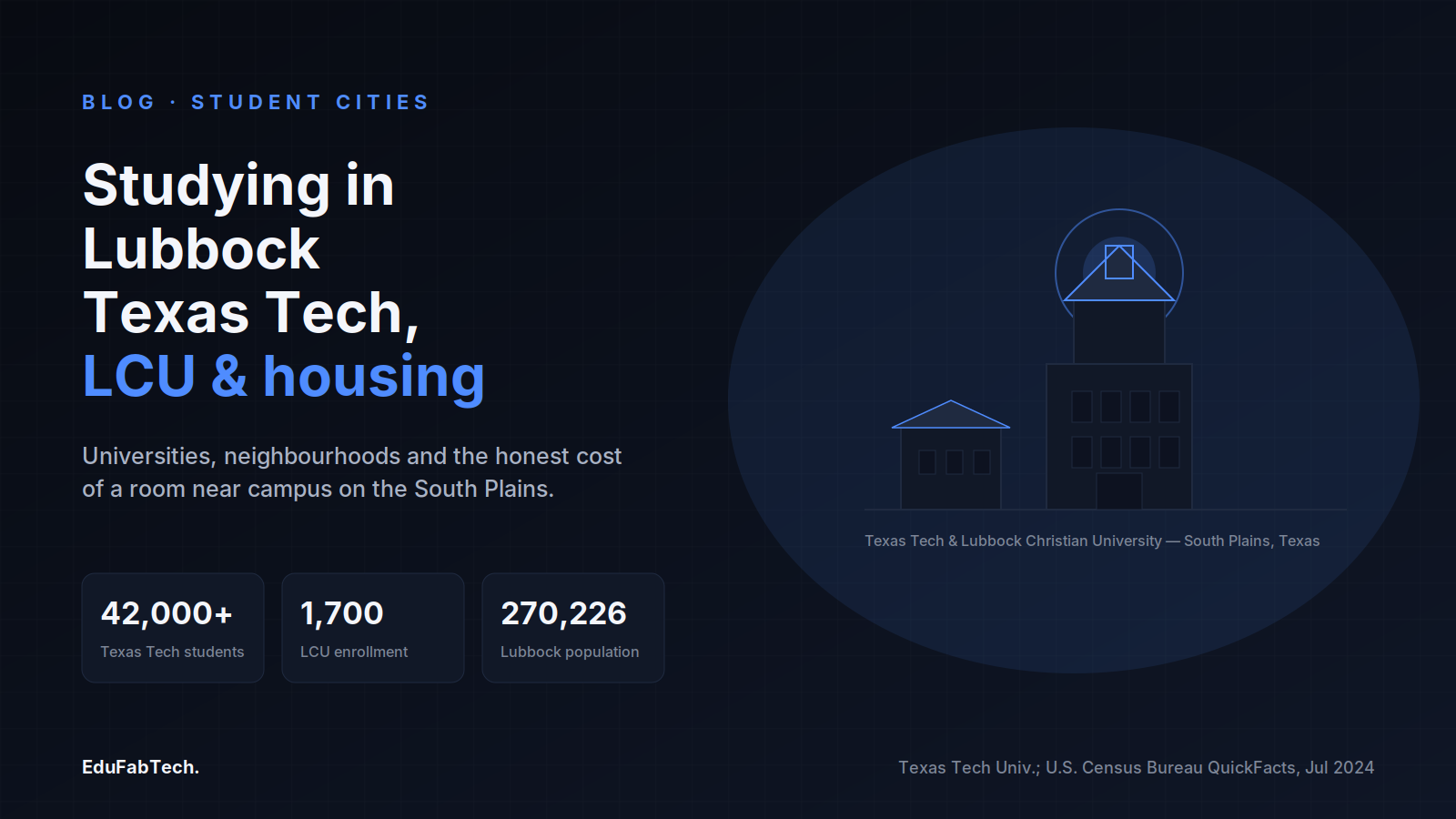
Lubbock sits in the middle of the Llano Estacado, the flat, high tableland of the Texas South Plains, roughly equidistant from Dallas, Albuquerque and the New Mexico line and a long way from anywhere else. That isolation shapes student life as much as any policy does: the city is its own gravitational centre, cotton fields begin where the suburbs end, and the sky does most of the scenery. According to the U.S. Census Bureau's QuickFacts (July 2024 estimate), about 270,226 people live here, which makes Lubbock a mid-sized city built largely around one very large university.
That university is Texas Tech University, founded in 1923 and still occupying its original campus off Broadway in central Lubbock. Texas Tech describes itself on its About page as a comprehensive public research university enrolling more than 42,000 students across thirteen colleges and schools, and counts itself among the Carnegie "Very High Research Activity" public universities. Its Spanish Renaissance architecture, red tile roofs and the sheer scale of the campus — one of the largest contiguous university campuses in the United States — give the city its visual identity.
Degrees at Texas Tech are earned through named colleges, and it helps to know them when you apply, because admission and advising often run through the college rather than the university. The largest is the Texas Tech University College of Arts & Sciences; engineering is housed in the Whitacre College of Engineering; and agriculture, a serious research strength on the South Plains, sits in the Texas Tech University College of Agricultural Sciences & Natural Resources. Design and planning are taught in the Texas Tech University College of Architecture, teaching qualifications in the Texas Tech University College of Education, and fields from nutrition to human development in the Texas Tech University College of Human Sciences. Journalism, advertising and public relations run through the Texas Tech University College of Media & Communication, and graduate study across the institution is administered by the Texas Tech University Graduate School.
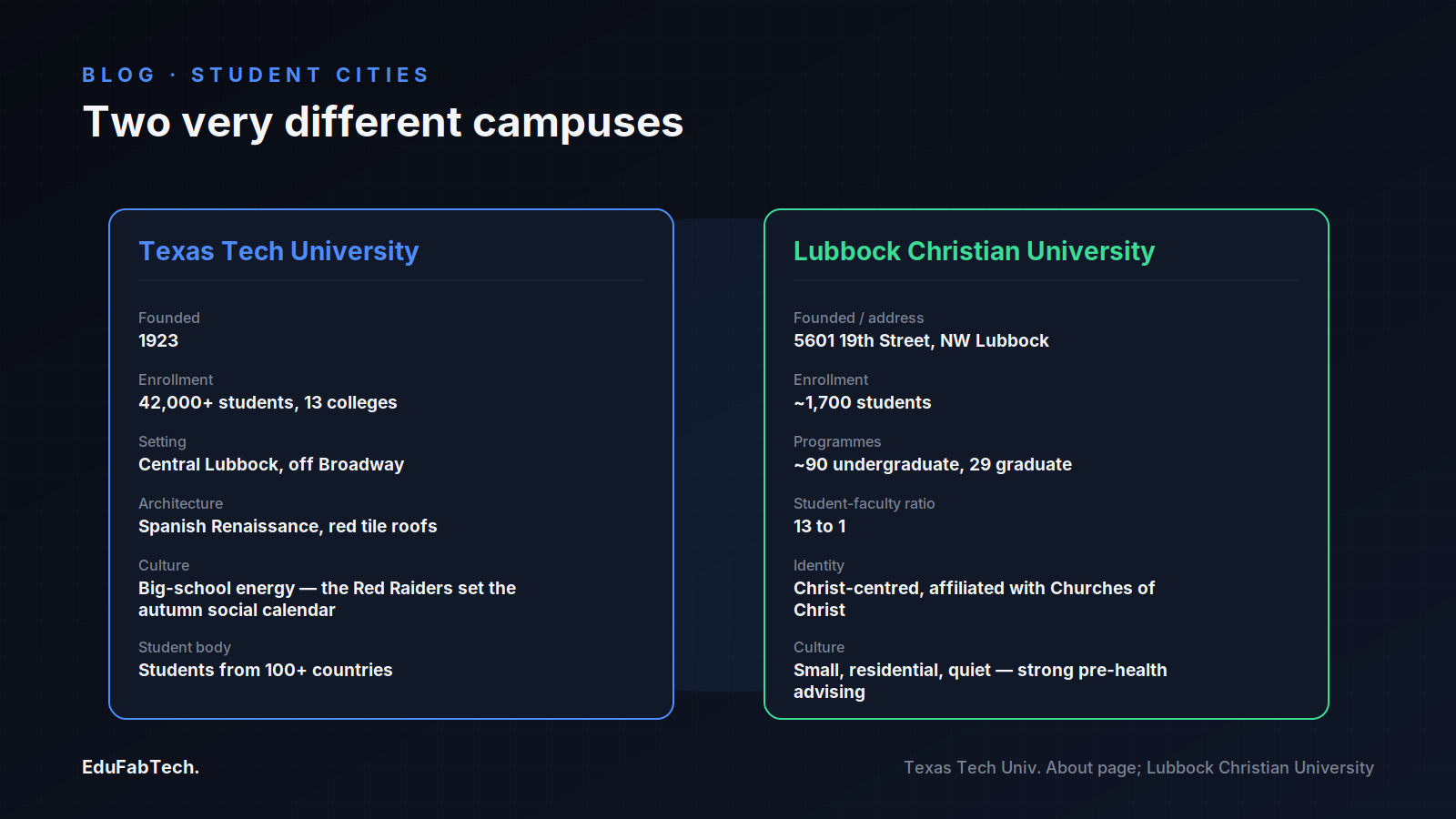
The second degree-granting institution in the city is Lubbock Christian University, at 5601 19th Street in the northwest of town. Its own website describes a Christ-centred community affiliated with the Churches of Christ, offering around 90 undergraduate and 29 graduate programmes with a 13-to-1 student-to-faculty ratio; recent counts put enrolment near 1,700. LCU is small, residential and quiet by design, with a reputation for pre-health advising — it is a different experience from Texas Tech in almost every respect except the climate.
What it is like to study here
Texas Tech is a big state school, and the texture of life reflects that: large lecture sections in the first years, a dense calendar of student organisations, and an athletics culture — the Red Raiders — that genuinely organises the social week in autumn. For international students it is worth knowing that the student body spans more than a hundred countries, so support structures and community groups already exist. Lubbock Christian University runs on the opposite logic: small classes, a tight campus off 19th Street, and a faith-based framing that suits some students and not others. Both are worth visiting in person before committing, if you can, because the gap between them is wide and neither is a "default".
The neighbourhoods students actually choose
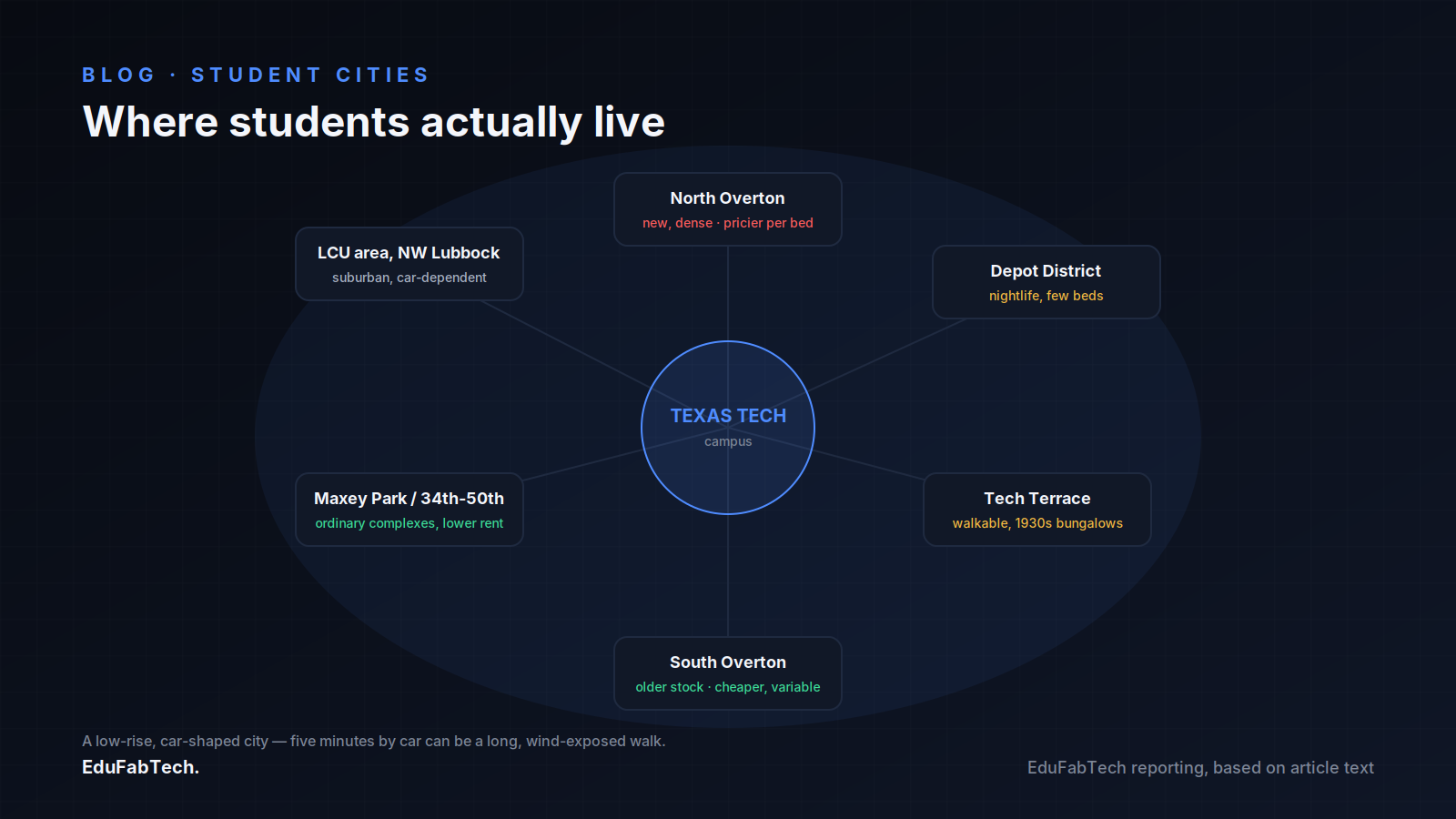
Most undergraduates at Texas Tech begin in the residence halls and then move into one of a handful of districts within a few kilometres of campus. Tech Terrace, the grid of 1930s bungalows just south-east of campus between roughly 19th and 34th Streets, is the classic student-and-young-professional neighbourhood: walkable, leafy by Lubbock standards, with coffee shops and small restaurants, and priced accordingly. North Overton, immediately east of campus, was largely rebuilt over the past two decades into a purpose-built student district of newer apartment blocks — convenient and modern, but denser and more expensive per bed. South Overton, directly south of campus, is older housing — divided houses and small apartments — and tends to be cheaper, though quality varies street by street.
Further out, the Maxey Park area and the stretches along 34th and 50th Streets offer ordinary apartment complexes at lower rents, trading walkability for a short bus ride or drive. The Depot District and downtown, north-east of campus, are less about living and more about going out — music venues and bars clustered around the old railway depot — but a few lofts and older units exist there. Around Lubbock Christian University in the north-west, housing is more suburban and car-dependent, and students there mostly live on or very near campus. Wherever you look, Lubbock is a low-rise, spread-out city: a place five minutes from campus by car can be a long, wind-exposed walk, so weigh the commute honestly.
Finding a room without losing a deposit
On-campus housing is booked through Texas Tech's housing office, and demand for the newer halls is real, so first-years should apply early once admitted. Off campus, the private market around Tech Terrace and Overton moves on an academic cycle: the best rooms for an August move-in are often signed in the spring, and complexes advertise aggressively to incoming students. A month-to-month search over the summer is possible but leaves you with thinner choices.
The scams that appear in Lubbock are the ordinary ones, dressed in local clothing: listings for "houses near Tech" at suspiciously low rents, a landlord who is conveniently out of state and wants a holding deposit before you can see the place, or a cloned advert for a real Tech Terrace house. The defences are simple and non-negotiable. See the actual unit — or have someone you trust see it — before you pay anything. Confirm the person collecting money controls the property. Get a written, signed lease that names the deposit and the conditions for its return. And never send money by bank wire, gift card, payment app or cryptocurrency to "hold" a room; no legitimate Lubbock landlord needs an irreversible transfer before you have keys and a signed lease. EduFabTech keeps local listings for rooms and places to stay and a wider set of student listings across the city if you want a starting point.
Furnishing a room for very little
Because so many students arrive and leave each year, Lubbock has a steady churn of cheap second-hand furniture — the end of each semester, especially May, floods the market with desks, futons and mini-fridges. The National Flea Market of Lubbock on Clovis Road runs at weekends and is the obvious place for household odds and ends, and thrift stores run by Goodwill Industries of Northwest Texas and local charities are scattered across the city. The Lubbock Downtown Farmers Market is a different kind of market — its own site lists it running every Saturday from 9am to 1pm at 5th Street and Avenue J (the LHUCA Plaza) through the 2026 growing season, 23 May to 24 October — but it is where you will find local produce rather than a mattress. For furniture, kitchenware and free giveaways from departing students, EduFabTech's second-hand and furniture listings are built for exactly this moment.
Working while you study
Many students take part-time jobs, and the campuses themselves — dining halls, the library, recreation centre, departmental offices — are the most common first employers. For international students the rules are strict and worth reading at the source rather than second-hand. According to the U.S. Department of Homeland Security's Study in the States, F-1 students may work on campus but "may not work more than 20 hours per week when school is in session", and active students may apply for on-campus employment up to 30 days before classes begin through their Designated School Official. The same DHS page explains that off-campus employment is generally only available after at least one full academic year and under specific conditions, requiring a Form I-765 filed with USCIS. This is a summary, not legal advice — your university's international office and the DHS page itself are the authorities to follow. Local openings aimed at students are collected on EduFabTech's jobs page.
Libraries and places to study
The centre of study life at Texas Tech is the University Library at 2802 18th Street. Its own pages describe a mix of reservable group study rooms for two to twelve people, individual carrels, and quiet floors in the stacks. For late-night work, the Library announced that, effective 15 February 2026, it stays open 24 hours a day Sundays through Thursdays, with the main interior closing at midnight and patrons moving to the Croslin Room — which keeps comfortable seating, wireless and WEPA printing through the night — while on Fridays and Saturdays everything closes at 10pm. Lubbock Christian University has its own library on its 19th Street campus for its students. Beyond the libraries, the coffee shops of Tech Terrace are the unofficial overflow study halls, and EduFabTech lists quieter rentable desks and study spaces around town.
Getting around
Lubbock is a driving city, but students have one genuine advantage: the municipal operator, Citibus, lets Texas Tech students ride the whole fixed-route network for nothing. Citibus's maps and schedules page states that a student attending Texas Tech can "ride any fixed-route service for free with proof of TTU ID", covering both the on-campus shuttles and the city routes — a real saving if you live along a line in Tech Terrace or Overton. The on-campus routes run only when the university is in session. For trips the fixed routes do not reach, Citibus On-Demand costs between $2.00 and $10.00 per trip depending on distance, according to Citibus's services page. Cycling is feasible given the flat terrain, with the caveat that the wind is a constant companion; beyond the student fare, a car remains the default for most residents.
What things cost
Housing is the largest line in any student budget, and Lubbock is still comparatively affordable for a university city. The most reliable public figure is the university's own: Texas Tech's housing rates for the Fall 2026–Spring 2027 academic year list a standard double room in the traditional residence halls at $5,275 for the year, with triple-occupancy rooms as low as $4,250 and apartment-style units in West Village running up to $9,000, the page noting that rates are subject to change. Off campus, the U.S. Census Bureau's QuickFacts reports a median gross rent of $1,182 across the city for 2020–2024 — a whole-market figure, not a student rate, and one that students typically beat by sharing a house in South Overton or splitting an apartment. Build a monthly budget around rent, utilities, food and the occasional long drive out of town, and remember that the free Citibus fare removes one cost that bites students in many other cities.
The honest trade-offs
What is good about Lubbock is concrete: the cost of living is manageable, Texas Tech is a large and well-resourced research university, and the student community is big enough to find your people in. The city is safe-feeling in its student districts and close enough to campus that many never need a long commute. What is hard is mostly geography and weather. Lubbock is isolated — a serious road trip from any other big city — so getting "away" means flying or committing to hours of driving. The climate is demanding: hot summers, cold snaps, and above all wind and periodic dust storms that sweep off the plains and coat everything. The spread-out layout rewards having a car, and the free bus, while excellent, does not run everywhere at every hour. None of this is a reason to stay away; it is simply the shape of the place, and worth knowing before you sign a year-long lease.
A checklist for the first few weeks
- Apply for on-campus housing early if you want it, and start the off-campus search in spring for an August move-in.
- Never pay a deposit before seeing the unit and signing a lease, and never by wire, gift card or crypto.
- If you are on an F-1 visa, meet your international student office before taking any job and read the DHS rules first.
- Get your RaiderCard, which doubles as your free pass on Citibus fixed routes.
- Find your study base early — a group room or carrel in the University Library, or the 24-hour Croslin Room for exam season.
- Furnish from the end-of-semester second-hand wave rather than buying new; check local free giveaways first.
- Pack for wind and sun, and plan one way out of town — a car, a ride-share network, or the nearest airport — before you need it.
A quick question for readers
Do you work part-time while you study?
Many students work to pay the bills. See how common it is — and how many hours people really do.
Pick an answer, create a free account in a minute, and your vote counts. Already a member? Sign in
Comments 0
CommentNo comments yet. Members start the conversation.
Source: Texas Tech University
Sources (5)
- Texas Tech University. Housing Academic Year Rates (Fall 2026–Spring 2027). Texas Tech University, 2026. depts.ttu.edu ↗ · checked 10 Oct 2026
- Texas Tech University. About Texas Tech. Texas Tech University, 2026. ttu.edu ↗ · checked 10 Oct 2026
- U.S. Census Bureau. QuickFacts: Lubbock city, Texas. U.S. Census Bureau, 2024. census.gov ↗ · checked 10 Oct 2026
- U.S. Department of Homeland Security. Working in the United States. Study in the States (DHS), 2026. studyinthestates.dhs.gov ↗ · checked 10 Oct 2026
- Citibus. Maps and Schedules. Citibus (City of Lubbock), 2026. citibus.com ↗ · checked 10 Oct 2026