Studying in Lübeck: universities, housing and student life
A practical, sourced guide to Lübeck's three degree-granting institutions, where students live, what rooms cost, how to get around and the honest trade-offs of a small Hanseatic city on the Trave.
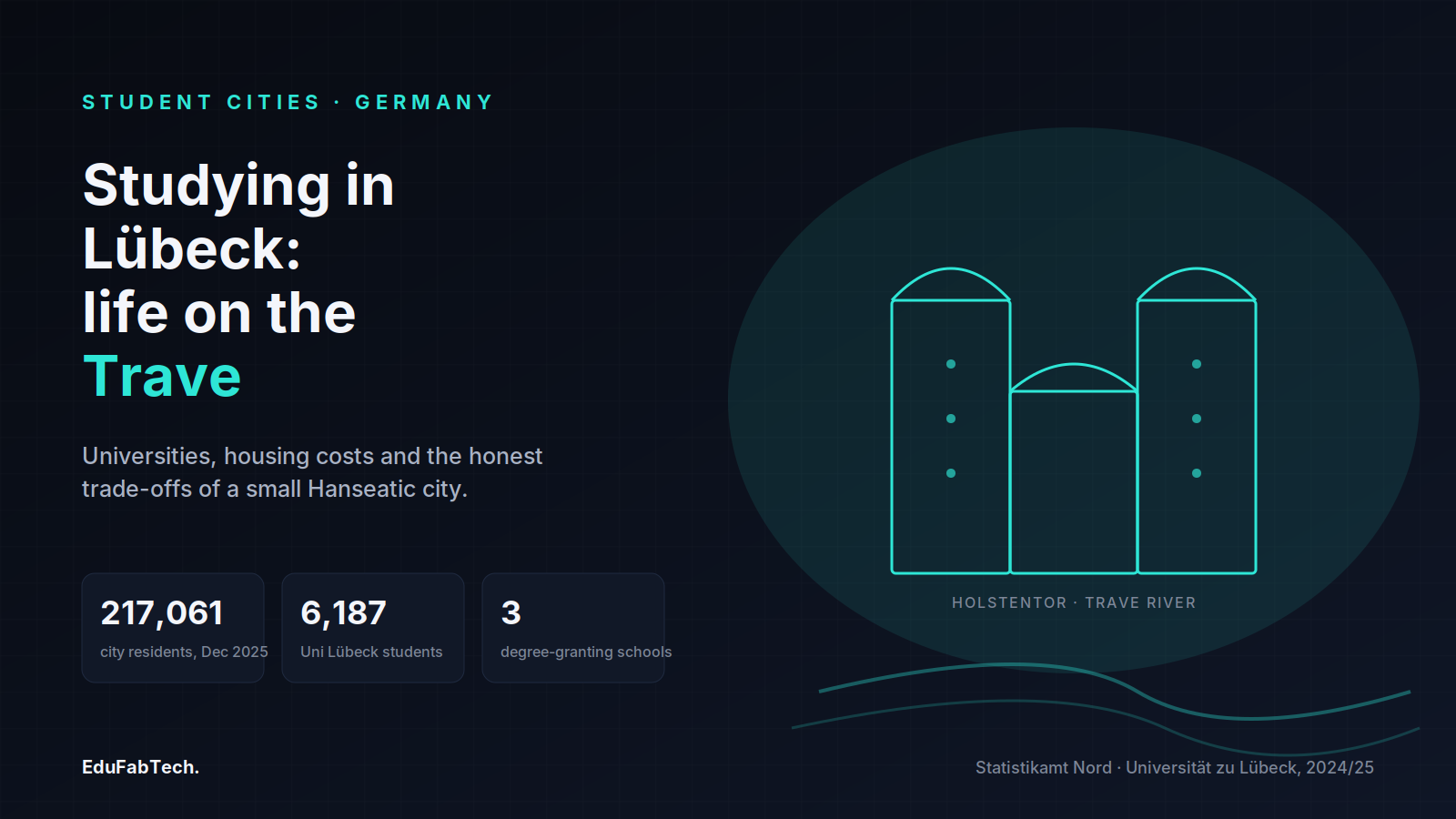
Lübeck stands where the river Trave loops toward the Baltic, its medieval centre pressed onto an island ringed by water and the Elbe–Lübeck Canal. The brick-Gothic old town — the twin-towered Holstentor, the church spires, the salt warehouses along the quay — is a UNESCO World Heritage site, and it bends daily life more than any timetable: rents, bike routes and nightlife all curve around that compact core. Statistikamt Nord recorded 217,061 residents in Lübeck on 31 December 2025 (Statistikamt Nord), which makes it a mid-sized city you can cross on foot while still finding quiet corners.
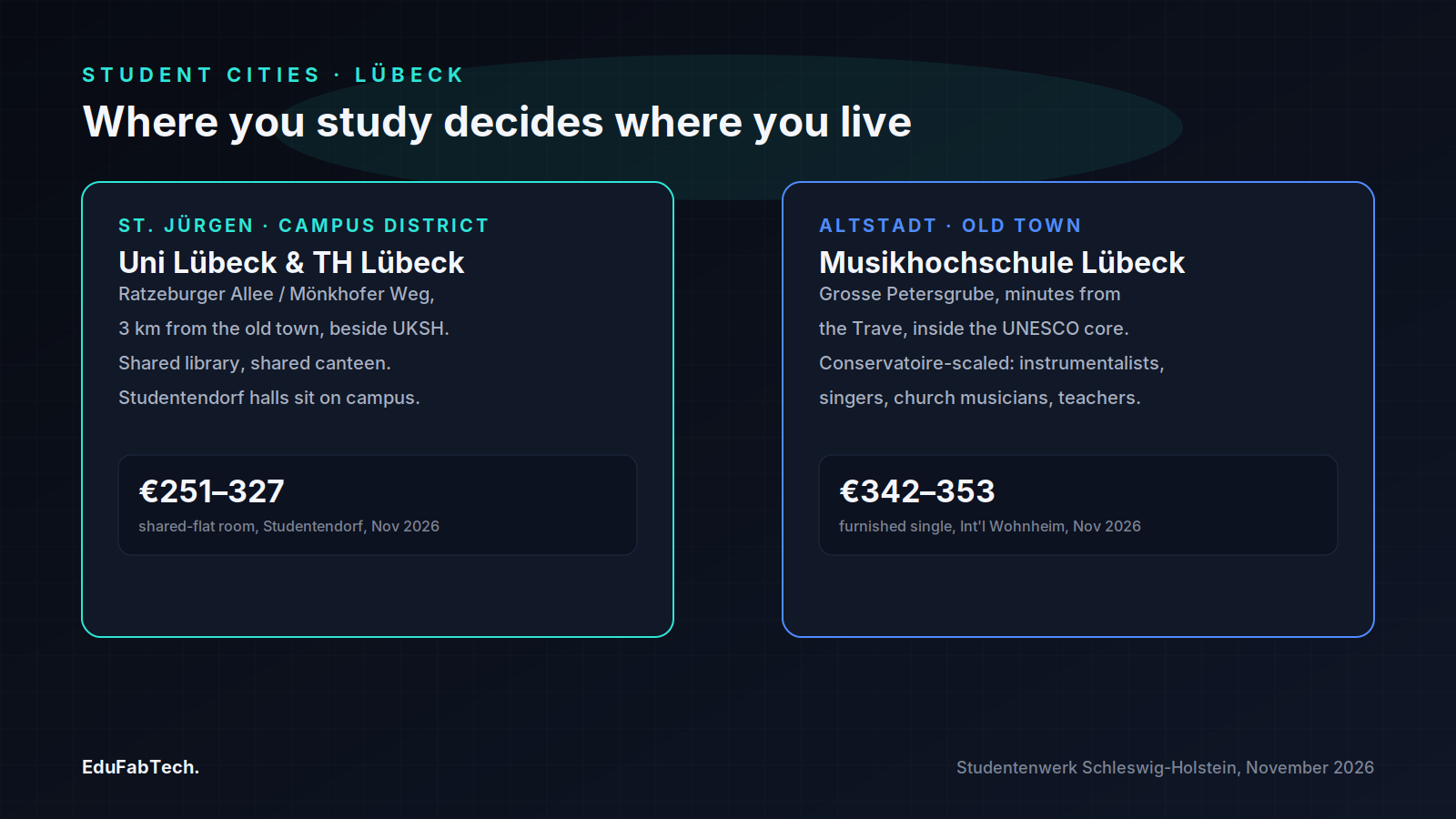
For students the place has a split personality. The two large institutions sit together about three kilometres south-east of the old town, in the St. Jürgen district along Ratzeburger Allee and Mönkhofer Weg, clustered around the Universitätsklinikum Schleswig-Holstein (UKSH). The conservatoire, by contrast, lives inside the Altstadt. Where you study decides which Lübeck you inhabit.
The universities, and where they actually sit
The University of Lübeck (Universität zu Lübeck) was founded in 1964 and calls itself a life-science university under the motto "Im Focus das Leben", concentrating teaching and research in medicine, informatics and the natural sciences — from molecular life science to medical engineering (University of Lübeck). It is not a sprawling general university. In the winter semester 2024/25 it enrolled 6,187 students, of whom 792 were international, according to the University of Lübeck's 2024 annual report (Universitätskennzahlen 2024). Its campus and the central library sit next to the UKSH on Ratzeburger Allee, so medicine and the lab sciences share one walkable science quarter. Doctoral candidates here are organised through the university's Centre for Doctoral Studies Lübeck rather than a separate degree-granting graduate school.
A few minutes away on Mönkhofer Weg is the Technische Hochschule Lübeck (TH Lübeck), a university of applied sciences built around four departments — Applied Natural Sciences; Architecture and Civil Engineering; Electrical Engineering and Computer Science; and Mechanical Engineering and Business Administration — offering over 30 Bachelor's and Master's programmes, which the school describes as the most diverse range of studies in Lübeck (TH Lübeck). Teaching is applied and project-based, there are no tuition fees, and because the campuses adjoin, Uni and TH students use the same canteen and the same library.
The Lübeck Academy of Music (Musikhochschule Lübeck) is the city's third degree-granting institution and the one rooted in the old town: it occupies a row of protected merchant houses around Große Petersgrube, minutes from the Trave, and trains instrumentalists, singers, church musicians and music teachers (Musikhochschule Lübeck). It is small and conservatoire-scaled, and its students shape the old town's concert calendar far out of proportion to their numbers.
Where students find rooms
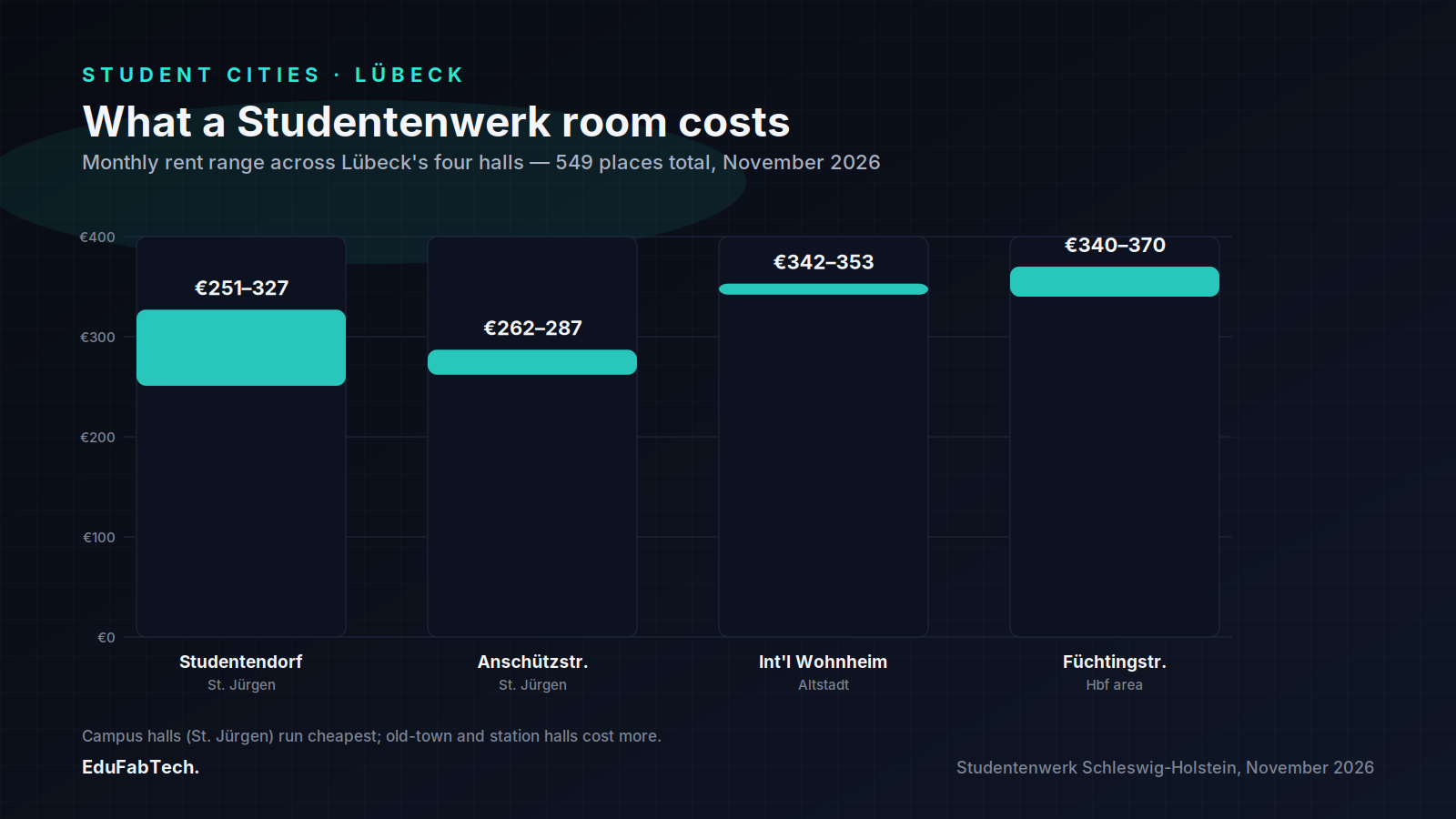
Most newcomers start with the halls run by the Studentenwerk Schleswig-Holstein, the public body for student services across the region. As of November 2026 it lists 549 places in four Lübeck houses (Studentenwerk Schleswig-Holstein). Two of them — the Studentendorf and the Wohnheim Anschützstraße — sit directly beside the campus in St. Jürgen; a room in a shared flat there is listed at €251–327 and €262–287 a month respectively. The Internationales Studentenwohnheim on Alfstraße/Fischstraße places you inside the old town, with furnished single apartments at €342–353, while the Wohnheim Füchtingstraße near the main station offers unfurnished apartments at €340–370 (all figures Studentenwerk Schleswig-Holstein, November 2026). Stays in these halls are limited by semester count, and places are scarce when both universities' intakes arrive at once.
Because the halls cannot house everyone, the private market fills the gap: rooms in a shared flat (a WG) and small studios, mostly in St. Jürgen and St. Lorenz near the station, or in the old town at a premium. Start looking weeks before you arrive — Lübeck's stock tightens in September and October — and treat an early application for a Studentenwerk room, lodged as soon as you hold an admission letter, as your safety net. EduFabTech's local listings for the city gather rooms, second-hand goods and jobs in one place: see everything in Lübeck and, specifically, rooms and places to stay.
Renting without getting caught out
Scams in Lübeck follow the national pattern but concentrate where demand peaks: listings for cheap rooms in the Altstadt or beside the UKSH campus, posted just before the semester by a "landlord" who is conveniently abroad and wants a deposit wired to hold the room. Do not send it. A deposit (Kaution) is normally capped at three months' basic rent under German tenancy law and is paid after you sign, often into a separate account — never by bank transfer, gift card or cryptocurrency to reserve a place you have not seen. View the room in person or by live video, meet the person letting it, and pay only once you hold a written contract. If you are still abroad, a Studentenwerk hall is the safer first move precisely because it removes the stranger-with-a-key risk. Browse listings near the University of Lübeck or near TH Lübeck to compare what is realistic around each campus.
Furnishing a room on the cheap
Once the room is yours, the economical way to fill it is second-hand. Lübeck's open-air anchor is the Wochenmarkt on the Rathausmarkt, between the town hall and the Marienkirche, held on Mondays and Thursdays for regional produce, fish, plants and flowers, according to the Hansestadt Lübeck's market information (Hansestadt Lübeck). It is a food and household market rather than a furniture bazaar, but it anchors the weekly rhythm of the old town; seasonal flea markets also surface in and around the Altstadt through spring and autumn. For desks, lamps, kitchenware and bikes, the quickest wins come from departing students at the end of each semester. EduFabTech's city pages collect what is going locally: second-hand things, used furniture and items people are simply giving away free.
Working alongside your studies
Rules differ by nationality, and you should confirm your own case before signing any contract. The DAAD states that international students from outside the EU, Iceland, Liechtenstein, Norway and Switzerland may work 140 full days or 280 half days per year, and that working more than 20 hours a week triggers statutory health, unemployment and nursing-care contributions; it also records the German minimum wage at €13.90 as of January 2026 (DAAD). This is general information, not legal advice: the body that decides what your residence permit allows is the Ausländerbehörde of the Hansestadt Lübeck, and you should check with it before taking a job. In a city built around a university hospital, campus roles, the clinic and the port are the usual student openings; local part-time postings sit on EduFabTech's jobs page for Lübeck.
Libraries and places to study
The shared campus has one obvious workhorse: the Zentrale Hochschulbibliothek Lübeck (ZHB) on Ratzeburger Allee 160, which serves both the University of Lübeck and TH Lübeck. Its building is open Monday to Friday 09:00–22:30, Saturday 09:00–20:00 and Sunday 10:00–20:00, with hours valid from 28 September 2026 and staffed service running shorter (ZHB Lübeck). In the old town, the Bibliothek der Hansestadt Lübeck (the city's central public library) opens Monday to Friday 10:00–19:00 and Saturday 10:00–14:00 (Bibliothek der Hansestadt Lübeck), which suits conservatoire students and anyone living near the centre. The Studentenwerk's Mensa on Mönkhofer Weg 241 doubles as the campus social hub between lectures. More desks and quiet spaces are listed on EduFabTech's study-spaces page.
Getting around
Lübeck has no tram or underground; its public transport is a bus network run by Stadtverkehr Lübeck (SWHL). Students at all three institutions receive the Deutschland-Semesterticket, a reduced-price version of the national Deutschlandticket valid for unlimited second-class regional transport across Germany. For the winter semester 2025/26, the University of Lübeck's fee statute sets the total semester contribution at €226.60, of which €208.80 is the Deutschland-Semesterticket (Universität zu Lübeck); NAH.SH states the semester-ticket price stays unchanged through the summer semester 2027 (NAH.SH). The same ticket lets pedestrians use the Priwall ferry free and the on-demand lümo bus for a €1 surcharge (Stadtverkehr Lübeck). The city is flat and easily cycled, the old town is walkable end to end, and because the ticket is nationwide, Hamburg and the Baltic coast at Travemünde are both within reach without a further fare.
What is good, and what is hard
The good is specific to Lübeck. The science campus is concentrated rather than scattered, so you are rarely far from a lecture, the library or the Mensa. Hall rents in the €250–370 range sit well below Hamburg an hour away, tuition is free, and a UNESCO old town, the Baltic and Hamburg are all close. The focus is real: if you came for medicine, informatics, engineering or music, the city is organised around what you study.
The hard parts are equally concrete. Housing is tight at each semester start, and arriving without a confirmed room in September is stressful. The campus is a few kilometres from the old town, so where you live genuinely changes your week. Lübeck is smaller and quieter than the big student metros, the local job market is thinner, and the northern coastal climate means grey, windy, wet winters. Buses, with no tram or S-Bahn, thin out at the edges and late in the evening. None of this is a dealbreaker, but it is the honest texture of the place. Events worth building a first social circle around are listed on EduFabTech's Lübeck events page.
A checklist for the first weeks
- Register your address (Anmeldung) at the Bürger- und Ordnungsamt soon after you move in, bringing your landlord's confirmation.
- Enrol, pay the semester contribution, and activate the Deutschland-Semesterticket through the NAH.SH app.
- Open a German bank account and arrange statutory health insurance before enrolment is finalised.
- Get a ZHB card for coursework and a public-library card for the old town.
- If you are a non-EU student, confirm your work limits with the Ausländerbehörde before accepting any job.
- Apply for a Studentenwerk hall as early as possible, and never pay for a private room you have not seen in person or on a live video call.
A quick question for readers
Do you work part-time while you study?
Many students work to pay the bills. See how common it is — and how many hours people really do.
Pick an answer, create a free account in a minute, and your vote counts. Already a member? Sign in
Comments 3
Comment-
549 Studentenwerk places against 6,187 students enrolled at the University of Lübeck alone - and that's before you even add TH Lübeck's head…
-
549 Studentenwerk places against 6,187 students at the University of Lübeck alone — before you even add TH Lübeck's enrollment, which this p…
-
The number that actually matters here is the housing shortfall, not the rent range: 549 Studentenwerk places across four houses against two…
Join free to read the full comments and reply Comments are between members; an account takes a minute.
Source: Studentenwerk Schleswig-Holstein
Sources (5)
- Universität zu Lübeck. Universitätskennzahlen – Jahresbericht 2024. Universität zu Lübeck, 2024. uni-luebeck.de ↗ · checked 17 Nov 2026
- Studentenwerk Schleswig-Holstein. Wohnheime in Lübeck. Studentenwerk Schleswig-Holstein, 2026. studentenwerk.sh ↗ · checked 17 Nov 2026
- Universität zu Lübeck. Beitragssatzung der Studierendenschaft (Wintersemester 2025/26). Universität zu Lübeck, 2026. uni-luebeck.de ↗ · checked 17 Nov 2026
- NAH.SH. Deutschland-Semesterticket. NAH.SH GmbH, 2026. nah.sh ↗ · checked 17 Nov 2026
- Statistikamt Nord. Meine Region – Lübeck, Hansestadt. Statistisches Amt für Hamburg und Schleswig-Holstein, 2025. region.statistik-nord.de ↗ · checked 17 Nov 2026