Studying in Lüneburg: universities, housing and student life
A practical, sourced guide to Leuphana and the other schools in Lüneburg — where students live, how to rent safely, part-time work rules, study spaces, transport and what a semester really costs.
Lüneburg is a town that was rich before it was a university town. For about a thousand years it sat on a salt deposit; the salt was mined here until 1980, as the city portal hamburg.de notes, and the trade in it paid for the stepped brick gables, the patrician houses and the churches that still fill the old town. Because the centre came through the Second World War largely intact, what a student walks into today is a closed medieval townscape rather than a reconstruction — the oldest square, Am Sande, with its Renaissance façades and St. Johannis church, and the Stintmarkt, the old harbour quarter along the Ilmenau that is now where people drink in the evening.
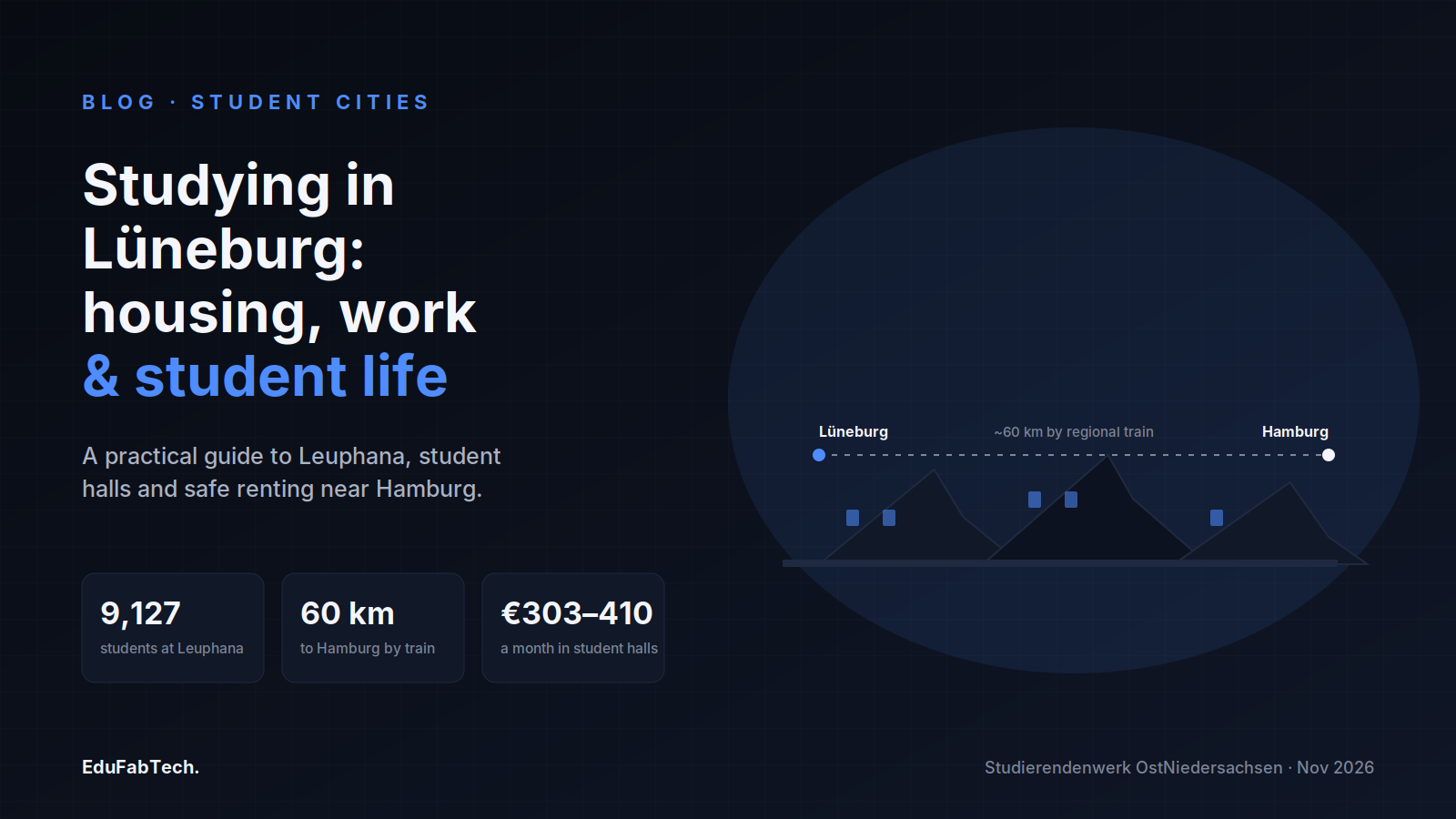
It is a small place — a quiet Hanseatic town where Leuphana University of Lüneburg and its several thousand students are large enough relative to the town that it feels visibly young in term time without ever feeling like a metropolis. The other defining fact is Hamburg: the two are separated by about 60 kilometres according to hamburg.de, and regional trains make the city centre an easy ride away. Lüneburg therefore sits in an unusual spot — a quiet Hanseatic town with its own full university, inside the pull of a major city whose jobs, airport and technical university are all reachable on a student ticket.
This guide gathers what is useful and checkable for someone deciding whether to study here or already packing: the institutions, where rooms come from and how to avoid losing money finding one, the markets and second-hand routes for furnishing a room, the work rules, the libraries, the transport, and an honest reckoning of what helps and what grates.
The universities in and around Lüneburg
The anchor is Leuphana University of Lüneburg. Its campus occupies a former barracks site on the southern edge of town, a set of brick buildings now organised around the Zentralgebäude — a central building designed by Daniel Libeskind, opened in 2017, with an auditorium seating 1,200, as the Lower Saxony study portal studieren-in-niedersachsen.de records. That portal lists 9,127 students and five faculties — education, management and technology, cultural sciences, sustainability and state sciences. Leuphana describes its campus as having been climate-neutral since 2014 on its own university pages, and sustainability runs through its teaching and research as a declared priority rather than a side theme.
What makes studying there distinctive is the structure. Leuphana splits undergraduate, graduate and continuing education into a College, a Graduate School and a Professional School. Every bachelor's student begins with the shared Leuphana Semester and an Opening Week before formal classes, then combines a major with a minor plus complementary studies, as the College sets out on its studies page. You can change your minor through the myCampus system. It is a deliberately interdisciplinary model, which suits people who want breadth and frustrates those who want to go straight and deep into one subject from day one.
Two other institutions matter. VWA und Berufsakademie Lüneburg, on Wichernstraße, runs dual-study Bachelor of Arts programmes — its three fields are business administration, media and IT management, and social work, each leading to a Bachelor of Arts, as its own site sets out; dual study means you alternate between a partner employer and the academy and earn while you learn, so it is a different path from a classic degree. And in the wider region sits Hamburg University of Technology, the engineering university in Hamburg's Harburg district; Leuphana names it among its regional partners on its university pages, and for a Lüneburg-based student it is realistically a regional-train commute rather than a local option. If your field is engineering or naval architecture, it is worth knowing it is on the same transport network your semester ticket covers.
Finding a room: start with the Studierendenwerk halls
The safest starting point is the Studierendenwerk OstNiedersachsen, the public body that runs the student halls. In Lüneburg its dormitories include Lessingstraße, Salzbrücker Straße, Wichernstraße (with a dedicated Erstsemesterhaus for first-semester students), Munstermannskamp and William-Watt-Straße, several of them close to or on the campus. These are furnished rooms, usually a private room in a shared flat (WG) with a communal kitchen, and the rent includes operating costs — the simplest way to arrive without first solving the private market.
As a concrete, current figure: the Salzbrücker Straße hall lists rooms in two-to-five-person shared flats of 10–17 m² at €302.50–€409.50 a month, and self-contained single apartments of 13–18 m² at €329.50–€412.50, operating costs included, on the Studierendenwerk OstNiedersachsen site (checked November 2026). Other halls span a similar to slightly higher band. Applications go through the Studierendenwerk's online form, not through any agent; the housing service point answers questions by phone and holds drop-in hours. Demand peaks before the winter semester, so apply as early as you can after an offer of a place — a room in a hall is not guaranteed, and the waiting list is longest in September and October. Beyond the halls, most students end up in private shared flats across the compact old town and the residential streets around it; because the whole town is small, almost nowhere is a long way from campus by bike. You can browse what is currently on offer in the city on EduFabTech's Lüneburg rooms listings or the wider Lüneburg page.
Avoiding rental scams before the semester
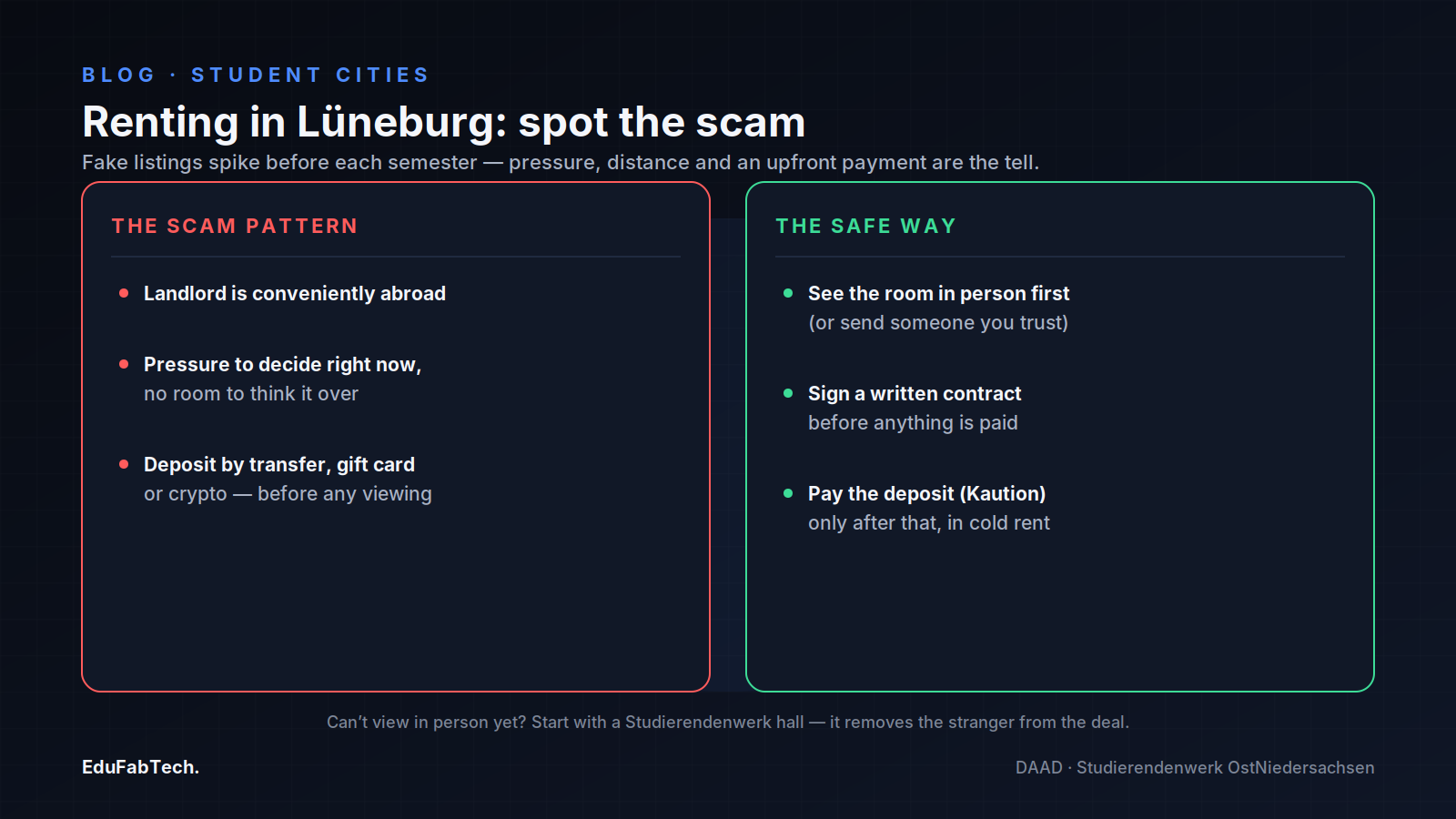
In a tight market like Lüneburg's, where demand spikes before the winter semester, the fraud pattern is predictable and worth naming. Fake listings appear in the weeks before each semester — in student housing groups, on WG portals and in international-student chats — offering a room that looks too good for the price, from a "landlord" who is conveniently abroad and wants a deposit transferred up front "to hold" it before you can view. That is the whole trick: pressure plus distance plus an advance payment.
The defences are simple. See the room, or have someone you trust see it, before any money changes hands. Never send a deposit by bank transfer, gift card or cryptocurrency to secure a place you have not entered, and treat any refusal to allow a viewing as the end of the conversation. A deposit (Kaution) in Germany is commonly up to a few months' cold rent and is paid once you have a signed contract and have seen the flat — not wired to a stranger to reserve one. If you are arriving from abroad and cannot view in person, lean on the Studierendenwerk halls for your first rooms precisely because they remove the stranger from the transaction. And bank on needing a Schufa-style record and proof of income that newcomers rarely have yet, which is another reason the public halls are the realistic first home.
Furnishing a room, and the markets worth knowing
A furnished hall room solves this for some; everyone else furnishes cheaply, and Lüneburg has good routes for that. Sack & Pack, the social second-hand store run by Neue Arbeit Lüneburg gGmbH at Vor dem Neuen Tore 35, sells used furniture, new mattresses, household appliances and household goods, delivers furniture and even picks up well-kept pieces for free; its own page lists opening hours of Monday to Friday, 9:30–17:00. For a student kitting out a first flat, a place that both sells cheaply and delivers is exactly the right kind of shop.
For food and the ordinary rhythm of the week, the Lüneburger Wochenmarkt runs on the Marktplatz in front of the town hall on Wednesdays and Saturdays from 7:00 to 13:00, with regional fruit, vegetables, cheese, fish and flowers, as the city tourism site lueneburg.info describes. For second-hand bargains, the organiser Flohmaxx holds open-air flea markets periodically on the Sülzwiesen event grounds and lists its dates on its own site (flohmaxx.de); these are seasonal, so check before going. Between those and the give-away culture among departing students, you can furnish a room for very little. EduFabTech also collects local offers of second-hand things and used furniture in the city.
Working alongside your studies
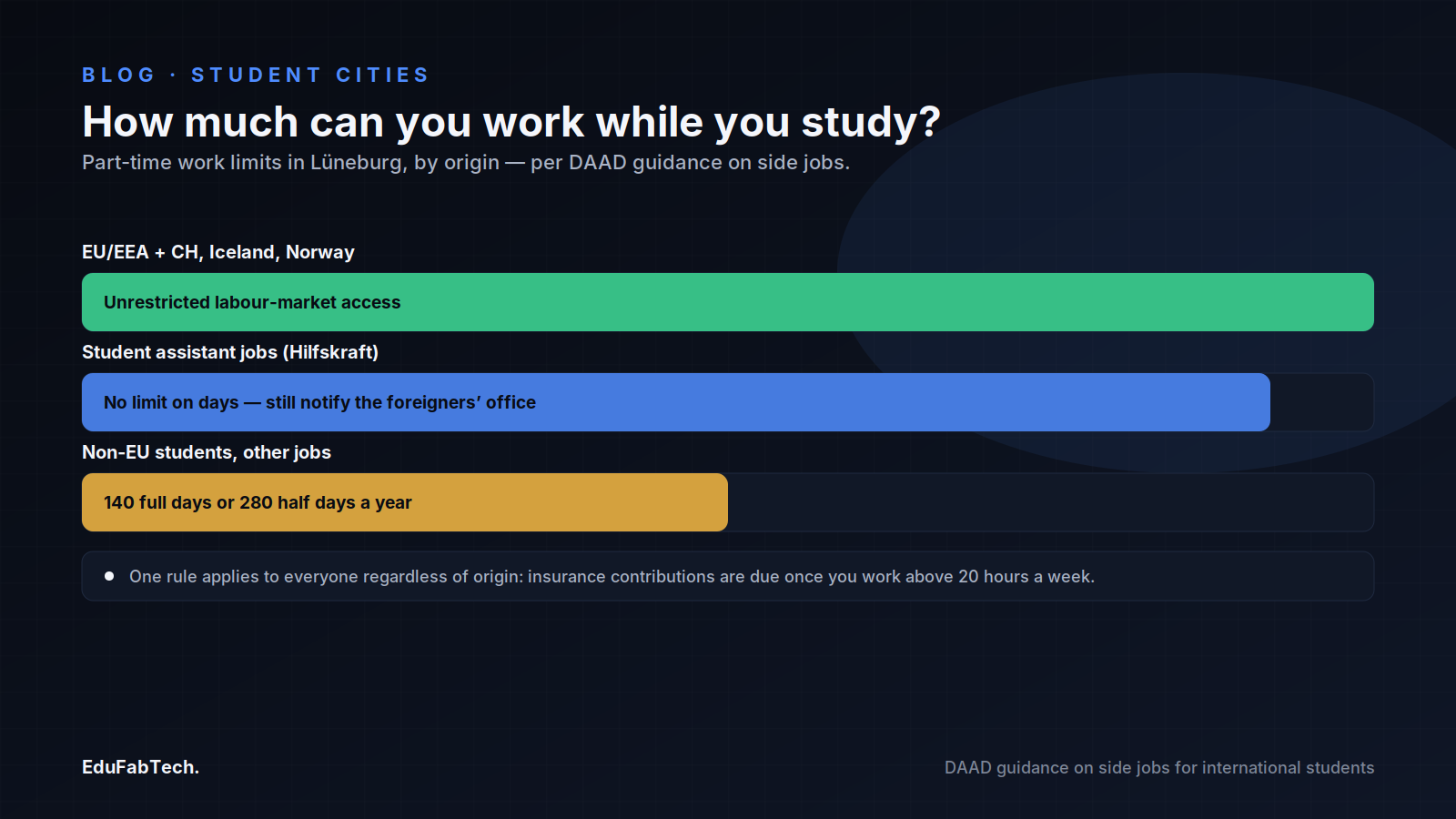
Many students here work part-time, and the rules depend on where you are from. According to the DAAD's guidance on side jobs, students from non-EU countries may work 140 full days or 280 half days per year; there is no limit on how many days academic assistants (studentische Hilfskräfte) at the university may work, though they must still notify the foreigners' office. Students from the EU, plus Iceland, Liechtenstein, Norway and Switzerland, have unrestricted access to the German labour market, with insurance contributions due above 20 hours a week. This is a summary, not legal advice, and the figures and conditions change — confirm your own position with the DAAD page above and with the Ausländerbehörde (foreigners' authority) at the Hansestadt Lüneburg / Landkreis before you commit to a job, because overstepping the day limit has serious consequences. Local openings aimed at students are gathered on EduFabTech's Lüneburg jobs listings.
Libraries and places to study
The central study hub is Leuphana's Medien- und Informationszentrum (MIZ) at Universitätsallee 1. As its own page sets out, it combines the university library with central IT services, and offers group study rooms, accessible workplaces and long-term lockers, with the collection searchable through the LUX catalogue. Because the campus is a single site, the MIZ is the natural default for quiet, desk-bound work; check its current opening hours before relying on a late evening, as these shift between term and the breaks. Beyond campus, the small, walkable old town means cafés and the public library are never far, and reading rooms fill up fast in exam weeks — a recurring theme in a town where one university concentrates most of the demand. You can see what study desks and spaces people are sharing locally on the Lüneburg study-spaces page.
Getting around, and what the semester ticket covers
Lüneburg is inside the HVV (Hamburger Verkehrsverbund), the regional transport network for the Hamburg area, and that shapes how students move. With the semester fee you receive the Deutschland-Semesterticket, which the HVV's students page describes as valid for travel in 2nd class on local and regional public transport across all of Germany for the semester shown on the ticket, loaded onto a smartphone. In practice that covers the town buses, the regional trains to Hamburg (around 60 kilometres away) and much further afield at no extra fare — a genuinely large benefit for a small-town student who wants a city within reach. Within Lüneburg itself, though, the honest answer is that most students simply cycle: the town is flat, compact and built before cars, and a bike is faster than waiting for a bus for most trips.
What a semester costs, and the honest trade-offs
The fixed, non-negotiable cost is the semester contribution. For winter semester 2026/27, Leuphana University of Lüneburg sets it at €484.24, made up of €150.00 for the Studentenwerk, €75.00 in administrative costs and €259.24 for the student body, as the College's re-registration page states; €226.80 of that student-body portion funds the Deutschland-Semesterticket described above. There is no tuition fee on top for standard programmes. Rent is the real monthly variable: the hall figures above (from €302.50 at Salzbrücker Straße per the Studierendenwerk, November 2026) give a reliable floor; private rooms vary more.
What is good about Lüneburg for a student is concrete. It is beautiful and intact in a way few German towns are, it is small enough to live in by bike without a commute, the one big university gives it a real student culture, and the semester ticket quietly hands you Hamburg and the whole regional rail network. What is hard is the flip side of the same facts. A small, pretty, desirable town has a tight rental market, and the housing crunch is worst for newcomers arriving for the winter semester; the single campus means library and seminar demand concentrates; nightlife is the Stintmarkt rather than a big-city spread; and the north-German weather is grey and wet for long stretches. If you want anonymity, scale and a dozen universities to choose between, this is not that. If you want a walkable Hanseatic town with a serious university and a fast line to a major city, it fits closely.
A short checklist for the first weeks
- Apply for a Studierendenwerk hall room as early as possible after your place is confirmed, and use it as your safe first address rather than wiring a deposit to an unseen private flat.
- Register your residence (Anmeldung) at the Bürgeramt soon after moving in; you will need it for almost everything else.
- Pay the semester contribution on time (€484.24 for winter 2026/27 at Leuphana) and activate your Deutschland-Semesterticket on your phone.
- Open a bank account and arrange health insurance before chasing a part-time job.
- If you are a non-EU student, check your work-day limit on the DAAD side-jobs page and confirm your own case with the Ausländerbehörde before signing an employment contract.
- Furnish from Sack & Pack, the Sülzwiesen flea markets and departing students; buy a reliable bike early.
- Learn the MIZ opening hours and claim a study routine before exam-week crowding sets in.
A quick question for readers
Do you work part-time while you study?
Many students work to pay the bills. See how common it is — and how many hours people really do.
Pick an answer, create a free account in a minute, and your vote counts. Already a member? Sign in
Comments 2
Comment-
The thing that doesn't add up for me is pitching the halls as the scam-proof fix for exactly the people who can't get into them. The piece s…
-
The 60km-to-Hamburg framing is the real pitch here, but the piece undersells the engineering angle: TU Hamburg-Harburg is named as a regiona…
Join free to read the full comments and reply Comments are between members; an account takes a minute.
Source: Leuphana University of Lüneburg
Sources (5)
- Leuphana University of Lüneburg. Bachelor studies: re-registration and assessments. Leuphana University of Lüneburg, 2026. leuphana.de ↗ · checked 26 Nov 2026
- Studierendenwerk OstNiedersachsen. Wohnheim Salzbrücker Straße. Studierendenwerk OstNiedersachsen, 2026. stw-on.de ↗ · checked 26 Nov 2026
- DAAD. Side jobs. Deutscher Akademischer Austauschdienst, 2026. daad.de ↗ · checked 26 Nov 2026
- HVV. Students. Hamburger Verkehrsverbund, 2026. hvv.de ↗ · checked 26 Nov 2026
- Lüneburg Marketing GmbH. Lüneburger Wochenmarkt. lueneburg.info, 2026. lueneburg.info ↗ · checked 26 Nov 2026